Review: Godzilla Vs. Kong

This movie is a tour de force – an intricate and sensitive tapestry of thought-provoking questions and exquisite metaphors, which forces the viewer to reexamine their relationship with the world at large. It is a story that questions our humanity in the face of natural disaster, our place in the universe, and the uncertainty of life in a modern context…

… just kidding. It’s a movie about a giant lizard and a giant monkey punching each other.

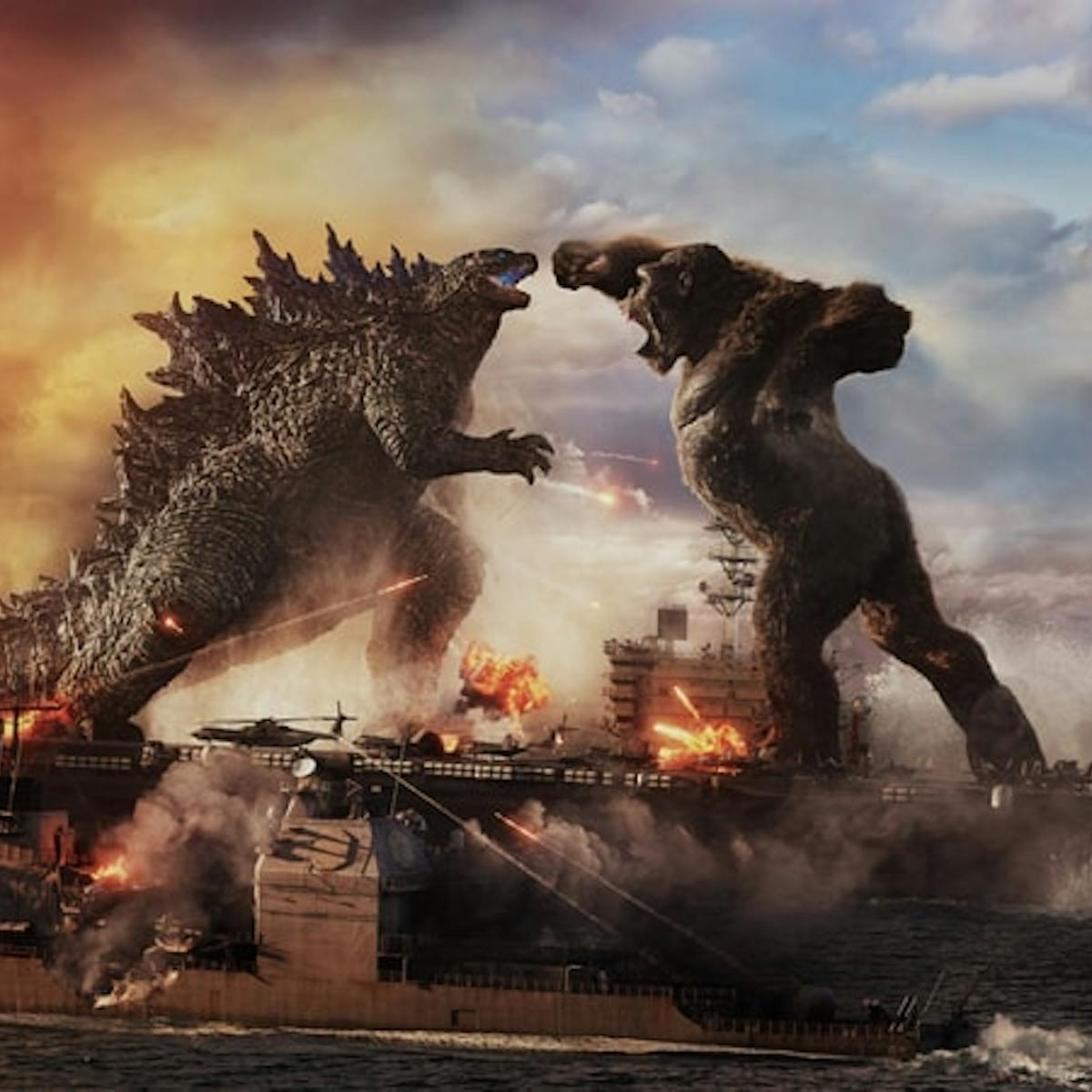
And that really is all you need to know about “Godzilla Vs. Kong,” the long-awaited fourth entry in the Monsterverse franchise. This is the long-awaited, official meeting of Japan’s greatest kaiju with his American counterpart – and while some parts of the movie don’t make a lot of sense (where is the sunlight in the Hollow Earth coming from?) or exist just for exposition, the monstrous beasts themselves keep us invested.

The movie opens with conspiracy podcaster Bernie (Brian Tyree Henry) infiltrating the obviously-evil megacorporation, Apex. Coincidentally, Godzilla decides to attack the facility during Bernie’s time there, which baffles the humans. Why has Godzilla, generally a benevolent figure, attacked humanity unprovoked? Madison Russell (Millie Bobby Brown) is convinced that Godzilla had a reason for attacking, and sets out to find Bernie in order to find answers.

Meanwhile, Apex is funding an expedition into the Hollow Earth, and they want Kong – imprisoned by Monarch on Skull Island – to lead them down there. The problem is, venturing onto the ocean puts him on Godzilla’s turf, and the big lizard will naturally attack any rival for the role of alpha Titan. So not only do they have to chain Kong up and transport him from the tropical Pacific to Antarctica, they have to deal with Godzilla attacking — which he does.

But getting Kong to Antarctica is only the first step, as the humans now need to follow him into a realm dominated by vast beasts – and some kind of power that Apex wants to get their hands on. And on the surface, Bernie, Madison and Madison’s friend Josh uncover the reason that Apex was attacked by Godzilla – and the horrifying possibilities if it’s ever used.

It has plot holes. It has inconsistencies with previous films. It has stuff that doesn’t make much sense. Yet there’s a refreshing kind of purity in “Godzilla Vs. Kong” that comes from knowing exactly what it is, and being happy with being just a popcorn blockbuster about two kaiju beating each other up. If that is what you expect – a sci-fi tale about giant monsters – then it’s likely to be an entertaining watch.

So there’s plenty of spectacle – boats explode or are overturned, buildings are smashed or blasted into glassy splinters, and the city of Hong Kong is more or less flattened for our amusement. Perhaps the only area where spectacle falls short is in the Hollow Earth itself – what we see is pretty spectacular, but we don’t see enough of it. The movie could have used another half hour of Kong’s adventures in the center of the Earth, the ancient civilization there, and the many monsters.

And make no mistake – despite an infestation of human characters, Kong himself is the main character here, a vast melancholy ape who occasionally bursts into chest-thumping, teeth-bearing rage. The CGI is exemplary, causing you to feel Kong’s isolation, his homesickness, his triumph and his pain. Godzilla is more of an antagonistic presence looming throughout most of the film. He has the power of a force of nature in the opening scenes, but up against someone as big as he is, he snarls and claws in a far more down-to-earth, personal manner.

The various actors in it do a decent job serving as side-characters to the CGI stars of the show – Alexander Skarsgard, Rebecca Hall and Brian Tyree Henry all do good jobs, Eiza Gonzalez and Demian Bichir are solid as smugly corporate overlords, and Julian Dennison steals the show as Madison’s hapless yet street-smart sidekick… and who ultimately turns out to be more plot-essential than she is.

Yeah, Millie Bobbie Brown’s character doesn’t really have a good reason to be in the story, and she’s so obnoxious and condescending that you end up wishing she hadn’t been. Kaylee Hottle’s character at least serves as an interpreter for Kong, even if children in kaiju movies are generally a bad sign.

If you expect “Godzilla Vs. Kong” to provide exactly what the title suggests, then you won’t be disappointed – it’s a big, robust movie that revolves around kaiju hitting each other. And in troubled times, don’t we need more of that?

Recommendation: Diana Wynne-Jones

I feel like fantasy author Diana Wynne-Jones doesn’t get as much love and attention as she deserves.

Oh, other authors often laud her, like Neil Gaiman, and Studio Ghibli has adapted two of her books into animated movies (one amazing though a loose adaptation, one mediocre). But she’s not a household name despite the charm and imaginativeness of her books, and the movies based on her books are more associated with Studio Ghibli than the original author.

She did experience something of a renaissance several years ago during the Harry Potter craze of the late nineties to late aughts – it was a time when people were hopping on the bandwagon of children’s/young-adult’s fantasy stories, hoping to strike Potter gold. Some of these would-be franchises were good (Artemis Fowl), and some were bleeding-from-the-eyes-bad (G.P. Taylor’s Christian fantasies presented as Potter alternatives).

Diana Wynne-Jones seemed like a natural choice to reprint and promote – she had already written a huge number of fantasy stories, often involving witches and wizards. She was also British, and she had a great deal of the same charm of style and setting that had been presented in Rowling’s books. And she was imaginative – arguably much more so than Rowling – with multiverses, dimensional hopping, twists and even science-fiction woven into the fantasy.

Maybe that’s why she didn’t become as famous as Rowling – her books take more effort to comprehend, and a structure and framework that take more time to comprehend. A school for magic is a little easier to understand than the Chrestomanci universe, which has many different parallel worlds. Or a story based on the ballad of Tam Lin. Or the time-bending antics of A Tale of Time City. Or the plot twists that blow your mind in Archer’s Goon, The Power of Three and Deep Secret.

But obviously, less popular doesn’t mean less good. Jones came up with some wildly clever ideas and plumbed them to their depths, sometimes with clever yet affectionate parodies of the fantasy genre (and many affectionate nods to J.R.R. Tolkien). She was also even better than Rowling at writing twisty mysteries within her fantasy stories.

The Chrestomanci stories are a wonderful series of stories about Christopher Chant, a supremely powerful magician born with nine lives who travels between worlds. He’s not always the center of the stories, because they tend to be focused on the people who become involved with him in these worlds – kids forbidden from using magic, a seemingly ordinary boy whose narcissistic sister is a gifted sorceress, a Romeo and Juliet story, a boy cursed with bad karma, and so on.

Then there are the Magid stories. Sadly, Jones only wrote two of these – Deep Secret and The Merlin Conspiracy, but they are among my favorites. The first one is a bizarre sci-fantasy story set at a scifi/fantasy convention, in which a colorful cast of characters are trying to figure out who the heir of an interstellar empire is. The second is a world-hopping love story between the best character of Deep Secret and a girl from another world, where royalty is magic and a conspiracy may take over magic throughout the multiverse.

I won’t summarize every book she’s written, only say that they involve time travel, Norse gods, a malevolent old woman with supernatural powers, a Goon, a star in a dog’s form, a ghost attempting to solve her own murder, a game diving into everyone’s favorite books, a Celtic-flavored fantasy that I can’t describe without spoiling the twist, and various other things.

So if you like stories with imagination, a dark edge and that clever, slightly quirky Britishness, than her books are a must-read.

On criticisms of Detective Pikachu (extensive spoilers)

I’ve seen some criticisms of how the movie Detective Pikachu handles its disabled lead villain. Simply put, some people don’t like the use of the trope of a disabled person going to great lengths to be “normal,” as people interpret that as meaning implies that their life is worth less or is unbearable because of their disability.

On the one hand, I can understand not wanting your life to be seen as “less” because of a disability, and wanting people to realize that you can be happy and fulfilled despite the limitations it puts on you.

But this criticism rubs me the wrong way for two reasons. Spoilers below.

First, I am not going to police how disabled people feel about their disability. Demanding that all disabled people be happy and content with their disability – or even want it – is far worse than implying that they might be unhappy with their limitations. It seems to feed into the idea that being disabled is an “identity” – I’ve seen people talk about the “disabled community” – rather than a simple problem that your body has, and thus nothing negative can be said about it, and you have to be proud and happy.

And before you challenge me on this, I am facing a disability in a few years’ time. I will not accept anyone telling me that I shouldn’t be angry about this, or that I shouldn’t want to be “normal.” You don’t get to dictate how I feel and what I want, and how I feel is not wrong or incorrect. Got it?

The second problem is that… no, being disabled isn’t the villain’s motivation for wanting to merge people with Pokemon. It was his original motivation, several years ago, in that he was looking for a cure for a debilitating disease that put him in a wheelchair. But by the time of Detective Pokemon, his plans have evolved drastically – they don’t really have anything to do with his disease anymore. I don’t think he even mentions it in the present.

That’s because his plans for merging people with Pokemon include merging every human with a Pokemon, not just himself. He believes that Pokemon are superior to humans, and that he would be elevating humans by giving them Pokemon bodies. So not just disabled humans, but all humans are considered by him to not be good enough. That his his motivation, not escaping his disability.

In fact, he seems to be the only one who doesn’t benefit from his plan, because his method of “merging” with Mewtwo just involves controlling him with a mechanical headset. They don’t merge physically, meaning that he is still confined to his wheelchair in the long-run, even if he can temporarily transfer his mind to Mewtwo.

This is what happens when you do a surface-level critique of something based on tropes you think are “problematic,” without actually examining the plot and characters for what they actually are. I would understand having an issue if the villain’s motive was “I want to escape my disability by merging with a Pokemon,” but that isn’t his motivation, and pretending that it is is just disingenuous.

Review: Zack Snyder’s Justice League

Back in 2017, Warner Brothers released Joss Whedon’s Justice League, supposedly the springboard to a shared universe of spinoff movies. But the movie cratered, and in the years since, it has been widely considered to be a creative disaster.

But another version of the movie was widely rumored to exist – a cut by the original director Zack Snyder, before it was sliced and diced by the studio and Whedon in an effort to make a more marketable blockbuster. And after years of fans demanding that the studio release the artist’s vision, the fabled “Snyder Cut” was finally released, completed and four hours long. Was it worth the wait?

In a word, yes.

Zack Snyder’s Justice League covers roughly the same territory as the Joss Whedon Cut – Batman (Ben Affleck) brings together several superheroes to fight an extraterrestrial warlord named Steppenwolf (Ciaran Hinds). This includes the immortal warrior Diana (Gal Gadot), young speedster Barry Allen (Ezra Miller), the gruff water-warrior Arthur (Jason Momoa) and a traumatized young cyborg named Victor (Ray Fisher). In their quest to keep Steppenwolf from uniting the three Motherboxes that will spell the Earth’s doom, they realize that they need the help of Superman (Henry Cavill) – and they may have the means of returning him to life.

But whole the overall plot – and some scenes – are familiar, the movie has whole swathes that are new and enriching. Characters are massively fleshed out, poorly-conceived comedy is notably absent, and the rich lore of the DC universe is woven into the tapestry of the plot – most notably in the malevolent Darkseid and his courtiers, who give some reason for Steppenwolf to conquer Earth other than “he just wants to, okay?”

In short, with four hours to expand into, the Snyder Cut has the ability to be a richer, more compelling narrative. Snyder’s vision here is a muscular, smooth, flowing expanse of scenes that all interweave neatly – nothing here could be trimmed without diminishing something else. This even includes some beloved DC characters who don’t play much of a role here, but were clearly intended to contribute more to a shared universe.

Snyder also strikes an almost perfect balance of action, comedy and tragedy here. There are some moments of understated comedy woven in (“This is Alfred. I work for him”), but it’s kept sedate and appropriate to whatever is happening. There are some great action scenes as well (such as the tragic battle of Steppenwolf against the Amazons), though Snyder makes sure to weave subtle characterization into them. But he delves deep into the loss and pain of the characters here, especially Cyborg’s misery and anger over being turned into… well, a cyborg. Yet he also shows their nobility and their desire to help others.

Furthermore, the Snyder Cut simply feels… bigger and more epic than Whedon’s cut. Whedon’s film always seemed flimsy and small in scale, but this actually feels like our heroes are going up against an apocalyptic threat. This is particularly true in the Justice League’s final battle against Steppenwolf, which is turned from a standard superhero climax into something dazzling – time is bent, space is torn, battles are fought in body and in the mind, and it feels like no other heroes could possibly do what the Justice League is doing.

Furthermore, the characters are finally done justice by this cut – Snyder’s Batman is intelligent and competent, his Superman is a stern but kind and good person, and his Wonder Woman is fierce and magnificent. Even Steppenwolf is given more character dimensions here – in just a few lines, Snyder makes this horned alien monstrosity feel like a real person, who desperately wants redemption and a welcome home. You almost feel sorry for him, even if you don’t want him to succeed.

But the greatest character development comes for Barry and Victor. Barry is shown not just as a funny quippy kid, but as growing into his role as a hero and completely devoting himself to saving the entire world. And Fisher does an outstanding job as Victor, whose raw pain and misery are recognizable in any person who’s suffered a life-changing injury or disease, but whose compassion for others is never dimmed.

Zack Snyder’s Justice League has some flaws, but it is a wildly different – and far superior – cut to the disaster that was released in theaters. It combined slam-bang action and a lore-rich script with a lot of heart and soul – all you could ask from a superhero movie.

Review: Hellboy (2019)

From its very first opening moments, the 2019 reboot “Hellboy” shows us exactly the kind of movie that it is – with a bird eating the liquefied eyeball of a rotten corpse, and Ian McShane throwing a gratuitous F-bomb.

Specifically, it’s the kind of movie that a 13-year-old who thinks he’s edgy would make – lots of swearing, lots of characters being obnoxious, lots of extremely graphic violence shown in lovingly-framed detail, and so on. “Hellboy” seems to aspire to be kind of like “Deadpool” in its mixture of comedy and bloody violence, but the meandering, overstuffed storyline and unlikable lead characters make it a chore to sit through.

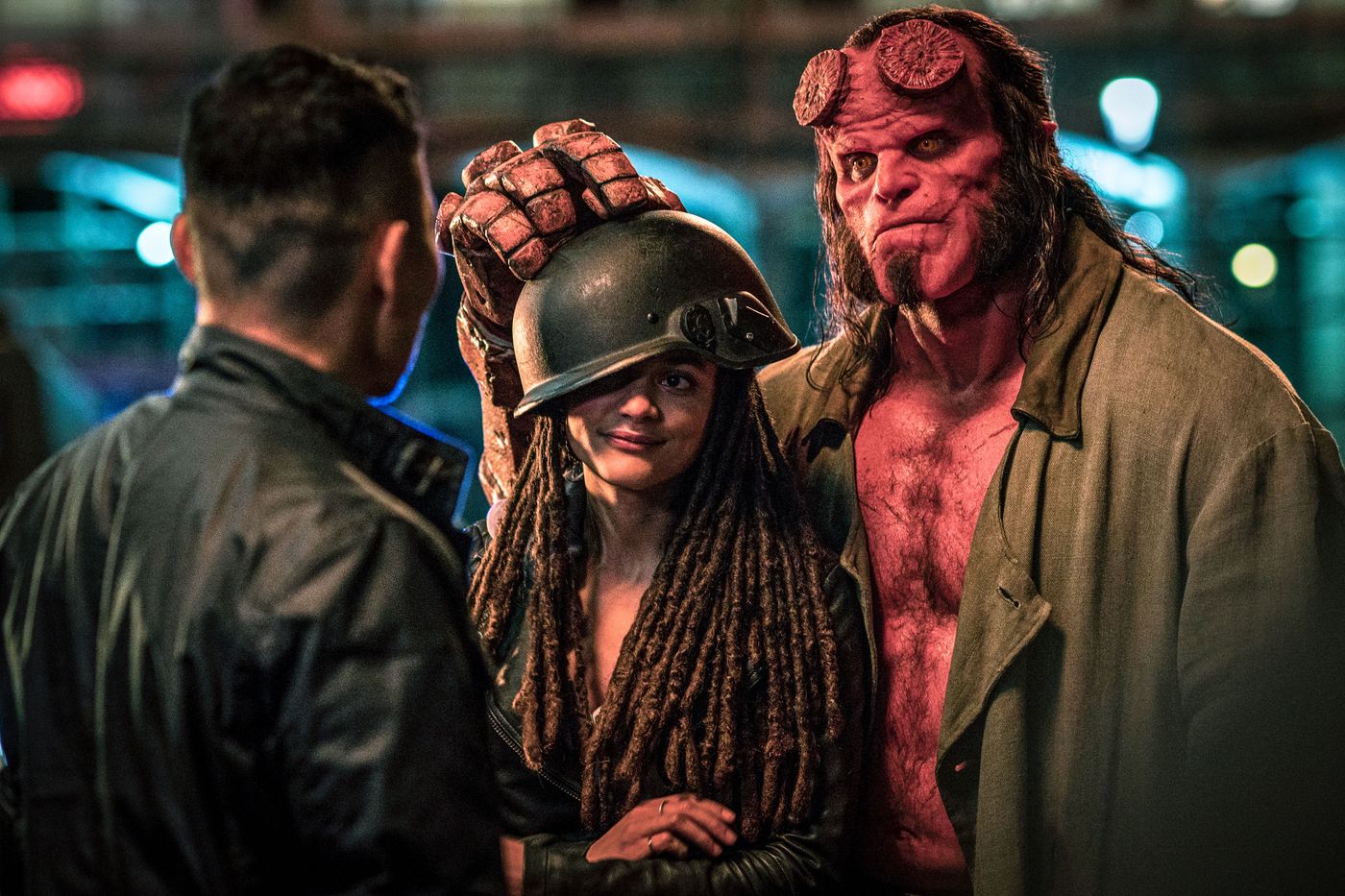
After killing a B.P.R.D. agent who had been vampirized, Hellboy (David Harbour) angsts about his status as a monster, and what that means to an organization dedicated to stamping them out. He’s then sent to help the Osiris Club in England with exterminating a trio of giants… only for the Club to try to kill him because he’s destined to bring about the apocalypse. If you’re wondering what all this has to do with the main plot, the answer is: very little.

The actual villain of the piece is Nimue (Milla Jovovich), the legendary sorceress, who was chopped into six pieces by King Arthur and sent to six different parts of England. Not the world. Not Europe. Just England. Now the pig-fae Gruagach (Stephen Graham) is reuniting her various body parts – and if she is fully restored, she will bring down an apocalyptic plague across the entire world, wiping out humanity.

Hellboy is soon called on to stop Nimue, along with ghost-punching medium Alice Monaghan (Sasha Lane) and surly B.P.R.D. agent Ben Daimio (Daniel Dae Kim). But Nimue quickly decides that she wants Hellboy as her king, since she knows of his apocalyptic destiny and wants him her to rule over a new world at her side. Unfortunately for the current world, Hellboy seems quite tempted by the offer.

“Hellboy” was already facing an uphill battle, given that the character’s previous appearances were directed by the beloved Guillermo del Toro. But even if one appreciates it entirely on its own merits, the movie is still pretty terrible – and only part of that is due to the relentless swearing and hyper-graphic gore, which feel like a teen boy’s idea of what an R-rated movie should be like.

One of the big problems is that the story is an overstuffed mess, with subplots unrelated to the main plot. Whole chunks of the narrative could have been easily streamlined out, such as Hellboy’s fight with the giants, which feels like a side-quest in a video game. The cinematography is pretty ugly and grimy, the special effects range from acceptable to “how did this get released in theaters?”, and the dialogue is bad more often than not (“But it’s not going to work, you know, cause I’m a Capricorn and you’re f***ing nuts!”).

It also has a wealth of characters who exist entirely to vomit exposition. Baba Yaga, for instance, is a character who exists entirely to tell people to go places, rather than having any real impact on the plot. Or consider the blind woman with precognitive powers, who is just there to recount baby’s Hellboy’s entry into our world, a bizarre scene that is somehow sidetracked by the appearance of Lobster Johnson. “Who?” you may be asking. The answer: nobody who matters to the plot, so it doesn’t matter.

Of course, the main characters aren’t much better. It’s worth noting that no criticism should fall upon David Harbour, who gives as good a performance as anyone could possibly give. The movie fails him, not the other way around.

Specifically, it fails him by making Hellboy a whiny, passive-aggressive brat who is easily swayed by Nimue and gripes about his father constantly. His angst over monsters not getting to live in the open seems rather hollow as well, considering that we see virtually no monsters who aren’t actively harmful to humans… and since Hellboy himself is hardly a secret, since he goes on a days-long bender in a Mexican bar.

The other characters aren’t particularly likable either – Alice tends towards being smugly annoying, and Daimio seems to be stuck in a combatively bad mood with no particular reason or resolution. No, being revealed as a werejaguar does not count as an arc. The closest to a character who actually feels three-dimensional is Ian McShane’s Professor Broom, although even he isn’t a terribly likable person.

The 2019 reboot of “Hellboy” stumbles badly in its attempt to give us a darker, grittier portrait of our demonic hero – mainly because of the sloppy plot and painfully clumsy script. Stick with the comics or the earlier films.

Review: Chaos Walking

Patrick Ness’s Chaos Walking trilogy was never going to be an easy book series to adapt into movie form, simply because one of its central concepts – the Noise, the telepathic projection of thoughts from humans and other living things – is so difficult to represent in a visual medium.

But it turns out that the deeply annoying movie version of the Noise is not the only problem with “Chaos Walking” – it’s a staggering, awkward beast of a movie that seems to hope that we’ll find the constant overlapping chatter of Tom Holland to be suspenseful and gripping. It’s not – it’s intensely annoying, like listening to someone chatter banalities directly in your ear while you’re trying to watch TV.

Holland plays Todd Hewitt, a young man raised in a human colony where there are no women, and all the men are affected by the Noise, which causes their thoughts to manifest as voices and flickering images around their heads.

One day he encounters a strange scavenger in the woods, and a fiery spacecraft that has just crashed into their world. It turns out this stranger is a girl – something Todd has only heard of – named Viola (Daisy Ridley), and she doesn’t have the Noise. She’s from a scouting mission investigating what happened to the first wave of colonists on the planet, and she quickly discovers that Todd’s home of Prentisstown is… not friendly.

When Mayor Prentiss (Mads Mikkelson) voices his ambition to ambush the new colony ship, Viola ends up on the run, hiding in the barn belonging to Todd and his fathers. The only hope for Todd and Viola is to get to another town that Todd has never heard of, Farbranch. Furthermore, it turns out there has been a lot of stuff that Todd hasn’t been told, specifically about the women and the native alien life.

“Chaos Walking” is one of those movies that really doesn’t have any business being as bad as it is. Ness’s original novel “The Knife of Never Letting Go” is an imaginative and clever sci-fi novel. Doug Liman has made some excellent action and sci-fi movies, and it has a cast of talented actors, both veterans and relative newcomers. Yet the sum of all these parts is as awkward and weird as Todd himself.

Liman’s direction in this film is, to put it bluntly, rather strange – there are odd silences where characters just stare and stand in place, punctuated by rapid-fire, hyperactive chattering that grated on my nerves like a belt sander. Somehow, the Noise was understandable and even cleverly-written in the book, but the way it’s handled in the movie is just… deeply unpleasant.

In addition to the awkward and grating Noise, the movie feels like large chunks of it have been sewn together haphazardly, with some events – like the early encounters with Aaron, the preacher – feeling clunky and artificial. The script also telegraphs Prentiss’ evilness and his sinister plans way, way too early, as if it’s afraid to surprise us later on – things that should be subtle and secret are instead made obvious and glaring. Just like the Noise.

The actors give a mixed bag of performances – Mikkelson is hypnotic even in his lesser roles, and here he has quiet dignity and menace as Prentiss. Sadly, David Oyelowo is two-dimensionally evil here, which seems like a waste of his talents, and Nick Jonas is thoroughly unconvincing as a thuggish rich boy who poses a physical threat to others.

Perhaps the biggest waste are Holland and Ridley. Ridley is called upon to look wide-eyed and scared almost all the time, not doing much else, and Holland is drowned out by his own pre-recorded chatter, making his character feel like an awkward weirdo who can’t stop fixating on Viola’s hair.

As valiant as “Chaos Walking’s” intentions were, the movie stumbled over its own weird, haphazard, dull self, becoming a sci-fi beast that can’t stop talking. Overall, a waste of great material and cast.

Random facts about me

  • I love rodents. Most rodents, in general, but the smarter or friendlier ones obviously take precedence. Rats are my favorite, but their lives are too short.
  • I have a deep fondness for Ikea, based in my childhood visits there.
  • Hate-watching/hate-reading is a fond pastime for me. Unlike most people, I freely admit that I love screeching about how abysmally bad something is.
  • Least favorite book of all time (not including books that were written specifically to promote hate): Battlefield Earth, which in my review I compared to swimming in a sea of sewage.
  • I have no life.
  • Among my favorite movies: Alien, The Age of Innocence, Psycho. Not necessarily because of the content itself, but because they are filmed and directed so flawlessly that I basically don’t have to pay attention to what might be done wrong.
  • I admit that I was a Snyder Cut disbeliever before it was announced that it actually existed, but I am now a full supporter.
  • I hate fish. In every way. I dislike fish because they barely seem like living things to me – they’re like evolutionary leftovers with barely a brain. And I don’t like eating them. The only exception is tuna, which I can tolerate – all other fish are viscerally disgusting to me, both in taste and texture.
  • My favorite food is probably pizza, meat toppings.
  • I am afraid of the ocean. Both because most of it is lightless, endless cold depths, and because it contains creatures ranging from the nightmarish to the grotesque. I love being near the ocean, but I don’t like wading more than a few feet into it. Very contradictory.
  • I love cheese. I wish there was an inexpensive way for me to sample various cheeses aside from the ones you find prepackaged at the grocery store.
  • I watch way too much Youtube.
  • I’m a contrarian. Pompously tell me I should be on your side because your ideology is right, and I immediately want to point out how you’re the worst and nobody should support you. Tell me I’m bad if I don’t do X or Y, and I’ll immediately want to not do it just to spite you.
  • I suffer from depression. No, not the “I has the sads because society” kind that every basic person on social media claims to have, the serious mental illness that warps my perceptions, my emotions, and plunges me into nihilistic hatred of humanity and life itself unless I take several medications. I also have fairly severe anxiety with paranoid features.
  • I don’t believe people should have heroes or role models… at least, not living ones. Living ones will inevitably let you down by revealing themselves to be terrible people who have used systems like politics or Hollywood to conceal their misdeeds. Only admire dead people whose bad stuff has been thoroughly parsed and examined.
  • Favorite color: green, preferably a darker forest green.
  • I like bread. I sadly don’t get the opportunity to eat much of it, but I love different types and flavors.
  • I have never had a dog or cat.
  • I can’t choose a least favorite movie, because there is such a variety of bad movies with different degrees of ineptitude, bad quality and enjoyability that I can’t pinpoint a single one.
  • Favorite authors in terms of overall consistent quality: J.R.R. Tolkien, Garth Nix, Susan Cooper, Maggie Stiefvater. I may be forgetting some…
  • I don’t know how to dance.
  • I am terminally single.
  • I like science fiction, but many science fiction authors don’t like me.
  • Favorite podcast: Welcome to Night Vale. The randomness, weirdness and unexplained qualities are something that strike a chord with me.

Maybe I’ll make a sequel blog post if other factoids about my uninteresting self pop up in my head. Anyway, ciao!

The Mummy 2017 and Sexism

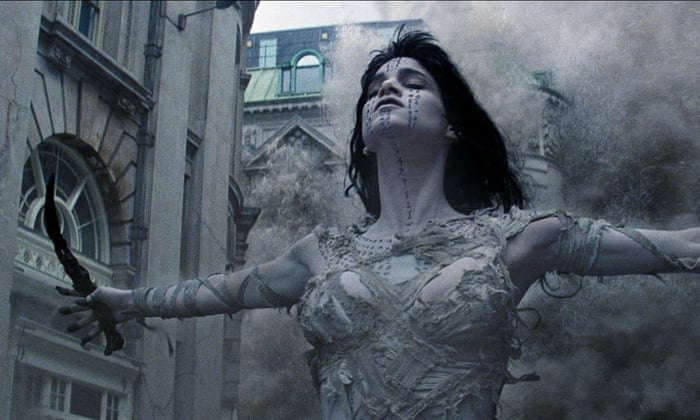
One of the many changes made to Mummy lore in the Tom Cruise movie The Mummy is that it focused on a female mummy rather than the traditional male ones. Despite Twitter’s beliefs that all gender/race flips are greeted with sexist racist fanboy hatred, the viewing public did not have a problem with gender-flipping the mummy, especially since she was played by the wonderful Sofia Boutella, who gives the character a real sense of wiry, acrobatic physicality.

Unfortunately, the movie sucked for myriad reasons. Among the reasons: the crushing lack of research, the lack of Egypt, Tom Cruise’s midlife crisis, the need to shoehorn a S.H.I.E.L.D.-like organization into the story, the script full of holes, the blatant ripping off of An American Werewolf In London, and so forth. It’s not a good movie, and I didn’t enjoy it.

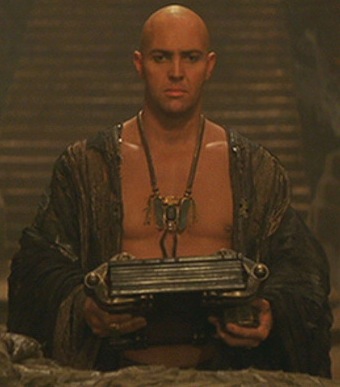
But the thing that really stuck out to me is that despite deciding to make the mummy female… the movie is actually rather sexist towards her. This is best highlighted when you compare the 2017 mummy, Ahmanet, to her male counterpart in the 1999 movie, Imhotep. And two things really stuck out at me.

One, Ahmanet is weak. I don’t mean she’s weakly characterized – although she is – but that she’s not very powerful for an undead mummy powered by divine sponsorship. About midway through the movie, she’s captured by the troops of Prodigium (the monster-hunting equivalent of S.H.I.E.L.D.). Do they use magical tools and amulets? Do they somehow neutralize the power of Set, rendering her helpless? Do they use centuries of research and knowledge and technology and the supernatural to overwhelm this godlike figure’s godlike powers?

Nope. They use ropes and hooks to catch her, then chain her up with a mercury drip. It isn’t even hard for them.

If that doesn’t sound weak, stop for a moment and remember Imhotep from the 1999 movie. Imhotep was powerful. Ridiculously so. He had his weaknesses (like kitties), but it’s hard to imagine him being completely incapacitated by some guys with ropes. Yet the female mummy is weak and gets taken down almost effortlessly.

And you may be thinking, “Well, it’s to show how amazing Prodigium is! They’re so capable and strong that they can stop a god-powered mummy!”

But no, that isn’t the case. Because that is the second time that Ahmanet is taken down by mere mortal schlubs – the first time was in ancient Egypt right after she murdered her family, and she was newly juiced-up with Set’s power. Not only were the people who caught her ordinary people, but they didn’t have technology, centuries of organized study and gathered magical power. They were just people. Not only did they catch her, but they successfully mummified her alive (which is not possible, incidentally) and transported her to another country before properly imprisoning her in a neutralizing element. That is, for a mummy, quite weak.

For the record, Imhotep also was caught and buried alive by ordinary humans… but that was before he had most of his powers. So it made sense that the Medjai could catch him!

The other part of Ahmanet that struck me as sexist is her ultimate goal. Her initial goal seems to be to rule Egypt, because she apparently was raised with the belief that she would be the queen regnant when her father died, but then his wife had a baby boy so she was knocked out of the succession. For the record, pharoahs had many wives, so the chances of a pharoah having only two children in twenty years is… very unlikely. That’s a more medieval-European trope.

Anyway, she was so upset about not becoming queen that she summoned the god Set, and he gave her… skin text and four pupils, and a knife. So she wandered off and killed her entire family, baby included, and then decides to bring Set into a mortal man’s body because she’s in love with him. When she revives in the present, her motive does not change – she wants Set to incarnate in Tom Cruise’s body.

Now, let’s again compare her to Imhotep.

Imhotep also had romantic love as the centerpiece of his quest. He was the secret lover of the pharoah’s mistress (why not a lesser wife or concubine? Again, very medieval-European!), until she committed suicide so that the Medjai wouldn’t capture Imhotep. So his goal was to bring her back to life. He was captured and sealed away under a magic spell, and when he is revived as a mummy, his ultimate goal is also unchanged – once he has his body restored, he wants to bring his lover’s soul back in Rachel Weisz’s body.

Similar motives, similar goals, similar story progression, yes?

Well, no. Like I mentioned before, Ahmanet’s goal is to revive an evil god, so he can rule the world. She wants to be his queen, not a queen regnant. She even explicitly says this, and she acts like a lovesick fangirl for most of the story.

Imhotep, on the other hand, never gives the impression that he’s going to be subservient to any person, and at no point do you imagine that his lover is going to be the one sitting up on the throne while he’s just the arm candy.

I don’t know much about the production of this movie, but I will say that this motivation feels a little like it was shoved in there. It may be bad writing giving the character inconsistent or poorly-explained motives… or it may be the obviously-insecure-about-his-age Tom Cruise insisting that all women in the movie must be dazzled by his toothy charm. I don’t know.

But either way, the handling of the female mummy was not good, and they should have simply followed this rule: if it isn’t something you can see Imhotep doing, leave it out.

Online Dating

Currently, I am facing a terrifying prospect: online dating.

To be frank, I have not dated someone in years, and I’m riddled with anxiety at the prospect. I’m a very socially awkward person upon first meeting, and I am bad at reading others’ social cues.

Furthermore, I am very critical of my looks, and obviously various apps require a photo. I have this horrible vision of going on a date, and the other person being completely repulsed by how I look. But the alternative is much worse, even though I know there’s no guarantee that I’ll actually find someone compatible or have kids. I feel exhausted and anxious and like life has passed me by.

Zack Snyder’s Justice League: Part 2 (Spoilers)

I’ve finished the entire film now, seen it multiple times, and formulated quite a few thoughts about it. Among them:

Thankfully, the random Russian family is absent from this cut of the movie, being one of Whedon’s many baffling creative choices – I mean, why give Cyborg a whole character arc when you can just show random nameless people that we don’t care about? In this cut, the Russian town is completely deserted, which seems like a more likely choice for Steppenwolf’s secret headquarters… and, somehow, makes the whole event seem much more sinister. It’s a mission of death, brewing and blooming in a place that is, effectively, dead.

Jeremy Irons as Alfred Pennyworth is, by the way, a delight. The fact that he’s more prominently featured in the Snyder Cut is another point in its favor.

A pretty effective horror scene in which a hapless janitor finds a parademon lurking in the lab… very good at establishing mood and the sinisterness of the parademons. I honestly never felt that in the Josstice League cut.

The firing of the message arrow was longer and more ritualized here, giving more of a feeling that the Amazons are using magic, and very ancient means. It’s also specified that the arrow is an arrow of the goddess Artemis. Overall, it has a slight “lighting the beacons of Gondor” feeling.

It also leads into an excellent scene of Diana investigating the temple where the arrow landed, which – again – increases the feeling of atmosphere and menace considerably. In the Josstice League cut, she just saw it on TV and immediately knew what it meant. Here she knows its significance, but we see her uncovering what it means through non-verbal means and an Indiana Jones-style infiltration of an ancient secret chamber. Compared to the hamfisted dialogue of the Whedon cut, it’s refreshing to have a director assume his audience is smart enough to decipher what’s going on.

Ryan Choi is in this. If you don’t know who Ryan Choi is, he is the second person to assume the mantle of the Atom, a size-changing superhero. Basically, our dear Zack Snyder was laying groundwork for a future movie if the character went over well. But like most non-white characters, he was eliminated from the theatrical cut, which is a shame, because he has some good energy and works well opposite Silas Stone.

Something about Joe Morton apparently just says “genius scientist.” I have seen him in several roles, and the three most prominent ones – this one included – all cast him as a genius scientist.

He’s also our entry-way to Victor Stone, aka Cyborg, whom we first meet being emo in a hidden apartment. This was… about all the character development Cyborg had in the Josstice League cut – he was just emo and wooden for the whole movie, and then he just sort of decided not to be at the climax. It was truly abysmal, and I actively disliked the character of Cyborg because he was so poorly-written.

Turns out that was all Whedon’s fault. Again. Thanks, Whedon. Thanks so much.

Ah, slo-mo. It wouldn’t be a Zack Snyder movie without slo-mo.

A new scene also introduces us to Vulko, Aquaman’s mentor figure, who is rocking the Elrond hair here. He’s appeared in the Aquaman movie so his appearance is not a huge surprise, but it would have been a fun way to segue into Momoa’s own movie.

One contribution Snyder has made that I’m not really a fan of is the air bubbles that Atlanteans generate whenever they want to talk, and their apparent inability to communicate verbally without them. If they’re able to breathe water, they should be able to talk underwater. Especially since sound does travel underwater – Snyder could have had some fun with it by coming up with watery distortion.

I do, however, love the way that Steppenwolf communicates with DeSaad in this movie, in which a giant slab of stone in the middle of a nuclear power plant (no, I don’t know why it’s there) turns into a molten representation of whoever he’s talking to. It’s a very cool-looking visual representation of communication, more so than just talking through a portal or something like that.

The Snyder Cut also does something that Whedon’s never did: makes Steppenwolf a three-dimensional villain. One of the things I (and everyone else) hated about Steppenwolf was how thin and cliched he was – we’re simply informed that he conquers because… that’s what he likes to do. That’s his whole motive. Nothing deeper or more identifiable than that.

But in Snyder’s cut, you almost feel sorry for Steppenwolf. His motivation here is that he somehow betrayed Darkseid once in the distant past, and now he has to conquer worlds to be allowed to return home. It’s a simple motive – he wants to go home – but it’s one that we can understand and sympathize with, even if he’s still obviously evil.

Diana also gives a more elongated version of the “age of heroes” retelling, with some notable differences. For one thing, it’s worth noting that Whedon trimmed out the African and Asian warriors fighting for the kingdoms of men. More attention is paid to the Green Lantern who dies during the fight. We also see more of the Motherboxes and how they work, which makes them feel more like they aren’t just MacGuffins.

But the biggest difference is that it isn’t Steppenwolf who gets his butt kicked by Earth’s defenders – it’s Darkseid himself, albeit before he started wearing a shirt and calling himself Darkseid. He also is forced to retreat because Ares critically injures him, to the point where he’s bleeding all over the place. We also get an idea of how hard it is to hurt Darkseid – even in his youthful, less powerful days, it takes two or three Greek gods to take him down.

It’s interesting that despite the rather bleak depiction of Batman in Batman V. Superman, It’s Snyder’s cut that has Batman being more optimistic about humanity and the possibility of heroes coming together, whereas Whedon’s is all whiny gloom.