Backrooms – The Most Accessible Horror?

So, I saw the Backrooms movie on the second day of its release, at about eleven in the morning (which is a weird time to be watching a horror movie). I’m usually a few years behind Internet things that people are into, so it’s pleasant to be there before the Backrooms becomes a mainstream thing.

And it probably will, because… this movie is a hit. A huge hit. As I write this, it has been out five days and has amassed $118 million, which is a pretty good showing for any movie, but is phenomenal for a movie that only cost ten million to make, by a first-time director who isn’t even old enough to drink. It’s so massive a success that McDonald’s just rolled out a Backrooms commercial as the movie premiered, which is kind of a gamble, since nobody knew if this would be successful.

I know that a ten-million-dollar movie isn’t the biggest gamble you can find in Hollywood – that would probably have been something like the original Lord of the Rings trilogy. But it is a gamble in the sense that this is a movie that isn’t based on a TV show, book or video game, but on a series of short videos posted on Youtube full of esoteric details, mystery and cryptic clues… based on a creepypasta. And it isn’t an adaptation so much as an addition to the preexisting webseries. To my knowledge, this doesn’t really have a precedent in the movie industry, so I was genuinely very interested in seeing if this very 21st-century phenomenon would turn out well.

I was especially interested in seeing how it would turn out because Kane Pixels/Parsons, the originator of the Backrooms videos, was directing the movie. Hollywood hasn’t done well with creepypastas and Internet lore before this, as seen by the Slenderman movie. If you haven’t seen it, it was just a standard horror movie with nothing distinctly Slenderman about the title character except his appearance, and was clearly made by people who neither knew nor cared about the preexisting lore.

But back to the Backrooms. Honestly, I wonder if the webseries is part of the reason that the movie is doing as well as it is. Specifically, the fact that it’s so accessible to everyone who has a phone or a computer.

I mean, the bar is so low to getting involved in the Backrooms lore and figuring out whether you will want to see the movie or not. All you have to do is go onto Youtube and type in “Backrooms,” and you’ll immediately find Kane Pixels’ channel. No money is needed, and it isn’t hard to access. All you need to do is watch, and you’ll have a pretty solid idea of whether the movie’s brand of eerie dreamlike horror is something that you’d enjoy watching for a whole feature film.

And likewise, understanding the lore is easy as well. If you try to get into the Backrooms lore and are confused, there are countless videos dissecting Kane Pixels’ videos frame by frame, and exploring all the subtle clues, details, messages and timeline of the Backrooms and A-Sync. Once again, all you have to do is go onto Youtube and check out a Wendigoon video or two – long videos, I should add – and you’ll find that most of the legwork has been done for you. It’s practically the easiest thing to get involved in.

Whatever the reason, it’s fantastic that the Backrooms have become a bona fide hit in movie theaters – not just indie horror, but horror that accurately captures the esoteric nature of the material, and which brings a little of the strangeness and darkness of the Internet into the sanitized, mass-produced realm of Hollywood movies.

Have a nice day, and don’t no-clip through any walls.

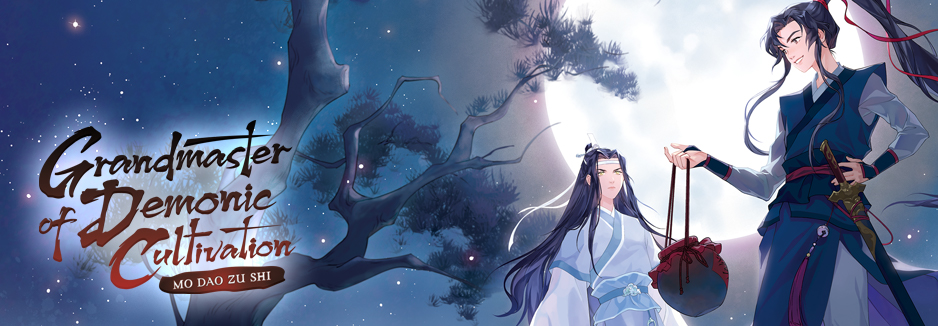
Recommendation: The Grandmaster Of Demonic Cultivation (Mo Dao Zu Shi)

Despite the general government disapproval of same-sex relationships, China does have some media focusing on such characters. Boys’ love content in China is known as “danmei,” and don’t ask me what that literally means because I know about ten words in Mandarin, and half of them are numbers.

And the most famous example of the breed is probably Mo Dao Zu Shi or The Grandmaster of Demonic Cultivation (alternate unofficial title: “The Founder of Diabolism). This webnovel has an animated adaptation, a live-action adaptation in the form of The Untamed, an audio drama, a stage play, a manhua, and a currently-ongoing manga in Japan. I can testify that all of them are very good (except the stage play, which I haven’t seen), although some of them are censored. The Untamed, for instance, is unable to openly depict the main characters as being romantically involved with one another, so the actors just gaze lovingly at each other a lot.

The story is about Wei Wuxian, who died thirteen years before the events of the series. He was basically considered a supervillain by his entire society, who used a necromantic form of cultivation to control the dead, including a sapient superzombie named Wen Ning. In the present, he’s brought back to life in the body of a mentally ill young man who wants Wei Wuxian to kill his relatives, and after some craziness and several deaths, Wei Wuxian ends up being captured by Lan Wangji, a very morally upright and noble cultivator that he knew in his old life, who seems weirdly determined to keep Wei Wuxian close to him at all times.

The two of them go on a road trip to find the dismembered body parts of a fierce corpse (zombie) that has been scattered across many different cities, which are also the key to finding out who the dead person was and how he died. Without spoiling too much, they get entangled in a conspiracy of political murder and really unpleasant secrets. And at the same time, Wei Wuxian starts discovering that he has romantic feelings for Lan Wangji, but after spending the better part of fifteen years being called a monster, he subconsciously doesn’t believe that they could possibly be returned. He’s a little clueless, because readers will probably have figured out some stuff about Lan Wangji that Wei Wuxian hasn’t.

I’m summing up a lot – there’s a decent-sized cast, some side-plots and a lot of flashbacks spanning several years and a whole war – but that is the basic description of the webnovel. The author, Mo Xiang Tong Xiu (known as MXTX), has written three webnovels and all of them have been really popular. MDZS is arguably the most plot-heavy of the three, and honestly, that is the way I like this sort of story: a heavy dose of plot, with the romance sort of wound through it.

The romance is very much an opposites-attract kind of story – Wei Wuxian is this sort of brilliant, erratic little gremlin who loves to cause trouble, and Lan Wangji is this almost superhumanly cool, elegant and silent figure that only loses his composure around Wei Wuxian. But at the core, they do have a lot in common, like wanting to protect innocent people and doing the right thing even if the world is against them. And the slow burn of them getting together is complicated by a series of misunderstandings, lost memories and the fact that Lan Wangji doesn’t really know how to express his emotions outwardly.

And yes, it’s a slow-burn – things only really coalesce in the climactic (literally, in some cases) part of the story, at which time the stories get much more sexual. Let’s just say that the fandom’s catchphrase “Every day means every day” is earned.

It also earns a lot of attention for the secondary characters, all of whom are pretty vivid… including the dead ones, both animate and not. There’s Wei Wuxian’s estranged martial brother Jiang Cheng, who’s crabby, violent and very emotionally stunted; Lan Xichen, Lan Wangji’s too-agreeable older brother; Wen Qing, a courageous and rather terse doctor that Wei Wuxian befriends; Xue Yang, a charming psychopath who traps the characters in a haunted city; Nie Huaisang, the dweeby ex-classmate Wei Wuxian runs into; and a bunch of lovably naive teenagers who tend to follow the main characters around wherever they go.

So if you’re looking for a romance with a lot of plot and misunderstandings (so many misunderstandings), this one might be something you’d like.

Zach Creggar’s Resident Evil: A Rant

Out of every franchise in the world, the Resident Evil franchise might have the worst track record when it comes to films. There have been seven films made about this bestselling series, six Milla Jovovich fanfics by Paul W. S. Anderson, and one crappy “adaptation” of the first two games that got every character wrong. Capcom needs to really start having a Nintendo-like grip on their IPs so they can get a decent movie made.

And right now we’re facing down the barrel of an eighth movie, by acclaimed horror filmmaker Zach Creggar. Good, right? Good news?

No.

First, he made it pretty clear from the beginning that he’s not going to bother with actual game lore or canon, that this “adaptation” is HIS story that HE wants to tell. He also apparently said that it wouldn’t have many zombies. Resident Evil, without zombies. Even the one with werewolves and vampires still had zombies.

And then a script, allegedly by Creggar, leaked to the Internet. Now, you might be saying, “But there’s no proof the script is real. It could be some random crap generated by a rando online… or worse, by A.I.” And folks, I would normally entertain that argument gladly, if nothing else for the sake of optimism that this movie might still turn out decent. The Internet is full of fake stuff, and fake scripts and spoilers have come up before.

But here’s the problem: a few weeks later, a trailer was released for the movie… and it contained scenes and images straight out of the script. Very striking scenes and images. So it looks like the script was NOT written in response to the trailer… which means that unfortunately, it seems to be the real article.

I say “unfortunately” because this script is bad. Really bad. This movie makes Resident Evil: Welcome to Raccoon City look like Lord of the Rings. This movie makes the Netflix series look like a legitimate Resident Evil story. This movie makes Alice look like the best protagonist ever written, just by virtue of her not being a bumbling selfish idiot. This is what every single person does NOT want to see in a film adaptation.

And I’m not just talking about “this movie doesn’t have Leon/Chris/Claire/Jill” or “this isn’t a direct adaptation of any of the games.” The concept of it – a delivery man trying to get through an infected Raccoon City and survive – COULD have worked. It wouldn’t have been a proper adaptation, since it would only be adapting minimal material, but it could have been a good MOVIE. But it isn’t.

Before I go forward with the stuff I hated in it, a warning: this will contain spoilers for the script. I am still very lightly entertaining the possibility that this script isn’t real, but I’ve pretty much concluded that it is. So if it is, and it was used for the final movie, it will contain spoilers for Zach Cregger’s Resident Evil.

  1. First, the plot. There really isn’t one. The entire movie is basically this loser Bryan bumbling into Raccoon City and having multiple encounters with infected people and animals. Not the kind in the games where you make actual progression and new things happen because of the people/things you encounter – the characters he encounters don’t really contribute to the story, and the “progression” is entirely him shambling around seeing new monsters.
  2. Bryan is an idiot. It says a lot about what Hollywood thinks of you and me that the relatable “normal” person they write is a bumbling loser with more thumbs than brain cells. We’re also expected to like and relate to this guy… when he is actually the person in all those other zombie movies who HIDES THAT HE IS INFECTED and thus dooms other people out of his own selfishness.
  3. Marvel humor. Marvel humor does not belong in a Resident Evil movie. There are funny moments in some of the games (I’m thinking of Resident Evil: Village’s “boulder-punching asshole” line) but not Marvel humor. This completely undercuts the horror and tension by turning to the audience constantly and saying, “LOL, this is so weird, right? Woo, look, he’s turning into a zombie but someone’s throwing beakers at him! Funny! Laugh at this horrifying moment!”
  4. “Fuck” and “yo” are approximately 50% of the dialogue. Bryan even says “yo” to himself.
  5. There is also a subplot about abortion and babies. This subplot has literally no reason to exist except to give Bryan a thematic reason to massacre infected babies and small children. It doesn’t lead to anything else, the girlfriend character doesn’t appear for the rest of the movie, and the character development Bryan is supposedly given because of the dilemma ends up… well, I’ll explain more later.
  6. There are no zombies here. Not one. What do they have instead? Well, have you seen The Thing? Because the infection essentially turns them into The Thing, only less intelligent and thus less scary – lots of tentacles and infected corpses merging into larger monster masses.
  7. There’s also no T-virus. Instead we’re told this all stems from some weird attempt to accelerate evolution… because evolving apparently means we’re going to become mindless masses of teeth and tentacles that absorb corpses.
  8. Characters other than Bryan barely have a reason to be in the movie. One character named Pauline seems like she might be important (and give us somebody for Bryan to talk to other than himself), but she’s killed off a few scenes later. The movie also introduces a badass action character named Max… and then he just sort of walks out of the movie and we never even find out what happened to him. I almost wonder if Max was some kind of “take-that” to the characters of Leon Kennedy and Chris Redfield, both of whom are very competent, buttkicking action characters who can get through a game intact and alive. It’s almost like Creggar is saying, “Hey, you want Leon or Chris? You want someone who can kill all the monsters and save the day? Well tough! You get the blithering loser delivery man instead!”
  9. The Resident Evil-ness of the movie is surface-level. Even more surface-level than the Netflix series. Essentially, the only things that it has in common with any Resident Evil story is because the setting is called Raccoon City, and the evil corporation responsible is called Umbrella. Change those names, and there’s nothing Resident Evil about it at all.
  10. The ending. To put it simply, the movie ends with Bryan, who is infected, finally turning into a monster and killing the people who had just formulated a cure. The cure is destroyed, and the human race is doomed, because Bryan is a selfish moron who couldn’t tell them, “I’m infected. I’ll wait outside while you make a cure. Please come out and save me when you’re done.”
  11. Because of that ending… the entire movie, which is about delivering the MacGuffin for the cure, is pointless. Nothing that we saw actually led to anything, and nothing the character of Bryan went through resulted in any kind of character development. It essentially ends with Zach Creggar saying, “I just wasted a few hours of your life. Thanks for the money, suckers.”

I can only assume that Zach Creggar wanted to make a not-zombie movie himself, but probably couldn’t get the funding for it (especially before Weapons came out). So the studio just slapped a few Resident Evil names on Creggar’s script and figured that a recognizable IP will make it profitable.

I don’t know why it is so, so hard to get a decent Resident Evil movie. Each game has a plot and well-developed characters already plotted out for you, so all you need to do is strip out the backtracking, streamline the story a little into a three-act structure, and cast people who kinda look like the characters. That’s it. It’s not difficult. But it’s apparently something that no movie studio can manage today, because even the Resident Evil movie that was closest to the games did it all wrong by cramming two games into one film and getting the characters and casting dramatically wrong. “Soft boi uwu Wesker” is a particular thorn in my side.

On a related note, I recently watched the Japanese movie Exit 8 which is based on a hit indie game that has no plot and no characters. You just walk through the same hallway repeatedly, looking out for “anomalies” and trying to get eight levels right in a row, so you can win and escape the liminal space. Simple, but not easy.

This movie even has the main character facing the same dilemma as Bryan – his recent ex-girlfriend has just told him that she’s pregnant, and neither one of them knows what to do. But rather than just using that as filler that never goes anywhere or leads to anything, it becomes the backbone of the story – the Lost Man’s wanderings become an opportunity for the liminal maze to teach him that he can be a good dad, and to help him grow in courage and self-assurance. His escape becomes wrapped up in his ability to put his good qualities into actions, and his willingness to care for and prioritize a little boy who’s also in the maze.

But it’s obvious that Exit 8 started with the game and cultivated a story to grow around it, while Zach Creggar just had a bunch of gross monster moments he wanted to string together into a movie and then slapped a Resident Evil sticker on it.

So the lesson learned is: Don’t watch Zach Creggar’s movie. Watch Exit 8. Really good movie with simple concept, good characters, good effects, and it makes you feel like something was actually accomplished.

The Crow 2024: Where Are The Good People?

So, I just watched The Crow. Not the original Brandon Lee movie, a searingly raw, beautiful tragedy of love, revenge and sorrow that sadly led to the death of its lead actor. I watched the 2024 remake… if you can call it a remake when it has very little connective tissue to the previous movie or its graphic novel origin.

And it is bad.

Now, there are many, many reasons that it’s bad. I could go on for hours about the sucky aspects of it. The acting (FKA Twigs is excruciatingly bad). The writing… so much cringe Tumblr dialogue. The entire romance takes place over the course of a week or so, so it has no feeling of real weight, as opposed to the impending wedding of the original Eric and Shelly. And of course, the change from a purely mortal psychopath and his minions to a… soul-peddling Satanic billionaire in a suit.

But I think the change/development that bothers me the most is that there are no good people in the story.

See, in the original movie, a large part of the tragedy of Eric and Shelly’s deaths was that they were, in fact, good people. Not stereotypical ones – they were both pretty alternative, and they were a little edgy – but good people who tried to help others and protect innocents. Their deaths hurt us because they were senseless horrors that happened to people who didn’t deserve it, people whose hearts were pure. And even though we only see little snippets of their lives in flashback, we believe that their love was real because they were good people.

And they were not the only people. There’s also the little girl they helped care for, with the drug-addicted mother. And there is Ernie Hudson’s cop character, who helps Eric take down the bad guys and process his grief and loss and pain. This is a world that is cruel and sad and brutal, but it has little glimmers of light and love that make it all worth it.

The remake… does not have those things. There is not a single character in it who is a good person. Nobody to admire. Nobody to like. Nobody who isn’t at the very least a selfish a-hole.

This is especially egregious when it comes to Eric and Shelly, because… as I said, the tragedy of their deaths was that they died senselessly, and that it was a bad thing that happened to good people who didn’t deserve it. That was the entire impetus behind the story of the Crow. The story was inspired by the senseless death of the author’s fiancee, and his struggle to deal with the eternal fact that bad things happen to good people, and a lot of the time, it isn’t for any greater reason or consequence.

2024 Eric and Shelly? Well, their deaths are a direct consequence of Shelly being an edgy rebel and hanging out with the aforementioned billionaire, and even doing bad stuff on his behalf. She’s no longer an innocent party, and their deaths somehow feel less tragic because of it.

And even if she hadn’t, both Eric and Shelly have lost the innocent passion that you felt in the original. In this iteration, they’re a pair of self-indulgent drug addicts who make the entire movie feel strangely sleazy and shallow. Their “love” is not a deep passionate romance that is about to culminate in marriage – it’s a post-rehab weekend fling between two junkies who are calling whatever they feel “true love.” And the movie expects us to agree with them, even though there’s nothing to indicate anything deeper than lust or bonding over pills.

I think part of the problem is that the people making the movie do not know the difference between a protagonist and a good person. A lot of bad writers have this problem. We’re expected to like, admire and relate to the main character because they ARE the main character, not because they’re a person who deserves those things. Sadly, this works with some people, as evidenced by the many people who think of Rick Deckard as a good guy instead of, you know, an assassin.

(Note: I am not saying Blade Runner is an example of bad writing. It’s not. I am simply pointing out that many people do not think critically about the protagonists of the media they consume and assume that the main character is a good person who’s in the right, and Rick Deckard is a good example)

Another part of it is… I think the people making this either don’t believe that good people exist, or they literally do not know what a good person is. The former seems supported by the fact that there is nobody in this movie that is actually good; there’s no little girl or Ernie Hudson cop to serve as a counterpoint to the corruption. Even Shelly’s mom is in league with the villains and doesn’t care about her daughter. The latter is supported by the fact that they apparently think that we’re going to be inspired by the “love” of two oppressively cringe, immature addicts who say stuff like, “If I’m ever hard to love, try to love me harder” and actively contribute to their own deaths.

Anyway, I may rant and rave more about the many, many, many ways this movie sucks and how inferior it is to the original, but that is one of my major pet peeves.

The problem with Medusa

One of the biggest problems in today’s world is that people will believe whatever they are told, even if the truth is easily findable through things like search engines and repositories of ancient texts. And one of those things is the legend of Medusa, which… most people really misrepresent online. Frequently, people misrepresent it (sometimes deliberately, but mostly due to ignorance).

If you go by the stories told on social media, the story of Medusa needs to be “reclaimed” because the original Greek legend is about an unfortunate priestess who was raped by Poseidon, and then cursed by Athena. According to those people, it’s a powerful story about a woman victimized by patriarchal cruelty, which needs to be regarded as a tragedy unintended by the Greeks, and her slaying by Perseus is a further tragedy and deeply unfair.

There’s one slight problem: it’s not true.

That is NOT the original Greek legend. In the original Greek legends, Medusa was – like most monsters – born a monster. She was never a human woman, cursed or otherwise. She was the product of a minor sea god and his sister/wife, and she and her sisters were always monstrous. Whether she should have been killed is another question entirely, but she was definitely never a human woman.

The whole backstory about her being a priestess cursed after sleeping with Neptune/Poseidon? That was the invention of a later poet, Ovid. Ovid was not an ancient Greek. Or a Greek at all. He was a Roman, born much later. He essentially wrote a fanfic about Medusa that… I don’t know, he thought was cooler and more interesting than the original tale.

Similarly, the idea that she was raped and victim-blamed is a modern invention. Nothing such appears in the original myths, and Ovid never depicts her as having been raped; he depicts it as purely consensual, if extremely stupid. It’s not a part of the “original” myths, as many people online will tell you it is – it’s about reinventing this minor mythological figure as a victimized mascot. Furthermore, even if you treat Ovid’s version as the “original,” it effectively strips the character of all accountability for the stupid decision to have sex in Minerva’s temple. Yes, it’s still wrong in the story to curse her, but in ancient myths where humans are little pawns thrown around by the gods, what would you expect to happen when you have sex with a god in the temple of another god who doesn’t like the first god very much?

So, to everyone… PLEASE stop promoting this myth about the myth. Myths should be examined and analyzed for what they are, not for the fan-fiction people write about them. Yes, write books and stories that reimagine, reinvent or explore those myths… plenty of excellent books do that, and have done for thousands of years… but don’t present those stories as being the real, “authentic” versions of the legend.

Elio Vs. KPop Demon Hunters – What’s In A Name?

So right now, two animated original stories have recently been released. One is Elio, a Pixar movie about a kid who gets abducted by aliens and… well, the plot doesn’t seem to have much more than that. The other is K-Pop Demon Hunters, which… is about K-pop stars who are also secretly demon hunters.

Now, I cannot speak to the quality of these two movies, since I haven’t seen either in full, except to say that the reception I’ve seen to Elio has been very mixed. Some people think it’s great, some people think it sucks. K-Pop Demon Hunters seems to have gotten overall a much more positive reaction despite a very silly premise, and as far as I can tell, that’s due to two things. One, it’s a well-written movie, from the clips I’ve seen. Two, it’s a genuine movie made out of someone’s culture and passions, not a soulless corporate product.

But I think one big contributor to the downfall of Elio and the rise of K-Pop Demon Hunters is the titles.

KPDH has a title that tells you, upfront and openly, what it’s about. It’s a movie about K-pop and demon-hunting. The premise is silly, like I said, but it doesn’t care how silly it sounds. You will probably know right out of the gate if this is a movie you are interested in. Furthermore, the title is eye-catching. It’s bold, it’s brash, it’s unapologetically different from every other title out there – and that makes it both memorable and attractive. It makes you want to know more.

On the other hand… what does “Elio” tell you?

Honestly, to me it sounds like the name of an indie dramedy about an older man (I keep imagining Tom Hanks) whose wife died and he’s been depressed ever since, but then he adopts a stray dog and it teaches him how to live again or something sappy like that. That dramedy would ultimately be trying to get an Oscar, but everybody would have forgotten about it by the time Oscar season rolls around.

That is what the title Elio says to me. It doesn’t say “wacky children’s space adventures with slug aliens.” It doesn’t say ANYTHING about the movie it’s attached to, or what to expect, or WHY you should see the movie. It’s just… a name. The movie could just as easily be called “Wally” or “Sean” or “Jake” or “Mike.” It tells you nothing except that it has a character named “Elio” in it, and that’s… not enough to really attract attention and interest.

And yes, I know that there are some very successful movies that are just the characters’ names – John Wick comes to mind. But there are also ones that definitely weren’t done any favors by their titles, like Salt.

I’m not saying that Pixar has to go full out K-pop Demon Hunters in their titles. But they really need to stop with the really bland, nondescript titles that are either names (like this and Luca), or they show a minimum of effort (like Soul). Their movies have been struggling for the past few years, for varying reasons, but the titles certainly don’t help.

Oh, and ditch the current art style too. The bean-mouth thing is tired.

The intimidation of rationality: Sherlock Holmes and Hercule Poirot

Extensive spoilers for Death on the Nile, “The Adventure of the Blue Carbuncle” and BBC’s Sherlock.

So, I’m back again.

And earlier today, I was listening to a video someone made about the many flaws of the BBC show Sherlock, which was a massive success as a show but also a terrible Sherlock Holmes adaptation. For many reasons, but I think the biggest one is that they fundamentally got Sherlock Holmes WRONG as a character, depicting him as an obnoxious, self-absorbed sociopath who desperately needs to be taught about the wonderfulness of friendship and empathy and rainbows and sunshine and puppies, et cetera. Feel free to vomit.

And it occurred to me as I listened… this isn’t the first time I’ve seen something like that.

I saw it a few years ago in the absolutely heinous big-screen adaptation of Death on the Nile by Kevin Branagh, which absolutely raped every single character in it. Zero attempts to make it feel timeless, realistic or elegant, zero attempt to adapt Christie’s brilliant story, motives or characters; just trashy Hollywood crap. Seriously, if you want to watch the story, watch the old 197os version with Peter Ustinov, Mia Farrow and David Niven. Pretty faithful (they condense a few characters and add a motive, but mostly correct), visually stunning, and not as obnoxiously horny or preoccupied with current-day politics.

But one thing that really galled me was the need to depict Hercule Poirot as being a detective ONLY because he’s traumatized and grieving. Apparently Kenneth Branagh… cannot grasp a human being who wants to understand the mechanics of a crime, who wants to unlock a puzzle, who relies on rationality, intelligence and deduction. He evidently thinks that a person who has those qualities must have been traumatized into it, because otherwise he’d “care” more and abandon being a detective.

And I think the same thought process went into Sherlock. Spoilers for a show that’s been out for years and everybody has already heard about it, but in case you haven’t and you still want to watch it, I’m going to spoil the final episode.

Ready?

Ready?

Ready?

Okay, in the final episode of Sherlock it’s revealed that Sherlock’s entire personality has been shaped by the fact that his sister murdered his best friend when he was a then-normal little boy, and that’s why he’s a “high-functioning sociopath” who’s obsessed with solving crimes. Everything he does, everything he is, is once again the result of horrible trauma that made him a “broken” person who needs to be shown the power of friendship and empathy. Gag me with a spoon.

… not to mention that Steven Moffat and Mark Gatiss seem to think that superior deductive abilities are essentially a precognitive superpower. They pretty clearly have a surface-level-only understanding of what an intelligent person’s mind is, and how it works; that kind of intelligence apparently seems like magic to them, whereas the original Holmes stories always explained Holmes’ deductions in detail, and the character himself always emphasized that other people could learn to do what he did.

These two depictions of legendary detectives are… really weird. The people making them seem to think that only a broken, mentally-scarred person could become a pragmatic, intelligent, deductive person, and that something is “wrong” or “missing” from them. That’s… a scary attitude to have. Not scary to the people who have it, but scary for the wildly anti-intellectual bent that it shows.

I think what both of these abominations show is that some people are extremely frightened of people who are genuinely intelligent – not just smart or clever, but geniuses or in some sort of elite field. They themselves are not intelligent – sometimes they’re really, really stupid – and so they try to defang what frightens them by imagining that those scary, scary smart people are actually just broken and scared, and that’s why they value intellect.

Furthermore… I think this is also coming from people who not only are scared of intelligence, but genuinely devalue it. I think they’re people who mainly value “feelings” and emotions and empathy, and think those are the most important factor. The existence of characters like Sherlock Holmes (the patron saint of deductive reasoning) and Hercule Poirot (he of the little grey cells) upset them, because those characters rely primarily on rationality, deduction and knowledge, not emotions and feefees. Even their knowledge of emotions and feelings tends to be psychologically based – they analyze and they apply their knowledge to figure out motives and actions. They do NOT turn into neurotic emotional messes who need extensive therapy because of their crippling personal problems.

And contrary to the stereotype of Holmes, he and Poirot are not people devoid of emotion or connection to others. In Death on the Nile, one of the most striking series of interactions is Poirot’s interactions with Jacqueline de Bellefort, a young woman seemingly stalking her ex-lover and his new wife (who was also her best friend). Due to his knowledge of psychology and the nature of evil, Poirot recognizes that Jackie is falling prey to evil, but knows she still has the chance to turn back and save herself. He genuinely wants her to not put her murderous plan into motion, not just for the sake of her victim, but for the sake of her own soul. She doesn’t do as he urges, and it genuinely saddens Poirot by the end that this bright young woman ultimately chose to destroy herself and several other people, when it could have been avoided easily.

Sherlock Holmes doesn’t usually get quite as personal in his stories, but he often shows sympathy and compassion for others in his stories. “The Adventure of the Blue Carbuncle” is notable for ending not with an arrest, but with Holmes letting the thief go because it’s Christmas, and he’s confident that the man won’t offend again. That’s not the actions of an emotionally stunted sociopath, but of someone who does care very deeply about others, even if he tries to stay detached.

So making these stories, you have people who are not very smart… and who rely on emotions and empathy for everything, including their storytelling… while ironically being so un-empathetic that they can’t grasp the mindset of a person who is rational, intelligent and deductive, so they depict someone different from themselves as “broken” or “defective.”

I guess it’s not surprising that such Moffat, Gatiss and Branagh can’t grasp the value of a steel-trap mind, or detective stories written by two of the greatest masters of the genre. Their own minds are mush. So I’d like to ask them, most politely: stop adapting mystery stories. Stick to bad melodrama, which is more your speed. You’re not good at mysteries, and you’re not good at writing geniuses.

Recommendation: Unpublished Brandon Sanderson

Every author has a trail of half-finished outlines, ideas or books that just didn’t work out. Books in embryo, which may or may not eventually be finished and released to the public. And apparently Brandon Sanderson is no different… he’s got whole novels that just aren’t published.

I’ve been reading them lately, and honestly, it’s a shame that these books weren’t published and canon to the Cosmere, because they’re pretty good overall. Although I understand why, obviously, Way of Kings Prime isn’t – it’s basically an earlier draft of a now-published novel that is drastically different in form now. It’s interesting as a look into the evolution of the novel we eventually got.

But the other two books are different. One was revised and released as a graphic novel, with some significant changes (such as a supporting character’s gender and family life) and the other just hasn’t been published officially in any form, although as I understand it, the worldbuilding is canon. White Sand takes place on a tidally-locked planet where half of it is in darkness and half in light, and the main character is a very weak sand mage who ends up accidentally becoming the leader of his order. And also they’re on the verge of being disbanded, and most of them have been murdered, and he has to somehow fight with sand-magic without being able to do more than a small amount of it.

The other is Aether of Night, kind of a cross between a Shakespearean comedy and a high-stakes high fantasy. It follows a prince/priest who ends up becoming king when his identical twin brother, who was the actual heir, is killed by mysterious shadow creatures, along with their father and a lot of other people. And those mysterious creatures are constantly invading their country and trying to overwhelm the populace, and they’re associated with a pair of feuding gods.

… and at the same time, there is also this comedic aspect, in that the former-priest-turned-king has to also select a wife from several candidates. They’re from different countries, religions and cultures, with different attitudes towards getting the prize, and some of them have their own agendas, and there are diplomatic repercussions to his choice. So as much as I enjoyed the book, I can see why Sanderson wasn’t really satisfied with the combination of high-fantasy potential apocalypse/Shakespearean comedy. You’re like, the world is potentially ending and over half the population is gonna die… so why are we hearing about some guy trying to figure out which girl he’ll marry?

And I just found out that he has another unpublished book called Dragonsteel, which I do not know anything about and which I now have to read. So stay tuned.

It’s bad to be an advanced reader?

So, watch the above video before reading more. Be sure to see other videos by KrimsonRogue – he’s one of the few Booktubers I follow religiously, and watch every video he makes.

I am not entirely sure what this man he’s talking about is on. I have personal experience in this, because – not to boast – I was a pretty advanced reader as a young child. In first grade, I read The Hobbit. The next year, I read The Lord of the Rings. I read so quickly and at such a level that my teacher effectively stopped expecting me to read the books supplied by the school for a book club, because I blew through them too fast. Then she tried to hold me back from surpassing my peers, but that’s a tale for another day.

And then there was the library. I went there at least twice a week, and over the next years, I was able to find plenty of books that were appropriate for kids, but advanced enough for my reading skills. Just in the kids’ section, there were the Chronicles of Prydain, the Dark is Rising Sequence, Diana Wynne-Jones, the Riddlemaster trilogy, the Green Sky trilogy, the Earthsea books, and so on.

And I did not restrict myself to the adult section – I prowled through the teen section and the adult sections as well, and picked up a number of authors that I still read – stuff like Arthur C. Clarke. Not just in fantasy and sci-fi either. I developed a love for murder mysteries then, thanks to Agatha Christie, Ngaio Marsh, Elizabeth Peters, etc. I also checked out biographies of various people who sounded interesting. And, of course, I checked the new arrivals religiously, in case there was something there that I might be interested in.

And the options for reading for kids were far, far more limited back then. There was no Rick Riordan, no Five Nights at Freddy’s, no Shannon Messenger, no Marissa Meyer, Garth Nix was early in his career, etc.

I’m sorry, but I don’t buy for a second that there’s some sort of shortage of books for children who read at a more advanced level. It doesn’t make sense logically, because a child who can read above their grade is capable of reading books for older readers… AND FOR KIDS. The pool of available books is not diminished, it’s INCREASED. I was capable of reading books like Lord of the Rings, sure, but I still read plenty of high-quality, intelligent, challenging books aimed at kids.

I can think of a number of books for younger readers that are as complex and well-written, if not more so, than many adult works I’ve read. Take Marissa Meyer’s Lunar Chronicles – I would have eagerly devoured a series about a cyborg Cinderella. Such books are usually aimed at young adults and kids not because they lack the qualities supposedly required by adult fiction, but because their protagonists are young.

Evidently this guy didn’t learn the lesson that the Harry Potter franchise supposedly taught us – that you’re not locked into a particular age group’s reading material. Adults can read kids’ books, and kids can (if properly screened) read books for older readers. I read books for 9-12-year-olds, young adults AND adults – and I do not have a dearth of books to read these days. Even though a lot of the new releases don’t appeal to me, I still have a to-read pile that is dauntingly huge.

And yet, with countless people telling him how wrong he is, that kids are not doomed to have nothing to read if they’re more advanced readers… he still is willing to die on this hill. Insisting that having kids who are academically advanced – especially in reading – is bad for them and is only inflicted on them by borderline-abusive parents. Considering that the American school system is a global joke that regularly churns out illiterate adults with no skills or relevant knowledge, we could use a lot more kids who are not just learning, but learning beyond what could be expected of them.

And as KrimsonRogue points out, the professed cost of constantly obtaining books is easily offset with a library card. Fun fact: library cards are free. So is checking out anything with them. For a bookish child, there’s nothing more delightful.

Despite protestations to the contrary, I have to wonder if he truly has kids who are ahead of their grade, or whether they’re dead average… and that bothers him, so he insists that it’s actually better for kids to NOT be smart and advanced to offset his discomfort. Maybe I’m wrong. But he seems very insistent that this is the case, and not willing to listen to anyone else’s perspective.

Youtube Recs – Village Cooking Channel

I don’t understand a word of any language spoken in India.

But somehow, that isn’t really a barrier when watching the Village Cooking Channel, a pretty major channel with 26 MILLION followers. Sure, the only part of the video I can really understand is “always welcome you,” but the content is so much fun and so wholesome that it doesn’t really matter.

The contents of the channel are pretty simple: half a dozen Indian men from a rural village go out into a remote field, start a fire, and cook. They cook a lot. They cook very, very large quantities – sometimes it looks like they’re cooking enough for their entire village. Whole goats filled with biryani, five hundred fried chicken legs, giant whole tuna, dragon fruit milkshakes, the world’s largest popsicles, hundreds of quail, and huge quantities of popcorn.

And some of the dishes are either unusual or unknown to American palates – think chickens cooked inside watermelons, soan papdi, goat brains, chicken in bamboo, stingray, rose cookies, goat feet, kizhi parotta, jelly cake, and so on. It’s a fascinating glimpse into how other cultures eat and the wide variety of foods that have developed in India. And despite the frequent deep-frying, most of it is probably much healthier than the average Western diet.

The guys in it are pretty fun to watch – they’re energetic and shout out the names of the ingredients as they prepare the food. They harvest some of it themselves, and so everything they make is pretty much entirely made out of whole ingredients that practically glow with freshness. Even the water looks delicious in these videos. I don’t know how you make water look delicious, but they’ve managed it.

And the best part? After the men have eaten generous portions of the food they’ve prepared, they always give what they haven’t eaten to elderly poor people living in their community. It’s heartwarming to see, and a reminder of what actual organic community looks like.