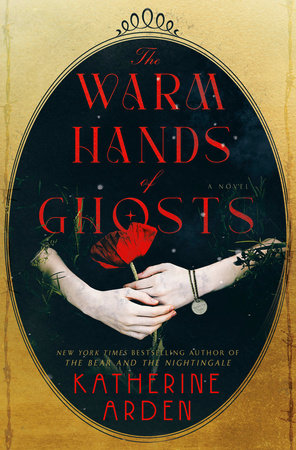
Disclaimer: I received a copy of this book from NetGalley in exchange for an honest review.
Nowhere seems more appropriate for a story about the lost and forsaken than a story set in one of the World Wars, whether it’s a fantasy or straight historical fiction. And the search for one of those lost, forsaken souls sparks off the events of “The Warm Hands Of Ghosts,” Katherine Arden’s historical fantasy about a woman’s search for her brother, and that brother’s fall from grace. It’s not a comfortable or complicated book, but it does have a certain dark, dismal charm.
It’s 1918, World War I is raging, and nurse Laura Iven has little other than her work to occupy her – her parents died in freak accidents, she suffered some nasty injuries in her field work at the front, and her brother Freddy has just been declared missing, presumed dead. Then a seance tells her that Freddie is still alive – and though she doesn’t entirely believe it, she decides to go back to the front with her new friends Pim Shaw and Mary Burton to find out what happened to him.
Soon after arriving, the women take shelter in a strange, dreamlike hotel, where a man named Faland plays the fiddle and tantalizes people with a magic mirror. While Laura searches for some sign of her brother, she is told stories about the Fiddler and the sinister spell he weaves over the people who find him – and she begins to wonder if Freddie’s fate might somehow be connected to this man.
Alternating chapters also show what happened to Freddie the year before – how he was left for dead in an overturned pillbox, with a German soldier named Hans Winter. The two men bond as they try to find a way back to one of their armies, and Freddie goes to extreme lengths to make sure his new friend will survive. But these lengths also put him in the hands of Faland, and a Faustian pact that will steal away what is most precious to him.
“The Warm Hands of Ghosts” is a book that is easier to appreciate than to actually enjoy – it’s a beautifully-written, beautifully-sculpted tale about the horrors of war, the price people will pay to escape them, and the bonds between people facing those horrors. But at the same time, Katherine Arden’s tale has stretches that aren’t exactly gripping, especially in Laura’s part of the story, and while the grey bleakness of the war is well-explored, she doesn’t really fully address the implications or theological aspects of the story that she brings up.
Furthermore, the alternating chapters from Laura and Freddie’s perspectives do start to sap some of the tension, especially when Faland’s true nature reveals itself – you kind of want the story to just stick to Freddie and explore the horror of his situation. Instead, every time something important happens in one of the parallel narratives, it’s cut off and we switch to the other one.
The characters also are a mixed bag – Laura is a character that it’s easier to admire than to like, being a rather cold and prickly woman. It’s entirely understandable, and well-displayed, how she became that way, but it’s hard to warm up to her. Supporting characters like the enchantingly feminine Pim or the bluntly practical American doctor Jones end up feeling more like characters you want to follow. And Freddie is a more raw and dynamic character, since his journey is more horrifying and gripping, as is his relationship with enemy soldier Winter.
“The Warm Hands of Ghosts” is a striking, well-written and well-researched tale of war, loss and the sinister forces that underlie human horrors. However, it needed more fleshing-out of some aspects of the plot, and a heroine who feels less cold and armored.



 The Forest