Review: Batman vs. Teenage Mutant Ninja Turtles

The Batman/Teenage Mutant Ninja Turtles miniseries is one of my favorite comic books of all time, so you can imagine how loudly I yelled when news of an animated adaptation hit the Internet.

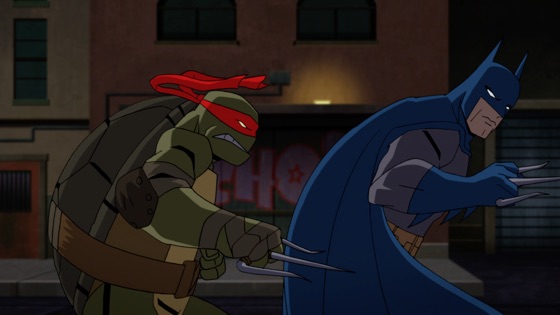
And though it deviates from the comics in some substantial ways (for instance, the idea of Batman and the Turtles coming from different dimensions is completely dispensed with), Batman vs. Teenage Mutant Ninja Turtles is a prime example of a fun romp. It’s heavy on memorable fight scenes, colorful transformations, and some gentle ribbing on both the franchises, and a great crossover that allows both Batman and the Turtles to shine in equal measure. Just don’t expect the “versus” to last very long.

When an experimental generator is stolen, Batgirl (Rachel Bloom) has a very strange account of events – how enemy ninjas invaded the laboratory, and fought four “lizard-men.” Batman (Troy Baker) vows to stop them from stealing more equipment, and soon discovers that the enemy ninjas are led by the masked, bladed Shredder (Andrew Kishino). He also encounters four mutant Turtles who are attempting to stop Shredder, brothers Leonardo, Raphael, Donatello and Michelangelo (Eric Bauza, Darren Criss, Baron Vaughn and Kyle Mooney). And after some initial misunderstandings, the two families join forces.

And thanks to Robin (Ben Giroux), they soon get a picture of what Shredder is planning to do – he’s joined forces with the malevolent Ra’s al Ghul, and is building a machine that could potentially mutate all of Gotham. But first, they’re going to mutate the residents of Arkham Asylum, unleashing a terrifying band of mutants who might just be able to take down Batman and the Turtles. And even if the heroes survive the encounter, they still have two armies of evil ninja waiting to cause mass mayhem.

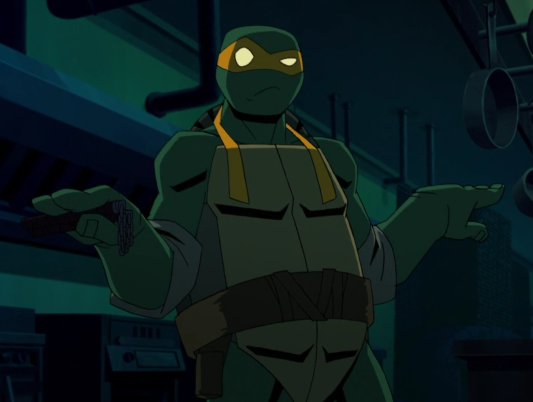
There isn’t a lot of actual “versus” in Batman vs. Teenage Mutant Ninja Turtles (they get over their antagonism pretty fast), but this little crossover knows why you’re here – to see Batman hang out with everybody’s favorite mutant reptiles, combining the dark brooding seriousness of Gotham with the lighter but still action-packed Turtle aesthetic. Batman’s world brings some darkness to the Turtles (mutated Harley Quinn is strangely nightmarish), while the Turtles bring some fun to Batman (Michelangelo dressing up in Batman’s cowl and riding his T-Rex).

And, of course, to see awesome fight scenes such as Shredder going toe-to-toe with Batman, which is a fight that you probably never knew you needed desperately to see. In fact, the movie is packed with such action – dodging Mr. Freeze’s blasts of ice, a frenzied vehicular battle against the Foot Clan, attacks from mutated ninja, and of course some nasty battles in Arkham. They’re not bloodless either – we get shuriken in the head, broken teeth, and quite a few people are killed in rather messy ways, ranging from arrows to explosions.

And of course, the movie seems very aware of how awesome this team-up is, and never hesitates to trot out the stuff that will make your inner eight-year-old cheer (the long chase involving the Turtle Van and a certain giant mutant). Perhaps the biggest stumble is the decision to have Batman and the Turtles as natives of the same universe, rather than from parallel Earths – it’s hard to believe that people in the far-off land of New York would think that Batman, one of the greatest superheroes of all time and a well-documented presence, is just an urban legend.

The voice acting is pretty strong here, especially for Batman, the Turtles, Ra’s al Ghul and Robin. The characters are also given a fair amount of fleshing out, considering the action-heavy storyline. They’re all familiar forms of the characters we know and love (Raphael is a rebel who clashes with Leonardo over how to treat bad guys, Batman is a brooding loner, Michelangelo is the fun-loving one who squees over cool stuff), but we have some nice moments such as Leonardo struggling through a nightmare of his brothers’ gruesome deaths, and his feelings of guilt.

For anyone familiar with either franchise – or both, preferably – Batman vs. Teenage Mutant Ninja Turtles is a fun rollercoaster ride of mildly bloody action, awesome battles, and the best crossover team-up that every geek has ever wanted to see. It has a few adaptational flaws, but taken on its own merits, it’s a thoroughly enjoyable way to spend an afternoon.

Review: Batman Unlimited: Mechs vs. Mutants

Batman fights a Godzilla-sized Killer Croc… in a giant Batman-themed mech suit.

If your head did not just explode from the sheer awesomeness of that idea, then I am sorry, my friend – there is just no help for you. Batman Unlimited: Mechs vs. Mutants, the third and final film in the Batman Unlimited series, proves that they saved the best for last. The script is tighter and cleverer than in the previous movies, and the action gets literally supersized in Pacific-Rim-style brawls.

After several months in exile in Antarctica, the Penguin (Dana Snyder) convinces his antisocial roommate Mr. Freeze (Oded Fehr) to return them to Gotham in over to take it over. Their plan: break into Arkham Asylum to free Bane (Carlos Alazraqui), Killer Croc (John DiMaggio), Clayface (Dave B. Mitchell) and Chemo, then combine the essences of three of them into a super-growth potion that will make Killer Croc and Chemo into kaiju-sized monsters. In case you’re wondering why they would want to do that, Killer Croc has somehow gained the ability to spew ice, which causes a small ice age to fall over Gotham.

Batman (Roger Craig Smith) immediately takes on these foes alongside his newest Robin Damien (Lucien Dodge), Nightwing (Will Friedle), Green Arrow (Chris Diamantopoulos) and the Flash (Charlie Schlatter). However, things quickly spiral out of control when Penguin betrays Freeze, and causes Clayface and Bane to also grow to gargantuan proportions. So there’s only one thing that the Caped Crusader can do: run back to Wayne Enterprises and get the building-sized, fully-functional battle mech suit that can punch out these giant monsters. Green Arrow has one too.

I may be slightly biased in the favor of Batman Unlimited: Mechs vs. Mutants, because I happen to think that Pacific Rim is a modern masterpiece. Mecha punching giant monsters makes me happy. What can I say? And there’s definitely a similar vibe to this film, with an emphasis on giant monstrous supervillains being repeatedly punched through buildings by Batman and Green Arrow’s giant mechanical fists. Also, toxic chemicals, snow and lava are spraying everywhere, so it’s not just punching.

It’s also probably the most complicated of the Batman Unlimited movies – in addition to the four kaiju-sized supervillains, there are also two main villains who are planning to betray each other. It’s abundantly clear that Freeze and Penguin aren’t going to be friendly for long, which further complicates a tale that already had plenty of stuff going on. There are some things that are a little zany (a penguin operating lab machinery), but they oddly seem to fit the over-the-top tone of the film.

The voice actors all do pretty good jobs, including Oded Fehr’s turn as the antisocial, perpetually-frustrated Mr. Freeze. The movie also works in a subplot for Damien, who is upset and feeling inadequate because he humiliated himself during a fight with the Joker. He doesn’t really resemble the arrogant brat from the comics… at all… but he is a fairly likable Robin.

And in addition, to the villains who actually do stuff in the movie, there are also some cameos by characters such as Cheetah, Mad Hatter, Hush, Two-Face, and most notably Troy Baker’s Joker, who is there just to be cranky because Penguin isn’t including him in the plan. Admittedly, it would be wonderful to see a kaiju-sized Joker rampaging through Gotham, but it never happens.

Also, there’s a henchpenguin named Buzz, who is hands-down the best character in the movie.

Batman Unlimited: Monsters vs. Mechs gives us exactly what the title suggests – if the thought of Batman piloting a Jaeger-style mech gives you a thrill, then this little animated movie might just be your speed. At the very least, it’s a fun way for the kids to spend an hour or so.

Review: Batman/Teenage Mutant Ninja Turtles III

In the first Batman/Teenage Mutant Ninja Turtles miniseries, the Turtles found themselves stranded in Batman’s universe, where they had to help Batman defeat Shredder. In the second miniseries, Batman had to pay a visit to the Turtles’ world to help them defeat Bane.

So where were they going when the third crossover came around? Why, a new universe made of the two worlds mashed together!

And this composite world does make Batman/Teenage Mutant Ninja Turtles III a little difficult to immerse yourself into at first, since your mind will probably be busy parsing through all the composite characters and figuring out who is what is who. But once you get used to Clayface being merged with Rocksteady and Killer Croc being merged with Bebop, it’s a rollicking mind-bending adventure that affectionately homages the pasts of both franchises.

Ever since the tragic death of his parents, Bruce Wayne has been raised by his butler/sensei/surrogate father Splinter, alongside his four mutant turtle brothers Leonardo, Donatello, Raphael and Michelangelo. The five of them battle against the Smile Clan, a ninja clan who are led by the brutal Laughing Man (an amalgam of Shredder and the Joker). But Bruce is haunted by strange dreams and feelings that something isn’t right – and his feelings are proven right when a Raphael from another universe appears.

But it’s not just any alternate version of Raphael – it’s the Raphael from the original Mirage comics, the prime universe from which all Turtle realities spring. And not only does he know that something is very wrong with this amalgamated reality, he knows why: the Turtles’ great enemy Krang is trying to rule both the Turtle and DC multiverses, by capturing both the Mirage Turtles and the original Batman.

The Turtles and Batman aren’t exactly pleased with the revelation that the shared life and experiences they all remember aren’t “real,” but they slowly come to realize that the Mirage Raphael is telling the truth. The only way for them to take down Krang, and separate their universes again, is for both Batman and the Turtles to find out who they really are – and reform the world into what it’s supposed to be.

If the first two Batman/Teenage Mutant Ninja Turtles adventures felt like explorations of each other’s universes, then the third feels like a celebration of both franchises. This came out in time for Batman’s 80th anniversary, and the Turtles’ 35th, and the love for both is strong – especially since it goes out of its way to highlight the “progenitor” Batman and Turtles (the latter of whom is even drawn by Kevin Eastman in black and white).

And it’s a fun ride – it has some wrenching pathos (the rediscovery of Alfred), some heartwarming moments (the Turtles reunion with April) and some funny lines thrown in to keep it from ever feeling too dark (“… I’ve finally found the great progenitors!” “That’s not a nice thing to call someone, dude!”). Above all, it has a sense of rising butt-kicking action as the Turtles and Batman dig up their true identities and start forcing the universe into the shape it’s meant to be, which requires some reorganization of the Smile Clan. With every triumph comes a little thrill.

Its biggest flaw is that it can be a little confusing at times – some characters are clearly amalgamations of characters from both the Bat and Turtle universes… and other seem like they are (the Turtles, the Laughing Man), but we later find out that their counterparts do actually exist in this world. Also, the Bat-Family kind of comes out of nowhere for the big climactic battle.

As always, Freddie Williams II’ art is awesome – he knows the right style to render both Batman and the Turtles in, giving them a complex, sculpted look that fits both universes. And the legendary Kevin Eastman contributes some pages as well, sketching in the progenitor Turtles and their world in a rough black-and-white style that harkens back to the Mirage comics, allowing those Turtles to stand out.

There’s a certain bittersweetness to Batman/Teenage Mutant Ninja Turtles III, since we’re probably not going to get another crossover for awhile – and if we do, probably not a sequel to this one. But it’s still a rollicking ride through both franchises, rendered with affection and respect. Cowabunga!

Review: Batman Unlimited: Monster Mayhem

Second verse, same as the first… but now with more Joker and a cyber-robo-T-rex.

So if you enjoyed the first futuristic, colorful Batman Unlimited adventure, you’re probably going to enjoy the second, “Batman Unlimited: Monster Mayhem.” It follows roughly the same pattern as the first movie – a bunch of motley minor supervillains start running amuck, and are found to be involved in a mysterious scheme that threatens all of Gotham city. But it has enough mysteries and differences that it doesn’t feel repetitive, especially with the outstanding Troy Baker taking center stage as everyone’s favorite psychotic clown.

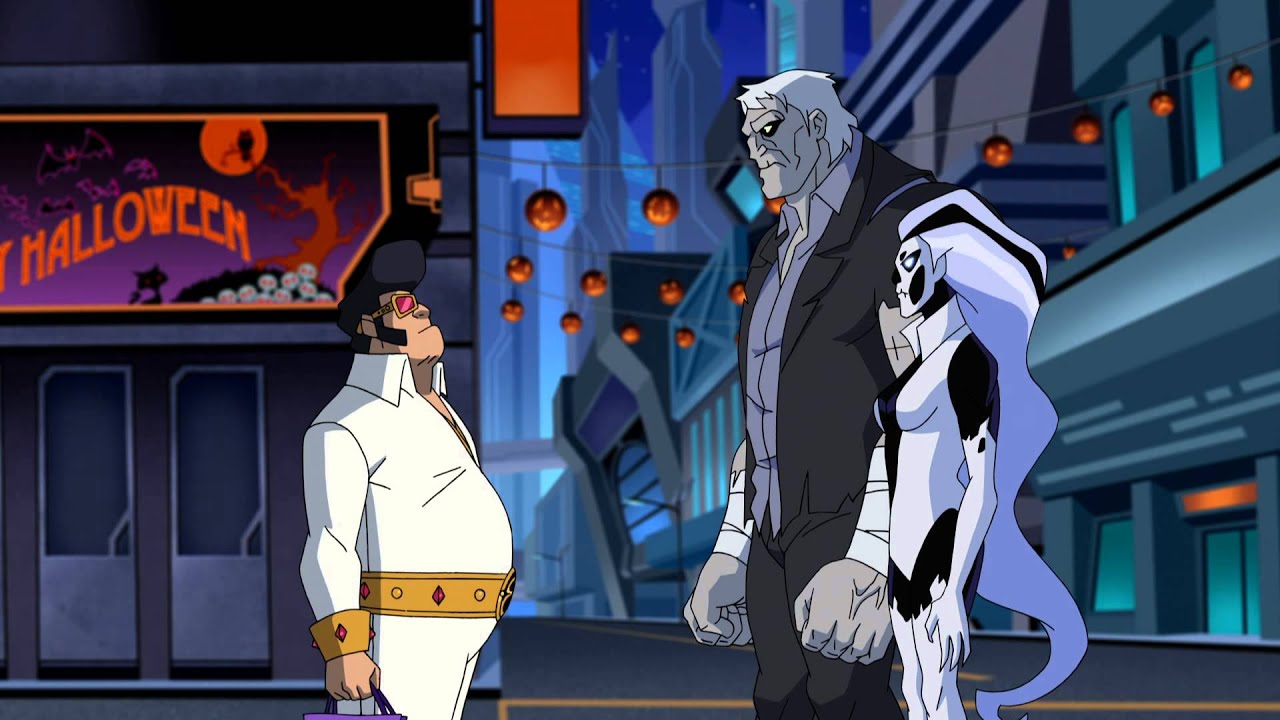
On Halloween, Solomon Grundy (Fred Tatasciore), Silver Banshee (Kari Wuhrer) and Scarecrow (Brian T. Delaney) manage to break out of Arkham Asylum and escape, despite the best efforts of Nightwing (Will Friedle) and Green Arrow (Chris Diamantopoulos). Batman isn’t entirely sure why they’re teaming up, and he gets a little distracted by the kidnapping of a famous video game designer by Clayface. And who is the mastermind behind all of this? None other than the Joker (Troy Baker).

Unfortunately, the Joker has a plan far more devious than merely kidnapping video game designers and stealing atomic batteries. After stealing a rare Incan gem, he unleashes a computer virus on all of Gotham, reducing the city to a darkened shell of its former self and turning Batman’s tech against him and his allies. Oh, and he declares himself king and puts his various cronies in positions of power. So naturally Batman and his allies will have to get creative in order to find their enemies and bring them down – both physically and digitally – before Joker has the chance to spread his virus across the entire world.

If you enjoyed Batman Unlimited: Animal Instincts, there’s a fairly good chance you will also enjoy Batman Unlimited: Mutant Mayhem. It still has the feeling of a fluffy but fun toy commercial with a plot added, and it has mostly the same heroic cast – although Cyborg is a supporting superhero rather than the Flash – and a fairly colorful array of villains. But the real showstopper is the Joker, played to gleefully insane perfection by Troy Baker. Baker is probably the second-best animated Joker out there, and he gives a thoroughly fun performance (such as when he plays several news anchors at once).

Of course, the entire cast is pretty good – Smith has a good low voice for Batman, Diamantopoulos is good as the lighter, wittier Green Arrow, and they’re backed by Friedle and Yuri Lowenthal as Nightwing and Red Robin. The latter two are also made more distinct by showing some of Nightwing’s fears as a superhero, balanced out against Red Robin’s quirky love of video games and unconventional fighting style.

There’s plenty of action in this movie, and it’s kept fast-moving and innovative at all times – baseballs as weapons, World War II planes, fear gas, an Iron-Man-like mech suit, a genuinely spooky attack by Clayface, and a very trippy cyber-battle between Batman and the Joker. There are some slower moments where Batman and his compatriots have to do some detective work, but these fortunately don’t bog down the pace.

The only problem is that Cyborg doesn’t have much superheroing to do in this movie – he mostly just gets infected by the virus, and spends almost all his screen time fighting the good guys. Also, “monster mayhem” is kind of an erroneous description, since there are no monsters here, except maybe Solomon Grundy; this mostly seems to be the title because, well, the beginning takes place on Halloween and some of the villains are a little spooky.

It’s not the deepest or most intricate adventure for the Dark Knight, but Batman Unlimited: Monster Mayhem is a colorful and action-packed popcorn adventure – and if you enjoy the Joker, Baker’s performance is a must-see.

On Harley Quinn Part 1

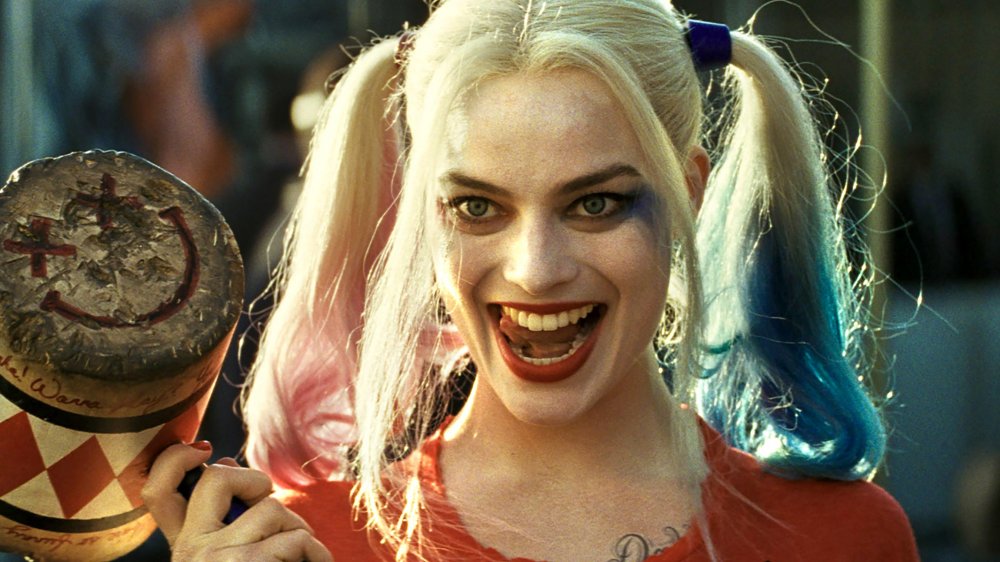
I’ve come to the conclusion that, as far as I am concerned, the best version of Harley Quinn is from the movie Assault on Arkham.

I’m kind of picky about my Harleys. For instance, I’m not really a fan of the Harley-leaves-the-Joker-and-becomes-a-wacky-Deadpool-like-antihero way the character is often handled now, because I feel like her massively screwed-up personality and warped mind are on display with Mista J. It allows her to be bad and corrupted, but also kind of pitiable and sad. Turning her into a copy of Deadpool takes away what made her interesting in the first place.

Then there was that dreadful Batman and Harley Quinn movie, which tried to pad itself out with diarrhea gags, musical numbers, and R-rated humor that felt like it was written by a fourteen-year-old boy. But the worst part was how it moralistically wagged its finger at the audience for objectifying Harley Quinn… while it blatantly objectified Harley Quinn.

Suicide Squad: Hell to Pay? So-so movie, and Harley is suitably flaky and intentionally annoying, but I felt like it didn’t really reflect her nastier, weirder side. She seemed to be all kookiness.

Suicide Squad? Do not want. Birds of Prey? No thank you! The Suicide Squad? Reserving judgement, but James Gunn gives me hope that things will turn out for the best. Or at least entertaining.

I do think she was handled interestingly in Batman: The Brave and the Bold, where she had a flapper aesthetic without losing her edge. And of course, I loved her role in Batman vs. Teenage Mutant Ninja Turtles, where she annoys the hell out of Shredder, demands her doctorate be respected, mutates into a hyena, makes out with the Joker in a way that is both “weird and gross,” and is a huge pain for the heroes in the second-act climactic battle.

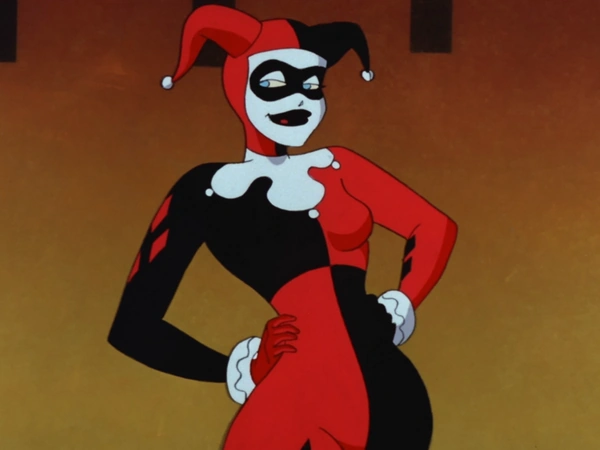
And of course, there’s the original Batman: The Animated Series, where the character came from – and which is still one of the best depictions of the character. For one thing, there was a whole arc in her interactions with Batman, growing from just being a henchwoman who obviously tries to kill the Dark Knight to kind of having a crush on him. At the same time, you see Batman’s opinion of her evolve, and he develops sympathy and even pity for her. It was a kids’ show so it was restricted in the way it could depict Harley, but they did get away with a lot, including showing an abusive Harley/Joker relationship that, scarily, is more adult and realistic than the one depicted in Suicide Squad.

Which brings me to Assault on Arkham, which is basically the movie that Suicide Squad was trying to be, but failed to be because David Ayer was also trying to make a darker, grittier version of Guardians of the Galaxy. The story is quite simple: the Suicide Squad is assembled by Amanda Waller, who wants them to break into Arkham Asylum (it seems to be harder to break in than out!) to recover something from the Riddler. Also, Batman is running around the place freaking out because the Joker has a dirty bomb hidden somewhere in Gotham.

If you were one of the many people disappointed by Suicide Squad, then Assault on Arkham might make you happy, because it does everything right that Suicide Squad did wrong. The biggest difference is that Ayer tried to make the bad guys in his movie ultimately heroic, and pushes the importance of working together and friendship. And… that doesn’t work for a team of murderous sociopaths that include a cold-blooded assassin whose only soft spot is somebody who isn’t on the team, a cannibal, a psychopath’s psychopathic girlfriend, a woman who doesn’t care about anyone else on the team (and isn’t really a part of it), and Slipknot.

(Admittedly, Slipknot might be a big fan of friendship and working together, but we don’t know because he dies about two minutes after being introduced, because he was kind of an idiot)

Honestly, the only person for whom that entire arc makes sense is El Diablo, a gang member who killed his family. Because unlike the others, he at least feels bad about it. And well, you have to have some cooperative skills if you’re in a gang.

It feels like Ayer wasn’t really comfortable with making a movie about bad people (as evidenced by Harley stealing a purse and explaining with a cringy “we’re BAD GUYS!,” as if shoplifting was a sign of her being a psycho). There’s always the feeling that he’s trying to paint them as not being as bad as they’re supposed to be, because he can’t bring himself to have them do bad things or act like the sociopathic losers they are.

There is none of that in Assault on Arkham. The best part of the movie is that the Suicide Squad do not act like friends. Oh, a few bonds (some very short-lived) do form between members, but for the most part these are bad people who dislike each other, don’t work well together, and take the absolute first chance they get to stab each other in the back. In fact, the climax of the movie is everything going to hell because these idiots have caused so much mayhem and disarray, and even as Arkham Asylum bursts into mass violence, they are still fighting each other. The characters are fun to watch, but they are definitely not depicted as good people or in any way likable.

I’m going to split this blog in half, because it’s getting too long.

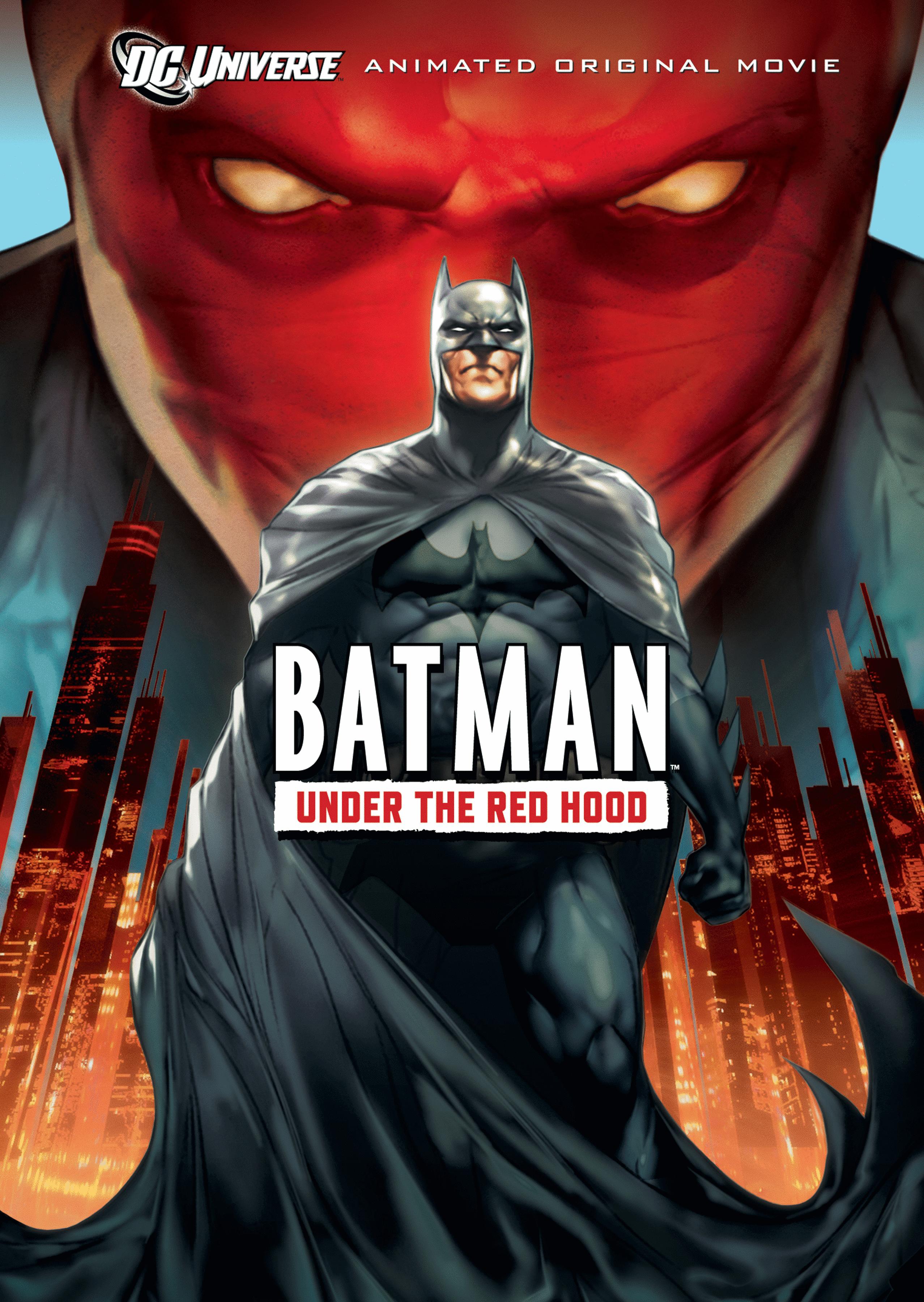
Review: Batman: Under The Red Hood

One of the most shocking events in DC Comics’ history was the death of Jason Todd, best known as the second Robin. As I understand it, the character was not popular, and DC eventually polled its readers to see if he should live or die… and he ended up savagely beaten with a crowbar and blown up, so you can imagine how the poll went.

But nobody really stays dead in comics – not major characters, anyway – and one of Batman’s greatest losses comes back to haunt him in “Batman: Under the Red Hood.” This is DC’s animation at its best – a tightly-written, dynamic mystery that unfolds like a bloody black rose, with Batman’s failures and losses at its heart, slowly building up to a conflict between him and the mysterious Red Hood.

Five years after the death of Jason Todd, a masked vigilante known as the Red Hood (Jensen Ackles) appears in Gotham and quickly takes over most of the city’s drug trade. After a disastrous incident involving a superpowered robot, Batman (Bruce Greenwood) and Nightwing (Neil Patrick Harris) encounter the Red Hood – and Batman quickly realizes that this is someone he knows, but he isn’t sure who. And after a second clash, he finds that Red Hood knows his true name.

Red Hood’s new dominance has also brought him into conflict with Black Mask (Wade Williams), a violent crime lord who is driven to extreme measures to take out his new enemy. Of course, his attempts only end up escalating the war, especially when the Joker gets involved. And at the same time, Batman delves into the mystery of who the Red Hood is and what brought him back to Gotham – and finds himself in a final standoff of revenge, hatred and loss.

It’s pretty obvious from the beginning of “Batman: Under the Red Hood” who the mysterious Red Hood is – the big mystery is how he’s returned to life, and what his ultimate plan is. And while Batman peels away the layers of the mystery, the story focuses on the magnitude of the Red Hood’s rise to power – he’s a new power player who uses Batman-like stealth, physical prowess and cunning to bloodily carve his way into the heart of Gotham’s underworld.

The story is a slow burn, but it’s kept from ever getting boring with sporadic bursts of action – falling helicopters, exploding chemical factories, people being set on fire, a troupe of murderous cyborgs, and so on. However, the violence and action never eclipse the emotional side of the story, which is present from the very first scene in which we see Batman desperately trying to get to an endangered Jason Todd, all the way to his climactic fistfight on top of a church.

This is, at its heart, a story about Batman’s losses, his failures, and his pain, and it’s hard not to feel for the Dark Knight as he’s confronted by something even more painful than Jason’s loss: the possibility that his beloved foster son has become his enemy. Red Hood is a more enigmatic character – sometimes he’s deadly serious, sometimes he’s laid-back and quippy. It’s only at the story’s climax that we see what has really driven him all this time, and where his anger has brought him.

Greenwood does a very solid job as Batman – stoic, a little stiff, but with some passionate emotion running under the surface. Ackles does an excellent job with Red Hood both in serious and in quippy mode, able to switch between the two at the drop of a hat. Harris makes a solid Nightwing, who is quirky and chatty and sort of floats out of the plot eventually. And while viewers may be used to Jokers with higher-pitched voices, John DiMaggio’s gritty, sinister-sounding Joker is a pretty chilling one.

DC Comics has made many good animated movies, but “Batman: Under the Red Hood” is probably one of their best – a sublimely dark, tragic thriller that is riveting right to its end. Just try looking away.

Recommendation: Batman Vs. Teenage Mutant Ninja Turtles

I’ve written a review of this movie, but I feel the need to gush about how much I love it.

I think what I really like about it is how respectful it is to both franchises. Too often in crossovers, one or the other side is neglected or made to look less competent or less important. This is especially a danger when one of the sides is known for being superhumanly awesome, like Batman.

But I felt like this movie highlighted the strengths and weaknesses of both the Bat-Family and the Ninja Turtles. Obviously they’re very different; Batman is measured and plans out things far in advance, while the Turtles tend to fly by the seat of their nonexistent pants. And this does cause conflict between them as the story unfolds, since Batman is used to people following his lead, and he gets kind of pissy when the Turtles just dash into the conflict. However, it is also shown that there are downsides to Batman’s approach as well, since he’s easily distracted from the main scheme of Shredder and Ra’s al Ghul by a mass breakout and mutation at Arkham Asylum. The Turtles are, in a sense, more focused than Batman because they are fixated on Shredder and his plan, and don’t really want to get involved in all the other criminals running amok in Gotham.

And this can be seen in the villains. Ra’s al Ghul knows exactly how to distract Batman long enough to get the cloud-seeder he wants. But Shredder doesn’t know why the hell Ra’s is doing this, because his enemies probably wouldn’t stray off the path of hunting him just because a mental asylum went boobies-up for the sixth time this month.

So I really like that both the Turtles and Batman have weaknesses and strengths, and Batman’s awesomeness (expertly outlined by Michelangelo) is balanced out by the Turtles’ varied gifts working in tandem. And it works especially well because the different Turtles are paired with different members of the Bat-Family, sometimes because they are similar and sometimes because they are wildly different.

And while all four of the Turtles are wonderfully characterized, I especially loved Michelangelo in this movie. Obviously, the characterization of Michelangelo over the years has really varied – he’s been a surfer dude, a tease and agitator, a space-case flake, and so on. But he’s always had a sweetness and an open-heartedness as a part of his character, which is best seen in the IDW comic book series, where he’s the most sensitive and childlike of the Turtles.

And he isn’t that different in this version. But in this one, he’s the enthusiastic one – he thinks Gotham is the coolest place he’s ever seen, and he loves every strange wacky detail about the place. His brothers are a little more laid-back about Gotham, its dangers and its oddities, but Michelangelo is delighted by gunbrellas to the point of ignoring his own safety. His enthusiasm is clearly the enthusiasm of the makers of this movie, and sometimes it feels like the audience is being carried along by his joy over polar bears with ice guns and police zeppelins.

“Does New York have mad blimps flying around for no reason? I mean, what are they for? I love ’em!”

Michelangelo, Batman vs. Teenage Mutant Ninja Turtles

And I think his enthusiasm is integral to emphasizing how much the people who made this movie loved the franchises: by having a character whose defining trait is how much he loves everything he comes across.

I also love his relationship with Alfred. Obviously it’s played for laughs, with the most rambunctious of the Ninja Turtles bumping up against Batman’s prim butler, who doesn’t understand Michelangelo’s love of skateboards and “greasy cheese bread.” But I enjoy the fact that neither one of them is acting in a way that is illogical to his character.

Michelangelo skateboarding through stately Wayne Manor and crashing into Alfred might seem like he’s being an asshole, but stop and think about it: not only is he a teenager, with all the dumb moments that come with a developing brain, but he’s literally been raised in a sewer. He’s probably not used to being able to skateboard wherever he pleases, and so Wayne Manor just seems like a giant empty space full of awesome curves and obstacles to him.

Obviously he figures out that Alfred doesn’t like this by the end, but it’s clear that he never skateboarded with malicious intent.

Alfred, for his part, is clearly not used to normal teenagers – insofar as you can call the Turtles “normal,” they are at least more normal than Bruce presumably was at the same age. And when you consider the Robins he’s dealt with over the years, usually scarred orphans or Damian Wayne… Alfred probably has no idea what a normal teenage boy is like, with bad table manners and dumb stunts on the stairs.

So that’s my thoughts for the time being on Batman vs. Teenage Mutant Ninja Turtles. Possibly more later. If you’re one of the two-and-a-half people reading this blog, absolutely check out the movie.

Review: Batman/Teenage Mutant Ninja Turtles II

The Totally Awesome Team-Up, Take Two! (small spoilers)

The first encounter between the Dark Knight and the Teenage Mutant Ninja Turtles was a rousing success, despite sounding like a crossover story dreamt up in some kid’s toy box.

So inevitably DC Comics and IDW Publishing decided to have their best-beloved comic-book characters encounter one another for the second time – this time with more dimension-hopping, more city-wide mayhem, and more epic fight scenes between a lot of people. “Batman/Teenage Mutant Ninja Turtles II’s” pacing is a little rushed, with some developments not taking as long as they rightly should have, but the unbridled awesomeness of the final issue almost makes up for that.

After a humiliating (and nearly fatal) defeat at the hands of Shredder’s Elite, Donatello laments that he isn’t as skilled a fighter as his brothers, and wishes that he could have both the intelligence and skill of Batman. To put his mind at ease, he attempts to use a dimensional teleporter to contact Batman – but accidentally switches himself with Bane, whom Batman had been about to fight. Now he’s in Gotham, and Bane is loose in New York.

After Batman and Donnie spend a week assembling a teleporter, they find that Bane has managed to take over the Foot Clan and is well on his way to conquering. Even worse, he’s got Baxter Stockman synthesizing Venom, so he can turn all his followers into roided-up monstrosities. The Turtles are badly outmatched even with Batman on their side – and when tragedy strikes, a guilt-ridden Donatello is driven to terrible lengths in an effort to stop Bane once and for all.

“Batman/Teenage Mutant Ninja Turtles II” aspires to be bigger and more explosive than the first adventure – the action consumes a whole city, armies of ninjas are involved, and the final issue is an outright battle royale. It’s also set primarily in the Turtles’ dimension this time, so it features a lot of supporting characters from their world, including Rocksteady, Bebop, Karai, the ever-unfortunate Baxter Stockman, and a certain helmeted ninja lord.

And for the most part, the story unfolds pretty well – there’s a good balance between action-packed fight scenes and the more emotional, low-key stuff, including a ceiling-collapsing battle between the Venom-enhanced Foot Clan and the Turtles/Batman team-up. There’s also a running subplot about Raphael getting into scraps with Damian Wayne, and the way the arrogant boy and the resident Turtle hothead manage to resolve their differences and come to a less violent way of interacting.

However, the miniseries is a little too short for its own good – things like the last-ditch effort to heal Splinter and Donnie taking Venom are far too brief and leave less of an impact than they should. But these flaws are almost compensated for by the final issue – a big, high-octane, splashy battle on Liberty Island with as many characters as possible. It also gives big sloppy affectionate kisses to the 1987 TV series in the form of many Easter egg homages. It’s just a delight to read, and you can tell the people who made it were having fun.

A lot of the character development in this particular miniseries revolves around Donatello, who is a technological genius but not quite the fighter his brothers are. His insecurity and feelings of inferiority are palpable and heart-wrenching, as is his rampant feelings of guilt when he sees what Bane has done to New York. Batman serves as an older, wiser presence who mentors him somewhat, reassuring him and helping talk him back from the brink when his grief and guilt get too out of control.

It’s also worth noting that Freddie Williams II does an excellent job with the art in this comic – it’s a good bridge between DC’s muscled, stocky style of artwork, and the more varied styles seen in IDW’s Turtles. The Turtles and Batman mesh together well artistically, and Williams does an excellent job with the emotions and turmoil in the characters’ faces.

“Batman/Teenage Mutant Ninja Turtles II” could have benefited from another issue or two, but is overall a pretty solid sequel to an excellent miniseries – lots of muscles, lots of emotions, and a grand finale that is loads of fun.