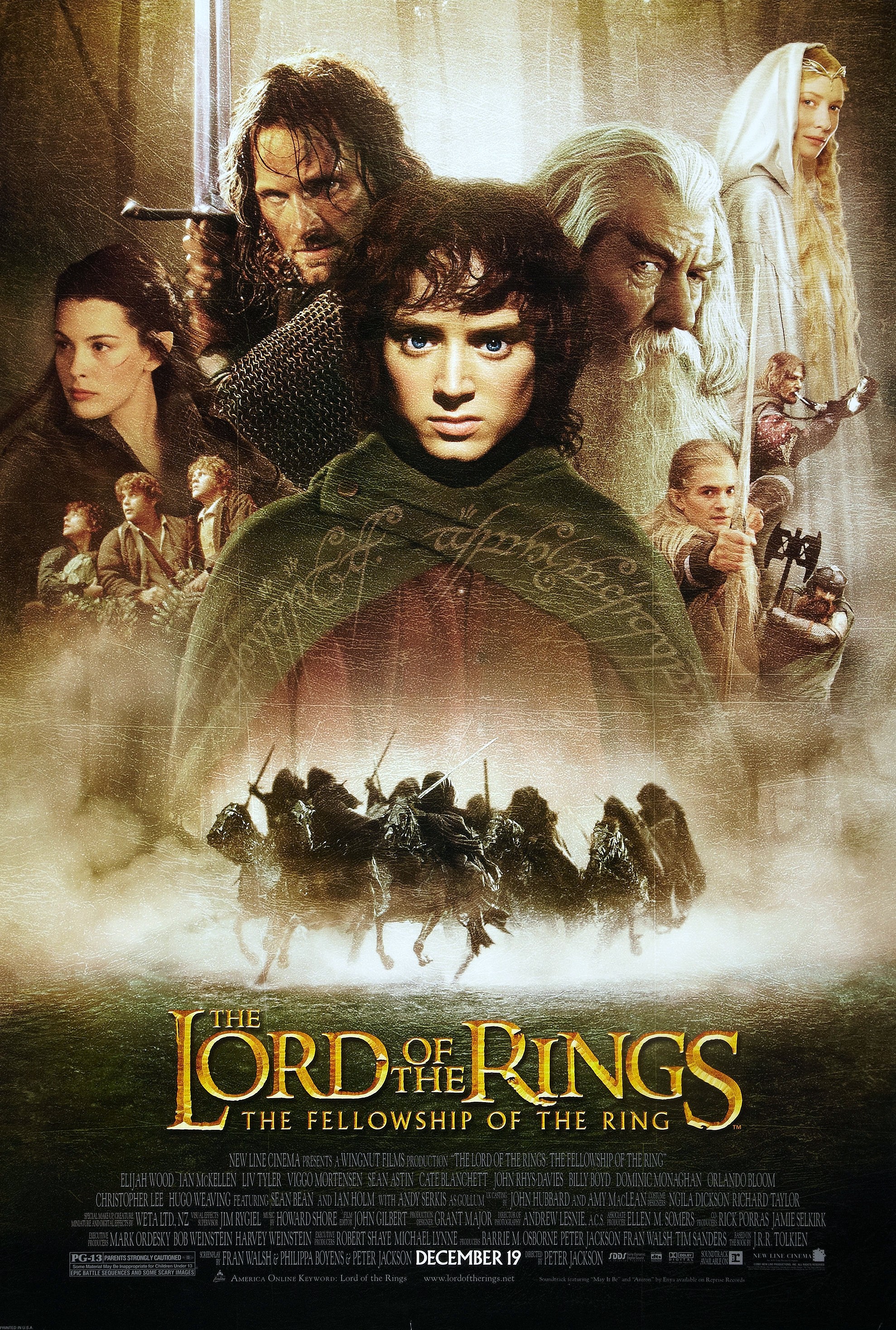
Review: Lord of the Rings Movie Trilogy

J.R.R. Tolkien’s “Lord of the Rings” trilogy was considered unfilmable for a very long time – the story was too big, too fantastical.

But in the late 1990s, New Zealand director Peter Jackson got the green light to shoot the “Lord of the Rings” movie trilogy: a sprawling fantasy epic that chronicles the tipping point of the mythical Middle-Earth, and the humble hobbits who change the world. The richness of J.R.R. Tolkien’s world is translated exquisitely into a movie trilogy full of beauty, horror, hope, humor and vibrant characters.

“The Fellowship of the Ring” introduces us to the hobbits. Eccentric old Bilbo Baggins (Ian Holm) leaves the peaceful Shire at his 111st birthday, leaving all he has to his young nephew Frodo (Elijah Wood) — including a golden Ring that makes the wearer invisible. But the grey wizard Gandalf (Ian McKellen) reveals that it’s actually the One Ring, which is the source of power for the demonic Dark Lord Sauron. So Frodo and his best pals leave the Shire and join a band of elves, men, and dwarves to take the Ring to the only place where it can be destroyed.

“The Two Towers” picks up immediately after “Fellowship” ends, with Frodo and Sam (Sean Astin) lost on the path to Mordor, and being stalked by the murderous Ring-junkie Gollum (Andy Serkis). Elsewhere, Aragorn (Viggo Mortensen), Legolas (Orlando Bloom), and Gimli (John Rhys-Davies) make a desperate stand with the kingdom of Rohan, but must face off against the evil wizard Saruman (Christopher Lee) and his orc armies.

“Return of the King” brings the trilogy to a dizzying head: Frodo and Sam’s friendship is threatened by Gollum’s trickery, leading Frodo into a potential fatal trap. Gandalf and Pippin head for the city of Gondor, while Aragorn summons an ancient army that might be able to turn the tide against Mordor. But no matter how many battles they win, the war will never be won if Frodo is not able to destroy the Ring once and for all.

J.R.R. Tolkien’s “Lord of the Rings” is one of those stories that is too big to fit into one movie – it’s almost too big to fit into three. While Jackson had to streamline the story considerably, the heart of the original novels is still there, with its message about how misfortunes can become blessings, and even the smallest and least imposing person can change the world. Despite the richness of the world-building and the complexity of the characters, it all boils down to that.

Changes are certainly made, such as altering and adding to the characters of Arwen and Faramir, as well as obviously having to leave a lot of events and characters out. Certainly the trilogy doesn’t need Tom Bombadil. But the overall story is remarkably faithful to Tolkien’s tale, and Jackson’s script with partner Philippa Boyens is a masterpiece of storytelling – full of humor and dramatic moments, adapting Tolkien’s richly-archaic prose into powerful speeches (such as Sam’s powerful final speech in “The Two Towers”).

Furthermore, it’s a beautifully-constructed movie – the exquisite sets and expansive New Zealand landscapes are breathtaking; the battle scenes are bloody and exciting; the different cultures of Middle-Earth feel deep and well-lived-in. All the trappings — clothes, jewelry, even beer mugs — are realistic. And the special effects are almost entirely convincing-looking, especially the gruesome Gollum. He’s the first fully convincing CGI character, and after awhile you’ll forget he is made digitally.

It also has a cast who give the performance of their lives – Elijah Wood as the wide-eyed, wounded Frodo Baggins; Sean Astin as his steadfast best friend Sam, who supports him no matter what happens; and Dominic Monaghan and Billy Boyd as the mischievous but brave Merry and Pippin. Ian McKellen’s Gandalf is the prototypical wizard – kindly and grandfatherly, but capable of anger and fear when confronted by the Ring – and Viggo Mortensen is outstanding as the noble king-in-waiting Aragorn. Orlando Bloom and John Rhys-Davies round out the cast as the elegant elf Legolas and doughty, down-to-earth dwarf Gimli – and there are a bunch of other great performances by actors such as Christopher Lee, Sean Bean, Liv Tyler, Hugo Weaving, Cate Blanchett, Miranda Otto, and many many more.

The extended versions of the movies are even better than the theatrical versions — plenty of cut scenes that fill out the characters and plotline are put back in. As a result, the extended versions cleave more closely to the original books. Not to mention TV specials, featurettes, cast commentary on everything in the movies, Sean Astin’s sweet little short film “The Long and Short of It,” and extensive behind-the-scenes footage that will inform viewers about special effects, sets, direction, and everyday life filming “Lord of the Riings.”

The movie adaptations of “The Lord of the Rings” trilogy are classics for a reason – while they have some flaws, Peter Jackson managed to adapt a brilliant story into brilliant, beloved movies. Powerful, gripping and full of beauty.

Eowyn and Feminism: A Rant Part 2

Which also brings me to Griffin and Liang’s complaint about Eowyn having her “happily ever after.” They managed to completely miss the entire point of everything that the good guys do at the end of the war. Eowyn turning away from her fighting days at the conclusion of the story is not just about her becoming a wifey. It’s about her choosing to embrace life rather than death, about creating something new and good and wholesome rather than seeking out martial glory.

Again, this is a thing that all the male characters do. Aragorn is rebuilding Gondor after its devastating war; Faramir is doing likewise to Ithilien; Legolas brings in a bunch of Wood-Elves to help fix the place up, and Gimli brought in Dwarves to fix up the war damage to Minas Tirith and Helm’s Deep and build a whole new kingdom. And of course, the hobbits return to the Shire and find it’s been wrecked by Saruman and his human lackeys, so once they drive them out, they have to restore the Shire to its former glory, which Sam plays a big part in, since he has a box of special Elven dirt and a mallorn seed. He literally causes the Shire’s plant life to return.

This is what Tolkien thought should happen after a war: not more fighting, but repairing the damage from the war and building things that are better and more noble. Everybody in his book takes part in this. So why is the woman expected to stay a warrior and keep slaying, when all the men are busy fixing stuff up and moving past the killing and death to peaceful lives?

Eowyn’s character arc is not about how she becomes a warrior and stays one forever because WOMAN FIGHTING EMPOWERED. That way, in Tolkien’s world, just leads to decay, blood, death and loss. Instead she embraces a new life of rebuilding and growth and life, which includes embracing romantic love. She even says at the end,

“I will be a shieldmaiden no longer, nor vie with the great Riders, nor take joy only in the songs of slaying. I will be a healer, and love all things that grow and are not barren.”

J.R.R. Tolkien, Return of the King

Faramir even highlights this plan by saying,

“And if she will, then let us cross the River and in happier days let us dwell in fair Ithilien and there make a garden. All things will grow with joy there, if the White Lady comes.”

J.R.R. Tolkien, Return of the King

Furthermore, a sane person would not see Eowyn getting married as being somehow a bad thing. Not only is it her embracing life rather than her suicidal rush towards death, but her relationship with Faramir is depicted as being one of equals. He respects her both as a woman and as a warrior, seeing no conflict between those two things, but wanting her to be happy and fulfilled in a way that fighting ultimately won’t make her.

Their relationship also makes sense because they were both recovering from similar experiences when they died: feelings of alienation and rejection, seeing their civilizations crumble from the corruption of outside forces, the recent death of father figures, and the Black Breath. Yeah, Tolkien could have outlined their relationship more, but her connection with Faramir goes a lot deeper than Liang’s contemptuous “Tolkien thinks women should get married to ANY man available.” They have a lot of similarities to build on, and unlike with Aragorn, she gets to know him as a person and not just crush on him because he’s an easy way out of a life she can’t stand anymore.

At the same time, Faramir is a more optimistic and sunny person than Eowyn, who tends to be kind of dark and moody. He lifts her up. He also provides a perspective for Eowyn beyond that of the Rohirrhim, where great deeds in battle are glorified. Gondor’s a little more sophisticated, and gives her an opportunity to learn to be something more positive than a warrior.

Faramir makes her a better, happier person by being who he is, and that’s ultimately a sign of a healthy, good relationship. Turning aside from being a shieldmaiden and marrying Faramir are part of a whole “deciding to live” change in Eowyn’s personality. You know, character growth. Something you don’t find in a lot of poorly-written characters that Griffin would define as “strong female characters.”

And even if Tolkien wanted to marry off his characters for a happy ending… so what? Is that so bad? Would Griffin and Liang have preferred it if Eowyn had just been miserable and lonely at the end of the trilogy? I already outlined why the “Eowyn stays a warrior and goes around killing stuff” thing was not going to fly in Tolkien’s world, so precisely why shouldn’t she get married?

This is why interpretation of a text from a particular political perspective is not the sole way you should look at it. Unless you’re very well-informed and dedicated to fairness and research, you can end up attributing motives and attitudes to the text and the author that are not fair or just, and you can end up bitching about things that are not actually problems. Like when you get upset when a female character does something that THE MEN ALSO DO, or when you totally ignore how a character’s actions dovetail with the attitudes and beliefs of the author.

That’s ultimately why I can’t take Griffin or Liang’s outrage seriously. Their feminist analysis is so shallow, so blinkered. They don’t think deeply about why Tolkien would have written Eowyn this way, they just condemn it because it doesn’t slavishly follow “strong woman” cliches and have Eowyn turn into Xena.

Seriously, how am I supposed to take “scholars” seriously when they can’t think outside of an incredibly narrow political viewpoint, or interpret a text by actual analysis? Major fail, you guys.

Eowyn and Feminism: A Rant Part 1

J.R.R. Tolkien is sometimes criticized for his female characters not being numerous or prominent enough. Despite this, he created the character of Eowyn, a warrior woman who disguises herself as a man so she can ride into battle alongside her brother and uncle, and was actually Aragorn’s love interest in earlier drafts. I read somewhere that Eowyn was created by Tolkien so his daughter would have a character to look up to, but I haven’t been able to find a source for it.

Anyway, Eowyn was an interesting and well-developed character that Tolkien clearly had some affection for. And she was treated with respect: her yearning to go fight and the unfairness of being left behind is treated sympathetically by both Tolkien and his characters, and never once is she dismissed because of her gender. Hell, she’s given the honor of killing the second most powerful bad guy in Middle-Earth (once Saruman lost his power) — even Aragorn didn’t get a memorable kill like that!

But when I glanced at her wikipedia page, I saw that feminist Peggy Griffin apparently claimed that Eowyn almost qualified as a “strong female character” (her exact phrasing) but didn’t because she decides to turn away from fighting and marry Faramir. The sneering implication of her text is that Eowyn is just being shoved into a romantic role with some random guy (not one of any importance), now that she’s done “playing” as a warrior.

What. A. Crock.

First, I do NOT like the stock “strong female character who wants to be a warrior, wears armor and defies authority” as an archetype, because it’s increasingly antithetical to good writing. It produces characters like the live-action Mulan, who has no flaws, no weaknesses, no identifiable qualities, no real obstacles to overcome, and thus flopped epically as a character because she was being compared to the well-developed, intelligent, hard-working, likable character from the 1990s. I’m not saying the “strong female character” archetype can’t be done well, but she needs to have more than “I rebel against all authority and I dress like a dude! Me so empowered!”

A female character should be written to be a good character first, and a woman second. Female characters should have to work for their triumphs, train, struggle, persevere, and work against their personal flaws in order to grow and become better (or if villains, possibly worse) people. Same as male characters. A good example is Leia from the original Star Wars trilogy: she was smart, capable, dynamic, strong-willed and an excellent leader on and off the battlefield, but she also had some personal flaws she had to overcome before she could find happiness. She had a bad temper (presumably inherited from her father) that often made her very snappish, and she had difficulty in Empire Strikes Back with expressing her deeper feelings that she has to work past (which she has, by the beginning of Return of the Jedi, which also coincides with the subsidence of her anger).

So it pisses me off that Ms. Griffin dismisses Eowyn’s journey just because it involves falling in love and retiring from the battlefield. You know why that isn’t an antifeminist thing to do?

Because all of the men do it.

Okay, not all the men get married at the end, but a substantial portion of the cast does. Aragorn gets married within a year, as does Faramir (obviously, since he married Eowyn), and Sam. Even Eowyn’s brother Eomer immediately starts sniffing around the Gondorian ladies in order to find himself a queen as fast as possible. Merry and Pippin didn’t get married to their wives right away (especially since Pippin is still technically a kid when the war ends) but they do settle down and get married, and later become the respective leaders of their clans.

And precisely why should Eowyn make being a warrior a way of life? All the men stop fighting when the war ends. Sure, some of them have to have some small-scale, brief conflicts because they have kingdoms and the Shire, and bad guys will inevitably attack. But none of the male characters continue fighting as a lifestyle after the war. And yet Griffin and her sneering cohort Liang claim that the ONLY reason a woman would quit her martial pursuits and get married is because she’s being forced into subservient domesticity under the patriarchy.

That’s because neither of them understand how Tolkien thought… and I suspect that is because neither of them has ever been a soldier, or even probably talked to one. Tolkien was a soldier, in the most hideously wasteful, pointless, poorly-handled wars in the history of the human race. He did not think that war and fighting were things that people — male or female — should do as a full-time pursuit, as a way of life. He thought that after the war was over, then people go home, get married and live peaceful lives.

Eowyn is literally being criticized for being treated exactly the same as the male characters. It probably never would have even occurred to Tolkien that he should write her eschewing marriage, donning a metal bra and riding around looking for people to kill. Not because he wanted to deprive a female character of power, but because it literally would not have occurred to him that anybody should do that. It’s not a matter of male vs. female, it’s just how he thought everyone should live.

That’s because Tolkien didn’t think of fighting as empowering, because he wasn’t an idiot. He knew that being a warrior was not just dangerous, but painful, messy, and capable of taking a terrible toll on a person (presumably he witnessed the shellshock victims after the wars). He knew that some people might find fame and honor on the battlefield with impressive deeds, but he didn’t believe that fighting should happen for its own sake. The male characters of Lord of the Rings only ever fight to save the world, not because they think it makes them look awesome.

Consider this quote:

“War must be, while we defend our lives against a destroyer who would devour all; but I do not love the bright sword for its sharpness, nor the arrow for its swiftness, nor the warrior for his glory. I love only that which they defend…”

J.R.R. Tolkien, The Two Towers

That quote, by the way, is by the male character that Liang dismisses as “any” man as if he had no importance. I think being the author’s mouthpiece on the morals and purpose of war is probably something reserved for important characters. Especially when the author specifically says that he identifies the most with that character… but hey, I’m not a “feminist scholar.” I just do research.

(Tolkien also didn’t have Eowyn dress as a man as some kind of feminist political statement — her dressing like a guy was purely practical, because she had to blend in with a force of men)

They also managed to miss the fact that Eowyn’s lust for battle-based glory is not depicted as a good thing. Eowyn’s longing for glory on the battlefield is at least partially based on suicidal depression and her frustrations over having to take care of her aged uncle, while her cousin died and her brother was exiled. Eomer suffered the same experiences, but he was able to go out and do something productive about it, because he was a man. By the time Eowyn kills the Witch-King, she’s pretty screwed up from months or YEARS of this treatment.

She’s not trying to fight from a healthy head-space — she’s trying to go out in a blaze of glory, after being trapped by her struggles in a country threatened with decay, because she sees nothing worthwhile in the life of a protector and leader off the battlefield. Aragorn explains in the Houses of Healing that she her crush on him was because he represented escape from Rohan and a chance for great deeds. That is not healthy.

And yet Tolkien is still completely sympathetic to her desires and wishes, even though they are not really in tandem with his own views on warfare.

“But who knows what she spoke to the darkness, alone, in the bitter watches of the night, when all her life seemed shrinking, and the walls of her bower closing in about her, a hutch to trammel some wild thing in?”

J.R.R. Tolkien, The Return of the King

I can’t say for sure, but Tolkien probably saw a lot of women who wanted to do things, and had the spirit and inner strength to accomplish them, but were constrained by society’s gender roles. Hell, he worked at Oxford — he probably saw a lot of this sort of thing. And he clearly had sympathy for them and their struggles.

And yet, Griffin and Liang just see it as “herp derp, woman fighting good, woman getting married bad, fighting is empowering, herp derp!”

TO BE CONTINUED