Review: Exhuma

Imagine if your ancestors had the power to curse you for… well, general discomfort after death.

That premise forms the bedrock for the South Korean horror movie “Exhuma,” in which a quartet of shamans, geomancers and morticians join forces to deal with vengeful ghosts. This is a movie that could never be remade in another country – not just because it relies on tension and dread rather than jump scares, but because the historical and cultural backdrop are so uniquely Korean.

Shaman Hwa-rim (Kim Go-eun) and her tatted apprentice Bong-gil (Lee Do-hyun) are summoned to Los Angeles to investigate a newborn baby who has been cursed by one of his ancestors. Hwa-rim makes arrangements with the family patriarch to exhume and cremate the child’s great-grandfather back in South Korea, with the help of her friends: feng-shui geomancer Kim Sang-deok (Choi Min-sik) and experienced mortician Yeong-geun (Yoo Hae-jin).

But the job turns out to be more complicated than expected. The grave is on a mountaintop near the North Korean border, surrounded by malign omens: foxes, an unmarked stone, rumors of graverobbing, and a snake with a human head. The only way the corpse can be exhumed is with a complex ritual that draws out and dissipates the malignant energies (involving knives, a drum and several dead pigs), so they can dig up and then cremate the unopened coffin. Sounds simple, right?

Not so simple, because some brain donor opens it, unleashing a vengeful spirit that decides he wants to kill his entire family – and our heroes have limited time to save the remaining kin from meeting gruesome ends. But it turns out that ironing out this family debacle is only the beginning of the horrors to come, as another coffin is found buried beneath the first – and dealing with this angry ghost will not be so easy.

“Exhuma” is the kind of movie that horror needs. No jump scares, even when something shocking and unexpected happens. This is a movie that slowly builds up a sense of pervasive, eerie dread, filling every shadowy corner until it suddenly flows with splattered blood and soaring fire. It’s also a uniquely Korean movie – without revealing some of the plot twists, the story relies heavily on both Korean history and Korean folklore, so it couldn’t really be told anywhere else.

Director/writer Jang Jae-hyun slowly layers mysteries and atmosphere (so many foxes!) on top of each other, then slowly peels away those layers like an onion. Some of the scenes in the second and third acts of the movie are deeply disturbing, especially when Bong-gil speaks for the angry ghosts. If the movie has a flaw, it’s that it feels a little weird that we go through the entire cycle of dealing with the cursed family… and then, suddenly, that plot Trojan-horses an entirely unrelated evil ghost for the third act. It’s kind of odd. Not bad, exactly, but disorienting.

The actors are all uniformly quite good: Kim Go-eun is cool and collected as an intelligent, businesslike shaman, which makes it all the more unnerving when the character is stricken with bone-chilling fear in the third act. Lee Do-hyun plays a secondary role to her throughout most of the movie, but gets to show his acting chops when Bong-gil gets possessed a few times. And Choi Min-sik and Yoo Hae-jin have delightful chemistry as a couple of old buddies who specialize in exhuming and reburying troublesome dead people, swinging between easy camaraderie to harrowing battles against the supernatural.

“Exhuma” has a slightly odd plot structure, but that doesn’t keep it from being a harrowing, suspenseful movie that slowly builds its way up to the blood’n’fire. Definitely worth watching for those who appreciate atmosphere in their horror.

Review: Godzilla Minus One (2023)

Sometimes, a classic franchise needs to get back to its roots.

And after a highly unconventional outing in “Shin Godzilla,” Toho and director/writer Takashi Yamazaki, decided to do just that in “Godzilla Minus One.” This may be the best Godzilla movie ever made – an emotionally deep, historically-rich tale of disaster, loss, grief and guilt, which just happens to center around a giant nuclear reptile.

Kōichi Shikishima (Ryunosuke Kamiki), a young kamikaze pilot, stops at remote Odo Island with the claim that his engine is malfunctioning… but the truth is, he just doesn’t want to die. That night, a large hostile reptile nicknamed Godzilla comes ashore and kills all the engineers, and Shikishima believes it’s because he froze up instead of shooting the creature. More guilt, on top of his belief that he failed his country instead of dying for it.

After returning to Tokyo to find his parents dead, Shikishima finds himself living with a young homeless woman named Noriko (Minami Hamabe) and an orphaned baby, Akiko (Sae Nagatani). He gets a job as a minesweeper to support the three of them, though his guilt and feelings of worthlessness keep him from explicitly forming a family unit. And he’s still haunted by what happened on Odo Island, and vivid dreams of the men he didn’t save.

Then a vast, mutated creature ravages U.S. ships on its way to Japan – and Shikishima realizes that it’s none other than Godzilla. Not only is he vast and strong, but he regenerates from almost any injury, and he’s able to shoot a nuclear blast from his mouth that can vaporize a heavy cruiser. With only the slimmest chance of success and very few resources, the chances of destroying Godzilla are virtually nonexistent – but if Shikishima can overcome his demons, Japan’s people might have a chance.

It may be a controversial opinion, but I feel that “Godzilla Minus One” actually tops the original 1954 classic, which spawned the entire Japanese kaiju genre. That’s because it’s not merely an outstanding kaiju movie with a slow-simmering allegorical message about the horrors of nuclear war, much as the original was, but a deeply personal story about survivor’s guilt, PTSD, love for one’s people, and what a government owes to the people who serve it.

Director/writer Takashi Yamazaki weaves together all these threads without being heavy-handed or slowing down the story. The slower-paced, more personal parts are never boring because they’re so richly characterized (including the parts with real-life Japanese military ships and aircraft). And the parts with Godzilla are electrifying, like when he monches on a train or chases the minesweeper ship with a look of pure hate on his face. This is a Godzilla who wants the human race dead, not the lovable world-saver of many other Godzilla films.

Much of the movie rests on Kamiki’s shoulders, and he gives an absolutely stellar performance here – he embodies the painful guilt, the fear, the terror, the trauma, the longing for love and fatherhood that he can’t bring himself to embrace because he doesn’t think he’s worthy of happiness. The other characters are drawn with equally loving complexity, such as the sweet-natured Noriko played by Minabe, tormented engineer Tachibana, Shikishima’s lovable fellow minesweepers, and Sumiko, a neighbor who initially blames Shikishima for the deaths of her children but helps care for Akiko despite that.

And since “Godzilla Minus One” won an Oscar for best visual effects, it would be unfair not to praise them. The effects on a movie that cost a mere $10-12 million are absolutely superb – Godzilla has rarely looked this good, and the widespread destruction looks painfully realistic. Even without being compared to the kind of half-baked VFX that currently comes out of companies like Disney, this is a masterpiece.

“Godzilla Minus One” is a movie that is deeply, richly satisfying, both as a kaiju movie and as a human drama – a triumph for Toho and the Godzilla series, and an outstanding film overall.

Review: The Boy And The Heron

Hayao Miyazaki is one of those artists that needs no introduction, a brilliant storyteller whose characters and richly-developed stories include tales of flying pigs and walking castles, forest gods and floating cities, preschooler mermaids and fantastical bathhouses. So even when nobody really knew what the plot was, “The Boy And The Heron” was already an alluring prospect.

And while perhaps not his most accessible film, it’s nevertheless a gripping piece of work – half semi-autobiographical tale of a young Japanese boy during World War II, half fantasy story about a strange fantastical world of long-forgotten family secrets. It often feels like Miyazaki is musing on the exquisite yet flawed process of creating a fantasy world, the unique minds that nurture them, and the creativity that future generations should have.

During World War II, a young boy named Mahito Maki (Luca Padovan) loses his beloved mother in a terrible hospital fire. A year or so later, his father Shoichi (Christian Bale) marries his late wife’s sister Natsuko (Gemma Chan). Mahito isn’t pleased by this – including the fact that his aunt/stepmother is pregnant – and he definitely isn’t happy to be moving to her remote country estate. His schoolmates are hostile, and the only company in the house is the bickering elderly servants.

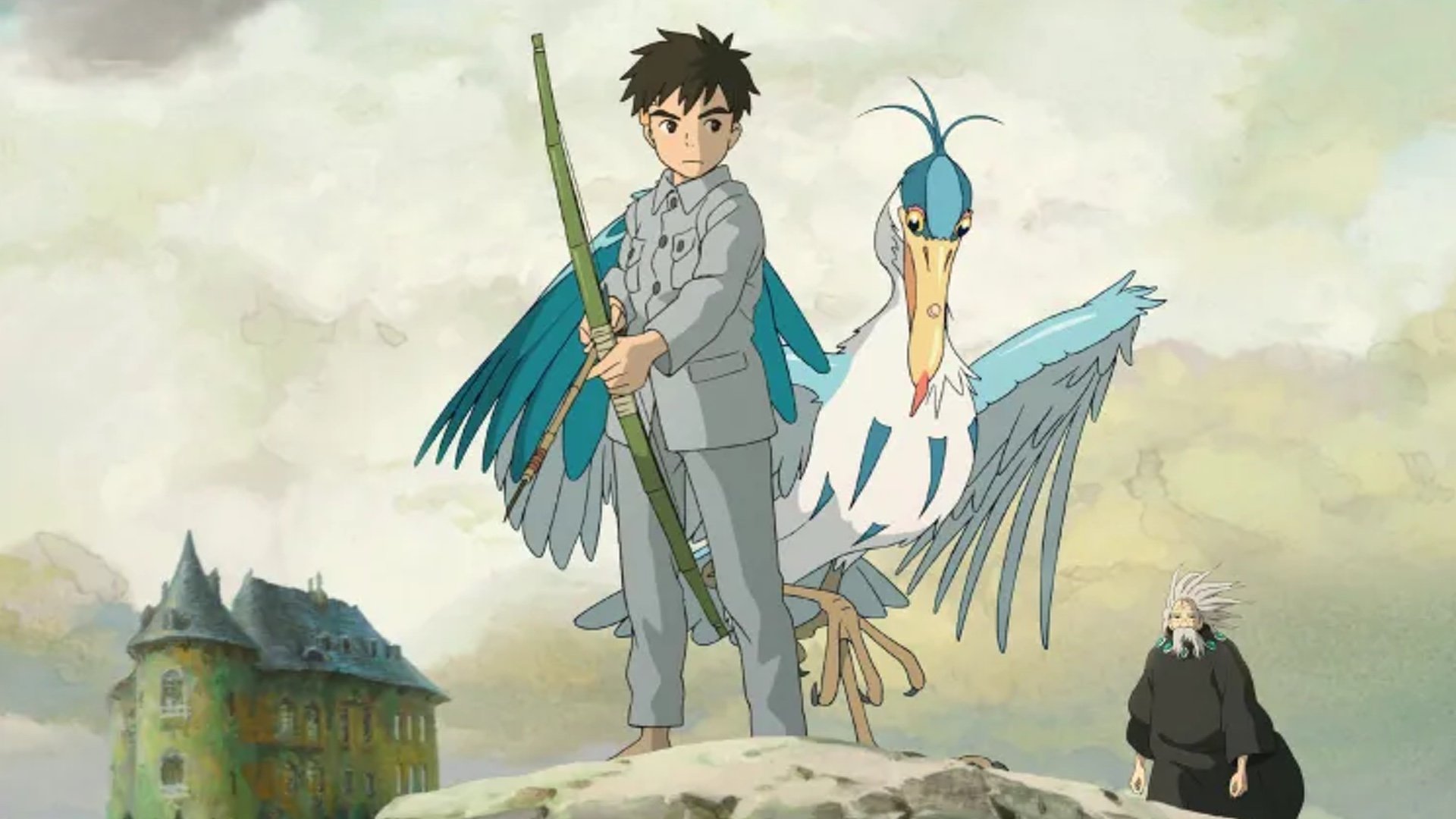
But he soon finds himself fascinated by a strange grey heron living in a pond nearby, and a strange stone tower that everyone warns him away from. When Natsuko wanders off and disappears, Mahito is drawn into the tower by the heron (actually a little man in a magic suit), who lures him with the promise of finding his mother again.

Instead, he finds himself in a strange fantasy world dominated by oceans and stone monuments, of blobby little spirits and a pyrokinetic girl named Lady Himi, who fends off hordes of talking pelicans. With the heron-man as his companion, he finds that his stepmother has fallen into the clutches of a civilization of talking, meat-eating parakeets – and to help her, he may have to take on responsibility for the entire world.

“The Boy And The Heron” is not Hayao Miyazaki’s most accessible film in many ways. It’s one of those films that may be a little confusing on your first viewing, but which increases in richness with subsequent watchings. It’s also one of those stories that lends itself to multiple symbolic interpretations, the most obvious – in my view, anyway – being that the existence of the other world is symbolic of a creative mind constructing its own universe in the process of storytelling, its flaws, and the need for younger creatives to take up the mantle.

And those mysteries and schemes are coiled around a hauntingly melancholy fantasy story – the world Mahito encounters is oddly empty despite its beauty and strangeness, like a vast cathedral with no people in it. It has an edge of wrongness and danger that always makes you feel like the hero is balancing on a knife’s edge, even from things that seem like they should be ridiculous (the man-eating parakeets are surprisingly unnerving). But even in that, Miyazaki works in some fun moments as well, such as Shoichi thinking Mahito has turned into a parakeet, or when Mahito has to deal with the heron-man.

And because this is Hayao Miyazaki, the entire story is lusciously animated – this is 2-D animation at its peak, distinctively Studio Ghibli in style, and detailed to the point where you can practically feel the frogs, the mossy stones, the feathers, the creaking wood. Miyazaki crafts visuals that are hauntingly beautiful and dreamlike, allowing Mahito to drift through strange, sometimes ethereal landscapes populated by strange creatures.

Mahito is a slightly weak spot in an otherwise lovely movie, simply because he’s much less expressive than many of Miyazaki’s other heroes. We know that he desperately misses his mother and isn’t happy about his father’s marriage, but it’s hard to tell what his exact emotions are much of the time, or how they will naturally lead to actions like constructing a bow-and-arrow. Fortunately he opens up more once he travels into the other world, especially when interacting with the exuberant Lady Himi (whose true identity is pretty easy to guess), the tomboyish Kiriko, or the heron-man (whose weird, slightly sinister and sometimes pathetic personality is a good contrast to Mahito’s more restrained one).

The English voice acting is uniformly good in this film, with actors such as Christian Bale, Dave Bautista, Gemma Chan, Mark Hamill and Willem Dafoe all giving excellent performances. Special shout-out to Robert Pattinson, who immediately earns his voice-acting cred by giving an excellent performance in a creaky, slightly sinister voice that sounds completely unlike his usual voice – watching the movie, you completely forget who’s performing the role, and just lose yourself in the voice-acting.

“The Boy And The Heron” has a few rough spots, but it’s still a strikingly lovely, symbolically-rich fantasy adventure that leaves you feeling melancholy yet hopeful. May Miyazaki give us more worlds to explore.