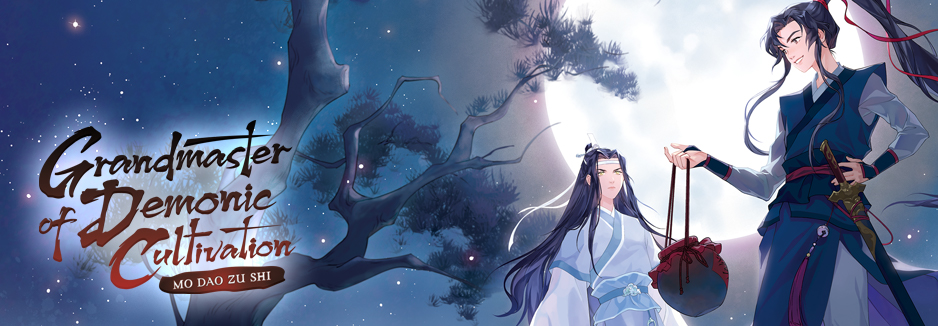
Despite the general government disapproval of same-sex relationships, China does have some media focusing on such characters. Boys’ love content in China is known as “danmei,” and don’t ask me what that literally means because I know about ten words in Mandarin, and half of them are numbers.
And the most famous example of the breed is probably Mo Dao Zu Shi or The Grandmaster of Demonic Cultivation (alternate unofficial title: “The Founder of Diabolism). This webnovel has an animated adaptation, a live-action adaptation in the form of The Untamed, an audio drama, a stage play, a manhua, and a currently-ongoing manga in Japan. I can testify that all of them are very good (except the stage play, which I haven’t seen), although some of them are censored. The Untamed, for instance, is unable to openly depict the main characters as being romantically involved with one another, so the actors just gaze lovingly at each other a lot.
The story is about Wei Wuxian, who died thirteen years before the events of the series. He was basically considered a supervillain by his entire society, who used a necromantic form of cultivation to control the dead, including a sapient superzombie named Wen Ning. In the present, he’s brought back to life in the body of a mentally ill young man who wants Wei Wuxian to kill his relatives, and after some craziness and several deaths, Wei Wuxian ends up being captured by Lan Wangji, a very morally upright and noble cultivator that he knew in his old life, who seems weirdly determined to keep Wei Wuxian close to him at all times.
The two of them go on a road trip to find the dismembered body parts of a fierce corpse (zombie) that has been scattered across many different cities, which are also the key to finding out who the dead person was and how he died. Without spoiling too much, they get entangled in a conspiracy of political murder and really unpleasant secrets. And at the same time, Wei Wuxian starts discovering that he has romantic feelings for Lan Wangji, but after spending the better part of fifteen years being called a monster, he subconsciously doesn’t believe that they could possibly be returned. He’s a little clueless, because readers will probably have figured out some stuff about Lan Wangji that Wei Wuxian hasn’t.
I’m summing up a lot – there’s a decent-sized cast, some side-plots and a lot of flashbacks spanning several years and a whole war – but that is the basic description of the webnovel. The author, Mo Xiang Tong Xiu (known as MXTX), has written three webnovels and all of them have been really popular. MDZS is arguably the most plot-heavy of the three, and honestly, that is the way I like this sort of story: a heavy dose of plot, with the romance sort of wound through it.
The romance is very much an opposites-attract kind of story – Wei Wuxian is this sort of brilliant, erratic little gremlin who loves to cause trouble, and Lan Wangji is this almost superhumanly cool, elegant and silent figure that only loses his composure around Wei Wuxian. But at the core, they do have a lot in common, like wanting to protect innocent people and doing the right thing even if the world is against them. And the slow burn of them getting together is complicated by a series of misunderstandings, lost memories and the fact that Lan Wangji doesn’t really know how to express his emotions outwardly.
And yes, it’s a slow-burn – things only really coalesce in the climactic (literally, in some cases) part of the story, at which time the stories get much more sexual. Let’s just say that the fandom’s catchphrase “Every day means every day” is earned.
It also earns a lot of attention for the secondary characters, all of whom are pretty vivid… including the dead ones, both animate and not. There’s Wei Wuxian’s estranged martial brother Jiang Cheng, who’s crabby, violent and very emotionally stunted; Lan Xichen, Lan Wangji’s too-agreeable older brother; Wen Qing, a courageous and rather terse doctor that Wei Wuxian befriends; Xue Yang, a charming psychopath who traps the characters in a haunted city; Nie Huaisang, the dweeby ex-classmate Wei Wuxian runs into; and a bunch of lovably naive teenagers who tend to follow the main characters around wherever they go.
So if you’re looking for a romance with a lot of plot and misunderstandings (so many misunderstandings), this one might be something you’d like.
 The Forest