Imagine if your ancestors had the power to curse you for… well, general discomfort after death.
That premise forms the bedrock for the South Korean horror movie “Exhuma,” in which a quartet of shamans, geomancers and morticians join forces to deal with vengeful ghosts. This is a movie that could never be remade in another country – not just because it relies on tension and dread rather than jump scares, but because the historical and cultural backdrop are so uniquely Korean.
Shaman Hwa-rim (Kim Go-eun) and her tatted apprentice Bong-gil (Lee Do-hyun) are summoned to Los Angeles to investigate a newborn baby who has been cursed by one of his ancestors. Hwa-rim makes arrangements with the family patriarch to exhume and cremate the child’s great-grandfather back in South Korea, with the help of her friends: feng-shui geomancer Kim Sang-deok (Choi Min-sik) and experienced mortician Yeong-geun (Yoo Hae-jin).
But the job turns out to be more complicated than expected. The grave is on a mountaintop near the North Korean border, surrounded by malign omens: foxes, an unmarked stone, rumors of graverobbing, and a snake with a human head. The only way the corpse can be exhumed is with a complex ritual that draws out and dissipates the malignant energies (involving knives, a drum and several dead pigs), so they can dig up and then cremate the unopened coffin. Sounds simple, right?
Not so simple, because some brain donor opens it, unleashing a vengeful spirit that decides he wants to kill his entire family – and our heroes have limited time to save the remaining kin from meeting gruesome ends. But it turns out that ironing out this family debacle is only the beginning of the horrors to come, as another coffin is found buried beneath the first – and dealing with this angry ghost will not be so easy.
“Exhuma” is the kind of movie that horror needs. No jump scares, even when something shocking and unexpected happens. This is a movie that slowly builds up a sense of pervasive, eerie dread, filling every shadowy corner until it suddenly flows with splattered blood and soaring fire. It’s also a uniquely Korean movie – without revealing some of the plot twists, the story relies heavily on both Korean history and Korean folklore, so it couldn’t really be told anywhere else.
Director/writer Jang Jae-hyun slowly layers mysteries and atmosphere (so many foxes!) on top of each other, then slowly peels away those layers like an onion. Some of the scenes in the second and third acts of the movie are deeply disturbing, especially when Bong-gil speaks for the angry ghosts. If the movie has a flaw, it’s that it feels a little weird that we go through the entire cycle of dealing with the cursed family… and then, suddenly, that plot Trojan-horses an entirely unrelated evil ghost for the third act. It’s kind of odd. Not bad, exactly, but disorienting.
The actors are all uniformly quite good: Kim Go-eun is cool and collected as an intelligent, businesslike shaman, which makes it all the more unnerving when the character is stricken with bone-chilling fear in the third act. Lee Do-hyun plays a secondary role to her throughout most of the movie, but gets to show his acting chops when Bong-gil gets possessed a few times. And Choi Min-sik and Yoo Hae-jin have delightful chemistry as a couple of old buddies who specialize in exhuming and reburying troublesome dead people, swinging between easy camaraderie to harrowing battles against the supernatural.
“Exhuma” has a slightly odd plot structure, but that doesn’t keep it from being a harrowing, suspenseful movie that slowly builds its way up to the blood’n’fire. Definitely worth watching for those who appreciate atmosphere in their horror.
I didn’t really expect a series about Godzilla to go into detail about the nature of time.
In fact, the series has a distinct lack of Godzilla about 90% of the time, which my brother found to be its biggest flaw – if you’re going into it to watch kaiju punching each other in the face, you will be sorely disappointed. There are kaiju, sure – there are a bunch of pterodactyl-like Rodans, there’s an Anguillas, there are some sea monsters and giant monster-spiders and so on. But they are more like unstoppable forces of nature whose origins and nature are a mystery, and who scare the pants off us feeble humans.
About 90% of the time, the story is divided between dealing with various non-Godzilla kaiju, and examining nonlinear timestreams, such as receiving information from the future, and particles that can’t be detected, and artificial intelligence. It’s a very intellectual series with Godzilla as the primal draw and the ultimate culmination of everything it’s building towards, so if you just want Godzilla in particular punching monsters you are not going to enjoy it. There’s a lot of talking.
Also red dust. Sooooooo much red dust. It makes sense in context.
The rest of the 90% is divided pretty evenly between trying to unravel the mysteries of time and trying to stop kaiju in creative ways. Especially since there are different people with different motives, and different knowledge, sometimes working together and sometimes kind of undermining one another. The story mostly revolves around a small group of oddballs – a nerdy girl majoring in imaginary creatures (now THERE’S a complete sink for your student loans), a crazy old man building a giant robot to save the world (because Japan), and a young man who seems to have a real knack for figuring out the kaiju and programming artificial intelligence.
It also takes notes from Shin Godzilla by having Godzilla evolve through different forms over the course of the series. In fact, sometimes you can only tell it’s him because of that classic Godzilla musical sting. His final form has a mouth that could eat an entire meatball sub in one bite.
Also: my brother noted that the female lead reminded him of Velma from Scooby-Doo… and I kinda see it. Nerdy, clumsy, chin-length hair and glasses, into weird esoteric stuff… she’s like Velma turned into a cute anime girl, only her interest is insects who are their own grandpa instead of the occult.
I’d say that its biggest flaw, aside from a lack of Godzilla, is that it probably takes a few viewings to understand the theories behind it. The concepts and theories are a bit dense at times, and it sometimes treats viewers as if they are already aware of the science, or the explanations sort of dart by so fast that you might not notice.
If you like thinking-style anime like Steins;Gate and a hefty dose of kaiju chaos, then Godzilla Singular Point is something you might enjoy. Even if you don’t know if you might like those things, it’s worth checking out simply because it is such an unusual beast.
Sometimes, a classic franchise needs to get back to its roots.
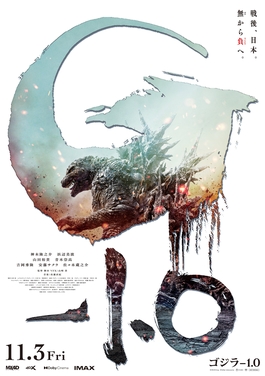
And after a highly unconventional outing in “Shin Godzilla,” Toho and director/writer Takashi Yamazaki, decided to do just that in “Godzilla Minus One.” This may be the best Godzilla movie ever made – an emotionally deep, historically-rich tale of disaster, loss, grief and guilt, which just happens to center around a giant nuclear reptile.
Kōichi Shikishima (Ryunosuke Kamiki), a young kamikaze pilot, stops at remote Odo Island with the claim that his engine is malfunctioning… but the truth is, he just doesn’t want to die. That night, a large hostile reptile nicknamed Godzilla comes ashore and kills all the engineers, and Shikishima believes it’s because he froze up instead of shooting the creature. More guilt, on top of his belief that he failed his country instead of dying for it.
After returning to Tokyo to find his parents dead, Shikishima finds himself living with a young homeless woman named Noriko (Minami Hamabe) and an orphaned baby, Akiko (Sae Nagatani). He gets a job as a minesweeper to support the three of them, though his guilt and feelings of worthlessness keep him from explicitly forming a family unit. And he’s still haunted by what happened on Odo Island, and vivid dreams of the men he didn’t save.
Then a vast, mutated creature ravages U.S. ships on its way to Japan – and Shikishima realizes that it’s none other than Godzilla. Not only is he vast and strong, but he regenerates from almost any injury, and he’s able to shoot a nuclear blast from his mouth that can vaporize a heavy cruiser. With only the slimmest chance of success and very few resources, the chances of destroying Godzilla are virtually nonexistent – but if Shikishima can overcome his demons, Japan’s people might have a chance.
It may be a controversial opinion, but I feel that “Godzilla Minus One” actually tops the original 1954 classic, which spawned the entire Japanese kaiju genre. That’s because it’s not merely an outstanding kaiju movie with a slow-simmering allegorical message about the horrors of nuclear war, much as the original was, but a deeply personal story about survivor’s guilt, PTSD, love for one’s people, and what a government owes to the people who serve it.
Director/writer Takashi Yamazaki weaves together all these threads without being heavy-handed or slowing down the story. The slower-paced, more personal parts are never boring because they’re so richly characterized (including the parts with real-life Japanese military ships and aircraft). And the parts with Godzilla are electrifying, like when he monches on a train or chases the minesweeper ship with a look of pure hate on his face. This is a Godzilla who wants the human race dead, not the lovable world-saver of many other Godzilla films.
Much of the movie rests on Kamiki’s shoulders, and he gives an absolutely stellar performance here – he embodies the painful guilt, the fear, the terror, the trauma, the longing for love and fatherhood that he can’t bring himself to embrace because he doesn’t think he’s worthy of happiness. The other characters are drawn with equally loving complexity, such as the sweet-natured Noriko played by Minabe, tormented engineer Tachibana, Shikishima’s lovable fellow minesweepers, and Sumiko, a neighbor who initially blames Shikishima for the deaths of her children but helps care for Akiko despite that.
And since “Godzilla Minus One” won an Oscar for best visual effects, it would be unfair not to praise them. The effects on a movie that cost a mere $10-12 million are absolutely superb – Godzilla has rarely looked this good, and the widespread destruction looks painfully realistic. Even without being compared to the kind of half-baked VFX that currently comes out of companies like Disney, this is a masterpiece.
“Godzilla Minus One” is a movie that is deeply, richly satisfying, both as a kaiju movie and as a human drama – a triumph for Toho and the Godzilla series, and an outstanding film overall.
Disclaimer: I received a free copy of this book from Netgalley in exchange for an honest review.
If I could succinctly describe Taran Matharu’s new book, it would simply be: “Eragon” if it were written for adults, by an adult.
Which is to say, “Dragon Rider” is a high fantasy with a lot of cultural richness and depth rather than Star Wars/Lord of the Rings tropes. It’s set in a world reminiscent of our own, but with soul-bindings to fantastical creatures like gryphons, dragons, chamroshes and various prehistoric beasts, and gives us a suitably underdog hero with the odds against him – and a baby dragon to help him bounce back.
As the third, least important son to the dead king of the Steppefolk, Jai is kept as a hostage in the Sabine Empire’s court. Specifically, as the personal attendant to the elderly, neglected ex-emperor Leonid. It gives him a front row seat to the dynamics of the new emperor’s court, but no respect – and a lot of hostility from the crown prince Titus and his friends, who see the Steppefolk as their barbarian inferiors. When Jai catches wind of a conspiracy against the visiting Dansk king, whose daughter is to marry Titus, he does his best to stop anyone from dying… only to lose everyone important to him.
And soon he finds himself lost in a freezing wilderness, surrounded by corpses… and most unexpectedly with a dragon egg. Without meaning to, he ends up soulbinding to the white infant dragon – and also ends up running into a prickly Dansk handmaiden named Frida, who knows something about being bound to a dragon. To save himself and his hatchling, Jai needs to get back to the Steppefolk, but staying alive in Sabine territory is the bigger immediate problem.
Taran Matharu’s fantasy world is reminiscent of our own in a lot of ways, mostly culturally: the Dansk (Northern European), the Steppefolk (Central Asians), the Sabines (Southern Europeans) and hints of other cultures like the Phoenix Empire (East Asia). It lends a lot of richness and depth to a fantasy story that is basically about becoming the spiritually-bonded partner of a mythical creature, and Matharu manages to evoke the feeling of a lot of history and complexity behind his tale.
It’s also distinctive because it takes some cues from Chinese cultivation fiction; it’s not a precise copying of its tropes, but the general ideas are there and integrated into the idea of soulbinding. The person in question learns how to acquire and store magical energy in a physical core, becoming stronger, physically purer and in possession of magical abilities. But it doesn’t make them all-powerful, and having a dragon doesn’t really keep Jai from being in constant danger (especially since she’s so small). So there’s plenty of suspense, action, grit, gore and dramatic confrontations.
Jai himself is a good underdog hero – not particularly exceptional, but he starts off as an ordinary kid that nobody expects anything from, relegated to a role nobody wants (which involves wiping an old man’s butt). He first starts to flower when he deduces that a conspiracy might be afoot, and tries to do the right thing – only for everything to implode in front of him. His relationships with other characters are pretty well-developed and enjoyable – his potentially romantic, slightly prickly connection with Frida, his immediate loving bond with Winter, and the quasi-father/son relationship he has with Leonid (who, to complicate things, personally executed Jai’s actual father). And then there’s Rufus, the mysterious old warrior with his own motives and complex history.
“Dragon Rider” takes a little time to get to any serious draconic action, but the destination is well-worth the journey. Well-rounded, vibrant and gritty, with plenty of room to flower in the future.
Hayao Miyazaki is one of those artists that needs no introduction, a brilliant storyteller whose characters and richly-developed stories include tales of flying pigs and walking castles, forest gods and floating cities, preschooler mermaids and fantastical bathhouses. So even when nobody really knew what the plot was, “The Boy And The Heron” was already an alluring prospect.
And while perhaps not his most accessible film, it’s nevertheless a gripping piece of work – half semi-autobiographical tale of a young Japanese boy during World War II, half fantasy story about a strange fantastical world of long-forgotten family secrets. It often feels like Miyazaki is musing on the exquisite yet flawed process of creating a fantasy world, the unique minds that nurture them, and the creativity that future generations should have.
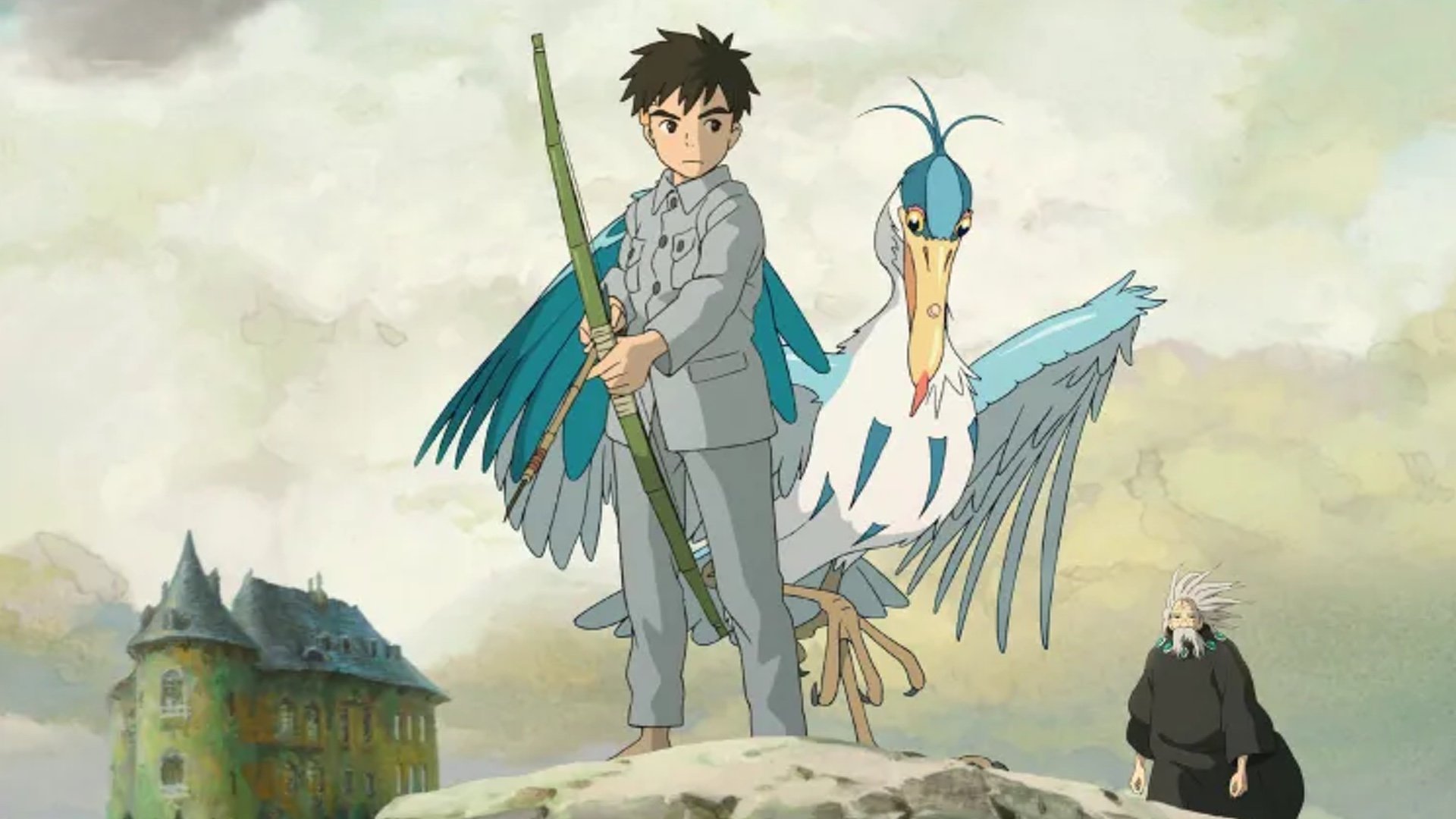
During World War II, a young boy named Mahito Maki (Luca Padovan) loses his beloved mother in a terrible hospital fire. A year or so later, his father Shoichi (Christian Bale) marries his late wife’s sister Natsuko (Gemma Chan). Mahito isn’t pleased by this – including the fact that his aunt/stepmother is pregnant – and he definitely isn’t happy to be moving to her remote country estate. His schoolmates are hostile, and the only company in the house is the bickering elderly servants.
But he soon finds himself fascinated by a strange grey heron living in a pond nearby, and a strange stone tower that everyone warns him away from. When Natsuko wanders off and disappears, Mahito is drawn into the tower by the heron (actually a little man in a magic suit), who lures him with the promise of finding his mother again.
Instead, he finds himself in a strange fantasy world dominated by oceans and stone monuments, of blobby little spirits and a pyrokinetic girl named Lady Himi, who fends off hordes of talking pelicans. With the heron-man as his companion, he finds that his stepmother has fallen into the clutches of a civilization of talking, meat-eating parakeets – and to help her, he may have to take on responsibility for the entire world.
“The Boy And The Heron” is not Hayao Miyazaki’s most accessible film in many ways. It’s one of those films that may be a little confusing on your first viewing, but which increases in richness with subsequent watchings. It’s also one of those stories that lends itself to multiple symbolic interpretations, the most obvious – in my view, anyway – being that the existence of the other world is symbolic of a creative mind constructing its own universe in the process of storytelling, its flaws, and the need for younger creatives to take up the mantle.
And those mysteries and schemes are coiled around a hauntingly melancholy fantasy story – the world Mahito encounters is oddly empty despite its beauty and strangeness, like a vast cathedral with no people in it. It has an edge of wrongness and danger that always makes you feel like the hero is balancing on a knife’s edge, even from things that seem like they should be ridiculous (the man-eating parakeets are surprisingly unnerving). But even in that, Miyazaki works in some fun moments as well, such as Shoichi thinking Mahito has turned into a parakeet, or when Mahito has to deal with the heron-man.
And because this is Hayao Miyazaki, the entire story is lusciously animated – this is 2-D animation at its peak, distinctively Studio Ghibli in style, and detailed to the point where you can practically feel the frogs, the mossy stones, the feathers, the creaking wood. Miyazaki crafts visuals that are hauntingly beautiful and dreamlike, allowing Mahito to drift through strange, sometimes ethereal landscapes populated by strange creatures.
Mahito is a slightly weak spot in an otherwise lovely movie, simply because he’s much less expressive than many of Miyazaki’s other heroes. We know that he desperately misses his mother and isn’t happy about his father’s marriage, but it’s hard to tell what his exact emotions are much of the time, or how they will naturally lead to actions like constructing a bow-and-arrow. Fortunately he opens up more once he travels into the other world, especially when interacting with the exuberant Lady Himi (whose true identity is pretty easy to guess), the tomboyish Kiriko, or the heron-man (whose weird, slightly sinister and sometimes pathetic personality is a good contrast to Mahito’s more restrained one).
The English voice acting is uniformly good in this film, with actors such as Christian Bale, Dave Bautista, Gemma Chan, Mark Hamill and Willem Dafoe all giving excellent performances. Special shout-out to Robert Pattinson, who immediately earns his voice-acting cred by giving an excellent performance in a creaky, slightly sinister voice that sounds completely unlike his usual voice – watching the movie, you completely forget who’s performing the role, and just lose yourself in the voice-acting.
“The Boy And The Heron” has a few rough spots, but it’s still a strikingly lovely, symbolically-rich fantasy adventure that leaves you feeling melancholy yet hopeful. May Miyazaki give us more worlds to explore.
Disclaimer: I received this book in exchange for a review from Netgalley. All opinions are my own.
Ah, time loops. An old sci-fi trope, but a good one – you relive the same short period of time, over and over, until you can find some way out of it. Such a loop forms the backdrop of “A Quantum Love Story” by Mike Chen, a clever and warmhearted little sci-fi tale with an oddball romance blooming at its heart, and a message about the importance of really living life instead of just existing.
Tennis-player-turned-scientist Mariana Pineda is grieving over the loss of her best friend/stepsister, and decides to quit her job at a facility with a revolutionary particle accelerator. But on that fateful day, she has a weird encounter with a technician named Carter Cho, gets hit with a beam of green energy… and awakens on the previous Monday morning. She’s now in a four-day time loop alongside Carter, who has already relived the same few days several times.
The two of them put their heads together to try to figure out a way to break the loop and return to regular life… even though Mariana discovers that there’s a kind of freedom and joy to spending time with Carter, free from worries about money, personal problems or cholesterol. The two of them begin to fall in love as Carter teaches Mariana about how to really live her life… but when his memory starts to disappear, their only chance for happiness is to break free once and for all.
There’s a kind of warm, quirky, friendly, comfortable quality to “Quantum Love Story,” despite the well-worn sci-fi premise. Mike Chen takes his time not only handling the scientific aspects of the story (Mariana provides a lot of the technobabble and theoretical substance) and the mystery of how the time loop occurred, but the slowly blooming relationship between the two lead characters as they get to know each other.
And the titular quantum love story is pretty charming, although not overwhelming or mushy – honestly, the story would work just as well if the characters were just friends. Chen depicts the relationship between Carter and Mariana as one that enriches both their lives, especially since Mariana has lived a rather sterile, staid, lonely life. Her blossoming connection with Carter is about teaching her how to live – mostly through his lusciously sensual love of food, which he has a natural gift for.
Since the story revolves around the lead characters almost exclusively, Chen has to make them very likable, or the titular love story would be torture. And fortunately, they ARE likable. Mariana starts as a tightly-closed bud of a person who has encountered happy free-spirited people, but never been one herself; it’s only with Carter’s influence and the freedom afforded by the loop that she starts to unfold. Carter is her opposite – a man who, despite the disappointment of his parents, seizes every opportunity to be happy and enjoy life. And food. So much food. Food food food.
“A Quantum Love Story” is a charming intersection between a light romance and a sci-fi mystery – a story about not only breaking out of time loops, but out of the ruts where people live their lives. Thoroughly enjoyable in every dimension.
For someone as pedantic and desperate to be seen as intellectual as Doktor Skipper is, he certainly has a very childish view of movies. “Movie has American military? Movie must be propaganda! American people clap for Godzilla? That means Godzilla is hero who cares about America! Original movie doesn’t delve into Japanese war crimes? That means movie bad! American Godzilla doesn’t symbolize nuclear weapons and instead is about the relentless and unstoppable qualities of the natural world, against whom we are but leaves in the wind? American Godzilla means nothing!”
He very much sounds like a child in the throes of “look how smart and adult I am,” which is a sign of immaturity.
And his automatic stance of “American movie bad, big budget movie bad, foreign low-budget movie good” smacks of elitism. Do I think Godzilla Minus One is superior to Legendary’s? Yes, I do. Does that mean Legendary’s is bad, meaningless or fails in what it set out to do? No. I kinda suspect that along with his “oh yeah, baby, criticize the government!” perspective, he only likes Minus One because it uses the only symbolic value that he believes the character should have, and because it’s a low-budget foreign film. Because he seems like the kind of person that will only admit to liking films he thinks will make him look good.
Actually, the whining about America in general is kind of tiresome. He came into this project with a predetermined thesis (“America bad, America no can do Godzilla!”) and then warped the plots, characters and facts around it to support that thesis. Doesn’t make for very good analysis, does it? If I were a teacher and a kid turned this in, I’d give him a pretty bad grade.
And some of the blatant mistakes he makes make me wonder if he fast-forwarded through the movies or played on his phone during them. Because the flask in Godzilla Vs. Kong did not contain water, and that fact was stated IMMEDIATELY after it was emptied.
And there are so many claims he makes that are easily disproven with the slightest amount of research. Like claiming that Japan replaced “Gojira” with “Godzilla”… no, they didn’t. To my knowledge, all the Japanese films have called him Gojira. The English subtitles/dubs might call him “Godzilla,” but that’s just the translation and not indicative of what the Japanese call him. Even the hideous 1998 movie had a Japanese character calling him “Gojira”!
Or the idea that people don’t know Godzilla is Japanese, when he’s best known for stomping around Japan. Or the public domain thing. The fact that ONLY Legendary is making American Godzilla films shows that that is not true, even without looking it up. If Godzilla were public domain in the US, he would be in SO many movies.
And considering that he all but says the Japanese deserved what they got, it’s very sinister that he laughed when talking about the Lucky Dragon, and flippantly described Hiroshima and Nagasaki as “turning that bitch into Fallout 3.” Funny how he demands that the effects of the nuclear bombs be used as a metaphor in every Godzilla production, or be dismissed as empty and meaningless, and claims the original symbolism makes it impossible for Americans to depict the character… but can joke and sneer about the actual bombings themselves. It’s not a terribly good look.
He also seems to think that the depiction of a country without explicit condemnation of its sins or government is political propaganda. The American military in Godzilla 2014 is… not glorified at all. They are, like all humans, ineffectual against the Titans, and they’re hesitant and anxious about the potential apocalypse if they get it wrong. Only one member of the American military contributes anything to the conflict. And Godzilla is not helping the American military – he spent 98% of the movie IGNORING them, because they are not a threat to him. It just so happens that his goals coincide with those of the American military – they both want the Mutos dead. He’s indifferent to what we tiny squishy ants think. THAT is the whole point of the Titans.
Which makes it even more annoying that he misrepresents American Godzilla as some kind of patriotic symbol. No, he doesn’t care about America, and such an idea is never even suggested. He doesn’t care about any country. And he’s not even FROM America in it – he only comes to the US because he’s tracking one of the Mutos there. As soon as the Mutos are dead, he dusts himself off and trundles back into international waters.
Not to mention “We know he’s American propaganda because he messed up a city in China!” despite the fact that he leveled an American city for the same in-story reason at the beginning of the movie. And Boston. And San Francisco. If he was a symbol of America only there to protect America alone, why would he have destroyed three major American cities, showing zero concern or remorse? Riiight, it doesn’t make sense.
Also, the Mutos weren’t Japanese. They were from the Philippines. One of them cocooned in Japan, but one of them also cocooned in Nevada.
It’s also notable that he leaves out entire ERAS of Godzilla’s reign, where the stories became darker, grittier, and did address the events of World War II. Or those very dark and gritty anime films. Instead he posits that it started dark and gritty, every movie after it was dumb and cartoony kids’ fodder, and then it became dark and gritty again recently. But that would involve watching the movies instead of playing them in the background while he romps through Fortnite.
I’m also not sure where he got this idea that the American public has ignored Godzilla Minus One because it’s too deep and smart for them. It topped the US box office for a week! That doesn’t happen to many foreign-language films! But it was #1 for a week, before being dethroned by another complex and beautiful Japanese movie. Its run was originally supposed to be very brief, but the rave reviews and popularity caused them to extend the run!
He also doesn’t seem to be aware that he himself is what is wrong with a lot of fandoms today – something becomes popular, and a lot of tourists who don’t actually like the property want to come in and change it into what THEY think it should be, rather than what it is. See Rings of Power and its Twitter fanbase of “Tolkien fans.” Or they just show up to complain about it, as if their viewpoints have importance and the actual fans should bow. I’m not really a Godzilla fan. But I don’t demand that all Godzilla movies be revamped to fit my sensibilities or what I like, without experimenting with other themes or metaphors or plots.
You can really see his film analysis perspective in how he claims the Mutos were innocents “unfairly vilified” by an empty simplistic stories, when it is literally a fight for survival. The Mutos are threatening to overrun the earth with hundreds of their spawn, and it is literally a matter of killing them or dying ourselves. Also, the movie does show empathy towards the Mutos – when the eggs are destroyed, the camera lingers on the female Muto grieving, and then flying into a rage.
I also find it amusing that he praises Godzilla Minus One’s depiction of Godzilla as a “natural disaster”… when that is literally how he is depicted in the Legendary films. He’s depicted as a dominant force of the natural world that cannot be stopped by anything less than King Ghidorah, above the machinations of mere mortals. He is indifferent to humans and our struggles, because he is a force of inhuman power. The films effectively state this is what the Titans are, and he is the one who stands above them all… so, yeah, he is as much a natural disaster as a hurricane or an earthquake.
He also doesn’t seem to realize that Godzilla Minus One does not have a $15 million dollar budget (inaccurate, because it was actually more like $10 million or $12 million) because it dares to criticize the American military… which it doesn’t do. It has that budget because it’s a smaller production from another country where budgets are drastically lower in general. If it depicted the American military in a positive light rather than mostly ignoring them, it would not have a $160 million budget.
“What is art?” Art is not just one thing, or represented by only one perspective or goal. It’s like saying “what is food?” and then claiming that a cheeseburger cannot be considered food because it isn’t a finely-marbled steak festooned with truffle oil.
And hey, Doktor Skipper? It’s “new-cleer.” Not “nuke-u-ler.”
Many years ago, I remember seeing news items about Anne Rice writing a new book about immortals living in Atlantis. But after that, the book seemed to be forgotten.
I can only assume that Anne Rice submitted the book, was rejected, and then reworked and repackaged it as a Vampire Chronicle, because there is no other explanation for a book like “Prince Lestat and the Realms of Atlantis.” Aside from the hilariously pulpy title, this cascade of baffling failure feels less like an elegant, history-spanning tale of vampires… and more like the bizarre, New-Agey love child of “Highlander 2” and the “Super Mario Bros” movie.
Now the host to the ancient spirit Amel, Lestat has been having strange dreams of an advanced city being destroyed and swallowed up by the sea. Guess what it is. At the same time, the malevolent Rhoshamandes has captured a strange, not-quite-human person named Derek, and held him captive to exploit what he knows. One thing Derek does know is that he is not the only one of his kind on this world. And he needs to find Amel.
As the vampire community becomes aware of the others — and terrified of them — Lestat attempts to unravel the secret origins of Amel and how exactly he has a connection to Atlantis (or Atalantaya, as Rice calls it). But the story of the mysterious immortals will not only explain the origins of Amel (and thus of vampires), but explain the origins of human civilization.
I can only conclude that Anne Rice has been watching a lot of “Ancient Aliens” and old sci-fi movies, and reading some of the weirder New Age books out there. Otherwise, there is little explanation for why she would turn her established mythology inside-out. The supernatural is sacrificed for pseudo-science (frequently less plausible), and the murky mythic origins of the vampires and civilization itself are given a whole new explanation.
Want to know what the new explanation is?
Really?
Really, really want to know?
Okay, the explanation is that Atlantis was run by immortal aliens called Replimoids — yes, really — sent to unleash a plague on the world so that all mammal life would die, because the Replimoids’ makers believe that the only dominant life that should evolve is reptilian life… because mammals have too many feels. But in a nauseatingly humanistic twist, the Replimoids become infatuated with how wonderful human beings are, because we have love and community and “fairness.”
Yes, it does sound like a spectacularly bad B-movie from the 1950s, and Rice handles it just as well — her visions of Atalantaya are painfully pedestrian (a pastel-colored Manhattan, full of floaty-clothed hippies and New-Agey futuristic tech) and bizarrely preachy (more bigotry against Christianity, which she claims was made up by the evil reptile aliens). And the science-fictiony things she makes up are almost ludicrous enough to be written by L. Ron Hubbard (the Replimoids are a combo of all species on Earth!).
The first half of the book is not much better — it’s mostly various vampires hanging around and discussing things together, including an interminable talk between Lestat and various ghosts and spirits. It has the occasional grotesquely memorable scene (a bizarre scene where a severed hand grows a face and starts BREASTFEEDING from a man), but mostly Rice focuses on luxury porn and vampires chatting. It really feels like padding to expand the central story of Atalantaya to the full length of a book.
As for Lestat, he’s become almost a parody of himself — he loafs around, declaring his love for every person he encounters and contemplating how boring it is to be a ruler. The only one of the Replimoids to be developed is Derek, a wilting weeping woobie; everyone else is either a vampire cameo or an undeveloped shell. The only character who ended up interesting me was Amel, mainly because he is snarky, cynical and irritable — a pleasant antidote to the love-obsessed vampires and drippy aliens.
It is quite literally difficult to believe that the woman who wrote “Interview with the Vampire” and “Queen of the Damned” could destroy her own legacy quite so effectively. And yet, there is “Prince Lestat and the Realms of Atlantis.” Q. E. D.
David Bowie’s sexuality was an integral part of his musical career — his gender-bending, elegantly androgynous appearance and his declarations of bisexuality.
It also seems to be the only part of his career that Wendy Leigh is actually interested in, because that is the unifying theme of the rather pretentiously-named “Bowie: The Biography.” While most of Bowie’s career is examined, Leigh merely skims over the parts of it that didn’t revolve around him having sex, who he was having sex with, how they were having sex, and preferably as many details as possible (like drag queens banging on the door).
Technically Wendy Leigh gives a pretty decent account of Bowie’s life, both on and off stage — his early life with a feisty and unconventional mother, his early music career and struggles to make it big, his involvement in the cultural attitudes that swept England at the time, his relationships with other musicians, his two marriages and fatherhood, and how he settled down from a wild rock god to an immortal, eternally-cool one.
But she seems oddly preoccupied by his sex life, which she establishes early in the book when she talks about how he asked, in a most gentlemanly way, for a sexy young woman to accompany him for a quickie in the bathroom. From there, Leigh almost fixates on who/what/when/where/why/how Bowie had sex — his bisexuality, his swinging lifestyle with his ex-wife Angela, the orgies held at their houses, his shocking pronouncements about his sexual identity, his various onstage personae… and of course, every single person he ever slept with, as far as I can tell.
In fact, she almost seems to lose interest when Bowie divorced Angie, and eventually settled into a life of monogamous contentment with Iman instead. While technically referring to this as another stage in his amorphous sexual life, Leigh seems to grow bored with Bowie after that — the final chapter of the book covers a good fifteen years of his life, but skims by everything in it quickly, as if she were just desperate to finish now that the salacious stuff is past.
In other words, this might as well have been called “Bowie: The Sexual Biography.” And as such, it’s kind of tiresome — like receiving a thin slice of meat smothered in cotton candy. You end up wanting more substance, but keep receiving nutritional fluff. While details of Bowie’s sex life are part and parcel of any biography of the man’s life, they’re so prevalent and so excessive in this book that you end up wishing she would focus on any other part of his life.
It even seeps into how Leigh addresses other people in Bowie’s life, such as her coverage of his ex-wife Angela, which is quite detailed but ultimately about her jealousy and all the kinky things she and Bowie did. But it’s not only what she includes (I didn’t need to repeatedly hear about hookups with random ladies in the bathroom) but what she leaves out; the detail wouldn’t be as out of place if she had given the same treatment to his career. However, it often feels like the career is treated as window-dressing rather than the central show.
Leigh’s writing is fairly decent, and she digs up some interesting factoids about David’s career and how it went (such as how he was financially cheated by a crooked “manager,” or how he responded to the 9/11 disaster where his wife and child were near the Towers), and it honestly left me wishing that she had done more in-depth reporting on what Bowie’s life was like in its entirety.It’s not as if there’s a dearth of information on things he did other than sex, since others have easily managed it and will likely do so again.
In brief, “Bowie: The Biography” is a flufftastic experience for those who want a frisson of pop star salaciousness — for those interested in the fuller details of Bowie’s life, give it a pass.
Wonderland. The Cheshire Cat. Down the rabbit hole. Mad as a hatter. Curiouser and curiouser. Tweedledum and Tweedledee. OFF WITH THEIR HEADS!
Even if you have never read “Alice in Wonderland” or its equally oddball sequel “Through the Looking Glass,” some part of its charmingly nonsensical stories has probably slipped into your head over the years. Lewis Carroll’s classic fantasy stories are dreamlike adventures that breezily eschews plot, character development and any kind of logic… and between his cleverly nonsensical writing (“I daresay it’s a French mouse, come over with William the Conqueror”) and surrealist adventures, it is absolutely perfect that way. How many books can say that?
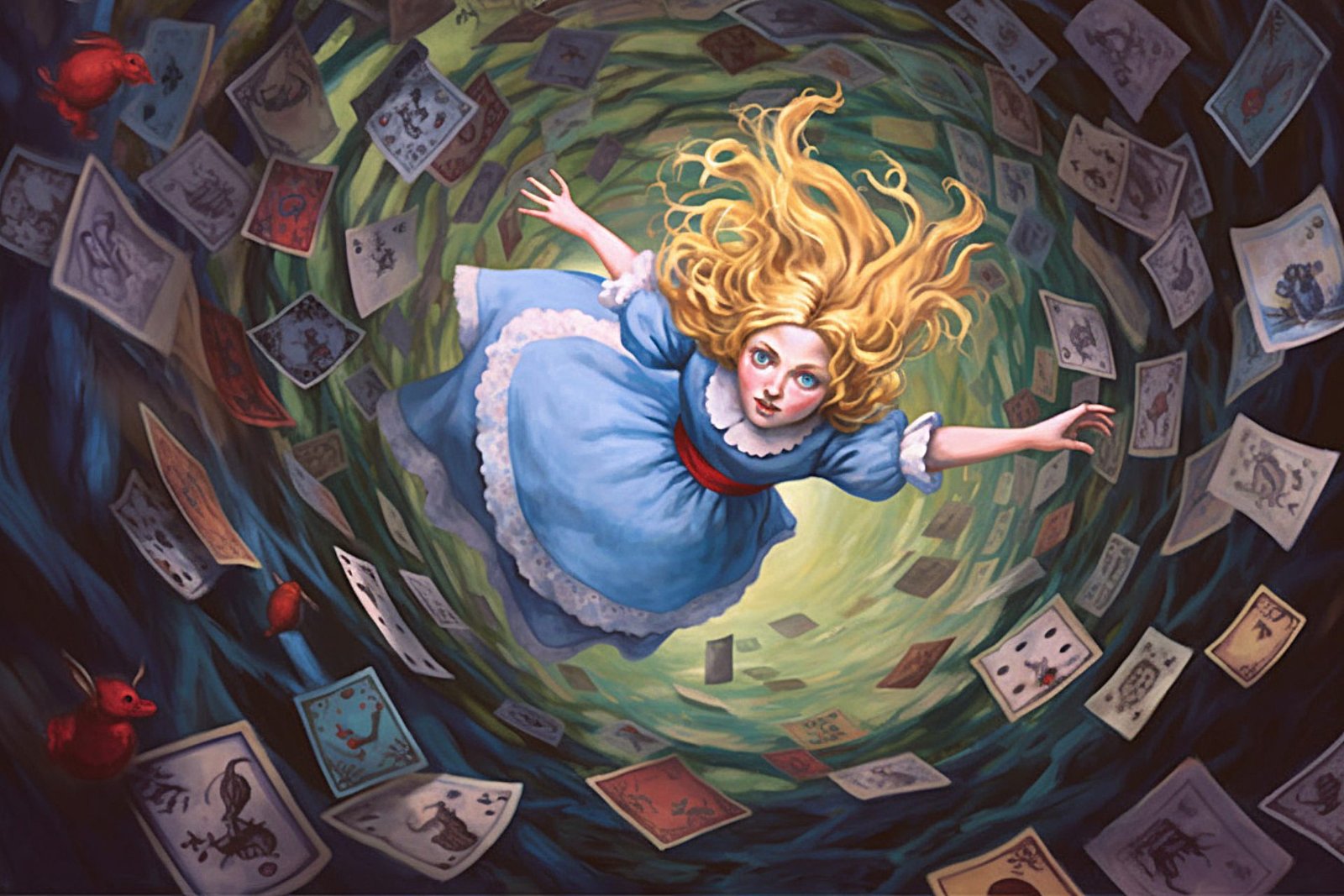
A bored young girl named Alice is by a riverbank when a White Rabbit runs by, fretting, “Oh dear! Oh dear! I shall be late!” and checking the watch from his waistcoat. Unsurprisingly, Alice pursues the rabbit down a rabbit-hole… and ends up floating down a deep tunnel to a strange place full of locked doors. There’s also a cake and a little bottle with labels instructing you to eat or drink them, which cause Alice to either shrink or grow exponentially.
As she continues pursuing the rabbit (who seems to think she’s someone named Mary Ann), Alice quickly discovers that Wonderland is a place where logic and reason have very, very little influence — talking animals in a Caucus-race, a hookah-smoking Caterpillar, even more bizarre growth potions, a grinning cat, the Duchess and her indestructible pig-baby, eternal tea-time with the March Hare and the Mad Hatter (plus the Dormouse), and finally the court of the Queen and King of Hearts.
And in the sequel, Alice steps through a mirror over the fireplace into a strange other world, where she encounters living chess pieces — including the Red Queen, who offers to make Alice a queen if she can make her way across the board in a chess match. As she makes her way across the chessboard, Alice encounters yet more strange people — the annoying yet philosophical twins Tweedledee and Tweedledum, the flaky White Queen, Humpty-Dumpty, and the clumsy White Knight.
“Alice in Wonderland” and “Through the Looking Glass” are two of those rare books that actually are more enjoyable and readable because they are pure nonsense, without more than a shred of plot or even proper narrative structure. The entire story is essentially Alice wandering from one wacky scenario to another, meeting more violently weird people with every stop and finding herself entangled in all sorts of surreal situations. It doesn’t really lead anywhere, or come from anywhere.
And yet, this works perfectly — it’s all about internally-logical nonsense, and a coherent plot or developed characters would get in the way of that. Never has such a perfect depiction of a weird dream been turned into fiction, especially since Alice regards everything that happens with a sort of perplexed detachment. Even though NOTHING in Wonderland makes sense (vanishing cats, sentient chess pieces, arguing playing-cards painting roses, the Hatter convinced that it is six o’clock all day every day, the Tweedles questioning her reality), she addresses everything with a sense of bemused internal logic (“I’ve had nothing yet, so I can’t take more”).
And Carroll festoons this wacky little tale with puns (“We called his Tortoise because he taught us”), odd snatches of mutilated poetry (the magnificently weird Jabberwocky poem) and tangled snarls of eccentric logic that only works if you’re technically insane (so… flamingoes are like mustard?). This keeps the plotless story as sparkling and swift-moving as a mountain stream laced with LSD, so the mind never has a chance to get bored by Alice simply wandering around, growing and shrinking, and engaged in a string of conversations with loopy people.
“Alice in Wonderland” and “Through the Looking Glass” are a mad, mad, mad, mad experience — and between Carroll’s sparkling dialogue and enchantingly surreal story, it’s also a lot of fun. Never a dull moment.






 The Forest