Tony Stark and Asshole Heroes

I was watching a review of Transformers 4: Age of Extinction, and it really reminded me of what a contemptible piece of crap Cade Yeager was. Sam Witwicky was arrogant and annoying, but Cade is both those things, plus… just horrible and selfish to everyone he comes across, especially the employee he leeches money from and the neighbors he steals from. Plus, he violently attacks some innocent people with a baseball bat, just because he’s failed to pay his mortgage because he’s a terrible inventor who refuses to get a real job. And somehow, we are supposed to be rooting for this selfish maniac.

And I kind of wonder… if that is because of Tony Stark.

Because I can think of another movie with a similar protagonist from a few years later, in 2017: Tom Cruise’s Nick Morton from The Mummy. This guy is also a character with zero redeeming characteristics; by the end of the movie, he has done ONE good thing, grand total. The rest of the time, he’s a selfish ass who hits-and-quits women he’s stealing stuff from, sells artifacts on the black market, and… really doesn’t do anything to make us like him. Like, at all. The movie acts as though we care whether he lives or dies, but I for one couldn’t have cared less, because he never said or did anything to make me care.

Back to Cade Yeager for a second, the way he’s shot and his “inventor” persona makes it pretty clear that they wanted us to get a Tony Stark vibe from the movie. As for Nick Morton, the entire Mummy movie was a blatant attempt to copy the Marvel Cinematic Universe’s formula…

So, were these characters DELIBERATELY made into assholes because Tony Stark is an asshole? And Hollywood, being Hollywood, missed the point and thought that the public was just dying to see more assholes?

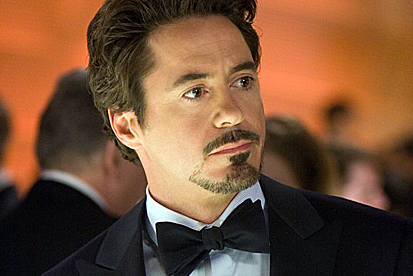
Because yes, Tony Stark is kind of an asshole. He is arrogant, and a pretty awful person at the beginning of the MCU. Just remember that: at the beginning. Now, Tony is a good asshole protagonist for four reasons:

  1. He changes. His character evolves even over the course of the first movie…
  2. … but even then, he was never an asshole as much as these guys were. Tony has good qualities and a good heart underneath it all, so he’s not just an asshole.
  3. He’s an entertaining asshole. He’s witty and clever and wildly intelligent, and this causes us to like him despite his bad behavior.
  4. Robert Downey Jr. A lot of the character’s charm is due to Downey, and it can’t just be copy-pasted with any actor.

So let’s examine these other two protagonist assholes.

First, neither of these characters change. The closest we have is that Nick does a sorta-unselfish thing at the movie’s end, but it’s for a woman he wants to bang, so it isn’t very impressive. Oh, and Cade decides it’s okay for a creepy guy to bang his underage daughter. That was apparently his arc. Very impressive.

Do either of them grow and develop from their hardships? Do we see them becoming less selfish, more caring, moving away from the bad behavior we saw at the movies’ beginnings, recognizing that they were assholes? Nope. Never.

Second, Tony is depicted as a selfish womanizer who sells weapons at the movie’s beginning. But he’s not shown being actively cruel to anyone, violent towards the innocent, and he sells weapons to the US military because he incorrectly believes that they’re the only recipients, and that he’s doing a good thing by selling those weapons. When he discovers otherwise, he immediately shuts down the weapon development, and works to help others.

Despite his external assholery, Tony Stark is shown from the very beginning to be someone who does want to help others and do the right thing. He doesn’t always succeed in knowing what that is, but a consistent behavior through all his MCU movies is that he wants to help and protect others.

Cade Yeager… doesn’t show any signs of that; he’s a violent thug who leeches off everyone around him. Nick Morton is just a literal soldier of fortune who wants to steal stuff for purely selfish reasons.

Third, neither of these characters are as impressively witty as Tony Stark. Not witty at all, really. Therefore, they do not entertain us.

Neither one is very smart, either — we’re told constantly that Cade Yeager is an inventor, but he’s not a very good one. He just makes wobbly robots that don’t do anything very well, as evidenced by the hilariously bad “painting” robot. There’s nothing to dazzle us and make us go “wow, he’s so smart.”

Nick Morton? Not smart at all, really.

Finally, Robert Downey Jr. Downey is a genuinely great actor with immense charisma and personal charm, and the Tony Stark character — as a lovable asshole — really only works because he is so charming.

Mark Wahlberg? Not a great actor, not charming. Tom Cruise? Well, people tell me he has charisma, but his giant toothy grin and staring eyes creep me out. And he certainly doesn’t have the talent or charisma to make anybody like Nick, since absolutely nobody was impressed by his performance.

So, just my rambly thoughts about how these asshole protagonists absolutely failed at trying desperately to be Tony Stark. All I can assume is that some Hollywood nitwit saw Iron Man and concluded, “Audiences love Tony Stark! He’s an asshole! That means people love assholes! And the bigger an asshole a hero is, the more people love him!”

Thanks, Hollywood. How about you un-learn that little lesson?

Review: Hellboy Animated

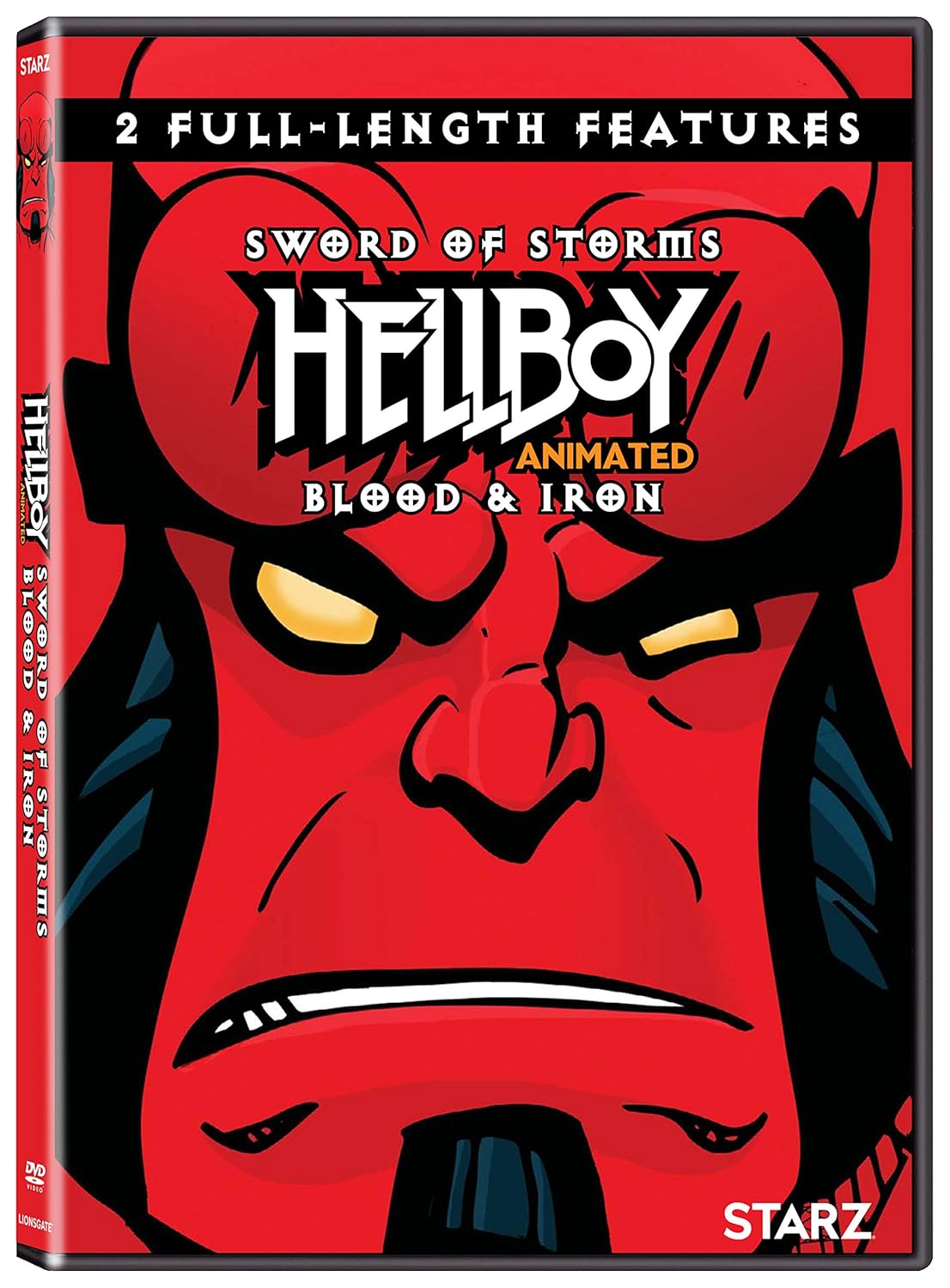
Folklore and legend are rich with plenty of ghouls, gods and monsters that fit nicely into the “Hellboy” universe. And “Hellboy: Sword of Storms/Blood & Iron” deals with some of the supernatural nasties in a pair of animated spinoff adventures. These two stories are solid if not brilliant, and they have plenty of Hellboy quips, weird creatures, and a healthy splattering of gore, fire and magic.

In “Blood and Iron,” the BPRD is asked to investigate a haunted mansion, and Professor Broom insists that Liz, Hellboy, Abe and himself go on the mission. Though the hype-happy owner is only interested in using the investigation to make money, the place is really haunted — bluish ghosts drift around, statues weep, and a witches’ magic circle is on the floor.

It soon becomes obvious that a pair of harpy-witches are trying to resurrect the evil Erzsebet Ondrushko, a horrendous vampire who was abducting young girls so she could bathe in their blood. Decades ago, Professor Broom defeated her and seemingly killed her. Now with Abe captured by the hags, Liz and Broom are in a race against time to stop the vampire’s resurrection — and even if they succeed, there’s still their witch-goddess Hecate, whom Hellboy must somehow stop.

And in “Sword of Storms,” first the team ventures into a green, slimy, root-filled underground temple, where they must battle an ancient bat-deity and a small army of Aztec mummies. Then to the main plot — a history professor receives an ancient scroll that tells the story of the demonic brothers Thunder and Lightning, and a doomed love between a princess and a young samurai. And when the professor finds the samurai’s sword — surprise! — he gets possessed by the demons.

But when the BPRD is called in, Hellboy touches the sword as well — and is sucked into a bizarre otherworld full of monsters, ghosts and magical creatures. In the meantime, Abe and Liz are caught in a typhoon that strands them in the middle of nowhere — and it turns out that dragons are on the way. To save civilization, Hellboy must not only escape from the otherworld of Japenese legend, but also deal with the demons and ghosts….

“Hellboy: Sword of Storms” and “Hellboy: Blood and Iron” are somewhat different beasts from the movies made by Guillermo del Toro — they have some characters and plots that were from the original Mike Mignola comics, and the art is more reminiscent of those. They’re fun additions to the Hellboy mythos, but they do have some flaws in there (the pallid ghostly romance in “Sword of Storms,” which is utterly unegaging because we don’t know or care about these people).

They are also quite different from each other — “Sword of Storms” is a very straightforward and simple storyline that travels along two parallel paths, while “Blood and Iron” branches out into multiple storylines (and even goes backward!). And they have plenty of dark facets — gore, slime, thunderstorms, creepy forests, haunted mansions and the various monsters that arise, ranging from harpies to headless goblins. And the writers do a pretty good job adding in that little humorous edge to the stories as well (“He really likes cucumbers… WHAT IS YOUR NAME?!”).

Ron Perlman’s vocals make this Hellboy absolutely perfect — he’s sarcastic but good-hearted (“You’re lucky we let you be seen with us!”), practical, and usually ends up dealing with all the messy stuff. Doug Jones provides an intellectual slant as the resourceful, mellow fish-man Abe, and Selma Blair has a little trouble bringing the sharp-witted pyrokinetic Liz to life. And John Hurt gets to be the star of “Blood and Iron,” where Professor Broom comes face to face with an old nemesis.

“Hellboy: Sword of Storms/Blood and Iron” have a few flaws, but they are solid animated adventures with plenty of monsters and dark twists. Just remember: These are definitely not for kids.

Review: My Hero Academia, Vol. 1

In most superhero movies and fiction, people with exceptional powers are a tiny minority. But imagine for a second that there’s a world where superpowers – called “Quirks” – are a part of life for most of the population. What would it be like to be one of the minority who have no powers, and what would it be like if somehow that changed?

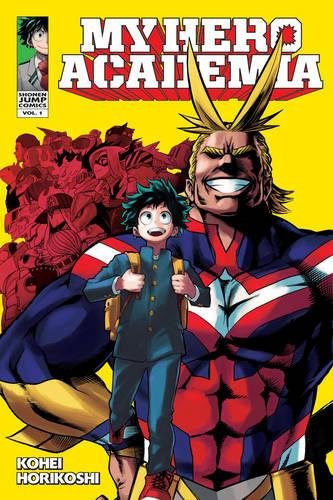
That’s the premise behind Kohei Horikoshi’s “My Hero Academia,” a vibrant and quick-paced manga series that takes place in just such a world, and which follows a steadfast underdog that wants nothing more than to save others. The first volume is still a little rough around the edges, but it overflows with energy, enthusiasm and raw potential, as well as some clever examinations of how such a society would work.

For his entire life, Izuku Midoriya idolized heroes. When he was small, he was found to be Quirkless in a world where the superpowers are commonplace. But rather than giving up, he dedicated himself to following and observing the superheroes – especially the beloved All Might, a seemingly invincible hero overflowing with positivity and heroism. And despite being bullied for his lack of a Quirk by his powerful classmate Katsuki Bakugō, he dreams of being a hero.

One day, he is saved by All Might and learns the superhero’s rather undignified personal secret. And after All Might witnesses the weak, Quirkless boy dash into danger to save his bully, he makes Izuku an offer: he will pass on his power to Izuku, allowing him to attend the hero-training U.A. High School. After months of training, of course. Can’t have a shonen series without training! But the training is only the first step — he has to get into UA, which involves a terrifying entrance exam, even as he tries to use a power he has only just obtained.

“My Hero Academia Volume 1” is entertaining in multiple ways. On the one hand, it’s a shonen manga in the classic mold, though it moves substantially faster than many of its brethren (the training begins and ends within one chapter). On the other hand, it’s also a rather quirky (pun intended) examination of the Japanese take on the superhero genre, with superpowers ranging from the ordinary (floating, explosions) to the more eccentric (belly-button laser, engine-powered legs).

The story whips by at a pretty fast pace, and things are kept energetic and colorful through the constant use of Quirks. But Horikoshi also doesn’t hesitate to pluck at the audience’s heartstrings whenever they have the chance, mostly focused on Izuku’s teary-eyed struggles to realize his dreams against all odds. At times, it’s really heartbreaking. Horikoshi’s artwork is still pretty rough here, with the characters’s expressions sometimes looking too cartoony, but he clearly has skill.

The character of Izuku reminds me a little of Marvel’s Captain America – he’s a weak, ordinary boy with a powerful, courageous heart and a real desire to save others, who is given superpowers artificially. He’s also shown to be quite bright, since he has to think strategically when “Kacchan” tries to actually harm him. The supporting cast is pretty likable but not very developed just yet – all we know of Katsuki is that he’s violent and almost pathologically proud, Uraraka is the perky and kind love interest, and Ida is dutiful, composed and extremely conscientious.

“My Hero Academia Volume 1” is a bold, colorful and energetic start to this entertaining series, and its likable protagonist makes it easy to get invested in his superheroic journey. Smash!

Artemiss Foul: A Rant

This movie is so bad, such a failure in every level of moviemaking, that I’m thinking about writing a review of it even though Amazon doesn’t have a whisper of a DVD/Blu-ray release. It is that bad.

It is so bad that when the trailer came out, I was aghast. I had not even read the first book in full, but I knew that this was an utter betrayal. My sister, who has only read the first CHAPTER of the first book, could see that it was a betrayal.

It’s a failure as an adaptation. They gutted it of the central premise that made it so unique and interesting, because Kenneth Branagh figured that kids couldn’t relate to a super-genius villain kid who doesn’t go to school.

Yo, Kenneth: lack of relatability is frequently a flaw in the audience, not in the character being adapted. If a person can’t relate to someone who isn’t exactly like them, then they’re not very imaginative and probably shouldn’t be watching a fantasy movie. If not going to an ordinary school somehow makes a child character unrelatable to real children, then they’re not going to be able to cope with ideas like fairy folk.

Except real children AREN’T like that — and I know this because quite a few of them read the books and had no trouble relating to Artemis, so I’m not just projecting my weird dark past-child self on the population at large. Because children are not dainty little angels who can’t comprehend things like greed, ruthlessness, anger and so on. They can comprehend why Artemis does things the way he does, even if they wouldn’t do it themselves.

And they LIKE the idea of a child criminal mastermind. They like seeing a kid being the haughty, smarter-than-everyone-else genius who can wrap even powerful fairies around his finger. They love that. The fact that he’s a criminal doesn’t matter to them — they love that he’s the smartest, which in the books is SHOWN rather than simply told to us.

And Branagh also gutted other parts of the story. In the book, Holly Short is the first and only woman in the LEPrecon force, and she has to fight against sexism and the heightened expectations that come with being a trailblazer. Does the movie show this to children? Nope! It decides to fill LEPrecon with female officers, because why show children that sexism is bad when you can just pretend it doesn’t exist?

Then they added the Aculos. What is the Aculos? It is a MacGuffin that serves to fix everything at the end, and nothing else. It was made up for this movie because Disney is stupid.

And there are a billion other changes that either don’t make sense or change things for the worse. Artemis’ mother being dead, because children are dainty angels who cannot cope with subplots about mental illness. Artemis just being told about the fairies instead of deducing it for himself. Cramming in Opal and other elements from the second book. Changing Artemis’ motivation from simple filthy lucre to “I must save my daddy!”

And for some reason, they decided to make the Eurasian Butler… the servant born to be a servant, from an ancient clan of servants… black. There is simply no way that that doesn’t look bad. Also, Butler is supposed to be a terrifying mountain of a man who can snap you in half with his bare hands, and the actor in the movie… looks kind of tubby. He’s not intimidating. And the blue contacts are very distracting; in some lights, they make him look blind.

They also decided, for no apparent reason, to have two different fairy characters talk like Christian Bale’s Batman. It sounds ridiculous, especially coming from Josh Gad’s Mulch Diggums, who looks like (to quote many reviews) a discount Hagrid and sounds like he’s about to tell us that he is the night. And Dame Judi Dench, for some reason, sounds like she smoked ALL the cigarettes and followed them up with a few gallons of whiskey.

Oh, and they removed God from the text of the Irish Blessing, because Mickey Mouse forbid we have even a hint of Christianity in anything. Feck you and your intolerance, Disney.

There was one thing… one thing in the entire movie that they kept, unadulterated and unalloyed. And it was the ONE thing that nobody actually wanted them to keep.

Did they somehow think that changing the very bedrock of the story was essential, but the one part that they COULDN’T change was having Mulch unhinge his jaw like a python and shoot dirt out of his ass? That was just ESSENTIAL. We can have a Artemis Fowl movie where the protagonist is an earnest good boy who surfs, but not have an Artemis Fowl movie where Mulch doesn’t poop large quantities of dirt while we sit there in agony.

Just… why? It was pretty gross and weird in the book, but it’s a thousand times worse when you actually see it in all its terrible CGI glory. Why? Why? Why?

Congratulations, Disney. First you absolutely molested A Wrinkle in Time (where they also erased any hint of Christianity), and now you’ve done even worse to Artemis Fowl. And the worst part is, you’re not going to learn a thing from those failures. You’re just going to conclude that the IPs are bad and unprofitable, rather than admitting that you screwed them up.

I’m going to get some sleep.

Review: My Hero Academia Season 2

Izuku “Deku” Midoriya has done the impossible — he has gained a powerful Quirk and made it into the top hero school in the world. He’s even fought villains, even though his Quirk shatters his bones when he uses it.

But his life promises to get a lot more complex in “My Hero Academia Season 2,” which crams together a few shonen anime standbys (a tournament, strength training with an old master) even as it spins up a truly harrowing, bloodsoaked subplot. Not only does the anime show Midoriya growing as a combatant, but it also fleshes out the history of his Quirk and the superhero world as a whole.

Mere days after the USJ attack, UA holds its annual, world-famous sports festival — a competition for the students that will allow them to show their Quirks to the pro heroes. All Might encourages Midoriya to show the world what he can do, but the boy is still struggling to use his Quirk without injuring himself. To make matters worse, he is competing not only with his classmates, but the other hero class AND the general studies students.

So on the day of the competition, Midoriya does everything he can to succeed without using his Quirk. But when he learns more about his reclusive classmate Shoto Todoroki, Midoriya is spurred to help the other boy with his… well, family issues. Let’s just say Shoto hasn’t had the best childhood, and he hates his abusive father with a passion.

Then the hero course students are faced with a new challenge: they have to intern with pro hero agencies. Midoriya is sent an offer by All Might’s old mentor, Gran Torino — and he soon discovers that Gran Torino might be just the teacher he needs to get One For All under his control. But he’s soon pulled into a chaotic attack on Hosu City, where Shiguraki has unleashed a trio of Nomus. Even worse, a vengeance-fueled Tenya Iida is on the hunt for the fanatical hero-killer, Stain — and even multiple UA students may not be able to take him down.

And no sooner have the UA students returned home from their internships than they are faced with the most terrifying threat yet: finals. Though they think they’re up against more mindless robots, the students quickly learn that they’ll be up against the UA faculty, all trained heroes with powerful Quirks. Worst of all? Midoriya has to fight All-Might… with Katsuki Bakugo as his partner.

If the first season of “My Hero Academia” was about Midoriya achieving his lifelong dream, than the second season is about how he’s going to live that dream now that he has it. He’s in UA, he has a Quirk, and he’s being mentored by the greatest superhero in the world. Now he has to tame that Quirk, and is thrown headlong into some extremely serious training and competition, as well as more encounters with actual villains.

And this season fleshes out the world of UA considerably, partly because it also fleshes out the students around Midoriya. There are a LOT of students in the UA hero course and beyond, and we see more of what makes them tick — Asui’s adventure on the high seas, Yaoyorozu’s collapse of self-confidence, Kirishima’s friendship with Tetsutetsu, Ochaco’s realization of her own limitations and her attempt to learn combat, and Tokoyami’s sensible and serious nature.

This development even extends to minor characters, such as a boy with a brainwashing Quirk who desperately wants to prove that he can be a hero. And we get some new characters, such as Todoroki’s cold and abusive father Endeavour, who sees him as nothing more than a project that he’s going to use against All Might. No wonder the poor kid is socially stunted and has major issues.

There’s also a lot of energetic and colorful fighting, Quirk against Quirk, even as Midoriya learns more about his own abilities (“The frozen pastry in my hand… is me!” “No, it’s not. Are you okay?”). The shonen cliche of the tournament is here, but it moves along much faster than most anime tournaments, blasting through major rounds in less than an episode. And the same goes for the internships and the final exams, which provide us with plenty of interesting fights, often with teachers that we haven’t really seen much in combat situations (like Mr. Cementoss or Midnight).

But the heart of the second season is the presence of the Hero Killer Stain, a freakish noseless fanatic whose hatred for “fake” heroes leads him to slaughter or disable them. The most piercing aspect of this character is not only his ideology, but the fact that it begins to subtly creep into the society around him with just a few videos on social media. And to make matters even worse, the League of Villains is still in the mix, with some unpleasant revelations about its leadership.

The second season of “My Hero Academia” springboards off the first season, and flowers into an action-packed, dynamic adventure streaked with darker moments. It relies a little too heavily on the sequential-fighting-episodes of shonen anime, but that’s a small price to pay for such a solid season.

Review: Midnight Sun

It’s no exaggeration to say that Edward Cullen is one of my least favorite male characters of all time. The only reason he does not sit atop the throne is… well, Christian Grey and Massimo Torricelli exist.

And after many years of refusing to do so, Stephenie Meyer has finally given the wangsty, unintimidating vampire his very own novel, “Midnight Sun,” which retells the entire story of her debut novel “Twilight” from Edward’s perspective. That sounds a lot more appealing than it is, once you realize that we then have to spend hundreds of pages in the head of a whiny, socially-inept misogynist who complains about everything.

In case you missed the media storm some years ago, Edward Cullen is a sparkly vampire who dwells in the town of Forks, Washington. He can read minds. He hates school, and he pretty much hates everyone around him, especially the women. But then once day the author’s self-insert, Bella Swan, stumbles into school and immediately entrances him with her delicious body odor. So he immediately wants to kill her, along with dozens of other innocent people. Swoon. Dream man.

And since Bella’s mind is unreadable, he begins obsessing over her, and decides that she is a selfless saint who is superior to all the common sheep. However, after he saves her from a freak car accident, Bella realizes that there’s something weird about him, which causes the Cullens to panic. But fear not! Stephenie Meyer will not mar her book with suspense, so Alice just blurts out that Bella is going to be her best friend and Edward’s soulmate, so everybody just calms down.

Of course, Edward can’t keep away from the universally irresistible girl who looks suspiciously like the author, and after creeping into her room for several weeks, he saves her from potential gang-rape and they start dating. Eventually the plot rears its ugly head, and some hostile vampires show up to kill Bella, which means Edward has to actually do something other than complain about how much other people suck and how tortured and evil he is.

Is “Midnight Sun” any good? Well, that depends on how you feel about the Twilight Saga as a whole. If you’re a fan of the previous books, you’ll probably love another fat tome of PG-rated vampire romance, in which all the characters talk like middle-aged women. If you find the books to be torture, then this book will probably make you want to set fire to an orphanage filled with puppies.

Sadly, Stephenie Meyer’s writing has not improved in quality over the last fifteen years — she still writes flowery, breathless, rambling prose that endlessly covers stuff that isn’t very interesting. And, of course, she talks endlessly about Bella’s “soft perfection” and how all men want her, and all women want Edward despite his complete lack of basic social skills. Furthermore, it’s incredibly melodramatic in a way that invokes more laughter than thrills, such as Edward rolling around on the floor of a hospital chapel.

“Midnight Sun” also completely destroys Edward’s entire image as a brooding Byronic jerk — it’s hard to see him as a smooth, elegant predator when he spends the entire book throwing tantrums and complaining about everything. He’s whiny, selfish, melodramatic, boring, has contempt for everyone around him… and oh, he’s also a raging misogynist who hates any woman who isn’t a soft-spoken doormat. What’s more, the combination of his homicidal impulses (which are very sexualized) and his complete lack of any normal social skills… well, it makes him seem like a guy who would have been a school shooter if he hadn’t become a vampire instead.

He also reinforces that Meyer does not know how to write male characters – his internal thoughts sound more like a middle-aged woman than a teen boy of any era (“I love you too much, for your good or mine“). Of course, the actual teen conversations are pretty heinous in general, such as a “lolz he’s such a nerd” conversation about Comic-Con that reeks of “How do you do, fellow kids?” Just… don’t talk about geeky stuff, Meyer.

If you have enjoyed Meyer’s other books, you’ll probably enjoy this one too. But if you didn’t, Meyer has not improved — “Midnight Sun” is every bit as bad as the books that precede it, with the added benefit of Edward’s melodramatic foulness.

Review: Meridian

If Laurell K. Hamilton ever wrote a straight romance novel, it would probably be something like “Meridian” — lots of flowing shirts, rape… and sex with a furry werewolf.

And if you aren’t a fan of those things, then “Meridian” won’t have a lot to recommend itself. This movie tries to be both a sexploitation movie AND a “beauty and the beast” gothic romance, but just ends up being painfully slow-moving and incoherent. Not to mention that the constant rape and furry sex completely neutralizes any hint of actual sexiness to be found.

The story follows Catherine Bomarzini (Sherilyn Fenn), an American art student who returns to her family castle in Italy. Then her idiot friend Gina (Charlie Spradling) invites a troupe of wandering magicians to dinner at the castle, led by the arrogant Lawrence (Malcom Jamieson). Then the troupe drugs the two women so Lawrence can rape them, followed by him handing off Catherine to his twin brother Oliver (Jamieson again).

Apparently we’re supposed to view THEIR sex as being real lovemaking, but she still seems rather dopey. Oh, and Oliver turns into a werewolf while raping Catherine.

The following day, Catherine begins seeing strange visions from the past — a dead girl in a flowing white dress, a werewolf (guess who it is!) and a secret passage filled with red light. She also begins to figure out that there is a longtime curse associated with her family, and that Oliver (whom she thinks is the same person as Lawrence) can only be freed by her.

The first half of “Meridian” is pure sexploitation (rape, boobies, Sherilynn Fenn naked), with every possible excuse to show boobs bouncing out of tight shirts. But after our first glimpse of the werewolf, director Charles Band starts trying to turn it into an atmospheric gothic romance with curses, a werewolf, a tormented Byronic hero in flowing white shirts and a mysterious painting. It fails. A lot.

The movie sludges along at a painfully slow pace, with awful dialogue (“I have no world without you”) and a lot of things that are never explained (that giant secret passage leading directly into a bedroom? Never explained). It drapes itself with scarlet velvet, moonlight, silver jewelry and shirts straight off of a romance novel cover, but Band can’t hide the wretchedly contrived story.

And the climax is fascinatingly ludicrous: a werewolf holding a crossbow is thwarted by a whip-cracking dwarf in Elizabethan garb. I felt like someone had slipped drugs into MY drink.

One of the biggest problems is the rape. Not only does the villain date-rape the heroine and her friend, but it’s shot in a slow-motion, erotic manner, as if Band was trying to make it alluring. And it’s made even worse because the HERO also rapes her. Yes. While the heroine is meant to be coming out of her drugged stupor, her lack of reaction to having sex with a werewolf shows she was still pretty out-of-it.

Oh yes. There is sex with a werewolf in full furry form, and we’re supposed to find it erotic. It’s not erotic. It’s actually rather grotesque to those without furry fetishes, and it negates any slight hints of sexiness that the movie might produce.

And despite Fenn’s decent acting, the characters are just awful. Catherine is a walking blank who reacts instead of acting, and Spradling’s entire purpose in the movie is to clean a painting and pick up a crossbow. As for Jamieson’s double performance as Lawrence and Oliver (oh, cute), he’s a little too excessive as both the evil mustache-twirling rapist and the brooding sad-eyed woobie.

“Meridian” is a disaster in every way — a rapey sexploitation movie that tries to transform itself into a gothic romance. As anything other than a showcase for slow-motion boobs, it fails.

Review: The Mummy (2017)

Since every movie franchise now has to be a cinematic universe, Universal decided to dig up up all their old movie monsters and fling them into new, flashier films.

And their most recent dead-on-arrival attempt to revive their shared universe was “The Mummy,” a remake/reboot-but-not-really of previous films about an undead horror rising from the tomb… except they pretty much abandoned any actual material from those movies except “there’s a mummy, and a giant screamy face.” Instead, they present a mass of action cliches without a hint of irony, dressing it up with a “sexy” mummy and a crammed-in starting point for the Dark Universe.

During an airstrike, soldier-of-fortune/looter Nick Morton (Tom Cruise) accidentally uncovers an Egyptian tomb buried under a town… in Iraq. Even the movie is aware of how strange that is. They just happen to have an archaeologist (Annabelle Wallis) on hand, who discovers this was the tomb of Ahmonet, an Egyptian princess whose lust for power caused her to sell her soul to Set, murder her family, and be mummified alive for her crimes. Never mind that the process of mummification would kill you.

But things immediately start going wrong — the plane carrying her sarcophagus crashes, Nick temporarily dies, and then he is haunted by visions of a bandaged woman stalking him through the mist. He’s been cursed by her, and she wants to use him as the vessel for Set. And even when Ahmonet is captured by a Super-Sekrit Organization (like S.H.I.E.L.D., but less competent), Nick finds that he may have no hope of escaping her grasp.

“The Mummy” is very much a MOAR action movie. Moar mummies. Moar crashes. Moar fistfights. Moar ‘splosions. Moar attractive women. Moar boogity-boo scares. Moar moar moar. This movie feels almost like a parody of a Hollywood action-horror movie, ticking off all the cliches and never bothering to do anything that we haven’t seen before… but without a sense of humor or self-awareness that everything in its story has been done before.

Instead, we’re pelted with so many cliches that it feels like the studio raided TV Tropes. And as a result, its massive, bombastic nature seems like a storm conjured up to try to hide the fact that the plot is as thin as papyrus — and it’s definitely not scary, or as funny as it thinks it is (haha, Nick is naked!). There are a few spooky moments here and there, mostly when we see Ahmanet scuttling around in her undead state, looking like an arthritic Gollum. But more often we just careen from place to place, following Nick and Boring Blonde as they lurch from one crisis to another, building up zero momentum as they go.

And as if to show the lack of care that went into it, there are also blatant fails at Egyptian mythology (Set as the god of death), ancient Egyptian culture, etymology (Jekyll claims “Satan” is an alternate name for Set) and history (what would the Crusaders have been doing in what is now Iraq? Being horribly lost?).

Tom Cruise is… Tom Cruise. Despite playing a looter, liar and thief, we’re clearly meant to be charmed by his roguish one-liners and occasional moments of not-totally-self-centered-ness. But when you boil him down, there isn’t really anything about the character to like or be interested in, which makes Wallis’ Boring Blonde’s transition from contempt to love seem even more ridiculously artificial. And Russell Crowe plays a woefully unimposing Dr. Jekyll, who predictably transitions into a ludicrously unscary, scenery-chewing Mr. Hyde.

Sofia Boutella does an excellent job with what little material she has; she seems to have been hired mostly because she can scuttle, scamper and bend a lot. Unfortunately, she’s simply not frightening here — her version of a mummy is too wriggly, weak and ALIVE to ever be a properly undead fright. She looks and acts more like a gymnast in a mummy-themed unitard.

“The Mummy” has a few good spots that haven’t been totally dried out, but the withered hulk is just a standard Hollywood blockbuster — lots of sound and fury, signifying that the Dark Universe was dead on arrival.

Review: Psycho

“Psycho” is one of those rare movies that needs no introduction, by a director who also needs no introduction.

It’s one of the greatest horror movies of all time, and it deserves to be. Alfred Hitchcock’s magnum opus is a clean-cut, low-budget affair that lulls you with its slow, uneasy pace, only to shock you with bursts of bloody violence that practically make you jump out of your chair. And the acting — especially by Tony Perkins — is absolutely brilliant.

Secretary Marion Crane (Janet Leigh) is entrusted with $40,000, which she’s supposed to deposit in the bank for her employer. Instead, she steals the money for her impoverished boyfriend, Sam Loomis (John Gavin). She ends up staying overnight at a remote motel, where the only other people are the owner Norman Bates (Anthony Perkins) and his crazy invalid mother.

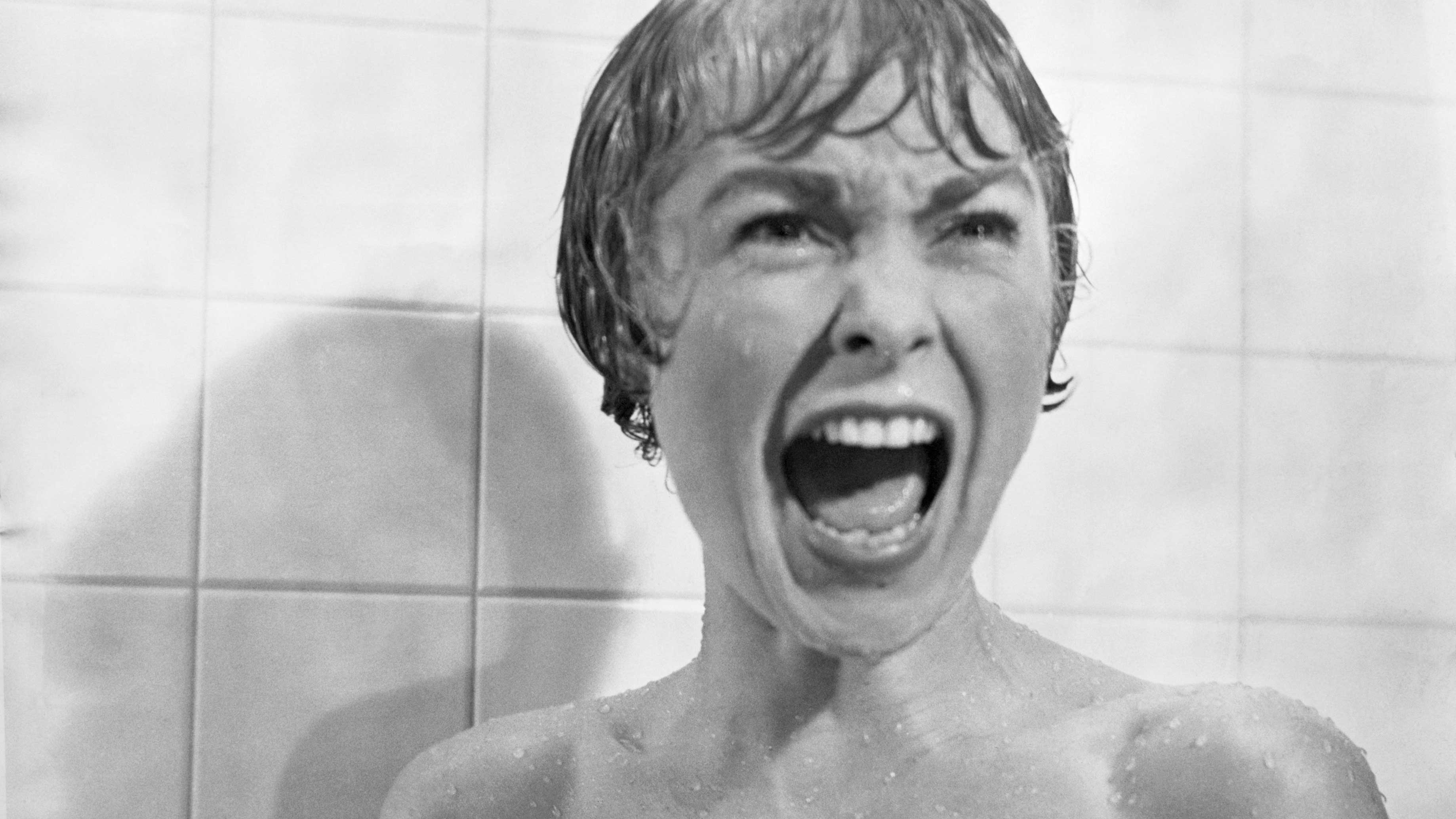
Then someone kills Marion in the shower. Believing his mother is responsible, a desperate Norman cleans up the crime scene and hides the body.

Meanwhile, Marion’s sister Lila (Vera Miles) is doing her best to find both her sister and the $40,000, hiring a private eye and trying to figure out where Marion went before her disappearance. Teaming up with Sam Loomis, she begins seeking out whoever saw her last — but neither of them are prepared for the true horror of Bates Motel.

The biggest problem with “Psycho” is probably that, like most legendary movies with a twist, the brilliant twist ending is so well known that its impact is lessened. Pretty much everybody knows what’s going to happen and what is going on, so it isn’t as shocking as it probably was back in 1960. It’s sort of like “I am your father” or “You blew it up!” — everybody knows the twist.

But that doesn’t mean that “Psycho” isn’t still freakishly scary and beautifully-made. Hitchcock’s direction is clean, smooth and elegant, painting the screen with light and shadow like a master painter. He fills every scene with a slow-building sense of unease, even if nothing bad is actually happening at the moment. It’s quiet, restrained…

… until suddenly a shadowy figure lunges out and starts stabbing somebody, while the screeching violins stab right along. The violence isn’t very graphic, but it’s incredibly shocking.

As Norman Bates, Tony Perkins gave one of the greatest performances you’ll ever see in a film — he comes across as shy and boyish, with an ineffable charm. He comes across as a harmless momma’s boy who’s probably never even talked to a girl before. But even from the start, there are hints that he can abruptly transform into something dark and twisted.

In fact, his is probably the only performance you’ll truly remember from the movie. Not that the other actors aren’t good — Miles and Leigh give brilliant low-key performances as a pair of desperate young women — but Perkins is just SO perfect and chilling that you can’t get over him.

“Psycho” doesn’t need a recommendation from anyone at this point — it’s one of those brilliant movies that has achieved a mythic status. Go see it. Now.

Review: My Hero Academia: Season One

In most superhero movies and fiction, people with exceptional powers are a tiny minority. But imagine for a second that there’s a world where superpowers – called “Quirks” – are a part of life for most of the population. What would it be like to be one of the minority who have no powers, and what would it be like if somehow that changed?

That’s the premise behind “My Hero Academia: Season One,” a vibrant and quick-paced anime that takes place in just such a world, which follows a steadfast underdog that wants nothing more than to save others. It has the feel of a classic shonen anime – lots of protracted fighting, a steadfast hero with an inspiring amount of courage who really needs to level up, and a colorful array of superpowers that get used in… interesting ways.

For his entire life, Izuku Midoriya idolized heroes. When he was small, he was found to be Quirkless in a world where the superpowers are commonplace. But rather than giving up, he dedicated himself to following and observing the superheroes – especially the beloved All Might, a seemingly invincible hero overflowing with positivity and heroism. And despite being bullied for his lack of a Quirk by his powerful classmate Katsuki Bakugō, he dreams of being a hero.

One day, he is saved by All Might and learns the superhero’s rather undignified personal secret. And after All Might witnesses the weak, Quirkless boy dash into danger to save his bully, he makes Izuku an offer: he will pass on his power to Izuku, allowing him to attend the hero-training U.A. High School. After months of training, of course. Can’t have a shonen series without training!

And that’s just the beginning of his woes – he has to actually make it past U.A.’s rigorous entrance exams, encounter U.A.’s eccentric faculty, and deal with the fact that any use of his powers immediately breaks his bones. But he may be forced to do some superheroing before he’s really ready – a force of supervillains (some more super than others) invade U.A., and the students end up having to defend themselves.

“My Hero Academia: Season One” is entertaining in multiple ways. On the one hand, it’s a shonen anime in the classic mold, though it moves substantially faster than many of its brethren (All Might’s training takes just one episode). On the other hand, it’s also a rather quirky (pun intended) examination of the Japanese take on the superhero genre, with superpowers ranging from the ordinary (ice, electricity) to the more eccentric (nitroglycerine sweat, belly-button laser, engine-powered legs).

The story whips by at a pretty fast pace, and things are kept energetic and colorful through the constant use of Quirks – the battles between the superpowered people is a pretty spectacular event whenever it shows up, and their weaknesses and strengths make for some pretty splashy fights. But the writers also don’t hesitate to pluck at the audience’s heartstrings whenever they have the chance, mostly focused on Izuku’s teary-eyed struggles to realize his dreams against all odds. At times, it’s really heartbreaking.

The character of Izuku reminds me a little of Marvel’s Captain America – he’s a weak, ordinary boy with a powerful, courageous heart and a real desire to save others, who is given superpowers artificially. He’s also shown to be quite bright, since he has to think strategically when “Kacchan” tries to actually harm him. The supporting cast is pretty compelling but not very developed just yet – all we know of Katsuki is that he’s violent and almost pathologically proud, Uraraka is the perky and kind love interest, and Iida is dutiful, composed and extremely conscientious.

“My Hero Academia: Season One” is a bold, colorful and energetic start to this entertaining series, and its likable protagonist makes it easy to get invested in his superheroic journey. Smash!