Review: Midnight Sun

It’s no exaggeration to say that Edward Cullen is one of my least favorite male characters of all time. The only reason he does not sit atop the throne is… well, Christian Grey and Massimo Torricelli exist.

And after many years of refusing to do so, Stephenie Meyer has finally given the wangsty, unintimidating vampire his very own novel, “Midnight Sun,” which retells the entire story of her debut novel “Twilight” from Edward’s perspective. That sounds a lot more appealing than it is, once you realize that we then have to spend hundreds of pages in the head of a whiny, socially-inept misogynist who complains about everything.

In case you missed the media storm some years ago, Edward Cullen is a sparkly vampire who dwells in the town of Forks, Washington. He can read minds. He hates school, and he pretty much hates everyone around him, especially the women. But then once day the author’s self-insert, Bella Swan, stumbles into school and immediately entrances him with her delicious body odor. So he immediately wants to kill her, along with dozens of other innocent people. Swoon. Dream man.

And since Bella’s mind is unreadable, he begins obsessing over her, and decides that she is a selfless saint who is superior to all the common sheep. However, after he saves her from a freak car accident, Bella realizes that there’s something weird about him, which causes the Cullens to panic. But fear not! Stephenie Meyer will not mar her book with suspense, so Alice just blurts out that Bella is going to be her best friend and Edward’s soulmate, so everybody just calms down.

Of course, Edward can’t keep away from the universally irresistible girl who looks suspiciously like the author, and after creeping into her room for several weeks, he saves her from potential gang-rape and they start dating. Eventually the plot rears its ugly head, and some hostile vampires show up to kill Bella, which means Edward has to actually do something other than complain about how much other people suck and how tortured and evil he is.

Is “Midnight Sun” any good? Well, that depends on how you feel about the Twilight Saga as a whole. If you’re a fan of the previous books, you’ll probably love another fat tome of PG-rated vampire romance, in which all the characters talk like middle-aged women. If you find the books to be torture, then this book will probably make you want to set fire to an orphanage filled with puppies.

Sadly, Stephenie Meyer’s writing has not improved in quality over the last fifteen years — she still writes flowery, breathless, rambling prose that endlessly covers stuff that isn’t very interesting. And, of course, she talks endlessly about Bella’s “soft perfection” and how all men want her, and all women want Edward despite his complete lack of basic social skills. Furthermore, it’s incredibly melodramatic in a way that invokes more laughter than thrills, such as Edward rolling around on the floor of a hospital chapel.

“Midnight Sun” also completely destroys Edward’s entire image as a brooding Byronic jerk — it’s hard to see him as a smooth, elegant predator when he spends the entire book throwing tantrums and complaining about everything. He’s whiny, selfish, melodramatic, boring, has contempt for everyone around him… and oh, he’s also a raging misogynist who hates any woman who isn’t a soft-spoken doormat. What’s more, the combination of his homicidal impulses (which are very sexualized) and his complete lack of any normal social skills… well, it makes him seem like a guy who would have been a school shooter if he hadn’t become a vampire instead.

He also reinforces that Meyer does not know how to write male characters – his internal thoughts sound more like a middle-aged woman than a teen boy of any era (“I love you too much, for your good or mine“). Of course, the actual teen conversations are pretty heinous in general, such as a “lolz he’s such a nerd” conversation about Comic-Con that reeks of “How do you do, fellow kids?” Just… don’t talk about geeky stuff, Meyer.

If you have enjoyed Meyer’s other books, you’ll probably enjoy this one too. But if you didn’t, Meyer has not improved — “Midnight Sun” is every bit as bad as the books that precede it, with the added benefit of Edward’s melodramatic foulness.

Review: Meridian

If Laurell K. Hamilton ever wrote a straight romance novel, it would probably be something like “Meridian” — lots of flowing shirts, rape… and sex with a furry werewolf.

And if you aren’t a fan of those things, then “Meridian” won’t have a lot to recommend itself. This movie tries to be both a sexploitation movie AND a “beauty and the beast” gothic romance, but just ends up being painfully slow-moving and incoherent. Not to mention that the constant rape and furry sex completely neutralizes any hint of actual sexiness to be found.

The story follows Catherine Bomarzini (Sherilyn Fenn), an American art student who returns to her family castle in Italy. Then her idiot friend Gina (Charlie Spradling) invites a troupe of wandering magicians to dinner at the castle, led by the arrogant Lawrence (Malcom Jamieson). Then the troupe drugs the two women so Lawrence can rape them, followed by him handing off Catherine to his twin brother Oliver (Jamieson again).

Apparently we’re supposed to view THEIR sex as being real lovemaking, but she still seems rather dopey. Oh, and Oliver turns into a werewolf while raping Catherine.

The following day, Catherine begins seeing strange visions from the past — a dead girl in a flowing white dress, a werewolf (guess who it is!) and a secret passage filled with red light. She also begins to figure out that there is a longtime curse associated with her family, and that Oliver (whom she thinks is the same person as Lawrence) can only be freed by her.

The first half of “Meridian” is pure sexploitation (rape, boobies, Sherilynn Fenn naked), with every possible excuse to show boobs bouncing out of tight shirts. But after our first glimpse of the werewolf, director Charles Band starts trying to turn it into an atmospheric gothic romance with curses, a werewolf, a tormented Byronic hero in flowing white shirts and a mysterious painting. It fails. A lot.

The movie sludges along at a painfully slow pace, with awful dialogue (“I have no world without you”) and a lot of things that are never explained (that giant secret passage leading directly into a bedroom? Never explained). It drapes itself with scarlet velvet, moonlight, silver jewelry and shirts straight off of a romance novel cover, but Band can’t hide the wretchedly contrived story.

And the climax is fascinatingly ludicrous: a werewolf holding a crossbow is thwarted by a whip-cracking dwarf in Elizabethan garb. I felt like someone had slipped drugs into MY drink.

One of the biggest problems is the rape. Not only does the villain date-rape the heroine and her friend, but it’s shot in a slow-motion, erotic manner, as if Band was trying to make it alluring. And it’s made even worse because the HERO also rapes her. Yes. While the heroine is meant to be coming out of her drugged stupor, her lack of reaction to having sex with a werewolf shows she was still pretty out-of-it.

Oh yes. There is sex with a werewolf in full furry form, and we’re supposed to find it erotic. It’s not erotic. It’s actually rather grotesque to those without furry fetishes, and it negates any slight hints of sexiness that the movie might produce.

And despite Fenn’s decent acting, the characters are just awful. Catherine is a walking blank who reacts instead of acting, and Spradling’s entire purpose in the movie is to clean a painting and pick up a crossbow. As for Jamieson’s double performance as Lawrence and Oliver (oh, cute), he’s a little too excessive as both the evil mustache-twirling rapist and the brooding sad-eyed woobie.

“Meridian” is a disaster in every way — a rapey sexploitation movie that tries to transform itself into a gothic romance. As anything other than a showcase for slow-motion boobs, it fails.

Review: The Mummy (2017)

Since every movie franchise now has to be a cinematic universe, Universal decided to dig up up all their old movie monsters and fling them into new, flashier films.

And their most recent dead-on-arrival attempt to revive their shared universe was “The Mummy,” a remake/reboot-but-not-really of previous films about an undead horror rising from the tomb… except they pretty much abandoned any actual material from those movies except “there’s a mummy, and a giant screamy face.” Instead, they present a mass of action cliches without a hint of irony, dressing it up with a “sexy” mummy and a crammed-in starting point for the Dark Universe.

During an airstrike, soldier-of-fortune/looter Nick Morton (Tom Cruise) accidentally uncovers an Egyptian tomb buried under a town… in Iraq. Even the movie is aware of how strange that is. They just happen to have an archaeologist (Annabelle Wallis) on hand, who discovers this was the tomb of Ahmonet, an Egyptian princess whose lust for power caused her to sell her soul to Set, murder her family, and be mummified alive for her crimes. Never mind that the process of mummification would kill you.

But things immediately start going wrong — the plane carrying her sarcophagus crashes, Nick temporarily dies, and then he is haunted by visions of a bandaged woman stalking him through the mist. He’s been cursed by her, and she wants to use him as the vessel for Set. And even when Ahmonet is captured by a Super-Sekrit Organization (like S.H.I.E.L.D., but less competent), Nick finds that he may have no hope of escaping her grasp.

“The Mummy” is very much a MOAR action movie. Moar mummies. Moar crashes. Moar fistfights. Moar ‘splosions. Moar attractive women. Moar boogity-boo scares. Moar moar moar. This movie feels almost like a parody of a Hollywood action-horror movie, ticking off all the cliches and never bothering to do anything that we haven’t seen before… but without a sense of humor or self-awareness that everything in its story has been done before.

Instead, we’re pelted with so many cliches that it feels like the studio raided TV Tropes. And as a result, its massive, bombastic nature seems like a storm conjured up to try to hide the fact that the plot is as thin as papyrus — and it’s definitely not scary, or as funny as it thinks it is (haha, Nick is naked!). There are a few spooky moments here and there, mostly when we see Ahmanet scuttling around in her undead state, looking like an arthritic Gollum. But more often we just careen from place to place, following Nick and Boring Blonde as they lurch from one crisis to another, building up zero momentum as they go.

And as if to show the lack of care that went into it, there are also blatant fails at Egyptian mythology (Set as the god of death), ancient Egyptian culture, etymology (Jekyll claims “Satan” is an alternate name for Set) and history (what would the Crusaders have been doing in what is now Iraq? Being horribly lost?).

Tom Cruise is… Tom Cruise. Despite playing a looter, liar and thief, we’re clearly meant to be charmed by his roguish one-liners and occasional moments of not-totally-self-centered-ness. But when you boil him down, there isn’t really anything about the character to like or be interested in, which makes Wallis’ Boring Blonde’s transition from contempt to love seem even more ridiculously artificial. And Russell Crowe plays a woefully unimposing Dr. Jekyll, who predictably transitions into a ludicrously unscary, scenery-chewing Mr. Hyde.

Sofia Boutella does an excellent job with what little material she has; she seems to have been hired mostly because she can scuttle, scamper and bend a lot. Unfortunately, she’s simply not frightening here — her version of a mummy is too wriggly, weak and ALIVE to ever be a properly undead fright. She looks and acts more like a gymnast in a mummy-themed unitard.

“The Mummy” has a few good spots that haven’t been totally dried out, but the withered hulk is just a standard Hollywood blockbuster — lots of sound and fury, signifying that the Dark Universe was dead on arrival.

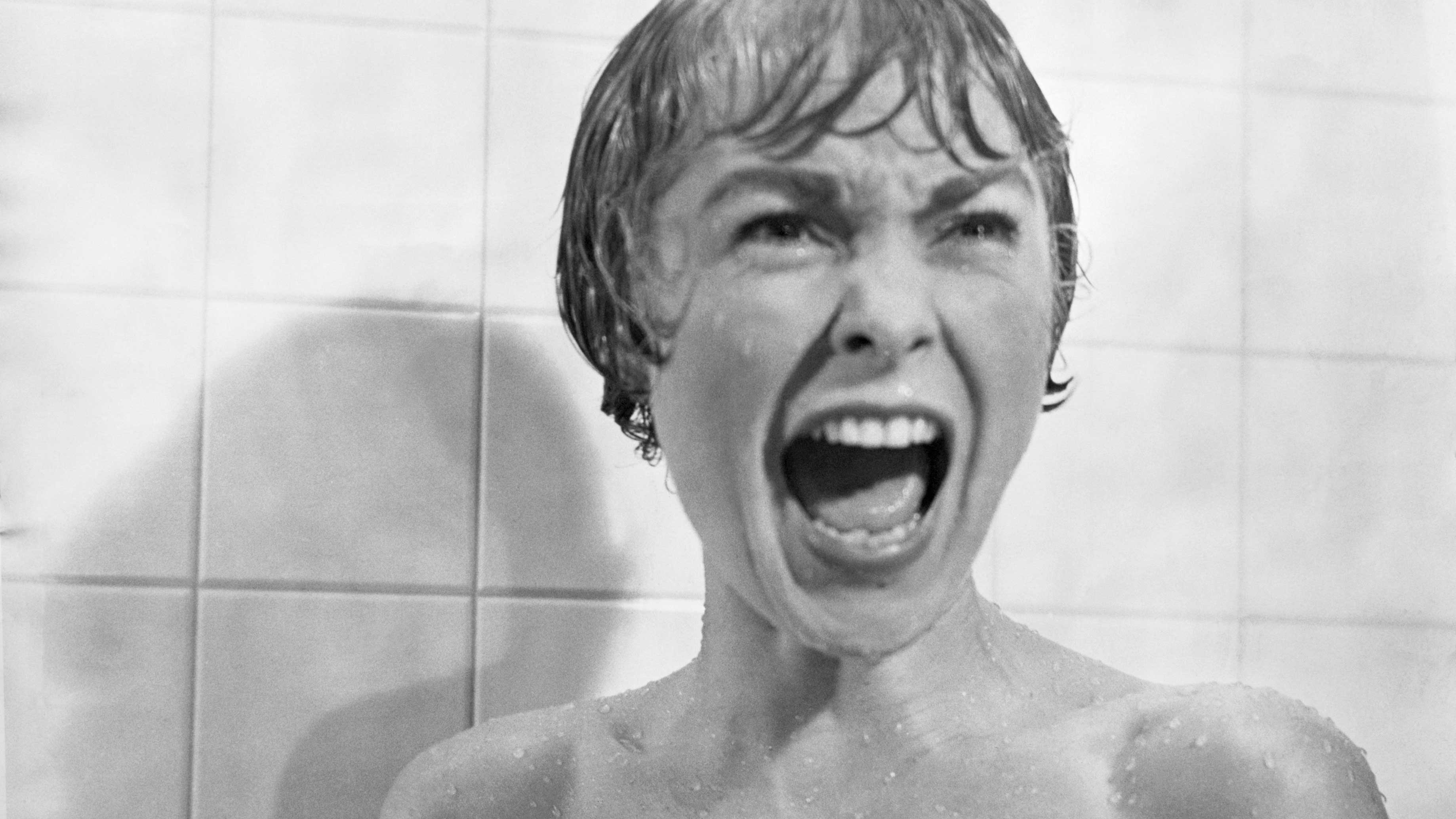
Review: Psycho

“Psycho” is one of those rare movies that needs no introduction, by a director who also needs no introduction.

It’s one of the greatest horror movies of all time, and it deserves to be. Alfred Hitchcock’s magnum opus is a clean-cut, low-budget affair that lulls you with its slow, uneasy pace, only to shock you with bursts of bloody violence that practically make you jump out of your chair. And the acting — especially by Tony Perkins — is absolutely brilliant.

Secretary Marion Crane (Janet Leigh) is entrusted with $40,000, which she’s supposed to deposit in the bank for her employer. Instead, she steals the money for her impoverished boyfriend, Sam Loomis (John Gavin). She ends up staying overnight at a remote motel, where the only other people are the owner Norman Bates (Anthony Perkins) and his crazy invalid mother.

Then someone kills Marion in the shower. Believing his mother is responsible, a desperate Norman cleans up the crime scene and hides the body.

Meanwhile, Marion’s sister Lila (Vera Miles) is doing her best to find both her sister and the $40,000, hiring a private eye and trying to figure out where Marion went before her disappearance. Teaming up with Sam Loomis, she begins seeking out whoever saw her last — but neither of them are prepared for the true horror of Bates Motel.

The biggest problem with “Psycho” is probably that, like most legendary movies with a twist, the brilliant twist ending is so well known that its impact is lessened. Pretty much everybody knows what’s going to happen and what is going on, so it isn’t as shocking as it probably was back in 1960. It’s sort of like “I am your father” or “You blew it up!” — everybody knows the twist.

But that doesn’t mean that “Psycho” isn’t still freakishly scary and beautifully-made. Hitchcock’s direction is clean, smooth and elegant, painting the screen with light and shadow like a master painter. He fills every scene with a slow-building sense of unease, even if nothing bad is actually happening at the moment. It’s quiet, restrained…

… until suddenly a shadowy figure lunges out and starts stabbing somebody, while the screeching violins stab right along. The violence isn’t very graphic, but it’s incredibly shocking.

As Norman Bates, Tony Perkins gave one of the greatest performances you’ll ever see in a film — he comes across as shy and boyish, with an ineffable charm. He comes across as a harmless momma’s boy who’s probably never even talked to a girl before. But even from the start, there are hints that he can abruptly transform into something dark and twisted.

In fact, his is probably the only performance you’ll truly remember from the movie. Not that the other actors aren’t good — Miles and Leigh give brilliant low-key performances as a pair of desperate young women — but Perkins is just SO perfect and chilling that you can’t get over him.

“Psycho” doesn’t need a recommendation from anyone at this point — it’s one of those brilliant movies that has achieved a mythic status. Go see it. Now.

Review: My Hero Academia: Season One

In most superhero movies and fiction, people with exceptional powers are a tiny minority. But imagine for a second that there’s a world where superpowers – called “Quirks” – are a part of life for most of the population. What would it be like to be one of the minority who have no powers, and what would it be like if somehow that changed?

That’s the premise behind “My Hero Academia: Season One,” a vibrant and quick-paced anime that takes place in just such a world, which follows a steadfast underdog that wants nothing more than to save others. It has the feel of a classic shonen anime – lots of protracted fighting, a steadfast hero with an inspiring amount of courage who really needs to level up, and a colorful array of superpowers that get used in… interesting ways.

For his entire life, Izuku Midoriya idolized heroes. When he was small, he was found to be Quirkless in a world where the superpowers are commonplace. But rather than giving up, he dedicated himself to following and observing the superheroes – especially the beloved All Might, a seemingly invincible hero overflowing with positivity and heroism. And despite being bullied for his lack of a Quirk by his powerful classmate Katsuki Bakugō, he dreams of being a hero.

One day, he is saved by All Might and learns the superhero’s rather undignified personal secret. And after All Might witnesses the weak, Quirkless boy dash into danger to save his bully, he makes Izuku an offer: he will pass on his power to Izuku, allowing him to attend the hero-training U.A. High School. After months of training, of course. Can’t have a shonen series without training!

And that’s just the beginning of his woes – he has to actually make it past U.A.’s rigorous entrance exams, encounter U.A.’s eccentric faculty, and deal with the fact that any use of his powers immediately breaks his bones. But he may be forced to do some superheroing before he’s really ready – a force of supervillains (some more super than others) invade U.A., and the students end up having to defend themselves.

“My Hero Academia: Season One” is entertaining in multiple ways. On the one hand, it’s a shonen anime in the classic mold, though it moves substantially faster than many of its brethren (All Might’s training takes just one episode). On the other hand, it’s also a rather quirky (pun intended) examination of the Japanese take on the superhero genre, with superpowers ranging from the ordinary (ice, electricity) to the more eccentric (nitroglycerine sweat, belly-button laser, engine-powered legs).

The story whips by at a pretty fast pace, and things are kept energetic and colorful through the constant use of Quirks – the battles between the superpowered people is a pretty spectacular event whenever it shows up, and their weaknesses and strengths make for some pretty splashy fights. But the writers also don’t hesitate to pluck at the audience’s heartstrings whenever they have the chance, mostly focused on Izuku’s teary-eyed struggles to realize his dreams against all odds. At times, it’s really heartbreaking.

The character of Izuku reminds me a little of Marvel’s Captain America – he’s a weak, ordinary boy with a powerful, courageous heart and a real desire to save others, who is given superpowers artificially. He’s also shown to be quite bright, since he has to think strategically when “Kacchan” tries to actually harm him. The supporting cast is pretty compelling but not very developed just yet – all we know of Katsuki is that he’s violent and almost pathologically proud, Uraraka is the perky and kind love interest, and Iida is dutiful, composed and extremely conscientious.

“My Hero Academia: Season One” is a bold, colorful and energetic start to this entertaining series, and its likable protagonist makes it easy to get invested in his superheroic journey. Smash!

Review: The Blackout: Invasion Earth

More than anything else, “The Blackout: Invasion Earth” reminds me of the TV show “Lost.” If Damon Lindelof were Russian, this might be the sort of movie he would produce.

And that’s because “The Blackout: Invasion Earth” has a truly fascinating sci-fi premise as a beginning, and for a while it seems like it’s chugging along pretty effectively – there’s military action, strange occurrences, and eventually some aliens. But the more answers that are revealed, the less satisfying they become, and the more hamfisted, clumsy and needlessly nihilistic the writing becomes.

The first half of the movie is a fascinating setup, with almost limitless potential. A complete blackout suddenly strikes most of the Earth’s surface, except for a circular region in Eastern Europe (including Moscow). The rest of the planet, thereafter dubbed the Quarantine Zone? Dark, incommunicado, and effectively uninhabited. Where did everyone go? Why is all technology down outside the “circle of life”? Why did all the bears attack the Russian army? And what blasted a giant tunnel through several urban skyscrapers, seemingly from space?

So far, so good. Egor Baranov crafts a genuinely suspenseful, semi-apocalyptic atmosphere, while introducing a variety of characters who find themselves on the front lines of the Quarantine Zone – an embittered man who has found purpose in the crisis, a compassionate journalist, a soldier and the medical doctor he hooked up with, and a general who is just trying to figure out what to do.

But… then we start getting answers, and they aren’t very good.

It seems that a small number of people have developed psychic powers. We don’t see most of them – just one guy, who is seeing visions of strange people who tell him that he’s needed to save the world. Soon the humans learn that all this insanity and change is part of a chilling alien invasion that has already begun, and which threatens our species with extinction if they don’t find a way to stop it.

“The Blackout: Invasion Earth” is a perfect demonstration that, when you build up a mass of mysteries and fascinating possibilities, you have to really stick the landing. But the more answers this film produces, the less satisfying they become – and a lot of the cool moments, such as the blasted skyscrapers and the bear attack, really don’t make a lot of sense when you find out what’s really going on. It’s like the story was written around these cool little moments, rather than the cool moments being the product of a well-thought-out story. See above comparison to “Lost.”

And without revealing too much about the ending, it’s ultimately a bleak, rather nihilistic depiction of humanity in general. Only in the last two minutes does anything even remotely positive happen, and it feels slapped on. Not to mention abrupt – the movie simply thuds to a stop, all problems unresolved.

Admittedly some of the problems – the uneven pacing, the thin characterization, the thin romance that leads nowhere – might be because this was originally conceived as a television series. But being a series wouldn’t have helped the flimsiness of the alien invasion plan, which shows the need for a few more script revisions. Honestly, the entire movie would have been better off without the aliens claiming they built the pyramids and started all religion.

As for the actors, they’re… meh. Just meh. Most of them do serviceable but not very good jobs, although Ksenia Kutepova is almost painfully out of her league whenever she tries to act serious. The only really memorable performance is Artyom Tkachenko as “Id,” an alien who claims he’s here to help humanity – given the structure of the aliens’ faces, Tkachenko is reduced to mainly acting with his eyebrows and eyes, and he gives a pretty decent performance.

“The Blackout: Invasion Earth” began with such promise and such memorable concepts… and then fell flat on its face with poor answers and a cast of rather uninteresting characters. Give this one a miss.

Review: The Thing

Imagine that you’re in a remote Antarctic outpost, locked in eternal icy winter, with little to do and only a few people to spend time with. Now imagine that a screaming, fleshy alien horror infiltrates your base, turning everyone it touches into extensions of itself – and if you don’t stop it, the entire planet will be destroyed.

That’s the premise behind “The Thing,” a haunting 1982 horror movie by masterful director John Carpenter. And this classic cult film is a prime example of science fiction at its most terrifying – it’s a slow-burning, claustrophobic film filled with psychological dread that periodically erupts into tentacular, flame-filled warfare. This is no jump-scare-filled schlock movie, but a finely-crafted nightmare.

A seemingly ordinary sled dog runs into an American station in the Antarctic, pursued by a crazed screaming Norwegian with a gun, who is quickly shot dead in self-defense. Helicopter pilot MacReady (Kurt Russell) and Dr. Copper (Richard Dysart) venture to the Norwegian base, and find that someone has burned it down. Everyone is dead and burned, frozen or both… and they find the remains of a horribly malformed, inhuman creature.

Well, they find out what happened when the Norwegian dog is kenneled with the other sled dogs: it starts absorbing them into one grotesque tentacled mass. Only fire kills it. The Americans soon realize that it’s an alien organism from a nearby crash site, which can perfectly mimic other organisms – so perfectly that no one can be sure who is really human, and who is part of The Thing. Even worse, it could assimilate all life on Earth in a relative short time, if it ever got out of the frozen wasteland of Antarctica.

So, unsurprisingly, there’s a lot of paranoia and suspicion among the Americans, especially after Dr. Blair (Wilford Brimley) sabotages their vehicles and destroys their communications equipment. Deprived of sleep and not knowing who to trust, MacReady and the others must discover who is a Thing before it’s too late.

John Carpenter produced a number of outstanding classic films like “Halloween,” “The Fog,” “They Live,” “Big Trouble in Little China,” “Escape From New York,” and so on. But “The Thing” may be Carpenter’s finest hour – it’s one of those carefully-cultivated, intricately intelligent movies that has pretty much no flaws. The acting, the writing, the atmosphere, and the feeling of all-consuming, gnawing paranoia right to the very final seconds of the film.

Carpenter’s direction here is mostly a slow-burn, building up a tripwire tension that permeates every scene… until, without warning, flesh starts stretching, tentacles whip out, and strange fluids pour out. The nightmarishness of the whole claustrophobic experience is only heightened by the way the movie makes you feel for the characters. You feel the horror of being surrounded by people who might not even be human, of being too afraid to sleep, of being surrounded by a wasteland of snow and burned remains.

And a lot of the movie’s effectiveness comes from its special effects. These are some of the most convincing practical effects ever captured on film – they’re fleshy, dripping with fluid, twisting and gnarling into something bloated and grotesque. And yet, for all the giant grainy teeth, oozing fluids and spider-legs, the most horrifying moments of The Thing’s presence are when it looks just a little too much like something ordinary and living, such as the giant screaming snarling dog-Thing. There’s almost a sense of cathartic relief when the humans fry one of the Things, just because something so profoundly wrong and horrifying is now dead.

The acting is also absolutely top-notch here, with Russell taking center stage as MacReady. The character isn’t really a hero – he’s just a guy who flies helicopters, who finds himself in the unenviable position of saving the world by whatever means necessary. He may be less educated than many of the other people in the outpost, but he’s undeniably intelligent, cunning and resourceful. But Russell is bolstered by some excellent supporting actors, including Brimley, Dysart, Keith David, and… well, pretty much everyone. The dog isn’t a bad actor either – its unnatural silence and calm is an early clue to what it truly is.

It may not have gotten the love it deserved when it was first released, but “The Thing” has proven over time that it is a true horror/sci-fi classic. Absolutely masterful.

Review: Strange Planet

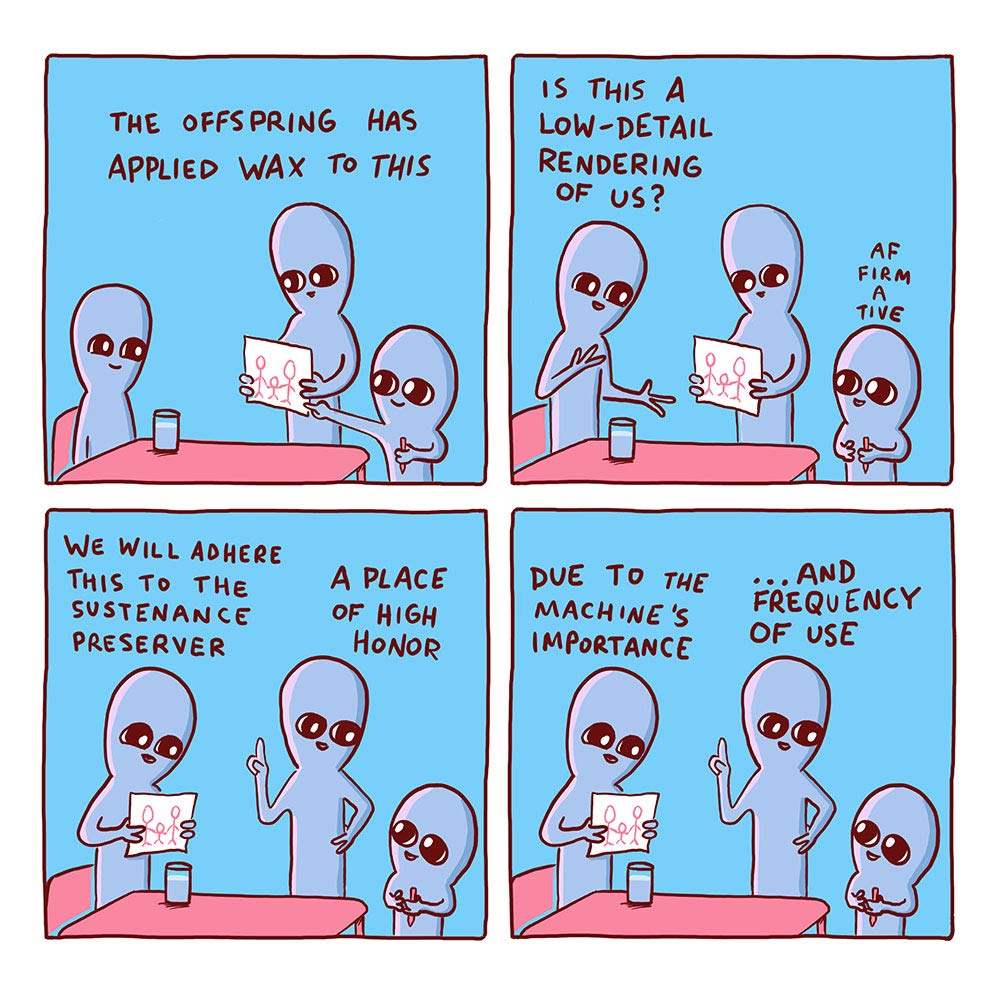
In Nathan W. Pyle’s little alien world, large-headed gray aliens with enormous eyes live their everyday lives, while explaining their actions in oddly formal, factual ways.

That’s it. That’s pretty much it.

It’s a simple formula, but one that is thoroughly endearing. “Strange Planet” is a collection of Pyle’s little four-panel comics about a “strange planet” occupied by these little gray aliens, whose lives are more or less identical to human lives, but who often explain themselves in ways that gently highlight the absurdity of things we take for granted.

These include surprise parties (“I believed the falsehoods you told me.” “Because trust!”), mosquitoes, babies, cats (“It’s vibrating”), coffee, birthday wishes (“Who wants to ingest this now that I have exhaled on it?”) smoke alarms, salt, TV news, giving flowers, makeup, wine, working out, assembling furniture, dogs, piercings (“I am considering a new hole in me”), pizza delivery, dental visits (“I’m here to scrape your mouth stones”), swimming pools, sports, and many other things.

Of course, it helps that the aliens have odd ways of phrasing things (“The group of orb-catchers that represent our region did not catch the orb tonight”). Also included: dougslice, rollmachine, personal star dimmers, seriousness cloth, sweet disks, plant liquid partially digested by insects and then stolen, the rollsuck, the hotdanger screamer, and many other charming little names.

They also have a knack for declaring their feelings in an oddly formal manner that reflects the most rational perspective on their actions, such as a sports fan declaring happily “I feel undeserved pride!” or a college graduate loudly declaring “My knowledge suffices” while other aliens announce “We smack our hands.” It’s this manner of phrasing things that calls attention to the oddness of some of our actions (wishing on falling stars) and makes them charmingly sardonic in nature.

The series’ charm also lies in Pyle’s simple art – the aliens are adorable with their little sexless gray bodies, bulbous heads and enormous eyes. Their surroundings are minimal, and their backgrounds often blank. They also all look alike, so you’re often not sure if most of the strips feature the same aliens or all-new ones every time.

Part of the charm of “Strange Planet” is that it isn’t that strange at all – it just calls attention to our own strangeness. And the chronicles of these cute little aliens are well-worth an hour or so of gentle smiles.

Review: Powers Volume 1: Who Killed Retro Girl?

Imagine a world where superheroes and supervillains actually exist – there are “powers” who use technology and superhuman abilities to save and/or endanger the world…

… and there are also cops who have to deal with all the mess.

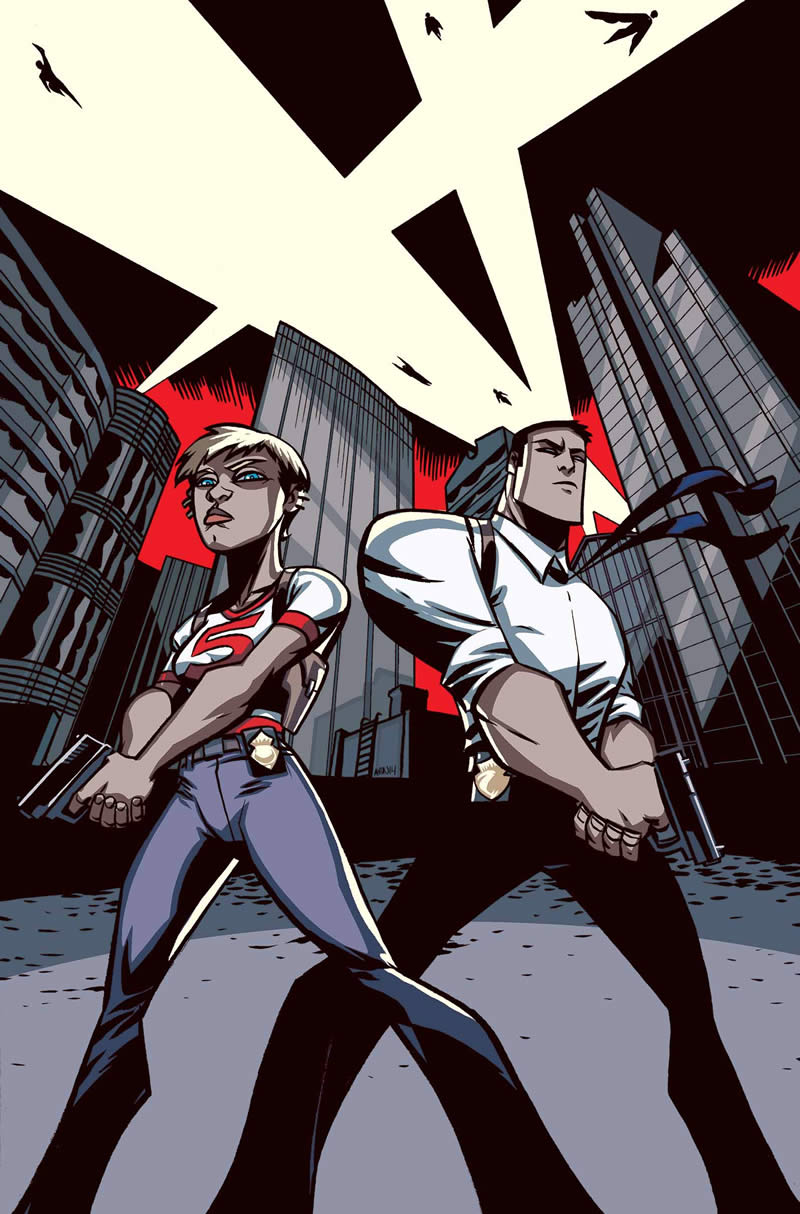
That should give you an idea of the world that “Powers Volume 1: Who Killed Retro Girl?” takes place in – this darkly clever comic book series is a police procedural about ordinary non-powered cops trying to solve violent crimes in a world where superhumans are everyday occurrences. Brian Michael Bendis spins up a genuinely suspenseful, gritty murder mystery with some twists and turns, which pairs up nicely with Michael Avon Oeming’s spare, angular artwork.

Christian Walker is called into a hostage situation, in which he saves a little girl named Calista from her mother’s deranged boyfriend. As if being saddled with a little girl wasn’t enough of a detriment to his day, he’s called into a homicide that rattles the city to its foundations. The famed and beloved superheroine known as Retro Girl has been stabbed in the throat… which is impressive, since she was nigh-invulnerable.

Oh, and Walker now has a new partner: Deena Pilgrim, a small but scrappy detective who has a penchant for crop-tops, and a deep-seated curiosity about Walker’s past.

As the city grieves and the news drags up every possible detail of her life, the two detectives begin investigating anyone who could have possibly wanted to kill Retro Girl. Supervillains, superheroes and local mafia bosses are all possible perps, but nothing that you could really hang your hat on. And as they try to unravel the seemingly impossible mystery, Deena begins to suspect that her new partner might be a power himself.

Police officers in superhero comics are usually pretty ineffectual characters, because they generally don’t have superpowers/superior tech and… well, many of the people committing crimes in superhero comics do. Superman could be an amazing police officer just by virtue of his Kryptonian abilities, but what can ordinary non-powered cops do when someone like Superman is murdered?

And Bendis crafts a pretty solid whodunnit: some clever clues strewn through the investigation, a lot of red herrings, and backstory for Retro Girl is conveyed through news reports that run at the bottom of the pages rather than interrupting the narrative. It’s a clever tactic, and it does keep the energy going. The entire story has a gritty, noir-ish atmosphere, peppered through with some dry comedy (the hypoglycemic coroner going off on a rant about space lizards and apes with laser guns).

But we’re also presented with a second mystery: what is actually up with Christian Walker? We see that he’s an exceptionally strong and rather skilled cop, quiet and rather reserved, but Deena quickly figures out that there’s more to him than meets the eye. And no, he’s not an Autobot. Deena herself is an excellent counterpoint to Christian’s introverted self – she’s sharp, fiery, outspoken and more than willing to beat up a whole room of bald mooks. Even her appearance is the opposite of his: light where he’s dark, small and slim where he is bulky and masculine.

Which brings me to the artwork. There’s something of a “Batman: The Animated Series” look to the character designs, especially the broad-shouldered, top-heavy, strong-jawed Christian. The style is fairly simple with thick lines, heavy shadows and geometric shapes, and Oeming often soaks whole scenes in specific colors – the red of Johnny Royalle’s club, the blue of the morgue, the purple of Triphammer’s home, and so on. It’s very striking, and keeps it from looking too murky.

Bendis and Oeming craft a powerful, striking opening story for their superhero-comic subversion, and “Powers Volume 1: Who Killed Retro Girl?” leaves you hungry for more adventures by Walker and Pilgrim. Gripping and intriguing.

Brandon Sanderson’s Cosmere

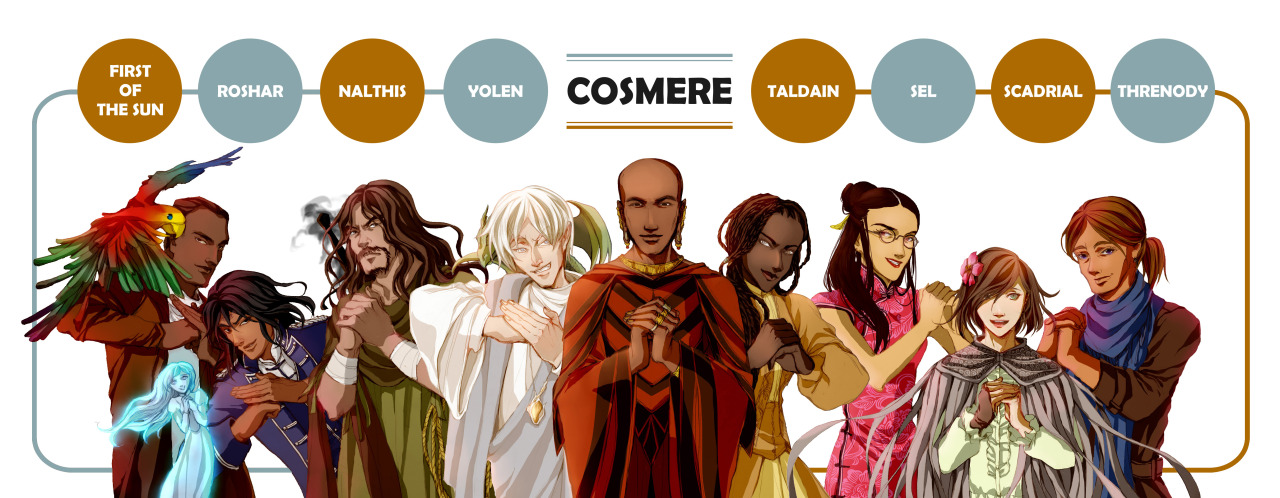
https://botanicaxu.tumblr.com/post/138862187844/finished-nine-characters-from-eight-shardworlds

Brandon Sanderson is one of my favorite authors, partly because he can take a genre where most of the corners have been explored, and expands them with either amazing skill or brilliant new ideas. He also just executes these books with incredibly complex plotting, such as the Stormlight Archive series, which will apparently have ten enormous volumes (the fourth is currently available for preorder). Even this man’s unpublished books are better than most authors can manage (the original White Sand and Aether of Night, which you can obtain from his message board by request).

And he’s created his own interconnected universe known as the Cosmere, which links together most of his published work. Mostly this is through the concept of Shards, which are fragments of this universe’s murdered power of creation, Adonalsium. This fuels the magic of these different worlds, which comes out in different unpredictable ways – in some of them, you might turn into a living zombie, and in others you can “burn” metals that give you superpowers. This blanket mythology allows him to tell various stories with various types of magic, but allows him to interlink them so that they can have greater significance in the future.

To date there have been eleven books in the Cosmere, along with several novellas and short stories that you can find in the Arcanum Unbounded collection, and a graphic novel series. Which, by the way, I do not recommend reading in its entirety until you’ve read the novels.

If this sounds intimidating, it really isn’t. Some of these works can be read pretty much independently of their greater mythology, and then later works can give you an appreciation of the greater, more universe-spanning story being told here.

If you’re interested in checking it out, I’d recommend that newcomers to the Cosmere start out with Elantris, Warbreaker or the first Mistborn trilogy. White Sand, the graphic novel, is also a good starting point if you want to get into it via comics (although I do recommend the unpublished text, which has some notable differences and a cliffhanger ending). These books were my introduction to the Cosmere, and they are stories that can be appreciated on their own before you connect them to a larger story. Or you can just read them independently, and enjoy them independently. It’s your choice.

(Also, Elantris has some flaws – I’d rate it three stars out of five – because it was one of Sanderson’s early works, but the overall story is an engaging one. So if that one isn’t to your taste, I’d recommend checking out Warbreaker before coming to any conclusions)

Then, I’d recommend checking out the short stories and novellas such as Mistborn: Secret History, Allomancer Jak and the Pits of Eltania, Shadows for Silence in the Forests of Hell, The Emperor’s Soul and Sixth of the Dusk. You can find all these in the Arcanum Unbounded collection that I mentioned before, along with a Stormlight Archive novella that takes place after the second book. But obviously, don’t read that until you read the first two Stormlight Archive books. Then there is the second era of Mistborn, which takes up the next three books in a much later time period than the original – and unlike most epic fantasy, it actually has technological advancements!

If you have read the books/stories and like them, and want to see more, then check out… well, the Stormlight Archive. These books are absolutely massive – each one is like a brick made out of paper – but they don’t feel that way. Reading the first one actually flew by pretty quickly for me – it took longer for me to read The Great Gatsby. These are ones that are best appreciated when you’ve read Sanderson’s other works and understand the universe they exist in; they delve into the cosmology of the Cosmere and how things got to be the way they are.

And the Cosmere is still expanding: Sanderson will be releasing a new Stormlight Archive book this November, and a new Mistborn novel after that. Furthermore he has plans for a bunch of other books, including a sequel to Warbreaker, two more trilogies for Mistborn, two more Elantris books, more Stormlight Archive, and a prequel series that he’s planning after the Stormlight Archive has concluded. And who knows? He may get other ideas for novels, novellas or short stories along the way.

So if you want epic fantasy that doesn’t just copy Tolkien, Martin or one of the other big names, Sanderson is a good option (especially since the Mistborn trilogies advance technology over time, and one future one will be a space opera!). And I haven’t even gotten into his non-Cosmere stuff…