So probably my biggest anticipated sequel is the second book of Maggie Stiefvater’s Dreamer trilogy. I’d love to refer to it by title, but Amazon doesn’t have it yet. Anyway, I practically get drunk on Maggie Stiefvater’s prose, so I’m dying to have more.
I’m also looking forward to Aurora Burning, the sequel to Amie Kaufman and Jay Kristoff’s Aurora Rising, which was probably one of my favorite sci-fi reads of last year. Without revealing too much about it, it has a lot of mystery, elf aliens, the Great Ultrasaur of Abraaxis IV, and it mingles a sense of humor with some very serious galaxy-threatening consequences, and a tinge of tragedy as well. So I do want to find out more.
Sarah J. Maas is releasing a fourth Court of Thorns and Roses book, but I don’t know anything about it.
After making a swerve into Japanese folklore, Julie Kagawa is going back to her Iron Fae series, and this time she’s writing about Puck. I’m all in.
I came into the famed manga series Jojo’s Bizarre Adventure more or less blind – I had seen a few memes and GIFs of the anime adaptation, but knew nothing of the actual story. All I knew that was that it presumably involved someone named JoJo, and that it was allegedly bizarre.
So how bizarre is the first volume of JoJo’s Bizarre Adventure: Part 1 – Phantom Blood? Less bizarre than the title would have you believe, presumably so that author Hirohiko Araki can gently lower you into the strange stuff rather than flinging you into the deep end and letting you drown in undiluted bizarre. It starts off fairly normal as the tale of a psychopath infiltrating an aristocratic family… and about two-thirds of the way through, weird things start to happen.
The story follows two young boys, the aristocratic Jonathan Joestar and his foster brother Dio Brando. They are raised together by Jonathan’s kindly father, whose kindness apparently doesn’t extend to keeping his son – or his son’s unfortunate dog, or his son’s girlfriend – away from a violent psychopath. Yes, Dio is pretty much pure evil, and is scheming to destroy Jonathan and steal the Joestar fortune for himself. Why? Well, because he’s a violent psychopath.
The two boys somehow manage to grow up and flourish despite their hatred for each other, and Dio being pure evil. But when Lord Joestar becomes mysteriously ill, Jonathan becomes convinced that Dio is responsible, and sets out to London to prove it. Dio pursues him with the intent of killing him, using an ancient Aztec mask that shoots giant spines into the brain of its wearer when it ingests blood.
And then things get weird.
Yes, that’s when things get weird. That’s when we encounter a strange man named after a rock’n’roll band, who spins a razor-brimmed hat on his arms like a top. And there are vampires.
Fortunately, the first volume of JoJo’s Bizarre Adventure: Part 1 – Phantom Blood is actually a pretty compelling read even before it spirals into the crazy stuff. It’s not a very complicated story – it’s more or less a clash between the ridiculously noble and idealistic Joestars, and the ceaselessly corrupt and evil Dio. There’s not really any shades of grey here, just a clash between darkness and light.
And Hirohiko Araki doesn’t really bother beating around the bush with showing us how evil Dio is, since literally the first thing he does when he meets Jonathan is to abuse the kid’s beloved dog. It’s pretty frustrating to watch, since Lord Joestar just sort of lets Dio do whatever he wants, rather than recognizing how despicable the boy is and getting him out of the Joestar family’s life. It’s actually a huge relief when Jonathan takes control of the situation, and fights back against Dio’s attempts to kill his father and crush his spirit.
And it’s all so wildly, wonderfully dramatic. Characters strike powerful poses and shout grandiose statements at each other, especially Dio’s openly narcissistic question of how “scum” like Jonathan could hurt him. The action scenes are relatively rare, but they are full of rough raw kinetic energy that bursts off of the page, lots of muscled bodies swinging and crashing with the power of collapsing Titans.
Although if cruelty to dogs bothers you, there are… certain scenes to be skipped.
The first volume of JoJo’s Bizarre Adventure: Part 1 – Phantom Blood is still a little rough around the edges, and it takes a little while to get to the weird stuff, but it’s a bombastic and entertaining ride. And one can only assume Hirohiko Araki has more bizarreness to come.
If there’s one thing the Greek gods were known for, it was being petty, cruel tyrants who made the lives of lesser gods and mere mortals unpleasant. But if there was a second thing they were known for, it was having flings with mortals and producing countless demigod children. Zeus was especially bad.
So Rick Riordan asks the question: what if the Greek gods were real, and still around in modern America, and there was a special camp specifically for those “half-blood” kids? “The Lightning Thief,” first book in the Percy Jackson and the Olympians series, is an effective entrance into a colorful Greco-influenced fantasy adventure, written in a sharp, irreverent style that fits its odd hero perfectly.
Perseus Jackson doesn’t seem like an exceptional kid – he has a mother he loves, a nasty stepfather he loathes, dyslexia and ADHD, and he goes to a school for troubled kids. But when his algebra teacher morphs into a monster and tries to kill him, Percy’s life spins out of control. After he’s attacked by the Minotaur and his mother is seemingly killed, he ends up at the magical Camp Halfblood, where the modern half-mortal offspring of the Greek gods are sheltered and taught.
But then Percy is identified as the son of the sea god Poseidon, which is a bit of a problem, since the gods Zeus, Poseidon and Hades all agreed not to sire any more children. Even worse, it seems that someone has stolen Zeus’s original, unspeakably powerful lightning bolt, Percy is being blamed for the theft, and all-out divine war will ravage the western world if the lightning bolt is not recovered and returned by the summer solstice. But no pressure.
So its up to Percy to reclaim the lightning bolt from Hades, who is the number one suspect. To make matters worse, his cross-country road trip – accompanied by the satyr Grover and Athena’s daughter Annabeth – turns out to be a particularly deadly one, as he encounters gods and monsters that all have reasons to want him dead – and becomes aware of something even worse stirring back to life.
It’s obvious by reading “The Lightning Thief” that Rick Riordan has a deep and rather irreverent love for Greek mythology – he knows about Grecian myths both notorious (Medusa) and obscure (the water beds of DEATH!), and he gives wickedly amusing modern twists to most of the gods we see without losing the core of what they are.
Dionysius, for instance, is the foul-tempered camp director, who wears a tiger-striped Hawaiian shirt, but we get a brief glimpse of the madness and mayhem he can unleash among mortals. Charon has developed a love of designer suits. Ares is a biker with smoking pits for eyes. And so on, and so forth. Even the quest itself feels like a clever modern update on the Grecians quests of old, with Percy and his friends stumbling across strange
And Riordan’s writing more or less parallels his approach to Greek mythology. Percy is a clever and smart-mouthed kid who has a tendency to rub people the wrong way, so even when he’s encountering gods and monsters, the first-person narrative stays snarky and flippant, with an underlying sense of wonder at how crazy his life has become. But Riordan can flip things around into serious, downright sinister territory, such as Percy’s dreams about a mysterious force awakening to attack the gods. And there are some very heartfelt moments, mostly tied up in Percy’s quest to free his mother from Hades’ grasp.
The one downside? Well, the aftermath of the plot… kind of involves cold-blooded premeditated murder. By the good guys. Yes, the person who gets murdered is scum, but it doesn’t really justify killing him when there are, you know, other options.
The characters are more or less divided into two different camps. There are the ones Percy likes and gets along with, such as the no-nonsense Annabeth, the nervy animal-loving Grover, and the noble uber-mentor Chiron (who has an interesting method of hiding his horsey hindquarters). On the other hand, there are the ones he dislikes and doesn’t get along with, like the ugly and brutish daughters of Ares, and Dionysius, who just really despises the campers. There’s not a lot of dimension in the characters just yet, but a shocking revelation about one character does hint that Riordan has more depth in mind for them.
“The Lightning Thief” is an imperfect but cracklingly dynamic opening to Rick Riordan’s mythological universe – and despite its flaws, it makes the prospect of future books incredibly appealing. Very enjoyable.
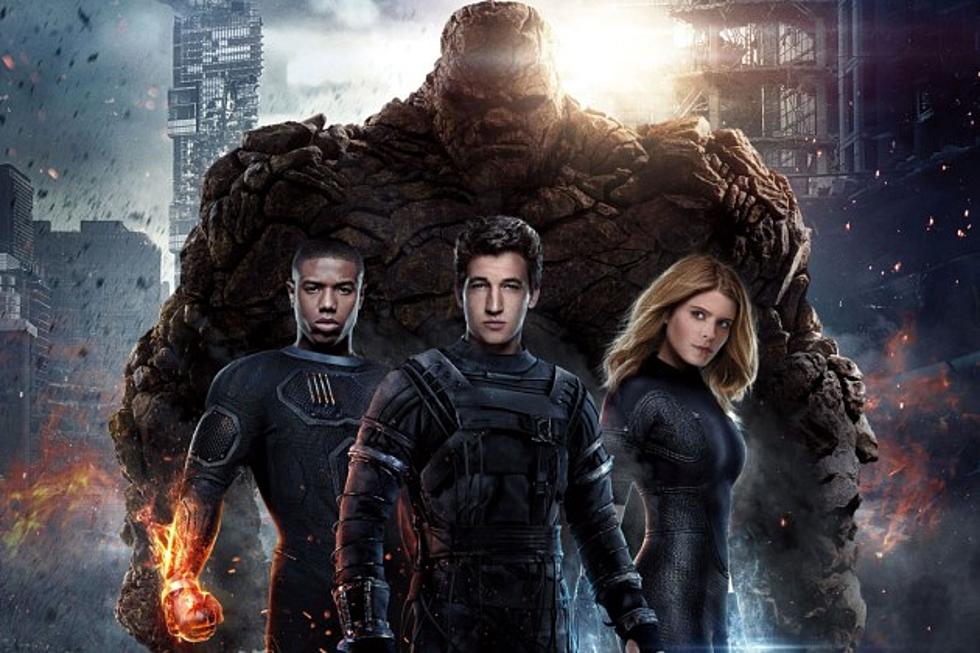
Back in 1994, a movie was made about the superhero team known as the Fantastic Four, directed by legendary schlockmeister Roger Corman. The movie was low-budget, cheesy, campy… and, unbeknownst to the cast and crew, intended never to be released since there had never been any intention of actually making it good.
Why am I mentioning this? Because despite its silliness, shoestring budget and incredibly hokey acting, that absurd little ashcan movie had a certain charm, an earnestness. It had heart.
And you won’t find any of that in the film released more than twenty years later, Josh Trank’s Fantastic Four (or as many people call it, “Fan4stic”). This is one of those adaptations that seems to be ashamed of its own source material – it’s a dry, dour, dismal and darkly disinterested expanse of choppy storytelling, a staggeringly bad villain, and a superhero team that don’t even really seem to like one another or care about saving the world.
Our… I’m going to say “hero” is Reed Richards (Miles Teller), who spends his formative years building a teleportation machine with his best friend Ben (Jamie Bell). Their efforts attract the attention of Dr. Storm and his daughter Sue (Kate Mara), who are apparently roaming random high school science fairs in search of scientific genius.
They quickly snatch up Reed and set him to work creating an interdimensional teleporter, assisted by Sue’s street-racing brother Johnny (Michael B. Jordan), who doesn’t seem to have any scientific expertise, and computer programmer Victor von Doom (Toby Kebbel). Upon hearing that astronauts will be sent into this other dimension instead of the nerd squad, Reed, Victor and Johnny all get drunk, and decide to go themselves. Yes, being a bunch of dumb drunks is the superhero origin story for this team.
Naturally, their trip is a complete disaster, leaving Victor presumed dead, and Reed, Ben, Johnny and Sue all burdened with superpowers that they don’t really want. Reed flees the facility for reasons that are never really explained, even though he is the key to rebuilding the teleporter and finding a cure for their conditions. However, they have no idea what is waiting for them on the other side.
The overall feeling I get from Fantastic Four is shame. It’s the kind of embarrassment a teenager feels when his mom whips out the baby album and shows his friends how cute he was in his baby bonnet. Fantastic Four wants to be a super-serious-edgy-not-at-all-silly-or-weird-like-the-comics movie, distancing itself from the comics rather than embracing them. No movie has ever been good when it is ashamed of its source material.
And unfortunately, this is not the kind of dark/gritty/serious movie that is plotted intricately and paced well, with plenty of action to keep the story feeling dynamic. This is a movie that seems to cycle from one poorly-lit room to another, with people talking in low monotones without much facial expression. On the rare occasions when action occurs – such as Ben Grimm ripping tanks apart – the movie quickly shifts it to a small TV screen, as if afraid that something exciting might happen.
It also timeskips shortly after the characters get their powers, which only makes the characters feel more disconnected from each other. By the time the main villain shows up, the movie is nearly over, and it tumbles over itself to have a final battle that feels both cliched (look, a sky-beam!) and strangely rushed. It’s like Fantastic Four can’t wait to be over.
And perhaps the movie’s biggest problem is that none of the characters are likable – Teller, Mara, Jordan and Bell are all wildly talented actors, but they’re drained of charisma and individual energy. Johnny seems like a petulant child, Reed is a piece of bland toast, and Mara seems like she’s just enduring it all. Only Bell gets any real development – the scene where Ben begs Reed not to leave him is genuinely heartrending, one of the few effective scenes in the whole movie.
Worst of all, the characters don’t seem like they even like each other. There’s no sense of sibling love between Johnny and Sue, no chemistry between Sue and Reed, and Reed and Ben barely even spend time around each other. They don’t feel like superheroes – they just feel like people with superpowers who don’t really get along until the climactic battle demands that they team up.
And Victor von Doom…. oh, dear. One of Marvel’s most infamous and fascinating villains… is turned into a pseudo-nihilistic computer-nerd edgelord who’s irritated that Sue won’t date him.
Josh Trank’s Fantastic Four is a grim, unpleasant slog – a poorly-lit, action-light story that never picks up any momentum. But the greatest sin is that it never has any heart – just a foursome of bland, unlikable characters.
Upon discovering the answer to a now-legendary problem, Archimedes famously yelled “Eureka!” (“I have found it!”), jumped out of his bath, and ran naked through the streets.
So “Eureka” seems like an appropriate name for the SyFy Channel’s quirky, well-written sci-fi series, all about a tiny town that brims over with geniuses and scientific breakthroughs. While it has the usual ups and downs of any long-running series, “Eureka: The Complete Series” is a charmingly eccentric little show that centers on the life of an ordinary law-forcement officer who just happens to live in a town full of oddball geniuses.
While dragging his delinquent daughter back to L.A., Marshal Jack Carter (Colin Ferguson) accidentally crashes the car. The only nearby place is the picture-perfect small-town of Eureka. But Jack starts to suspect that Eureka is a little odd — and his suspicions are confirmed when a tachyon accelerator starts ripping the seams out of the universe.
It turns out that Eureka is a town filled with geniuses, making groundbreaking scientific discoveries. After the local sheriff suffers a nasty accident, D.O.D. representative Allison Blake (Salli Richardson-Whitfield) makes Jack the new sheriff of Eureka. Now he has a new job, a “smart house” in an old nuclear bunker, and trigger-happy deputy Jo Lupo (Erica Cerra) who isn’t initially very happy to be working with him.
But life in Eureka is never peaceful, with countless scientific disasters threatening its people — and occasionally the whole world — and usually Sheriff Carter stumbles across some crimes and mishaps that just don’t seem to make sense. Some of them are more than mere technical problems: a mysterious Artifact that predates the universe, a boy with strange powers derived from said Artifact, a time jump that throws their lives out of balance by altering the past, a trip to Titan that goes horribly, horribly wrong, and the ever-present threat of government involvement.
“Eureka: The Complete Series” is a nearly ideal combination of gentle comedy and wild sci-fi, with the idea that leading experts in every scientific field imaginable (example: molecular gastronomy) have come to work in Eureka, in order to fully explore their fields. Unfortunately, most of these experts aren’t very good at the “being sensible” part of their job. So when there’s lots of genius and not enough common sense… well, let’s just say Carter’s everyman sensibility is required.
And the writers sprinkle it with funny scenarios (the whole town gets brainwashed into acting out the songs they listen to), bizarre problems (people are turned to stone) and funny dialogue (“I’m Sheriff Carter! I’m gonna save the day with my everyman logic, hahaha!”), which keep things from ever getting too serious. But there are moments of poignancy as well, such as the truly tragic loss of Henry Deacon’s first love, or the whole arc where the space crew is trapped in a virtual world that seems to have been set up to make them violently uncomfortable.
The biggest problem is that sometimes it feels like important plot threads are simply abandoned. The mysterious Artifact is held up as a cosmically inexplicable object that could change the way we see the universe… but it just sort of tapered off and was forgotten. And Allison’s ex-husband was eventually written out because the writers apparently couldn’t figure out what to do with him.
A lot of the show’s charm comes from the talented cast — Ferguson is particularly charming and slightly goofy as a guy so normal that he almost seems like a cliche. However, Carter is a lot smarter than he seems, and has a knack for figuring out the key to fixing these technical disasters. We also have a bunch of excellent actors like Cerra, Richardson-Whitfield, Ed Quinn, Niall Matter, Joe Morton and Neil Grayston. They play everything from nerds who push all the wrong buttons to super-genius mechanics, gun-toting sidekicks to charming bad-boys. Even the supporting cast is delightful, like Matt Frewer as an insane Aussie vet and Chris Gauthier as a feisty gay restauranteur.
Despite some dropped plot threads, “Eureka: The Complete Series” mixes equal measures of dramedy and sci-fi — where else can you find rage zombies, Egyptian bugs and brainwashing music? Clever, charming and well-written.
The first ten or so minutes of Valerian and the City of a Thousand Planets are a spellbinding reminder of just how good a Luc Besson movie can be.
First comes a nearly wordless exploration, save for David Bowie’s “Space Oddity,” of how the titular City came to be – the International Space Station is expanded first by international cooperation, and then by interstellar cooperation. Over the centuries it grows into a planet-sized home for countless alien races, gets renamed “Alpha,” and is sent floating off into deep space when it becomes so massive that its gravity threatens the Earth. This is followed by a tragic glimpse of the idyllic beach planet Mül and its primitive, innocent inhabitants, who are seemingly wiped out by an alien ship crashing and exploding. I would think such a small-scale explosion wouldn’t destroy the entire planet, but whatever. Maybe it’s a very small planet.
These two scenes are strong with showing rather than telling, excellent alien designs, and the richness of imagination that Besson brings to his science fiction tales. The problem is… right after these scenes, we’re tossed into the deep end with the main characters, and the plot actually starts. And sadly, these are the weakest points of Valerian and the City of a Thousand Planets, particularly the intensely weird performance of Dane DeHaan and the overabundance of fetch quests.
Major Valerian (DeHaan) and his partner Sergeant Laureline (Cara Delavigne) infiltrate the legendary extra-dimensional Big Market in order to secure the Mül converter – an animal that can reproduce any item by eating it. But when they get to Alpha to hand the converter over to their superior Commander Filitt (Clive Owen), he reveals that a strange radiation zone has appeared in the heart of the station… and then he is kidnapped by the humanoids from Mül.
Here’s where the plot essentially goes off the rails, because the story could more or less wrap up halfway through the movie. Instead, we’re treated to a series of side-quests that ultimately don’t accomplish anything for the main plot – after Valerian crashes, Laureline has to recover an all-seeing jellyfish from the butt of a whale so she can put it on her head to temporarily acquire psychic powers in order to find Valerian. No, really. And no sooner has she rescued him than she’s captured by hostile aliens, so Valerian now has to find a glamopod so he can infiltrate the aliens’ palace and rescue her, which means he has to infiltrate the red light district… it’s basically a giant oozing mass of filler and wasted time before we get back to the actual main storyline.
That might be okay if the main plot was one worth returning to, but alas, it isn’t. Once the beauty of Mül itself is removed from the story, it becomes a rather cliched tale of innocent flawless primitive natives whose lives are ruined by the Big Bad Military. It feels very much like a pale copy of James Cameron’s Avatar, which wasn’t exactly a scintillating example of originality in its own right.
It’s also graced with Dane DeHaan in the lead role, and he’s a truly baffling choice. The role of Valerian is written as a dashing, bad-boy rogue that others can’t help but be charmed by – the kind of guy who should be played by a young Harrison Ford or Kurt Russell. DeHaan looks more like a fifteen-year-old goth kid, with a voice that perpetually sounds like he’s trying to sound deep and intense. Watching him is a bizarre experience, particularly when he tries to romantically pursue Laureline – it’s like watching a teenage boy hitting on his long-suffering babysitter.
It’s also extremely uncomfortable, because the character crosses the line from romantic pursuit right into sexual harassment. He is repeatedly told by Laureline that she is disinterested in him romantically, but he keeps pestering her as she rolls her eyes and shoves him away. Naturally, this is depicted as charming and endearing, and that it’s just a matter of time until he wears down her resistance and wins her heart. It’s very unpleasant.
The other characters and actors are… okay. Delavigne isn’t given much to do, save be exasperated by everyone around her, but she’s competent enough. Rihanna has a brief but fairly memorable role as a shapeshifting prostitute who puts on a full song-and-dance routine for DeHaan, and she gives a mediocre but inoffensive performance. Clive Owen is also fairly good, although the supposed twist involving his character is fairly obvious to anyone who has ever seen this sort of science fiction before.
Valerian and the City of a Thousand Planets is something of a successor to James Cameron’s Avatar: profoundly cliched and not particularly interesting in plot, but visually entrancing and memorable. It’s just a shame that Besson couldn’t produce a script – or a cast – that lived up to those scintillating visuals.
I don’t read as much nonfiction as I really should, partly because I tend to like stuff that is weird, colorful and as scandalous as possible without being too gross. I’m a bad intellectual snob, because I read more about the sex lives of artists and royalty than about the cause of World War II or the history of various sovereign nations.
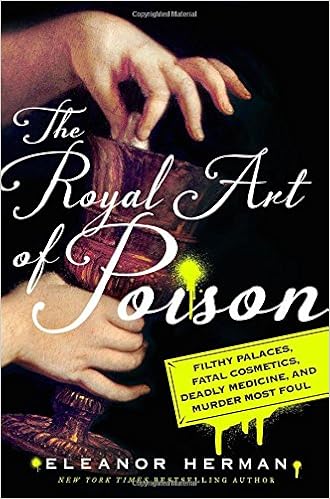
Which leads me to Eleanor Herman, who wrote an entire book about poison. Poisonings today are pretty mundane, straightforward and unglamorous affairs, and usually happen because of Vladimir Putin. The Royal Art of Poison instead focuses mostly on ye olde poisonings in all their glorious lurid detail – there are poison factories, a woman who spent years selling an iocane-like liquid that she smuggled in holy water vials, princesses who died in agony, and all sorts of insane ideas about what could neutralize or detect poison. Think unicorns.
And they did some pretty crazy stuff. Not just the extensive poison-taster of stereotypical medieval lore, but servants who had to test the bed linens, the napkin, the silverware, the clothes, even the chamber pot.
But Herman also addresses the things that poisoned people by accident, ranging from heavy-metal makeup to sewage to archaic medicine (both folk and “learned”) to potions created to maintain the youth and beauty of royal mistresses. The most successful of them was a woman who, ironically, poisoned herself with gold… but hey, she died looking decades younger than her real age. I’m surprised Hollywood hasn’t tried to follow her routine.
And Herman also does a little detective work in chapters interspersed throughout the text, wherein she studies the cases of various people thought to have died – or even just rumored to have died – because of poison. Their symptoms are examined, and sometimes their mortal remains, and Herman forms hypotheses about what killed them. Sometimes it was almost certainly poison. But oftentimes it was a medical condition that they couldn’t yet diagnose which caused people’s unpleasant deaths, or perhaps something that poisoned a person but which was perhaps unintended.
And because of the people often included in this – popes, kings, mistresses, Borgias, Medicis, and so on – there is also a soupçon of other things that make life interesting. There are tombs destroyed by the French Revolution. There are assassination attempts (sometimes foiled by dogs). There is the pervasive belief that women who don’t have enough sex go crazy (but too much is bad too – apparently sex is like chocolate). There is cannibalism. There are corpses stuffed into beds with sick people. There are dead birds tied to people’s heads. There is an alcoholic elk.You cannot make this up.
I know I’m making this book sound kind of like it’s all clickbaity sensation, but it’s very educational – Herman just makes it incredibly fun to learn these things, about the way medieval/Renaissance people thought and saw the world, and the things they did in their daily lives. You’ll find out about the evolution of religious practices, the courtly interplay of love, murder and power, intellectuals and scholars, the lives of more obscure royals and nobility (mad King Erik), and other fascinating historical tales that are made more colourful in the telling.
So if you enjoy history told in its most fascinatingly strange and wonderfully memorable, this book is a must-read. Also, read Herman’s other books.
I hate masks. Every time I try to speak through one, I get a mouthful of wet cloth. Breathing through them is horrible.
Jay Exci has an excellent Youtube channel.
I haven’t been to the library in weeks.
Books I want to check out: the Secrets of the Immortal Nicholas Flamel series, Seven Deadly Shadows, Call Down the Hawk, the fourth Percy Jackson book, some V.E./Victoria Schwab, the expanded edition of Neverwhere, etc.
Two Dresden Files books in one year? It’s Christmas come early!
And since Covid-19 has shut down the country, I cut my own hair.
And Harley Quinn is definitely considered one of those bad, unlikable people. Unlike with the DCEU version of Harley Quinn, we have it demonstrated for us that she’s crazy and dangerous in two different ways. First, when we first see her, she’s watching Looney Tunes on a phone, until a therapist takes it away from her… and Harley bites the woman’s ear off. That few seconds demonstrates what she is far more effectively than the DCEU Amanda Waller talking for several minutes about how she’s really crazy and dangerous, guys, REALLY. She’s as scary as the Joker, you guys! I swear! Please believe me!
It also establishes her kooky, somewhat childlike tastes. She likes laughing at cartoons, and ignores the strictures of prison rehabilitation in order to watch them.
The other is a scene in which Harley tries to use her sexuality to throw an intrusive security guard off his game, by pulling her jumpsuit top down and exposing her breasts. The guy’s response? Well, unlike in Suicide Squad, he isn’t immediately gaggling at her sexy body… instead, he screams “Don’t move, you crazy bitch!” and takes out his gun, implying that she is so dangerous and so insane that the sight of her is TERRIFYING and will override even the sight of a seminude, extremely attractive woman.
So, we have a woman who is established quickly as being dangerous and violent. However, immediately after establishing that, the movie quickly establishes that she is quirky and eccentric through dialogue. But even more importantly, it establishes that she is automatically drawn to authoritative male figures. Not just men like the Joker, note – she immediately voices her attraction to Deadshot, a man who is extremely unlike the Joker, being controlled, organized, focused, professional and sensible. However, he makes it clear that he’s the one in charge of the Suicide Squad, and that immediately draws Harley’s interest. And being Harley, she keeps pursuing him even though he really doesn’t give a damn about her.
A lot of people who have Harley “get over” the Joker and move on from him (such as in Birds of Prey) don’t seem to realize that being attracted to the Joker in the first place would indicate some serious, deep-rooted issues that wouldn’t magically end with a breakup. It’s not like she’s having a once-in-a-lifetime bad-boy fling that just got out of hand – she romantically attaches herself to a vile psychopath, and identifies with him so strongly that she styles herself after his gimmick. That indicates something that would take serious therapy and psychiatric intervention to even begin to unravel.
But the brilliant part of this movie is that it acknowledges both sides of Harley’s psyche. When the story begins, Harley has broken up with the Joker. It’s never explicitly said just what led to this breakup, but it is kind of hinted at when the Joker says about women that you can’t live with them, and can’t kick them from a moving car.
And this genuinely creepy scene is when we see that on some level, Harley is aware of how utterly screwed up she is, as she screams at Deadshot to let her go, and that she’s going to kill him for what he’s done to her. This is the closest Harley ever comes to full awareness of her own psychological twistedness, and the closest she comes to actually dealing with the wreck of her life due to her choice to be with the Joker.
But at the same time, we know this isn’t improvement. It isn’t empowerment. She’s following the same pattern with Deadshot, even to the point of addressing him as “puddin.” She isn’t attracted to Deadshot for healthy reasons – she’s attracted to him for the same reasons she’s attracted to the Joker, even though the two men are very different.
And because Harley isn’t actually fixing anything in her mind or her life, her screwed-up, twisted mind ends up circling back to the same old abusive relationship as usual. When the Joker manages to free himself from his Arkham cell, he encounters Harley and the Suicide Squad, and Harley immediately leaps on the opportunity to reunite with her “puddin,” to the point where she lies that her presence in Arkham was entirely a ruse to save him from captivity.
There is actually a brief pause between the Joker’s arrival and Harley’s embrace of him, and it actually made me wonder – when I first saw the movie – if she was actually sneakily finding a way to keep the Joker from killing Deadshot and the other surviving members of the Squad, or just seeking a way to escape Arkham without getting shot by him. However, it soon becomes evident that no, Harley is entirely in earnest.
And the demonstration that she’s completely in earnest in reuniting with the Joker – the man she previously tried to murder for “what he’s done to me” – is seen in her final fight with Batman. In this scene, Harley attacks Batman with dark tears dripping down her white-painted face, shouting that while the Joker might abuse her, “you’re the one that’s always hurting me!” Her self-awareness has been swamped by the familiarity of her abusive relationship, and rather than blaming the Joker for his abuse of her, she projects it onto a man who consistently interferes with the men she fixates her whole identity upon.
That’s what ultimately makes the Assault on Arkham Harley Quinn my favorite Harley Quinn: she’s complicated. She’s painfully realistic. She’s kind of a tragic figure, since she’s locked into the same patterns of destructive fixation on men who don’t care about her AT BEST, and she falls into her old abusive relationship again at the end. And yet, while clearly having some sympathy for her, the movie also doesn’t pretend that she’s in any way a good person – she is a violent psychopath herself, and she won’t magically turn into a semi-decent, semi-sane human being just because she’s away from the Joker…
… which is one of the biggest mistakes Birds of Prey made, with its much shallower, stupider version of Harley who is apparently nevertheless supposed to be likable and relatable. One thing Harley Quinn should ideally never be is “relatable.”
So that’s why Assault on Arkham’s Harley Quinn is probably the best depiction of the character to date. Agree? Disagree? Feel free to comment.
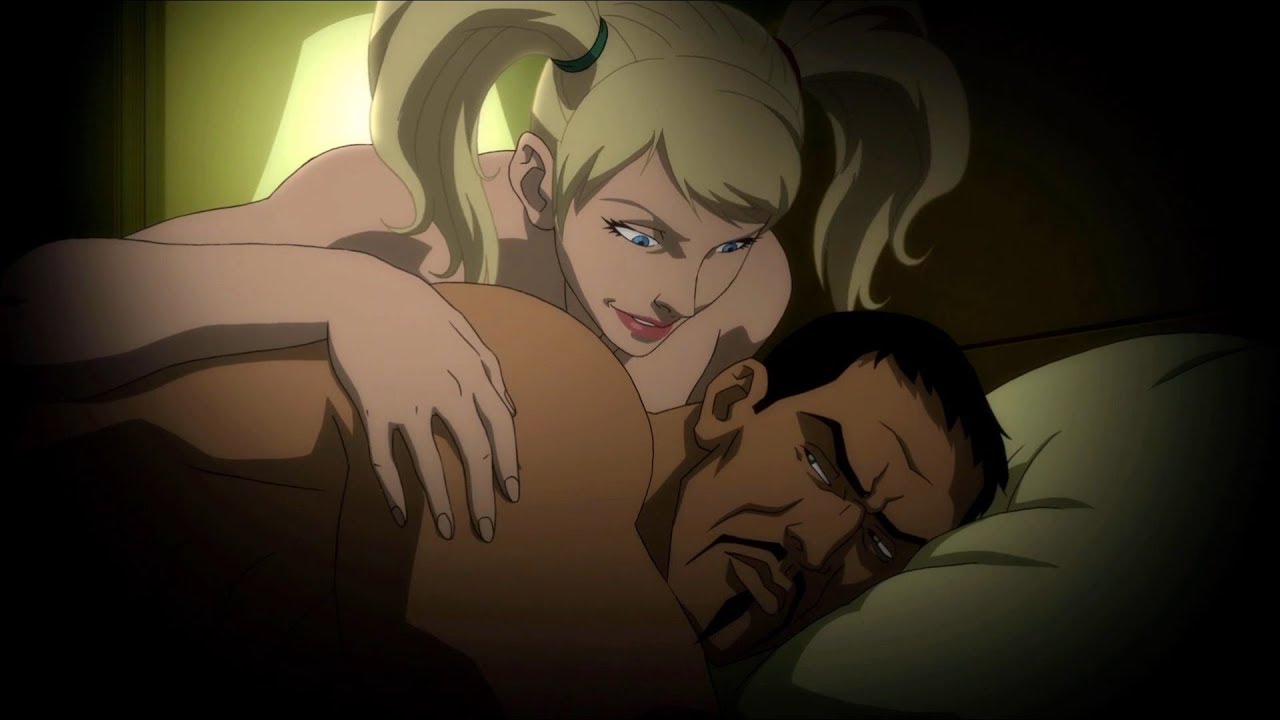
I’ve come to the conclusion that, as far as I am concerned, the best version of Harley Quinn is from the movie Assault on Arkham.
I’m kind of picky about my Harleys. For instance, I’m not really a fan of the Harley-leaves-the-Joker-and-becomes-a-wacky-Deadpool-like-antihero way the character is often handled now, because I feel like her massively screwed-up personality and warped mind are on display with Mista J. It allows her to be bad and corrupted, but also kind of pitiable and sad. Turning her into a copy of Deadpool takes away what made her interesting in the first place.
Then there was that dreadful Batman and Harley Quinn movie, which tried to pad itself out with diarrhea gags, musical numbers, and R-rated humor that felt like it was written by a fourteen-year-old boy. But the worst part was how it moralistically wagged its finger at the audience for objectifying Harley Quinn… while it blatantly objectified Harley Quinn.
Suicide Squad: Hell to Pay? So-so movie, and Harley is suitably flaky and intentionally annoying, but I felt like it didn’t really reflect her nastier, weirder side. She seemed to be all kookiness.
Suicide Squad? Do not want. Birds of Prey? No thank you! The Suicide Squad? Reserving judgement, but James Gunn gives me hope that things will turn out for the best. Or at least entertaining.
I do think she was handled interestingly in Batman: The Brave and the Bold, where she had a flapper aesthetic without losing her edge. And of course, I loved her role in Batman vs. Teenage Mutant Ninja Turtles, where she annoys the hell out of Shredder, demands her doctorate be respected, mutates into a hyena, makes out with the Joker in a way that is both “weird and gross,” and is a huge pain for the heroes in the second-act climactic battle.
And of course, there’s the original Batman: The Animated Series, where the character came from – and which is still one of the best depictions of the character. For one thing, there was a whole arc in her interactions with Batman, growing from just being a henchwoman who obviously tries to kill the Dark Knight to kind of having a crush on him. At the same time, you see Batman’s opinion of her evolve, and he develops sympathy and even pity for her. It was a kids’ show so it was restricted in the way it could depict Harley, but they did get away with a lot, including showing an abusive Harley/Joker relationship that, scarily, is more adult and realistic than the one depicted in Suicide Squad.
Which brings me to Assault on Arkham, which is basically the movie that Suicide Squad was trying to be, but failed to be because David Ayer was also trying to make a darker, grittier version of Guardians of the Galaxy. The story is quite simple: the Suicide Squad is assembled by Amanda Waller, who wants them to break into Arkham Asylum (it seems to be harder to break in than out!) to recover something from the Riddler. Also, Batman is running around the place freaking out because the Joker has a dirty bomb hidden somewhere in Gotham.
If you were one of the many people disappointed by Suicide Squad, then Assault on Arkham might make you happy, because it does everything right that Suicide Squad did wrong. The biggest difference is that Ayer tried to make the bad guys in his movie ultimately heroic, and pushes the importance of working together and friendship. And… that doesn’t work for a team of murderous sociopaths that include a cold-blooded assassin whose only soft spot is somebody who isn’t on the team, a cannibal, a psychopath’s psychopathic girlfriend, a woman who doesn’t care about anyone else on the team (and isn’t really a part of it), and Slipknot.
(Admittedly, Slipknot might be a big fan of friendship and working together, but we don’t know because he dies about two minutes after being introduced, because he was kind of an idiot)
Honestly, the only person for whom that entire arc makes sense is El Diablo, a gang member who killed his family. Because unlike the others, he at least feels bad about it. And well, you have to have some cooperative skills if you’re in a gang.
It feels like Ayer wasn’t really comfortable with making a movie about bad people (as evidenced by Harley stealing a purse and explaining with a cringy “we’re BAD GUYS!,” as if shoplifting was a sign of her being a psycho). There’s always the feeling that he’s trying to paint them as not being as bad as they’re supposed to be, because he can’t bring himself to have them do bad things or act like the sociopathic losers they are.
There is none of that in Assault on Arkham. The best part of the movie is that the Suicide Squad do not act like friends. Oh, a few bonds (some very short-lived) do form between members, but for the most part these are bad people who dislike each other, don’t work well together, and take the absolute first chance they get to stab each other in the back. In fact, the climax of the movie is everything going to hell because these idiots have caused so much mayhem and disarray, and even as Arkham Asylum bursts into mass violence, they are still fighting each other. The characters are fun to watch, but they are definitely not depicted as good people or in any way likable.
I’m going to split this blog in half, because it’s getting too long.