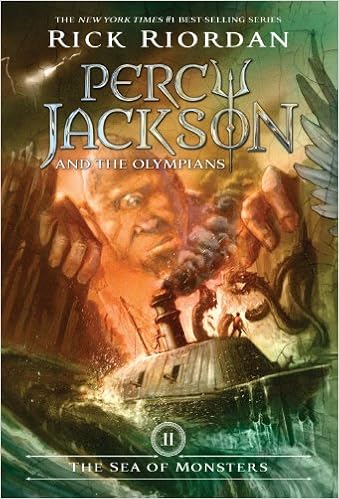
Review: The Sea of Monsters (Percy Jackson and the Olympians, Book 2)

Percy Jackson may have averted a war between the most powerful of the Olympian gods, saving the Western world in the process. But something more dangerous is on the horizon, something old and dark and terrible.

And that power starts pushing its way to Camp Half-Blood in the second book of the Percy Jackson and the Olympians series, The Sea of Monsters. Author Rick Riordan’s writing style is still snarky and fast-paced, and it feels feels a little more polished than in The Lightning Thief – especially since he weaves together a good portion of The Odyssey into his own adventure, but with the modern twist he’s so talented at creating.

For several months, Percy has been attending a prep school, where his only friend is a large, strong but childlike homeless boy named Tyson. But after an attack by monsters, Percy and Tyson are forced to flee with Annabeth back to Camp Half-blood. They soon learn that Thalia’s magic tree has been poisoned, meaning that the barrier protecting the camp is slowly disintegrating. To make matters worse, Chiron has been replaced by Tantalus, who hates the kids and takes a particular dislike to Percy, and Tyson is revealed to be a young Cyclops and also Percy’s half-brother.

But then a dream from Grover tips Percy and Annabeth off to the one thing that can save the camp – the Golden Fleece. Unfortunately, Grover is currently located in the Sea of Monsters – the Bermuda Triangle – and is in danger of being molested by a Cyclops who wants to marry and/or eat him. Unfortunately, Tantalus sends the brutish Clarisse to retrieve the Fleece, and forbids any other campers from going on a quest to find it, on pain of being eaten by harpies.

Shocking spoiler alert: Percy, Annabeth and Tyson decide to go on a quest to save Grover from death (or worse). But they soon discover that satyr-eating Cyclopes aren’t the only threat that lurks in the Sea of Monsters – ancient horrors are lurking, waiting to consume (or transform) the young heroes. Worst of all, an old enemy is also lurking in the Sea – and he wants the Golden Fleece as well.

There’s a hefty chunk of The Odyssey in the DNA of The Sea of Monsters – we have a visit to Circe (whose magical routine has changed a little… but not much), Scylla and Charybdis, and a visit to a Cyclops. However, the core of the story is Riordan’s own, and he creates a lot of stuff for this story that is very much in his own style (such as a Confederate ironclad crewed by zombies), and which works pretty seamlessly with any Homeric homages.

Riordan’s writing is a little more polished in this book, integrating the weirdly mythological with the modern world a little more smoothly (the Gray Sisters and their taxi). And he knows his mythology, as evidenced by the inclusion of Tantalus and his seething hatred of all kids, who is mostly used as an obstacle… and a source of laughs, since his mere presence repels all food and drink.

He also builds up a real sense of darkness and impending disaster, starting with the truly nasty monsters that roam through the Bermuda Triangle area… and building up to to the return of a familiar character, who is planning to use the Fleece for extremely evil reasons. But don’t worry, there’s still a wild, lighthearted side to these monstrous encounters. Let’s just say that centaurs know how to party. And pirates need vitamins.

Riordan also introduces or expands a few characters in the cast beyond just Percy and Annabeth. The most significant addition is Tyson, a kind and gentle boy who is mocked and ostracized by most other kids, especially since he often seems like he has a mental disability. This also leads to some good development for Percy, who struggles with feelings of both love and shame for his awkward, monstrous, childlike sibling – something that many siblings of disabled children sometimes feel. Clarisse also receives some development, since we see her uncertainty and the reason she’s so gung-ho to always succeed.

Rick Riordan was pretty entertaining in The Lightning Thief, but he seems to have hit his stride in The Sea of Monsters. The characters are deeper, the fantastical exploits more intricate, and the threat of the Big Bad substantially more present. And the story ain’t over yet.

Review: Batman Unlimited: Mechs vs. Mutants

Batman fights a Godzilla-sized Killer Croc… in a giant Batman-themed mech suit.

If your head did not just explode from the sheer awesomeness of that idea, then I am sorry, my friend – there is just no help for you. Batman Unlimited: Mechs vs. Mutants, the third and final film in the Batman Unlimited series, proves that they saved the best for last. The script is tighter and cleverer than in the previous movies, and the action gets literally supersized in Pacific-Rim-style brawls.

After several months in exile in Antarctica, the Penguin (Dana Snyder) convinces his antisocial roommate Mr. Freeze (Oded Fehr) to return them to Gotham in over to take it over. Their plan: break into Arkham Asylum to free Bane (Carlos Alazraqui), Killer Croc (John DiMaggio), Clayface (Dave B. Mitchell) and Chemo, then combine the essences of three of them into a super-growth potion that will make Killer Croc and Chemo into kaiju-sized monsters. In case you’re wondering why they would want to do that, Killer Croc has somehow gained the ability to spew ice, which causes a small ice age to fall over Gotham.

Batman (Roger Craig Smith) immediately takes on these foes alongside his newest Robin Damien (Lucien Dodge), Nightwing (Will Friedle), Green Arrow (Chris Diamantopoulos) and the Flash (Charlie Schlatter). However, things quickly spiral out of control when Penguin betrays Freeze, and causes Clayface and Bane to also grow to gargantuan proportions. So there’s only one thing that the Caped Crusader can do: run back to Wayne Enterprises and get the building-sized, fully-functional battle mech suit that can punch out these giant monsters. Green Arrow has one too.

I may be slightly biased in the favor of Batman Unlimited: Mechs vs. Mutants, because I happen to think that Pacific Rim is a modern masterpiece. Mecha punching giant monsters makes me happy. What can I say? And there’s definitely a similar vibe to this film, with an emphasis on giant monstrous supervillains being repeatedly punched through buildings by Batman and Green Arrow’s giant mechanical fists. Also, toxic chemicals, snow and lava are spraying everywhere, so it’s not just punching.

It’s also probably the most complicated of the Batman Unlimited movies – in addition to the four kaiju-sized supervillains, there are also two main villains who are planning to betray each other. It’s abundantly clear that Freeze and Penguin aren’t going to be friendly for long, which further complicates a tale that already had plenty of stuff going on. There are some things that are a little zany (a penguin operating lab machinery), but they oddly seem to fit the over-the-top tone of the film.

The voice actors all do pretty good jobs, including Oded Fehr’s turn as the antisocial, perpetually-frustrated Mr. Freeze. The movie also works in a subplot for Damien, who is upset and feeling inadequate because he humiliated himself during a fight with the Joker. He doesn’t really resemble the arrogant brat from the comics… at all… but he is a fairly likable Robin.

And in addition, to the villains who actually do stuff in the movie, there are also some cameos by characters such as Cheetah, Mad Hatter, Hush, Two-Face, and most notably Troy Baker’s Joker, who is there just to be cranky because Penguin isn’t including him in the plan. Admittedly, it would be wonderful to see a kaiju-sized Joker rampaging through Gotham, but it never happens.

Also, there’s a henchpenguin named Buzz, who is hands-down the best character in the movie.

Batman Unlimited: Monsters vs. Mechs gives us exactly what the title suggests – if the thought of Batman piloting a Jaeger-style mech gives you a thrill, then this little animated movie might just be your speed. At the very least, it’s a fun way for the kids to spend an hour or so.

A problem with the Inheritance series

I’ve been thinking about Christopher Paolini and the Inheritance series lately, and about the large quantities of virtual ink spilled over the years because of it. The series has a lot of problems with it – the derivative world-building, the Gary Stu protagonist, the clumsy insertion of the author’s views about things like vegetarianism, the screwed-up morality, the wildly unrealistic depictions of battle, and so on and so forth.

But I think a lot of the problems stem from the one thing: the author was growing up as he wrote the series.

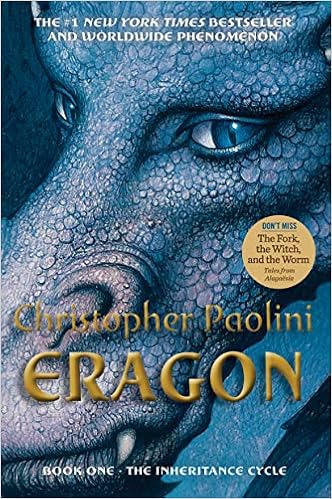
In case you are unaware of this series, Christopher Paolini was a teenager when he wrote the book Eragon. He was initially self-published, but was almost immediately picked up by Knopf and became a bestselling author. Now, I am not saying that a young person cannot be a good writer. It doesn’t happen very often, as I’ve seen firsthand, but it can happen.

The problem is that if you read the Inheritance series, it becomes obvious that certain parts of Paolini’s beliefs, thoughts and behavior were… not set in stone. As a child, you more or less align with what your parents think and believe. When you’re a teenager, and sometimes even when you’re a twentysomething, you are figuring out what you think, how you see the world, and what you believe is right. Sometimes it ultimately aligns with what your parents think, and sometimes it doesn’t. The point is, those decisions and how you work them out are a part of growing up.

Take religion. The second book, Eldest, is extremely anti-religion, depicting the atheist elves as rational, intelligent and superior in every way, and the religious dwarves as overemotional unintelligent inferiors. Sort of like how many a douchebag atheist likes to depict the world, rather than how it actually is.

And then, at the beginning of the third book… he also features a chapter devoted to cannibalistic religious rituals that honestly feel like anti-Catholic propaganda by someone who doesn’t actually know anything about the religion.

And then… later in the book… Eragon encounters a god. It doesn’t make much of an impression, oddly.

And then in the fourth book, he sort of goes, “I dunno, maybe there are gods, but I’m so awesome and have so much power that I don’t need gods for anything, and obviously they don’t care about anyone anyway.” Which is really a very stupid and illogical perspective, especially written by a mere weak fleshy meatbag like the rest of us, but it demonstrates an evolution of thought over the course of the entire series and the better part of a decade. The perspective, which at least admits the possibility of gods, here is not the same as it was in Eldest. And while this conversation shows no deep or consistent theological musings, he still demonstrates more thought than he showed in Eldest, where the depth of his theological examinations was “LOL religious people suk and atheists are awesome.” At least he was answering points that actually sounded real, and didn’t do it in a condemnatory or bigoted manner.

Here’s another: vegetarianism. We return to Eldest once again, in which Eragon becomes a vegetarian when spending time with the Mary Sue elves. Because they’re elves, and everything they do, think and believe is absolutely perfect, and so on and so forth. This is depicted as the only moral way to live, and that animals should not suffer for human (or elf) consumption (despite Arya wearing leather clothes. Oops). I’m not going to get into a debate about the morality of eating animals, I’m just saying that this is what he presents as the unwavering moral thing to do.

And then… in Inheritance, Eragon starts being tempted by meat, and eventually he decides hey, if he’s offered meat socially, he’ll have a little, and that moderation is an acceptable way to live. After that, he starts eating meat again.

Again, it shows a change in perspective over several years, and it demonstrates that Paolini’s perspective wasn’t a particularly solid one. I’m not saying people older than their teens and early twenties can’t change their opinions or perspectives – far from it. I am saying that the time when Paolini wrote these books was a period when a person is still figuring themselves and their perspectives out.

And there are other things in the series that would point to the naiveté of youth and a lack of personal experience. For instance, the condemnation of the king levying taxes in the first book. Not excessive taxes, like in the Robin Hood folklore – just the fact that taxes exist at all. It’s very much a child’s understanding of how the world works, and it doesn’t do the book any favors to include such a childish perspective.

Simply put, Paolini was growing up and figuring himself out as he wrote these books. He would have been better served by waiting a decade before publishing anything.

For a comparison, let’s take George Lucas. When Lucas made the original Star Wars, he was considered a young bright star on the rise. But he was in his early thirties by then. He was a man. He had grown up completely. Hence why there isn’t a massive shift in perspectives over the course of the original trilogy. There are changes, such as the identity of Luke’s father, but those are more due to Lucas changing the story as he wrote it, rather than some kind of shift in the way he saw the world.

Anyway, since he has hopefully settled down in his opinions and viewpoints, I am going to give adult Paolini a chance to impress me with his new science fiction novel, To Sleep in a Sea of Stars. As long as there are no screeds against meat or religion, anyway.

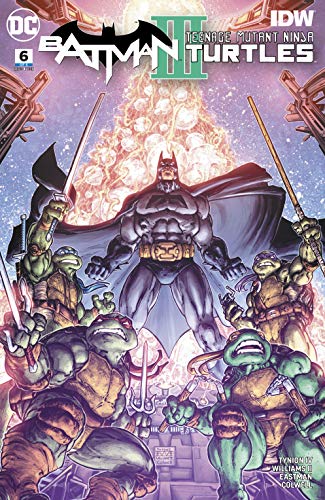
Review: Batman/Teenage Mutant Ninja Turtles III

In the first Batman/Teenage Mutant Ninja Turtles miniseries, the Turtles found themselves stranded in Batman’s universe, where they had to help Batman defeat Shredder. In the second miniseries, Batman had to pay a visit to the Turtles’ world to help them defeat Bane.

So where were they going when the third crossover came around? Why, a new universe made of the two worlds mashed together!

And this composite world does make Batman/Teenage Mutant Ninja Turtles III a little difficult to immerse yourself into at first, since your mind will probably be busy parsing through all the composite characters and figuring out who is what is who. But once you get used to Clayface being merged with Rocksteady and Killer Croc being merged with Bebop, it’s a rollicking mind-bending adventure that affectionately homages the pasts of both franchises.

Ever since the tragic death of his parents, Bruce Wayne has been raised by his butler/sensei/surrogate father Splinter, alongside his four mutant turtle brothers Leonardo, Donatello, Raphael and Michelangelo. The five of them battle against the Smile Clan, a ninja clan who are led by the brutal Laughing Man (an amalgam of Shredder and the Joker). But Bruce is haunted by strange dreams and feelings that something isn’t right – and his feelings are proven right when a Raphael from another universe appears.

But it’s not just any alternate version of Raphael – it’s the Raphael from the original Mirage comics, the prime universe from which all Turtle realities spring. And not only does he know that something is very wrong with this amalgamated reality, he knows why: the Turtles’ great enemy Krang is trying to rule both the Turtle and DC multiverses, by capturing both the Mirage Turtles and the original Batman.

The Turtles and Batman aren’t exactly pleased with the revelation that the shared life and experiences they all remember aren’t “real,” but they slowly come to realize that the Mirage Raphael is telling the truth. The only way for them to take down Krang, and separate their universes again, is for both Batman and the Turtles to find out who they really are – and reform the world into what it’s supposed to be.

If the first two Batman/Teenage Mutant Ninja Turtles adventures felt like explorations of each other’s universes, then the third feels like a celebration of both franchises. This came out in time for Batman’s 80th anniversary, and the Turtles’ 35th, and the love for both is strong – especially since it goes out of its way to highlight the “progenitor” Batman and Turtles (the latter of whom is even drawn by Kevin Eastman in black and white).

And it’s a fun ride – it has some wrenching pathos (the rediscovery of Alfred), some heartwarming moments (the Turtles reunion with April) and some funny lines thrown in to keep it from ever feeling too dark (“… I’ve finally found the great progenitors!” “That’s not a nice thing to call someone, dude!”). Above all, it has a sense of rising butt-kicking action as the Turtles and Batman dig up their true identities and start forcing the universe into the shape it’s meant to be, which requires some reorganization of the Smile Clan. With every triumph comes a little thrill.

Its biggest flaw is that it can be a little confusing at times – some characters are clearly amalgamations of characters from both the Bat and Turtle universes… and other seem like they are (the Turtles, the Laughing Man), but we later find out that their counterparts do actually exist in this world. Also, the Bat-Family kind of comes out of nowhere for the big climactic battle.

As always, Freddie Williams II’ art is awesome – he knows the right style to render both Batman and the Turtles in, giving them a complex, sculpted look that fits both universes. And the legendary Kevin Eastman contributes some pages as well, sketching in the progenitor Turtles and their world in a rough black-and-white style that harkens back to the Mirage comics, allowing those Turtles to stand out.

There’s a certain bittersweetness to Batman/Teenage Mutant Ninja Turtles III, since we’re probably not going to get another crossover for awhile – and if we do, probably not a sequel to this one. But it’s still a rollicking ride through both franchises, rendered with affection and respect. Cowabunga!

Review: Batman Unlimited: Monster Mayhem

Second verse, same as the first… but now with more Joker and a cyber-robo-T-rex.

So if you enjoyed the first futuristic, colorful Batman Unlimited adventure, you’re probably going to enjoy the second, “Batman Unlimited: Monster Mayhem.” It follows roughly the same pattern as the first movie – a bunch of motley minor supervillains start running amuck, and are found to be involved in a mysterious scheme that threatens all of Gotham city. But it has enough mysteries and differences that it doesn’t feel repetitive, especially with the outstanding Troy Baker taking center stage as everyone’s favorite psychotic clown.

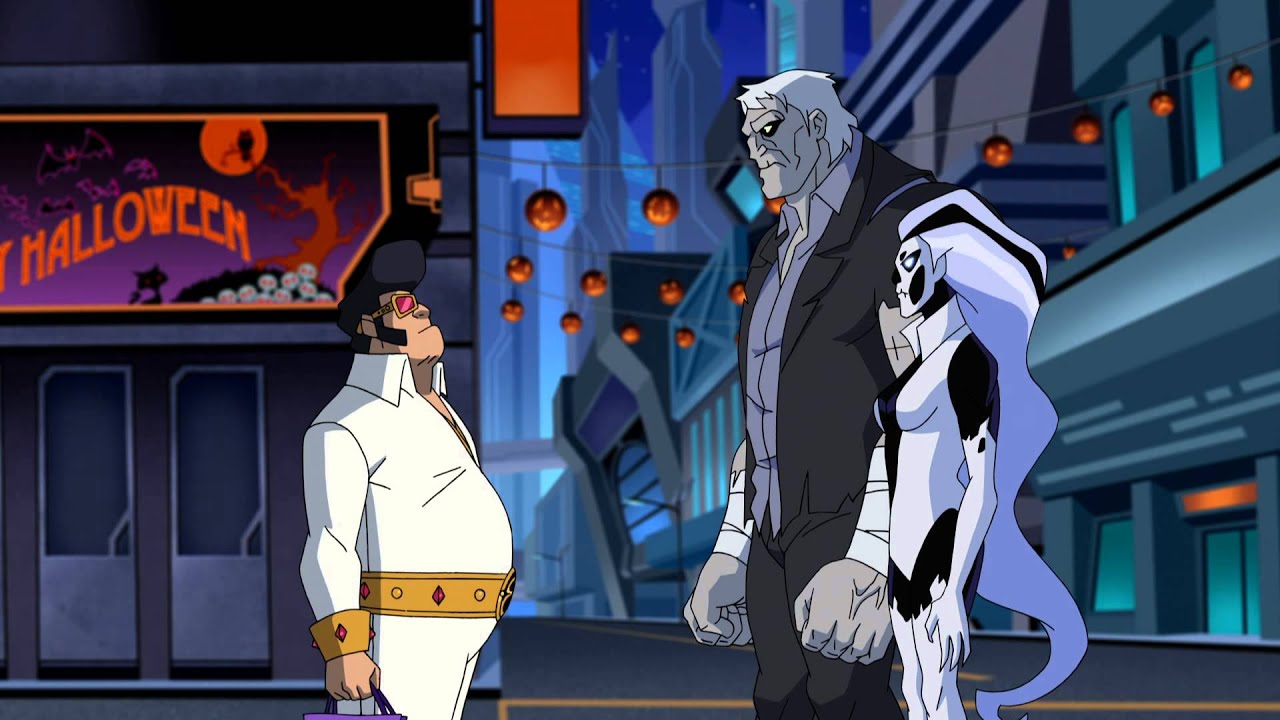
On Halloween, Solomon Grundy (Fred Tatasciore), Silver Banshee (Kari Wuhrer) and Scarecrow (Brian T. Delaney) manage to break out of Arkham Asylum and escape, despite the best efforts of Nightwing (Will Friedle) and Green Arrow (Chris Diamantopoulos). Batman isn’t entirely sure why they’re teaming up, and he gets a little distracted by the kidnapping of a famous video game designer by Clayface. And who is the mastermind behind all of this? None other than the Joker (Troy Baker).

Unfortunately, the Joker has a plan far more devious than merely kidnapping video game designers and stealing atomic batteries. After stealing a rare Incan gem, he unleashes a computer virus on all of Gotham, reducing the city to a darkened shell of its former self and turning Batman’s tech against him and his allies. Oh, and he declares himself king and puts his various cronies in positions of power. So naturally Batman and his allies will have to get creative in order to find their enemies and bring them down – both physically and digitally – before Joker has the chance to spread his virus across the entire world.

If you enjoyed Batman Unlimited: Animal Instincts, there’s a fairly good chance you will also enjoy Batman Unlimited: Mutant Mayhem. It still has the feeling of a fluffy but fun toy commercial with a plot added, and it has mostly the same heroic cast – although Cyborg is a supporting superhero rather than the Flash – and a fairly colorful array of villains. But the real showstopper is the Joker, played to gleefully insane perfection by Troy Baker. Baker is probably the second-best animated Joker out there, and he gives a thoroughly fun performance (such as when he plays several news anchors at once).

Of course, the entire cast is pretty good – Smith has a good low voice for Batman, Diamantopoulos is good as the lighter, wittier Green Arrow, and they’re backed by Friedle and Yuri Lowenthal as Nightwing and Red Robin. The latter two are also made more distinct by showing some of Nightwing’s fears as a superhero, balanced out against Red Robin’s quirky love of video games and unconventional fighting style.

There’s plenty of action in this movie, and it’s kept fast-moving and innovative at all times – baseballs as weapons, World War II planes, fear gas, an Iron-Man-like mech suit, a genuinely spooky attack by Clayface, and a very trippy cyber-battle between Batman and the Joker. There are some slower moments where Batman and his compatriots have to do some detective work, but these fortunately don’t bog down the pace.

The only problem is that Cyborg doesn’t have much superheroing to do in this movie – he mostly just gets infected by the virus, and spends almost all his screen time fighting the good guys. Also, “monster mayhem” is kind of an erroneous description, since there are no monsters here, except maybe Solomon Grundy; this mostly seems to be the title because, well, the beginning takes place on Halloween and some of the villains are a little spooky.

It’s not the deepest or most intricate adventure for the Dark Knight, but Batman Unlimited: Monster Mayhem is a colorful and action-packed popcorn adventure – and if you enjoy the Joker, Baker’s performance is a must-see.

Upcoming sequels

So probably my biggest anticipated sequel is the second book of Maggie Stiefvater’s Dreamer trilogy. I’d love to refer to it by title, but Amazon doesn’t have it yet. Anyway, I practically get drunk on Maggie Stiefvater’s prose, so I’m dying to have more.

I’m also looking forward to Aurora Burning, the sequel to Amie Kaufman and Jay Kristoff’s Aurora Rising, which was probably one of my favorite sci-fi reads of last year. Without revealing too much about it, it has a lot of mystery, elf aliens, the Great Ultrasaur of Abraaxis IV, and it mingles a sense of humor with some very serious galaxy-threatening consequences, and a tinge of tragedy as well. So I do want to find out more.

Sarah J. Maas is releasing a fourth Court of Thorns and Roses book, but I don’t know anything about it.

After making a swerve into Japanese folklore, Julie Kagawa is going back to her Iron Fae series, and this time she’s writing about Puck. I’m all in.

Review: JoJo’s Bizarre Adventure: Part 1 – Phantom Blood, Vol. 1

You expected another review, but it was me, Dio!

I came into the famed manga series Jojo’s Bizarre Adventure more or less blind – I had seen a few memes and GIFs of the anime adaptation, but knew nothing of the actual story. All I knew that was that it presumably involved someone named JoJo, and that it was allegedly bizarre.

So how bizarre is the first volume of JoJo’s Bizarre Adventure: Part 1 – Phantom Blood? Less bizarre than the title would have you believe, presumably so that author Hirohiko Araki can gently lower you into the strange stuff rather than flinging you into the deep end and letting you drown in undiluted bizarre. It starts off fairly normal as the tale of a psychopath infiltrating an aristocratic family… and about two-thirds of the way through, weird things start to happen.

The story follows two young boys, the aristocratic Jonathan Joestar and his foster brother Dio Brando. They are raised together by Jonathan’s kindly father, whose kindness apparently doesn’t extend to keeping his son – or his son’s unfortunate dog, or his son’s girlfriend – away from a violent psychopath. Yes, Dio is pretty much pure evil, and is scheming to destroy Jonathan and steal the Joestar fortune for himself. Why? Well, because he’s a violent psychopath.

The two boys somehow manage to grow up and flourish despite their hatred for each other, and Dio being pure evil. But when Lord Joestar becomes mysteriously ill, Jonathan becomes convinced that Dio is responsible, and sets out to London to prove it. Dio pursues him with the intent of killing him, using an ancient Aztec mask that shoots giant spines into the brain of its wearer when it ingests blood.

And then things get weird.

Yes, that’s when things get weird. That’s when we encounter a strange man named after a rock’n’roll band, who spins a razor-brimmed hat on his arms like a top. And there are vampires.

Fortunately, the first volume of JoJo’s Bizarre Adventure: Part 1 – Phantom Blood is actually a pretty compelling read even before it spirals into the crazy stuff. It’s not a very complicated story – it’s more or less a clash between the ridiculously noble and idealistic Joestars, and the ceaselessly corrupt and evil Dio. There’s not really any shades of grey here, just a clash between darkness and light.

And Hirohiko Araki doesn’t really bother beating around the bush with showing us how evil Dio is, since literally the first thing he does when he meets Jonathan is to abuse the kid’s beloved dog. It’s pretty frustrating to watch, since Lord Joestar just sort of lets Dio do whatever he wants, rather than recognizing how despicable the boy is and getting him out of the Joestar family’s life. It’s actually a huge relief when Jonathan takes control of the situation, and fights back against Dio’s attempts to kill his father and crush his spirit.

And it’s all so wildly, wonderfully dramatic. Characters strike powerful poses and shout grandiose statements at each other, especially Dio’s openly narcissistic question of how “scum” like Jonathan could hurt him. The action scenes are relatively rare, but they are full of rough raw kinetic energy that bursts off of the page, lots of muscled bodies swinging and crashing with the power of collapsing Titans.

Although if cruelty to dogs bothers you, there are… certain scenes to be skipped.

The first volume of JoJo’s Bizarre Adventure: Part 1 – Phantom Blood is still a little rough around the edges, and it takes a little while to get to the weird stuff, but it’s a bombastic and entertaining ride. And one can only assume Hirohiko Araki has more bizarreness to come.

Review: The Lightning Thief (Percy Jackson and the Olympians, Book 1)

If there’s one thing the Greek gods were known for, it was being petty, cruel tyrants who made the lives of lesser gods and mere mortals unpleasant. But if there was a second thing they were known for, it was having flings with mortals and producing countless demigod children. Zeus was especially bad.

So Rick Riordan asks the question: what if the Greek gods were real, and still around in modern America, and there was a special camp specifically for those “half-blood” kids? “The Lightning Thief,” first book in the Percy Jackson and the Olympians series, is an effective entrance into a colorful Greco-influenced fantasy adventure, written in a sharp, irreverent style that fits its odd hero perfectly.

Perseus Jackson doesn’t seem like an exceptional kid – he has a mother he loves, a nasty stepfather he loathes, dyslexia and ADHD, and he goes to a school for troubled kids. But when his algebra teacher morphs into a monster and tries to kill him, Percy’s life spins out of control. After he’s attacked by the Minotaur and his mother is seemingly killed, he ends up at the magical Camp Halfblood, where the modern half-mortal offspring of the Greek gods are sheltered and taught.

But then Percy is identified as the son of the sea god Poseidon, which is a bit of a problem, since the gods Zeus, Poseidon and Hades all agreed not to sire any more children. Even worse, it seems that someone has stolen Zeus’s original, unspeakably powerful lightning bolt, Percy is being blamed for the theft, and all-out divine war will ravage the western world if the lightning bolt is not recovered and returned by the summer solstice. But no pressure.

So its up to Percy to reclaim the lightning bolt from Hades, who is the number one suspect. To make matters worse, his cross-country road trip – accompanied by the satyr Grover and Athena’s daughter Annabeth – turns out to be a particularly deadly one, as he encounters gods and monsters that all have reasons to want him dead – and becomes aware of something even worse stirring back to life.

It’s obvious by reading “The Lightning Thief” that Rick Riordan has a deep and rather irreverent love for Greek mythology – he knows about Grecian myths both notorious (Medusa) and obscure (the water beds of DEATH!), and he gives wickedly amusing modern twists to most of the gods we see without losing the core of what they are.

Dionysius, for instance, is the foul-tempered camp director, who wears a tiger-striped Hawaiian shirt, but we get a brief glimpse of the madness and mayhem he can unleash among mortals. Charon has developed a love of designer suits. Ares is a biker with smoking pits for eyes. And so on, and so forth. Even the quest itself feels like a clever modern update on the Grecians quests of old, with Percy and his friends stumbling across strange

And Riordan’s writing more or less parallels his approach to Greek mythology. Percy is a clever and smart-mouthed kid who has a tendency to rub people the wrong way, so even when he’s encountering gods and monsters, the first-person narrative stays snarky and flippant, with an underlying sense of wonder at how crazy his life has become. But Riordan can flip things around into serious, downright sinister territory, such as Percy’s dreams about a mysterious force awakening to attack the gods. And there are some very heartfelt moments, mostly tied up in Percy’s quest to free his mother from Hades’ grasp.

The one downside? Well, the aftermath of the plot… kind of involves cold-blooded premeditated murder. By the good guys. Yes, the person who gets murdered is scum, but it doesn’t really justify killing him when there are, you know, other options.

The characters are more or less divided into two different camps. There are the ones Percy likes and gets along with, such as the no-nonsense Annabeth, the nervy animal-loving Grover, and the noble uber-mentor Chiron (who has an interesting method of hiding his horsey hindquarters). On the other hand, there are the ones he dislikes and doesn’t get along with, like the ugly and brutish daughters of Ares, and Dionysius, who just really despises the campers. There’s not a lot of dimension in the characters just yet, but a shocking revelation about one character does hint that Riordan has more depth in mind for them.

“The Lightning Thief” is an imperfect but cracklingly dynamic opening to Rick Riordan’s mythological universe – and despite its flaws, it makes the prospect of future books incredibly appealing. Very enjoyable.

Review: Fantastic Four (2015)

Back in 1994, a movie was made about the superhero team known as the Fantastic Four, directed by legendary schlockmeister Roger Corman. The movie was low-budget, cheesy, campy… and, unbeknownst to the cast and crew, intended never to be released since there had never been any intention of actually making it good.

Why am I mentioning this? Because despite its silliness, shoestring budget and incredibly hokey acting, that absurd little ashcan movie had a certain charm, an earnestness. It had heart.

And you won’t find any of that in the film released more than twenty years later, Josh Trank’s Fantastic Four (or as many people call it, “Fan4stic”). This is one of those adaptations that seems to be ashamed of its own source material – it’s a dry, dour, dismal and darkly disinterested expanse of choppy storytelling, a staggeringly bad villain, and a superhero team that don’t even really seem to like one another or care about saving the world.

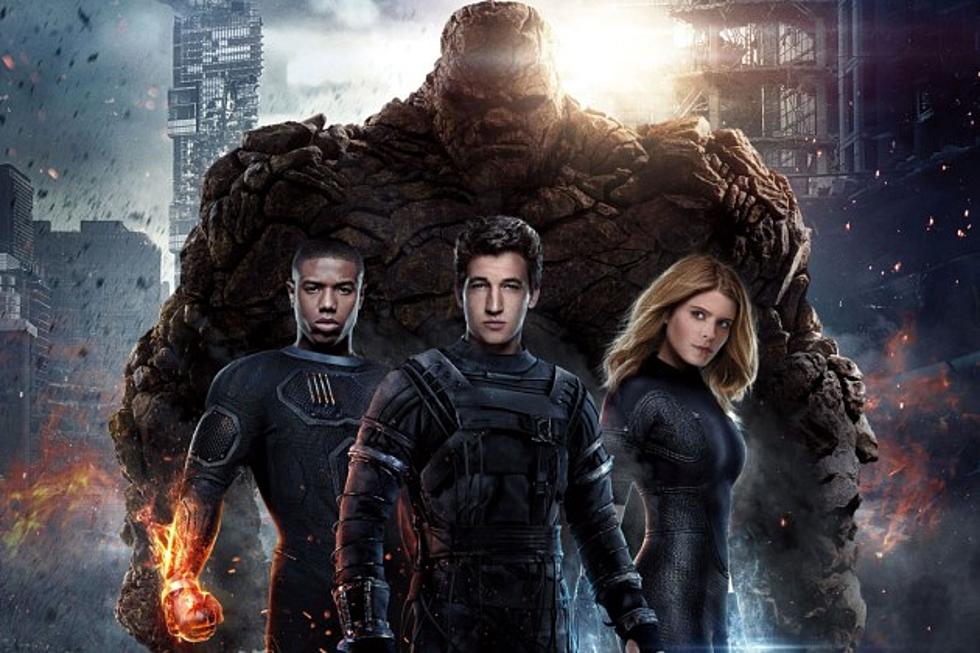
Our… I’m going to say “hero” is Reed Richards (Miles Teller), who spends his formative years building a teleportation machine with his best friend Ben (Jamie Bell). Their efforts attract the attention of Dr. Storm and his daughter Sue (Kate Mara), who are apparently roaming random high school science fairs in search of scientific genius.

They quickly snatch up Reed and set him to work creating an interdimensional teleporter, assisted by Sue’s street-racing brother Johnny (Michael B. Jordan), who doesn’t seem to have any scientific expertise, and computer programmer Victor von Doom (Toby Kebbel). Upon hearing that astronauts will be sent into this other dimension instead of the nerd squad, Reed, Victor and Johnny all get drunk, and decide to go themselves. Yes, being a bunch of dumb drunks is the superhero origin story for this team.

Naturally, their trip is a complete disaster, leaving Victor presumed dead, and Reed, Ben, Johnny and Sue all burdened with superpowers that they don’t really want. Reed flees the facility for reasons that are never really explained, even though he is the key to rebuilding the teleporter and finding a cure for their conditions. However, they have no idea what is waiting for them on the other side.

The overall feeling I get from Fantastic Four is shame. It’s the kind of embarrassment a teenager feels when his mom whips out the baby album and shows his friends how cute he was in his baby bonnet. Fantastic Four wants to be a super-serious-edgy-not-at-all-silly-or-weird-like-the-comics movie, distancing itself from the comics rather than embracing them. No movie has ever been good when it is ashamed of its source material.

And unfortunately, this is not the kind of dark/gritty/serious movie that is plotted intricately and paced well, with plenty of action to keep the story feeling dynamic. This is a movie that seems to cycle from one poorly-lit room to another, with people talking in low monotones without much facial expression. On the rare occasions when action occurs – such as Ben Grimm ripping tanks apart – the movie quickly shifts it to a small TV screen, as if afraid that something exciting might happen.

It also timeskips shortly after the characters get their powers, which only makes the characters feel more disconnected from each other. By the time the main villain shows up, the movie is nearly over, and it tumbles over itself to have a final battle that feels both cliched (look, a sky-beam!) and strangely rushed. It’s like Fantastic Four can’t wait to be over.

And perhaps the movie’s biggest problem is that none of the characters are likable – Teller, Mara, Jordan and Bell are all wildly talented actors, but they’re drained of charisma and individual energy. Johnny seems like a petulant child, Reed is a piece of bland toast, and Mara seems like she’s just enduring it all. Only Bell gets any real development – the scene where Ben begs Reed not to leave him is genuinely heartrending, one of the few effective scenes in the whole movie.

Worst of all, the characters don’t seem like they even like each other. There’s no sense of sibling love between Johnny and Sue, no chemistry between Sue and Reed, and Reed and Ben barely even spend time around each other. They don’t feel like superheroes – they just feel like people with superpowers who don’t really get along until the climactic battle demands that they team up.

And Victor von Doom…. oh, dear. One of Marvel’s most infamous and fascinating villains… is turned into a pseudo-nihilistic computer-nerd edgelord who’s irritated that Sue won’t date him.

Josh Trank’s Fantastic Four is a grim, unpleasant slog – a poorly-lit, action-light story that never picks up any momentum. But the greatest sin is that it never has any heart – just a foursome of bland, unlikable characters.

Review: Eureka – The Complete Series

Upon discovering the answer to a now-legendary problem, Archimedes famously yelled “Eureka!” (“I have found it!”), jumped out of his bath, and ran naked through the streets.

So “Eureka” seems like an appropriate name for the SyFy Channel’s quirky, well-written sci-fi series, all about a tiny town that brims over with geniuses and scientific breakthroughs. While it has the usual ups and downs of any long-running series, “Eureka: The Complete Series” is a charmingly eccentric little show that centers on the life of an ordinary law-forcement officer who just happens to live in a town full of oddball geniuses.

While dragging his delinquent daughter back to L.A., Marshal Jack Carter (Colin Ferguson) accidentally crashes the car. The only nearby place is the picture-perfect small-town of Eureka. But Jack starts to suspect that Eureka is a little odd — and his suspicions are confirmed when a tachyon accelerator starts ripping the seams out of the universe.

It turns out that Eureka is a town filled with geniuses, making groundbreaking scientific discoveries. After the local sheriff suffers a nasty accident, D.O.D. representative Allison Blake (Salli Richardson-Whitfield) makes Jack the new sheriff of Eureka. Now he has a new job, a “smart house” in an old nuclear bunker, and trigger-happy deputy Jo Lupo (Erica Cerra) who isn’t initially very happy to be working with him.

But life in Eureka is never peaceful, with countless scientific disasters threatening its people — and occasionally the whole world — and usually Sheriff Carter stumbles across some crimes and mishaps that just don’t seem to make sense. Some of them are more than mere technical problems: a mysterious Artifact that predates the universe, a boy with strange powers derived from said Artifact, a time jump that throws their lives out of balance by altering the past, a trip to Titan that goes horribly, horribly wrong, and the ever-present threat of government involvement.

“Eureka: The Complete Series” is a nearly ideal combination of gentle comedy and wild sci-fi, with the idea that leading experts in every scientific field imaginable (example: molecular gastronomy) have come to work in Eureka, in order to fully explore their fields. Unfortunately, most of these experts aren’t very good at the “being sensible” part of their job. So when there’s lots of genius and not enough common sense… well, let’s just say Carter’s everyman sensibility is required.

And the writers sprinkle it with funny scenarios (the whole town gets brainwashed into acting out the songs they listen to), bizarre problems (people are turned to stone) and funny dialogue (“I’m Sheriff Carter! I’m gonna save the day with my everyman logic, hahaha!”), which keep things from ever getting too serious. But there are moments of poignancy as well, such as the truly tragic loss of Henry Deacon’s first love, or the whole arc where the space crew is trapped in a virtual world that seems to have been set up to make them violently uncomfortable.

The biggest problem is that sometimes it feels like important plot threads are simply abandoned. The mysterious Artifact is held up as a cosmically inexplicable object that could change the way we see the universe… but it just sort of tapered off and was forgotten. And Allison’s ex-husband was eventually written out because the writers apparently couldn’t figure out what to do with him.

A lot of the show’s charm comes from the talented cast — Ferguson is particularly charming and slightly goofy as a guy so normal that he almost seems like a cliche. However, Carter is a lot smarter than he seems, and has a knack for figuring out the key to fixing these technical disasters. We also have a bunch of excellent actors like Cerra, Richardson-Whitfield, Ed Quinn, Niall Matter, Joe Morton and Neil Grayston. They play everything from nerds who push all the wrong buttons to super-genius mechanics, gun-toting sidekicks to charming bad-boys. Even the supporting cast is delightful, like Matt Frewer as an insane Aussie vet and Chris Gauthier as a feisty gay restauranteur.

Despite some dropped plot threads, “Eureka: The Complete Series” mixes equal measures of dramedy and sci-fi — where else can you find rage zombies, Egyptian bugs and brainwashing music? Clever, charming and well-written.