Review: Batman: Under The Red Hood

One of the most shocking events in DC Comics’ history was the death of Jason Todd, best known as the second Robin. As I understand it, the character was not popular, and DC eventually polled its readers to see if he should live or die… and he ended up savagely beaten with a crowbar and blown up, so you can imagine how the poll went.

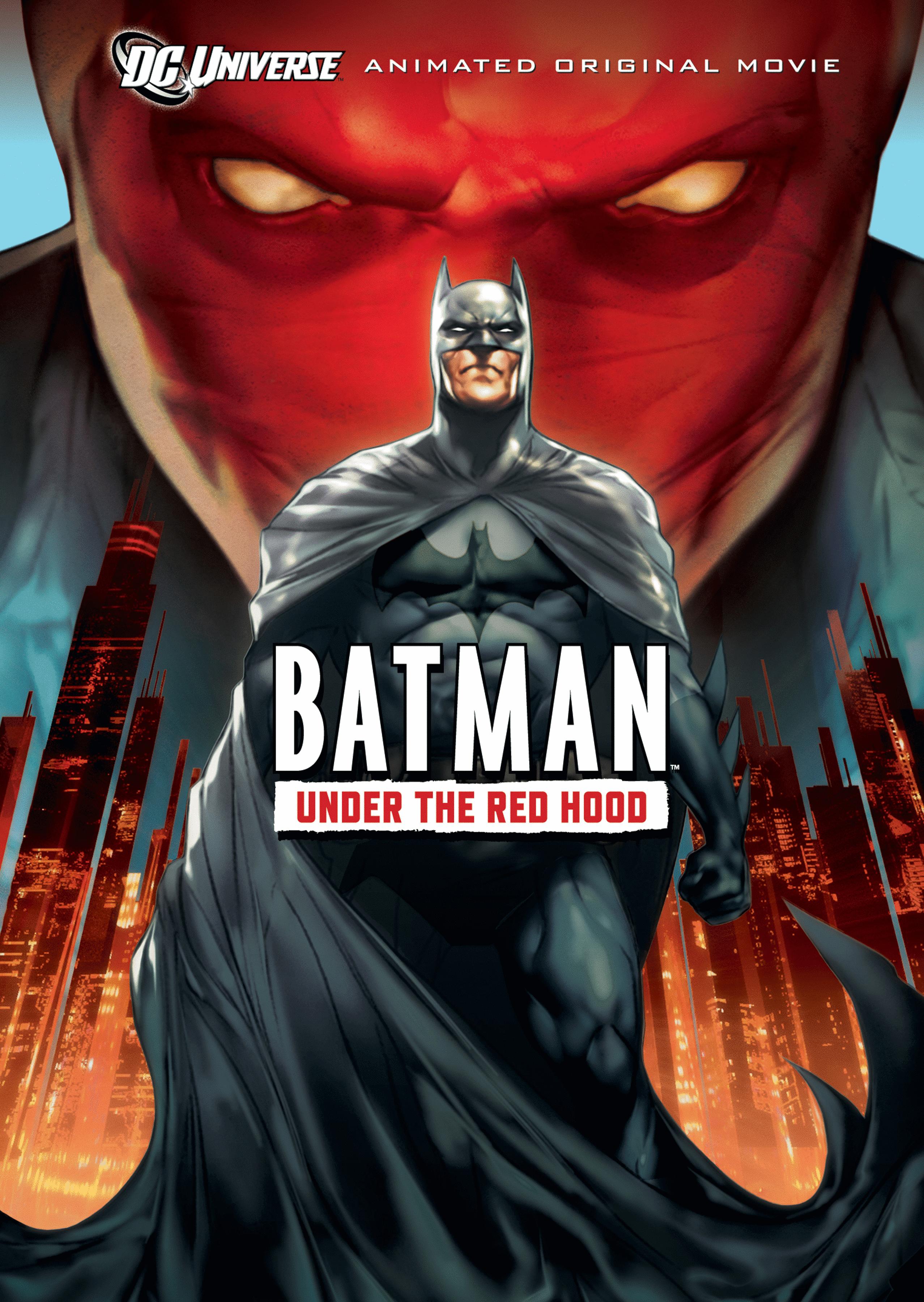
But nobody really stays dead in comics – not major characters, anyway – and one of Batman’s greatest losses comes back to haunt him in “Batman: Under the Red Hood.” This is DC’s animation at its best – a tightly-written, dynamic mystery that unfolds like a bloody black rose, with Batman’s failures and losses at its heart, slowly building up to a conflict between him and the mysterious Red Hood.

Five years after the death of Jason Todd, a masked vigilante known as the Red Hood (Jensen Ackles) appears in Gotham and quickly takes over most of the city’s drug trade. After a disastrous incident involving a superpowered robot, Batman (Bruce Greenwood) and Nightwing (Neil Patrick Harris) encounter the Red Hood – and Batman quickly realizes that this is someone he knows, but he isn’t sure who. And after a second clash, he finds that Red Hood knows his true name.

Red Hood’s new dominance has also brought him into conflict with Black Mask (Wade Williams), a violent crime lord who is driven to extreme measures to take out his new enemy. Of course, his attempts only end up escalating the war, especially when the Joker gets involved. And at the same time, Batman delves into the mystery of who the Red Hood is and what brought him back to Gotham – and finds himself in a final standoff of revenge, hatred and loss.

It’s pretty obvious from the beginning of “Batman: Under the Red Hood” who the mysterious Red Hood is – the big mystery is how he’s returned to life, and what his ultimate plan is. And while Batman peels away the layers of the mystery, the story focuses on the magnitude of the Red Hood’s rise to power – he’s a new power player who uses Batman-like stealth, physical prowess and cunning to bloodily carve his way into the heart of Gotham’s underworld.

The story is a slow burn, but it’s kept from ever getting boring with sporadic bursts of action – falling helicopters, exploding chemical factories, people being set on fire, a troupe of murderous cyborgs, and so on. However, the violence and action never eclipse the emotional side of the story, which is present from the very first scene in which we see Batman desperately trying to get to an endangered Jason Todd, all the way to his climactic fistfight on top of a church.

This is, at its heart, a story about Batman’s losses, his failures, and his pain, and it’s hard not to feel for the Dark Knight as he’s confronted by something even more painful than Jason’s loss: the possibility that his beloved foster son has become his enemy. Red Hood is a more enigmatic character – sometimes he’s deadly serious, sometimes he’s laid-back and quippy. It’s only at the story’s climax that we see what has really driven him all this time, and where his anger has brought him.

Greenwood does a very solid job as Batman – stoic, a little stiff, but with some passionate emotion running under the surface. Ackles does an excellent job with Red Hood both in serious and in quippy mode, able to switch between the two at the drop of a hat. Harris makes a solid Nightwing, who is quirky and chatty and sort of floats out of the plot eventually. And while viewers may be used to Jokers with higher-pitched voices, John DiMaggio’s gritty, sinister-sounding Joker is a pretty chilling one.

DC Comics has made many good animated movies, but “Batman: Under the Red Hood” is probably one of their best – a sublimely dark, tragic thriller that is riveting right to its end. Just try looking away.

Recommendation: Batman Vs. Teenage Mutant Ninja Turtles

I’ve written a review of this movie, but I feel the need to gush about how much I love it.

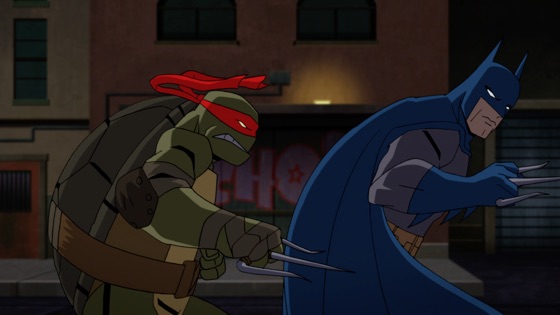
I think what I really like about it is how respectful it is to both franchises. Too often in crossovers, one or the other side is neglected or made to look less competent or less important. This is especially a danger when one of the sides is known for being superhumanly awesome, like Batman.

But I felt like this movie highlighted the strengths and weaknesses of both the Bat-Family and the Ninja Turtles. Obviously they’re very different; Batman is measured and plans out things far in advance, while the Turtles tend to fly by the seat of their nonexistent pants. And this does cause conflict between them as the story unfolds, since Batman is used to people following his lead, and he gets kind of pissy when the Turtles just dash into the conflict. However, it is also shown that there are downsides to Batman’s approach as well, since he’s easily distracted from the main scheme of Shredder and Ra’s al Ghul by a mass breakout and mutation at Arkham Asylum. The Turtles are, in a sense, more focused than Batman because they are fixated on Shredder and his plan, and don’t really want to get involved in all the other criminals running amok in Gotham.

And this can be seen in the villains. Ra’s al Ghul knows exactly how to distract Batman long enough to get the cloud-seeder he wants. But Shredder doesn’t know why the hell Ra’s is doing this, because his enemies probably wouldn’t stray off the path of hunting him just because a mental asylum went boobies-up for the sixth time this month.

So I really like that both the Turtles and Batman have weaknesses and strengths, and Batman’s awesomeness (expertly outlined by Michelangelo) is balanced out by the Turtles’ varied gifts working in tandem. And it works especially well because the different Turtles are paired with different members of the Bat-Family, sometimes because they are similar and sometimes because they are wildly different.

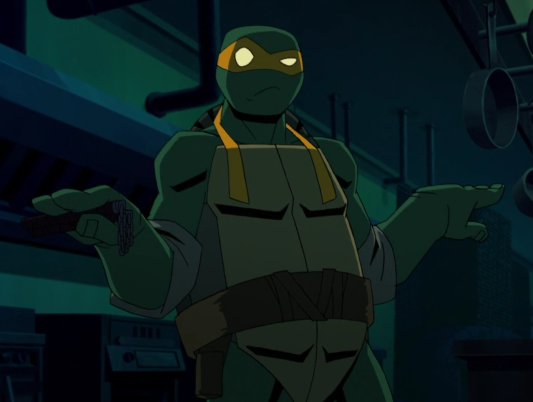
And while all four of the Turtles are wonderfully characterized, I especially loved Michelangelo in this movie. Obviously, the characterization of Michelangelo over the years has really varied – he’s been a surfer dude, a tease and agitator, a space-case flake, and so on. But he’s always had a sweetness and an open-heartedness as a part of his character, which is best seen in the IDW comic book series, where he’s the most sensitive and childlike of the Turtles.

And he isn’t that different in this version. But in this one, he’s the enthusiastic one – he thinks Gotham is the coolest place he’s ever seen, and he loves every strange wacky detail about the place. His brothers are a little more laid-back about Gotham, its dangers and its oddities, but Michelangelo is delighted by gunbrellas to the point of ignoring his own safety. His enthusiasm is clearly the enthusiasm of the makers of this movie, and sometimes it feels like the audience is being carried along by his joy over polar bears with ice guns and police zeppelins.

“Does New York have mad blimps flying around for no reason? I mean, what are they for? I love ’em!”

Michelangelo, Batman vs. Teenage Mutant Ninja Turtles

And I think his enthusiasm is integral to emphasizing how much the people who made this movie loved the franchises: by having a character whose defining trait is how much he loves everything he comes across.

I also love his relationship with Alfred. Obviously it’s played for laughs, with the most rambunctious of the Ninja Turtles bumping up against Batman’s prim butler, who doesn’t understand Michelangelo’s love of skateboards and “greasy cheese bread.” But I enjoy the fact that neither one of them is acting in a way that is illogical to his character.

Michelangelo skateboarding through stately Wayne Manor and crashing into Alfred might seem like he’s being an asshole, but stop and think about it: not only is he a teenager, with all the dumb moments that come with a developing brain, but he’s literally been raised in a sewer. He’s probably not used to being able to skateboard wherever he pleases, and so Wayne Manor just seems like a giant empty space full of awesome curves and obstacles to him.

Obviously he figures out that Alfred doesn’t like this by the end, but it’s clear that he never skateboarded with malicious intent.

Alfred, for his part, is clearly not used to normal teenagers – insofar as you can call the Turtles “normal,” they are at least more normal than Bruce presumably was at the same age. And when you consider the Robins he’s dealt with over the years, usually scarred orphans or Damian Wayne… Alfred probably has no idea what a normal teenage boy is like, with bad table manners and dumb stunts on the stairs.

So that’s my thoughts for the time being on Batman vs. Teenage Mutant Ninja Turtles. Possibly more later. If you’re one of the two-and-a-half people reading this blog, absolutely check out the movie.

Review: Dolittle

There have been two notable adaptations of Hugh Lofting’s Doctor Dolittle books – a Victorian fantasy adventure, and a doofy Eddie Murphy comedy with plenty of scatalogical humor and wisecracking animals.

And the biggest problem with “Dolittle” is that it tries to be both of these things at the same time, which makes it both stupid and kind of bipolar – one minute it’s trying to be a charming, quaint fantasy tale, the next it’s making jokes about dogs sniffing butts. It’s also a painful waste of a very talented cast, most of whom are playing animals with exactly one character trait apiece, but the biggest waste is obviously Robert Downey Jr.

As a very well-animated introduction explains, Dr. John Dolittle (Robert Downey Jr.) is a veterinarian who has the ability to speak to animals. But after the death of his wife, he locked himself away in a remote estate with his colorful array of animals, wanting nothing to do with the human race because… well, no good reason, actually. He just kind of does.

Years later, a kind-hearted boy named Tommy Stubbins (Harry Collett) accidentally shoots a squirrel, and takes it to Dolittle. Dolittle, it turns out, has become an insane recluse with mice living in his Old Testament beard. At the exact same time, Lady Rose (Carmel Laniado) brings news from Queen Victoria: she has become deathly ill, and needs Dolittle’s help. And after Dolittle decides for purely selfish reasons to help, he discovers that the queen has been poisoned. 

Since the only cure for the poison is a magical cure-all fruit from a far-off mythical island, Dolittle sets sail to find it – and of course his ship is entirely crewed by bickering, not-very-bright animals, as well as Stubbins (who jumped on at the last minute). Their only hope for finding the island is to head to a hostile pirate island and steal back a valuable journal, but Dolittle and Co. soon discover that they are being pursued by a British warship, led by Dolittle’s rival, Dr. Blair Müdfly (Michael Sheen).

“Dolittle” is one of those movies that is just…. dumb. The setting and the overall arc of the plot seem to indicate that this is meant to be a quaint, enchanting, adventure-laden fantasy story. The sunlit, nature-draped setting of Dolittle’s home (where carnivores somehow never eat any other animals), the dragon, the rambunctious pirate island, and scenes like Dolittle’s ship being towed by whales – they all seem to be from a story concept that might have actually been good.

The problem is, the movie is dumb. For instance, the entire plot revolves around an assassination plot (using one of those convenient movie poisons that, if counteracted in time, does zero physical harm) to take the throne from Queen Victoria. The problem is, buying into this central plot point requires you to be really ignorant about Queen Victoria, and British primogeniture in general. It only succeeds in making the obvious villain look like a bumbling fool.

But the biggest source of stupidity is the animals. They are stupid. Each one has one character trait apiece (being scared, being angry, being French, saying “bro”), and most of them talk in anachronisms (such as quotes from “The Godfather” and “Rush Hour”). Not only do their idiotic interactions eat up valuable time that could have been used to actually tell the story, but the jokes are rarely, if ever, funny. For instance, there’s a running gag that Dab-Dab the duck cannot tell medical instruments apart from vegetables. In its very first appearance, this joke is dragged out several times, until you just want to shriek “Cut cut cut!” at the screen.

And the quaint Victorian setting is somewhat at odds with the copious lowbrow humor, such as a tense scene involving a tiger that ends with testicular trauma, which is dragged out as if it were super-serious. And of course, the infamous scene involving a dragon’s butt and bagpipes.

I usually love Robert Downey Jr’s acting, so it is to my sorrow that I must report that he is shockingly bad in this movie – he gives a strangely affected, twee performance, with a head-scratchingly bad Welsh accent that makes him sound like he’s doing an impression of someone else. And his personal charisma isn’t enough to make Dolittle likable – he comes across as a nasty, selfish, childish man-child for most of the movie. Collett is so nondescript that he barely makes an impression, and Sheen gives a mad-eyed, hammy performance that screams “I’m in a bad kids’ movie and I know it.” 

Pretty much all of the animals are played by big-name actors such as Rami Malek, John Cena, Selena Gomez, Ralph Fiennes, Tom Holland and Kumail Nanjiani, and except for Emma Thompson’s Polynesia, it was a waste of money. None of them give a very good performance, and most of their voices aren’t distinctive enough for it to have been worth the effort. 

Its bipolar personality is probably the most memorable thing about “Dolittle” – aside from that, it’s just another stupid lowbrow comedy aimed at children, on the assumption that they have no taste. Not worth watching.

Review: Cats

I have seen terror. I have seen fright. I have seen fear. I have seen horror, curdling the mind to insanity. I have seen unreal shapes twisting in the darkness, misshapen and ghastly, devouring the innocent souls that are unlucky enough to cross their paths. I have seen them worship death, sending lost souls into the night, into the shadows. I have seen madness.

I have seen… “Cats.”

Okay, the movie “Cats” is not nearly as bad as my Lovecraftian hyperbole would make you think. But there’s no denying that this movie is a mess of nearly cosmic proportions – nearly everything that it does is done wrong, with a blissful lack of awareness as to how it is horrifying its audience with a feverish sea of sexualized CGI fur, confusing dialogue and the occasional blood sacrifice. The only enjoyment to be found here is purely ironic.

A young cat named Victoria (Francesca Hayward) is abandoned in an alleyway, and is quickly found by the Jellicle Cats. What are Jellicle Cats? I have no idea. The movie never really explains it, except that they apparently have a Jellicle Ball where the Jellicle Choice is made – specifically, one of them is chosen to die and be reborn. Yes, it does sound like a cult.

What we do know is that there are a lot of them, and they helpfully introduce themselves with a song every time Victoria encounters a new one – the rambunctious contrarian Rum Tum Tugger (Jason Derulo), the cockroach-consuming domestic tyrant Jennyanydots (Rebel Wilson), the ever-hungry Bustopher Jones (James Corden), the mischievous Mungojerrie and Rumpleteazer (Danny Collins and Naoimh Morgan), the possibly-senile Gus (Ian McKellen), and so on.

There’s also Macavity (Idris Elba), a malevolent sorcerer cat who is determined to be the Jellicle Choice by taking out (non-fatally) any of the other suicidal cats, even though the Jellicle matriarch Old Deuteronomy (Judi Dench) has vowed she will not choose him. Also, there’s the outcast cat Grizabella (Jennifer Hudson), who is shunned by the Jellicles and just sort of hangs around being sad.

It’s honestly difficult to summarize “Cats,” because it doesn’t have much of a plot – at least three-quarters of it is just cats introducing themselves (or each other) with songs based on T.S. Eliot poems. As soon as one cat finishes introducing him/herself to Victoria, another one bounces in to sing all about him/herself. At some point you just want SOMETHING, ANYTHING to happen other than cats introducing themselves, but by that time, the movie is practically over.

And it manages to be both boring and horrifying. There are some artistic choices here worthy of a fever dream, such as Jennyanydots peeling off her skin (thankfully, she has another one underneath it) and devouring little humanoid cockroaches. Or Rum Tum Tugger flipping open his coat like a flasher (why are any of these cats wearing clothes?). Or Gus spewing literally incoherent gibberish. Or everybody tripping on catnip. Or the final salute to Bovril. Somehow, the movie has all this bizarre, uncomfortable stuff happening in it, yet it also bores you to sleep. How is that possible?

And of course, there’s the special effects. Someone apparently decided to imitate the style of the stage play, in which humans dance around wearing cat costumes – or in this case, CGI fur. But with stage productions, there’s a suspension of disbelief in which the audience accepts that what they are seeing is not to be taken literally because live productions cannot give us literal cats singing and dancing. Movies, on the other hand, CAN give us these things, and thus we go into them with the mindset that what we see is literally what we are expected to see.

As a result, “Cats” seems less like a musical about a bunch of felines living in their own little subculture, and more like a post-apocalyptic world devoid of humans, where cats have mutated into humanoid creatures with PEOPLE faces, hands, feet and sometimes breasts. It’s very unnerving, and the uncanny valley effect isn’t helped by the face that sometimes people’s faces tend to float in front of their heads, too large or too small for the rest of them.

The acting doesn’t really help either – a few actors are mediocre (Judi Dench), and the rest range from bad to bizarre. Rebel Wilson and James Corden are both intensely annoying, and apparently are included just so we can laugh at how fat they are. Ian McKellen seems drunk. Idris Elba is grandstanding in a comical way (he yells “ME-OW!” every time he teleports). And Hayward – who is an excellent dancer – just sort of floats from one scenario to the next with a vaguely amazed smile, or a vaguely sad expression.

“Cats” is one of those bad movies that actually deserves study, so you can understand the thousands of little ways that it utterly fails to be anything it sets out to be. Consider this feline neutered.

Review: Batman/Teenage Mutant Ninja Turtles II

The Totally Awesome Team-Up, Take Two! (small spoilers)

The first encounter between the Dark Knight and the Teenage Mutant Ninja Turtles was a rousing success, despite sounding like a crossover story dreamt up in some kid’s toy box.

So inevitably DC Comics and IDW Publishing decided to have their best-beloved comic-book characters encounter one another for the second time – this time with more dimension-hopping, more city-wide mayhem, and more epic fight scenes between a lot of people. “Batman/Teenage Mutant Ninja Turtles II’s” pacing is a little rushed, with some developments not taking as long as they rightly should have, but the unbridled awesomeness of the final issue almost makes up for that.

After a humiliating (and nearly fatal) defeat at the hands of Shredder’s Elite, Donatello laments that he isn’t as skilled a fighter as his brothers, and wishes that he could have both the intelligence and skill of Batman. To put his mind at ease, he attempts to use a dimensional teleporter to contact Batman – but accidentally switches himself with Bane, whom Batman had been about to fight. Now he’s in Gotham, and Bane is loose in New York.

After Batman and Donnie spend a week assembling a teleporter, they find that Bane has managed to take over the Foot Clan and is well on his way to conquering. Even worse, he’s got Baxter Stockman synthesizing Venom, so he can turn all his followers into roided-up monstrosities. The Turtles are badly outmatched even with Batman on their side – and when tragedy strikes, a guilt-ridden Donatello is driven to terrible lengths in an effort to stop Bane once and for all.

“Batman/Teenage Mutant Ninja Turtles II” aspires to be bigger and more explosive than the first adventure – the action consumes a whole city, armies of ninjas are involved, and the final issue is an outright battle royale. It’s also set primarily in the Turtles’ dimension this time, so it features a lot of supporting characters from their world, including Rocksteady, Bebop, Karai, the ever-unfortunate Baxter Stockman, and a certain helmeted ninja lord.

And for the most part, the story unfolds pretty well – there’s a good balance between action-packed fight scenes and the more emotional, low-key stuff, including a ceiling-collapsing battle between the Venom-enhanced Foot Clan and the Turtles/Batman team-up. There’s also a running subplot about Raphael getting into scraps with Damian Wayne, and the way the arrogant boy and the resident Turtle hothead manage to resolve their differences and come to a less violent way of interacting.

However, the miniseries is a little too short for its own good – things like the last-ditch effort to heal Splinter and Donnie taking Venom are far too brief and leave less of an impact than they should. But these flaws are almost compensated for by the final issue – a big, high-octane, splashy battle on Liberty Island with as many characters as possible. It also gives big sloppy affectionate kisses to the 1987 TV series in the form of many Easter egg homages. It’s just a delight to read, and you can tell the people who made it were having fun.

A lot of the character development in this particular miniseries revolves around Donatello, who is a technological genius but not quite the fighter his brothers are. His insecurity and feelings of inferiority are palpable and heart-wrenching, as is his rampant feelings of guilt when he sees what Bane has done to New York. Batman serves as an older, wiser presence who mentors him somewhat, reassuring him and helping talk him back from the brink when his grief and guilt get too out of control.

It’s also worth noting that Freddie Williams II does an excellent job with the art in this comic – it’s a good bridge between DC’s muscled, stocky style of artwork, and the more varied styles seen in IDW’s Turtles. The Turtles and Batman mesh together well artistically, and Williams does an excellent job with the emotions and turmoil in the characters’ faces.

“Batman/Teenage Mutant Ninja Turtles II” could have benefited from another issue or two, but is overall a pretty solid sequel to an excellent miniseries – lots of muscles, lots of emotions, and a grand finale that is loads of fun.

Review: Gravity Falls: The Complete Series

The secrets of Gravity Falls

If Twin Peaks had been dreamed up by a ten-year-old on a massive sugar high, the result might be something like “Gravity Falls.”

And though this series lasted only a couple of seasons – both taking place in a single summer – it’s arguably one of the cleverest and most brilliant cartoon series ever to snare the imaginations of kids and adults alike. The weird occurrences are colorful and bizarre (“Onward, Aoshima!”), the characters are completely endearing, and the writing is tight as it winds together one-off strangenesses with some ongoing stories of mystery, magic and world-eating weird.

Twelve-year-old Dipper and Mabel Pines are spending the summer with their Grunkle Stan, an elderly con-man who runs the Mystery Shack, a ramshackle museum of bizarre, mostly fake items. However, Dipper is kind of worried about staying in Gravity Falls (his mosquito bites spell out BEWARB), until he finds finds a journal that reveals the many secrets of the town, but warns “in Gravity Falls, there is no one you can trust.”

Also, Mabel meets a strange, extremely-pale boy. She hopes he’s a Twilight-style vampire, but Dipper is afraid he’s a zombie. The truth… is a lot stranger than either theory.

This is only the beginning of the twins’ strange adventures – they face the legendary Gobblewonker, vengeful ghosts, a psychotic fake-psychic named Li’l Gideon, the secret fraud of the town’s founder, a time machine that Dipper tries to use to impress his crush, magical size-changing crystals, the Summerween Trickster, a boy band, a pterodactyl, a mini-golf course occupied by strange little creatures, Soos’ love life woes, a secret society that suppresses news of the supernatural, the Time Baby, alien tech, and many other crazy things.

And through these strange adventures, Dipper tries to uncover the mystery of who created the mysterious journal, and what happened to him – and discovers that it may be tied to Grunkle Stan in some way. He and Mabel also run afoul of a mischievous, devious creature (think a living Illuminati symbol) named Bill Cipher, who has plans for Gravity Falls that the twins must stop.

“Gravity Falls” is proof that just because a TV show is aimed at children, it doesn’t have to be stupid — codes and ciphers speckle the story, some of the stories can be horrifying or bittersweet, and it was obvious that series creator Alex Hirsch had mapped out complicated subplots and to-be-solved-mysteries from the very first episode onward. Pay close attention to everything as it unfolds, including the end credits of each episode.

Part of it is that the writing is really, really tight, with dialogue that is gloriously quotable (“I made this sculpture with my own two hands! It’s covered in my blood, sweat, tears, and other fluids!”) and a dry sense of humor that riddles almost every scene. Hirsch also has a talent for the bizarre, creating everything from hypermasculine minotaurs to a hallucination of a muscular-armed dolphin that spews rainbows from its many mouths. Nothing seems to be off-limits.

The characters are also delightful, endearing even when they aren’t admirable (“This seems like the kind of thing a responsible parent wouldn’t want you doing. Good thing I’m an uncle!”). Dipper is nervy and awkward, but also determined and dogged, while Mabel is a ball of sparkly whimsy and delight (“Are we in JAPAN?”). Also, she has a grappling hook and is perpetually on the hunt for a summer romance.

There’s also crusty old con-man Grunkle Stan, who is more than he seems to be; the endearingly hamster-like handyman Soos, who is more than a little strange himself (“Alas, twas naught but a dream”); and a colorful array of characters like Mabel’s friends, the crazed hillbilly Old Man McGucket, the Time Baby, a pair of government agents, and the nasty Li’l Gideon.

“Gravity Falls: The Complete Series” is a must-have for those who enjoy puzzles, clever writing, or just cartoon shows that might be even more delightful for adults than for their target audience. Onward, Aoshima!