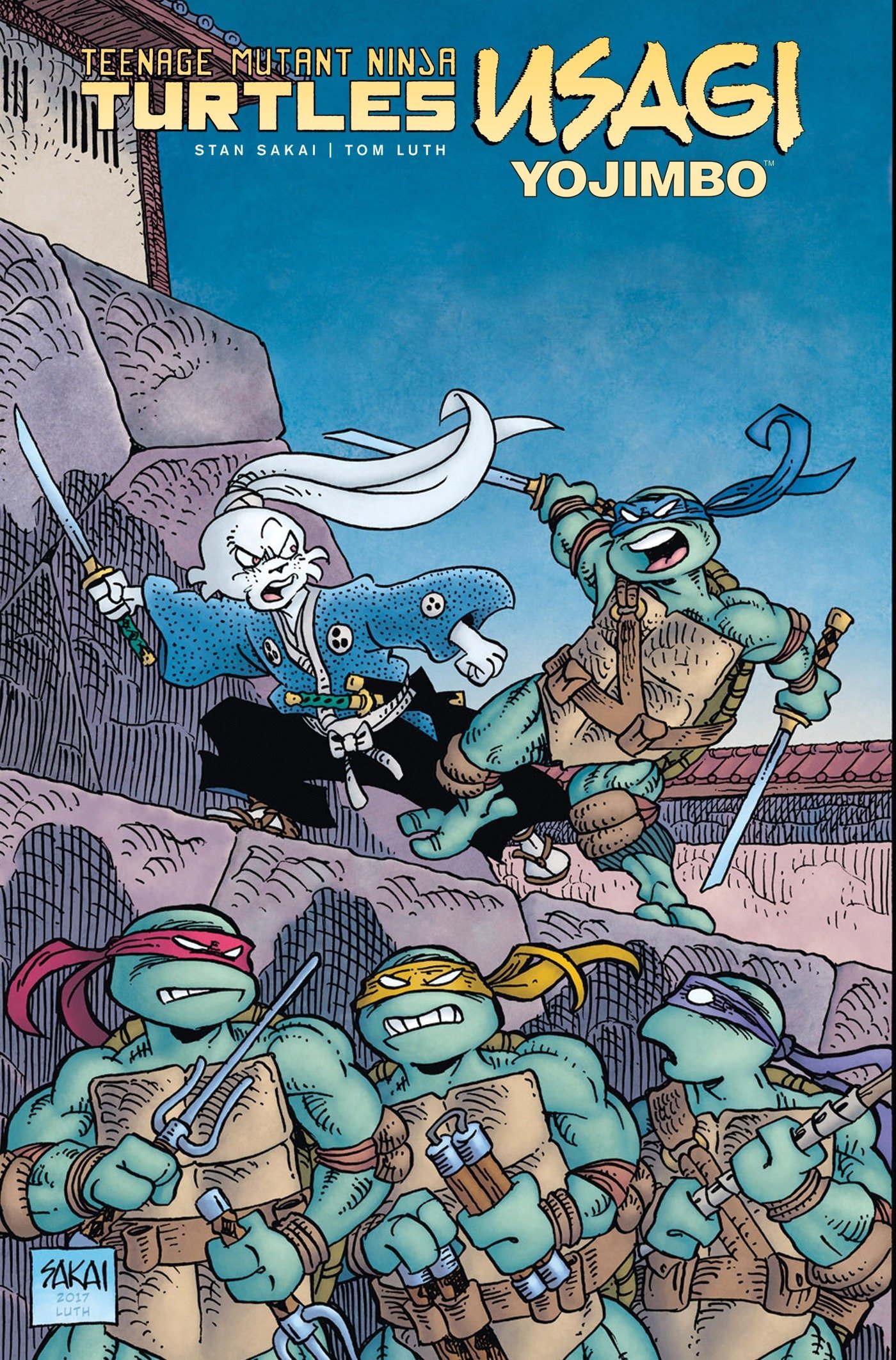
Usagi Yojimbo has a long history with the Teenage Mutant Ninja Turtles – the original comics had a few crossovers, and the character made guest appearances in three different Turtles TV shows.
And in “Teenage Mutant Ninja Turtles/Usagi Yojimbo,” Stan Sakai’s rabbity ronin encounters a new quartet of Ninja Turtles – the four boys from the IDW ongoing comic book series. The tale could have been a little longer than it is, and had more time with Usage and the Turtles just hanging out and fighting evil together, but Sakai’s lovably bendy-looking artwork and nimble writing is a joy to read.
Miyamoto Usagi defeats a group of bandits, and is greeted by a small group of travelers who tell him that “The Old One” is waiting for him in a nearby grotto. “The Old One” turns out to be Kakera, who says that he must undertake a journey to Tashima Shrine – but he needs protection, and the rabbit yojimbo isn’t enough alone. So Usagi gathers four small turtles from the grotto, and Kakera summons the Ninja Turtles.
Only, these aren’t the Ninja Turtles that Usagi knows, and they’re kind of upset at being kidnapped by Japanese-speaking strangers. But once that little misunderstanding is ironed out, Kakera explains that he is on a quest to reunite a fragment of rock with a larger stone, which will end the earthquakes caused by a giant catfish and save their entire land. Yes, that’s the explanation. Unfortunately, he is being pursued by the malevolent Jei, who will let nothing stand in his way as he tries to destroy the land.
Honestly, I wish “Teenage Mutant Ninja Turtles/Usagi Yojimbo” had been twice the length it was, at least – it just leaves you hungry for more interaction between Usagi and the IDW Ninja Turtles, especially after the combative first impressions they made on one another. Perhaps Sakai will write another crossover in the future, but for the time being he has crafted a nimble little story with lots of swords, bandits and a bit of bromance.
The story is best read by someone with at least a passing familiarity with the two different comic-book series, but it doesn’t take much knowledge to jump right in and figure out who people are and what they’re doing. Sakai’s artwork here is enchanting – deceptively simple and colorful, with over-expressive faces and curved limbs, and the Turtles being bulkier and more visibly muscular than Sakai’s own more willowy creations.
And his story is pretty straightforward, with a good chunk of the plot being devoted to Usagi’s first encounter with the Turtles (and a subsequent sword-swinging freakout from both Usagi and Leo). After that, it’s more or less a straightforward walk to the shrine, and a subsequent battle with Jei and his forces. It could have used a few more detours or problems along the way, especially to develop the burgeoning friendship and admiration between Leo and Usagi.
It could have used a little more narrative meat, but “Teenage Mutant Ninja Turtles/Usagi Yojimbo” is a pretty entertaining crossover between two very familiar franchises. A fun read for fans of either or both.
“The Sandman, Vol. 6: Fables and Reflections” is not quite as essential to the main storyline as the other Sandman short story collections.
But that doesn’t mean it isn’t a spellbinding, haunting series of stories, ranging from whimsical glimpses into the Dreaming to dark stories about the consequences of power. Neil Gaiman imbues every story with a sense of richness, mining mythology and history for the backdrops of his tales — and every single one casts a powerful spell over the readers.
The stories include: -A theatrical director whose fear is reflected in a nightmare of falling. -The story of Joshua Abraham Norton, the first and only Emperor of the United States – and the center of a struggle between Morpheus and Desire. -Lady Johanna Constantine sets out to post-Revolutionary France to retrieve a very unusual severed head for Morpheus, and must fight against the repressive, destructive regime. -An old legend of a werewolf obsessed with the portrait of a lovely young lady, and the lengths he goes to to find her. -A Roman Emperor who becomes a beggar for a day, reflecting on his horrendous past and Rome’s bleak future. -Marco Polo becomes lost in the desert, and stumbles into one of the places where the Dreaming overlaps with the waking world. -The caliph of Baghdad realizes that for all the beauty and majesty of his city, it will eventually crumble like all other great things. So he seeks out the king of dreams to make a very unusual pact with him.
The two most intriguing stories are “The Song of Orpheus” and “The Parliament of Rooks.” The former is a story of Dream’s legendary son, who loses his true love right after their wedding. Grief-stricken, Orpheus feuds with his powerful father, and calls on his aunt Death to help him get his love back. And the latter is a charming little story about Daniel Hall, a toddler who slips into the Dreaming during his naptime. While there, he is told the story of Adam’s three wives, the tale of Cain and Abel, and the parliament of rooks….
While few of the stories in “Fables and Reflections” are directly tied to the central Sandman storyline, this collection of shorts adds a lot of richness and texture to Morpheus’ world. Witches, gods, emperors, werewolves, severed heads and artists all wend their way through these stories, in a world where magic — often dark, twisted and strange — lurks everywhere.
It also seems to have many meditations on the impermanence of things, and the need to remember the past — “Thermidor” shows us a France where all of the past is repressed and obliterated, including the myths that shaped its culture. Baghdad’s beauty and culture are threatened by time, and Rome begins to crumble out of one man’s terrible secrets.
Morpheus wends through these tales like a dark silk ribbon, subtlely shaping the destinies of those he touches — an emperor, a caliph, an explorer and a little baby boy. We see him sorrowful, majestic, cold-hearted and kind, particularly in the tales involving Orpheus, whom he loves but has still not forgiven. And we have more background on Eve, Cain and Abe, all dwelling in the world of the Dreaming.
“The Sandman, Vol. 6: Fables and Reflections” is a jigsaw puzzle of silken dreams and shadowy memories — a beautiful experience, even in its darker moments.
Approximately 300 years ago, one of the Endless vanished. None of the others have seen him since, nor do they know where he went.
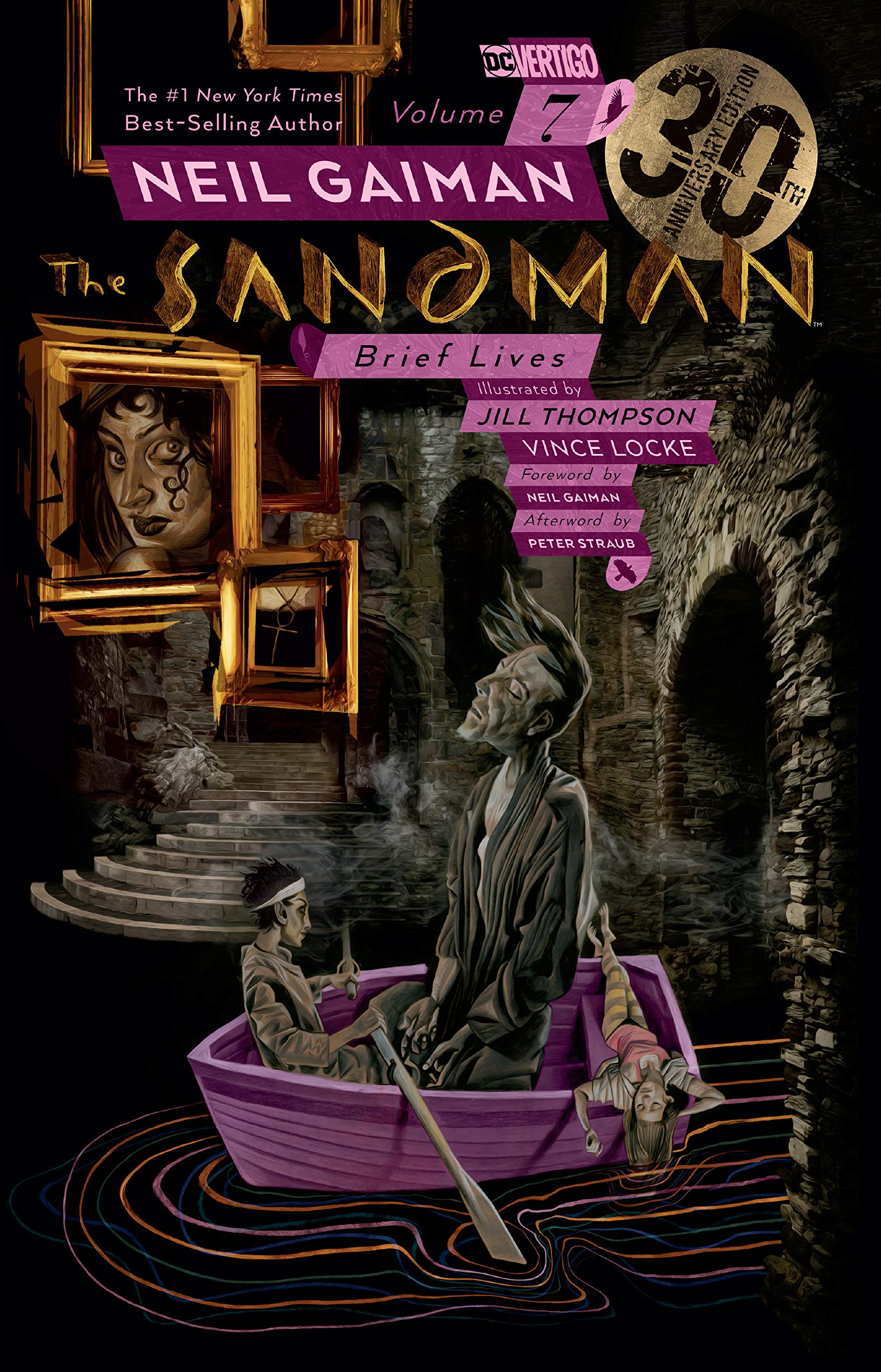
But it was pretty inevitable that one day, somebody would go looking for him. “The Sandman Vol. 7: Brief Lives” finally reveals what happened to the long-lost lord of Destruction, but it’s as the capstone to a bittersweet saga of everyday people, immortals, fallen gods and the most dysfunctional family in the universe.
After having a small meltdown in a gay bar, Delirium decides that she wants to find her older brother Destruction. She tries to enlist Dream to help her, and he decides to accompany his acid-tripping little sister on her quest. He’s already decided that her quest is hopeless, but he has nothing better to do after his latest romance failed.
But as Dream and Delirium make their way through the world, they come into contact with several people — both mortal and supernatural, from bellgirls to goddesses. Soon Dream realizes that they are spreading mayhem to anyone who tries to help them, and that finding his brother will exact a terrible cost from him.
At first, “Sandman Vol. 7: Brief Lives” felt kind of like a lighter, quirky chapter in the Sandman saga — it’s basically Morpheus and Delirium going on a little road trip to find Destruction. It’s kind of cute at first, especially since any story with Delirium is sure to be fun. Three words: tiny chocolate people.
But Gaiman’s story grows darker and more bittersweet as the the story winds on, especially since he unearths the stories of immortals adrift in a mortal world (think the goddess Ishtar dancing at a strip club). It’s a gritty, grimy world full of little flickers of haunting beauty, and ringed with magical realms.
Morpheus has changed drastically over the course of the Sandman series, growing from a cold arrogant creature to a more compassionate one. He’s still arrogant, but he recognizes it himself here — and in a twist worthy of Greek tragedy, he is forced into actions that will resonate through the rest of the series.
We also see more of Delirium, who has always seemed like a quirkily pathetic figure in a psychedelic sherbet-flavored wonderland. But here we see not only her deep love for her family, but a hint that she’s more powerful and perceptive than we’ve seen. And the people who are struck with misfortune aren’t just random redshirts — Gaiman lovely paints out their hopes, pasts and current lives.
While it seems rather lightweight at first, “The Sandman Vol. 7: Brief Lives” winds itself into a darkly bittersweet masterpiece — and the springboard for the Sandman series’ ending.
Do you remember Barbie? Not the doll, but the creepily perky blonde from “The Doll’s House” who had a matching husband named Ken. Well, she’s the protagonist of the fifth “Sandman” collection, which is accurately titled “A Game of You” — a haunting, fairy-tale exploration into a young woman’s dreaming imagination, and the friends who are trying to save her.
Having split from Ken, Barbie has since moved to New York and is living in a small apartment building with a lesbian couple named Hazel and Foxglove, a kindly transwoman named Wanda, a creepy guy, and a prim mystery woman named Thessaly. She also hasn’t dreamed in two years.
But then she has a run-in with an imaginary creature from her childhood, who gives her the magical jewel called the Porpentine with his dying breath. And that night, she goes back into a fantasy world from her childhood — a place of talking animals, haunted forests, and a mysterious enemy called the Cuckoo.
But as Barbie (aka Princess Barbara) sets out to defeat the Cuckoo, Thessaly wakes Foxglove, Hazel and Wanda, and reveals that Barbie is in desperate need of their help — and uses her magic to open a gateway to the realm of dreams. But they may not be in time to save Barbie from the machinations of the Cuckoo — or New York from the destructive magic being stirred.
In most authors’ works, supporting characters are just window dressing for the main characters. In Neil Gaiman’s works, every character has their own unique backstory and purpose in the plot — Barbie was just one of the minor background characters in a previous story, but in “A Game of You” we discover her dreams, her past, her fears, and her own connection to the Dream King.
And in turn, the other characters are given well-developed backstories, problems and personalities — the no-nonsense Thessaly, hinted to be an ancient witch or something; Hazel, who is afraid of what her pregnancy might mean for her relationship, and the sensitive, loyal Wanda who will never let Barbie down. Even the crazy dog-hating lady has a REASON to be here, and a history of her own.
Gaiman’s storytelling here mingles an enchanted high fantasy world (reminiscent of Narnia) with a darker, more gruesome story. I mean, there’s a skinned face with eyes and tongue NAILED TO THE WALL, having a casual conversation with Wanda. Ew. And even if things are worked out by the end, not everything turns out all right — there are tragic losses, changes, and Barbie has left behind a part of her life.
And where is Morpheus in all this? He only appears in a few scenes, but his involvement is truly vital to the story. And no, I won’t say how.
“Sandman Volume 5: A Game of You” will probably leave you with a little smile, but a tear in your eye. A magnificently powerful, haunting story.
Morpheus of the Endless has had many trials throughout the ages… but none quite as strange as the one he must face in “The Sandman, Volume Four: Season of Mists.” The fourth collection of Neil Gaiman’s classic Sandman series centers on sudden changes in the world of Hell, and the terrifying choice that the Lord of Dreams must make — who does it go to?
After a disastrous meeting with the other Endless, Morpheus goes to Hell to set free his onetime lover, Nada. But when he gets there, he finds that Lucifer is tired of being the lord of Hell, and is shutting the whole place down — and he gives ownership of it to Morpheus. In the meantime, the souls of the damned are roaming Earth, and the anguished demons have nowhere to go.
Morpheus isn’t interested in ruling Hell, so soon various powers appear to claim Hell — Norse, Japanese and Egyptian gods, a trio of powerful demons, Order, Chaos, a Faerie diplomat, and a pair of angels are sent to watch the proceedings. Threats, bribes and tricks ensue, leaving Morpheus with a seemingly-impossible choice to make.
Just a warning: This comic book, despite its brilliant storytelling, left me with a sort of squirmy feeling, because it bases itself on Christian theology that many people actually believe in (heaven, hell, Satan, angels, God, etc). But it isn’t in line with those beliefs, so some parts of it come across as… uncomfortable.
However, you should always keep in mind that it is merely fiction. “Season of Mists” is epic in scope — it encompasses different worlds, dimensions and lands in a seeemingly endless, wondrously terrifying universe. Gaiman is absolutely brilliant at conjuring the exquisite and the grotesque, the eerie and the strange — and he manages all of those here.
And the art really helps here — the bleak, raw wastes of Hell, the snowflake beauty of the angels, the visceral grotesqueness of the demons (one is a lumpen creature with a melting eyeless head and toothy mouths for nipples), and the twilit, mildly unnerving realm of Dreaming.
As for Morpheus himself, this story is a surprisingly personal one. He’s given a realm he doesn’t want, but doesn’t seem to have any good way of ridding himself of it (at least, not at first). And the Lord of Dream has to face up to his own misdeeds — namely, he FINALLY figures out that he was horrible to Nada, and that his punishment of her was cruel. The way their story is wrapped up is painful, but still very touching.
“The Sandman Volume Four: Season of Mists” made me uncomfortable with some of its handling of Christian theology, but there is no denying that it is a richly-imagined, powerful story by a master storyteller.
For its 20th anniversary, IDW Comics is doing something a little unusual – they are creating one-off issues of some of their series, set twenty years after or before the main series.
And since the Teenage Mutant Ninja Turtles are chronologically only a few years old, their comic issue therefore has to be twenty years later. This brings us to “Teenage Mutant Ninja Turtles: IDW 20/20,” a future tale that takes place in a war-torn 2039, and shows how the Turtles have changed – or not changed – in the next two decades, though fans of other characters may be left disappointed.
So what are the Turtles of the future like? Well, Raph seems more level-headed and less angry, and is still accompanied by his faithful pet dinosaur Pepperoni. Leonardo is more distant and mystical than in times past, and has acquired both a brown cloak and the ability to astrally teleport. Michelangelo has become more mature and tactical in his thinking, which is a good thing since he is now the team’s leader. And Donatello… he hasn’t really changed much, except that he now has armored shoulder pads.
The second Utrom civil war is raging across Europe, and the imprisoned Donnie sends his brothers news of a backup Technodrome. So the three set out (in their flying van) to Florence, deep in the heart of enemy territory, to stop the enemy Utroms before they can terraform first Europe, and then the world. They’re surrounded by foes on every side, and even Donnie’s unexpected return may not be enough to turn the tide – but the Turtles will triumph no matter what.
Fans of other characters in “Teenage Mutant Ninja Turtles” – Splinter, April, Casey, Alopex, Old Hob, Angel, Harold Lillja and the rest – may be a bit disappointed in “Teenage Mutant Ninja Turtles: IDW 20/20,” since the only supporting character whose future is revealed is Sally Pride. No, the focus in this comic is on the Turtles themselves – how they’ve changed, how they haven’t changed, and the brotherly bond that holds them together despite everything.
The story itself is a brief, pivotal slice of a much more epic tale, stretching across countries and encompassing entire wars and armies, and involving a large amount of action. Most of it involves the Turtles facing up against an onslaught of pink blobs in armored walkers, and the occasional explosion or blast of a dinosaur-mounted laser cannon. And while the situation remains grim and combative right through to the end, the story reminds us that no matter what, the Turtle brothers will always triumph where it counts.
Leo is the one that has changed the most in this future scenario – he’s more withdrawn, more quiet and distant from his brothers, which has clearly saddened all of them. But his connection to his brothers proves to be stronger than the pressure he has felt, and we see him break out of his shell (so to speak). Mikey is the other big change, having taken up the mantle of leader, which tempers his happy, optimistic personality with the stresses and fears of the job. Donnie and Raph haven’t changed nearly as much – the former is still an enthusiastic, nerdy peacemaker, and the latter is still passionate and driven in a fight.
It doesn’t give too much away about the future of the Turtles’ allies, but “Teenage Mutant Ninja Turtles: IDW 20/20” is an ultimately uplifting ode to what four reptilian brothers can do when they put their minds to it. Namely, saving the world.
I think most people have authors they won’t read, even if other people love their books. I have quite a few. Some are authors I tried in the past and have no desire to revisit, and some are authors I refuse to read on principle.
So for instance…
Philip Pullman
Mercedes Lackey
John Norman
James Joyce
E.L. James
Dan Brown
Victor Hugo
William Faulkner
Ayn Rand
Bernard Cornwell
Richard Dawkins
Tim LaHaye/Jerry Jenkins
Jean M. Auel
Margaret Mitchell
Nicholas Sparks
Marion Zimmer Bradley
Candace Bushnell
Friedrich Nietzsche
Blanka Lipinska
Peter David
Clive Barker
Diana Gabaldon
Anne McCaffrey
Junji Ito
Alice Oseman
Warren Ellis
Barbara Kingsolver
R.F. Kuang
Ernest Cline
Chuck Palahniuk
John Steinbeck
Ernest Hemingway
Anne Bishop
Dan Simmons
Isabel Allende
Scarlett St. Clair
Herman Melville
Michael Moorcock
J. D. Robb
Chuck Wendig
Joe Haldeman
Glen Cook
Franz Kafka
Brian Herbert
Jodi Picoult
R. A. Salvatore
Kevin J. Anderson
James Patterson
John Updike
John Ringo
I think I’ve got a pretty diverse listing of books I refuse to read – science fiction, fantasy, classic fiction, modern fiction, mystery, romance, comics, etc. The one thing they have in common is that I have zero desire to read them, even ironically or to explore/review how bad they are (which is why L. Ron Hubbard is conspicuously absent from the list, even though he wrote the worst book I have ever seen in my life – and I have seen some crappy books).
There are also pretty diverse reasons why I refuse to read these books. A lot of these authors bore or annoy me, for instance. Kevin J. Anderson, for instance, is like eating a diet of only white bread to me – it’s boring, it’s unmemorable, and I immediately start craving something with flavor and meatiness. Another is Herman Melville, whose magnum opus is about six thousand pages of whaling minutiae. Or James Joyce, because… James Joyce. Or R. A. Salvatore, who has been writing basically the same pap for decades.
Another large category is authors who are bigots. Typically, bigots against me and people like me. I don’t try to force anyone to boycott artists who disagree with them, like many do. But I reserve the right to criticize, to call out and to make it clear that these people are bigots. For instance, Philip Pullman, who wrote an entire fantasy trilogy about how much he hates Christianity. He’s not getting my money, because he’s a bigot filled with hate, and anyone who claims to be against hate better also be against him.
There’s a lot of bigots on that list. Some very big names. Nobody is too famous to call out.
A much smaller category would be ones that I have political or religious disagreement with. I am willing to listen to people of various political or religious persuasions, although I am obviously not going to entertain and agree with all viewpoints. Only idiots do that. But someone like Ayn Rand simply doesn’t make any sense in the real world, and promotes a hideous way of thinking mixed with childish self-worship, which we already have too much of in the world. And guys like John Ringo and John Norman are just… blech. Their attitudes towards women are hideous.
I also don’t think that authors should necessarily be expected to be any better than any other person; having skeletons in their closet, addictions or bad stuff in their past is not a reason to avoid someone’s work. However, I am not going to read books by Marion Zimmer Bradley – not just because she was a pedophile, but because her work is so suffused in her spiritual corruption that it is literally painful for me to read, and it was painful long before I learned what she was.
This is kind of tied into the bigot and political/religious thing, but some of these authors are simply awful people, and it’s unpleasant to put your mind in their playground.
The smallest listing of all – only two people, actually – is people I don’t want to read because they do their job too well. That is the only reason Junji Ito is on it, so… if you’re a fan of his, you can unclench. Being listed on here is actually a compliment.
I’ll probably come up with more authors I refuse to read in the future, but for now, fifty is plenty.
Imagine what would happen if Superman went bad. Not a mustache-twirling villain, but a frighteningly powerful fascist who demands loyalty and obedience from…. well, everyone. Sort of like a Twitter warrior with godlike powers.
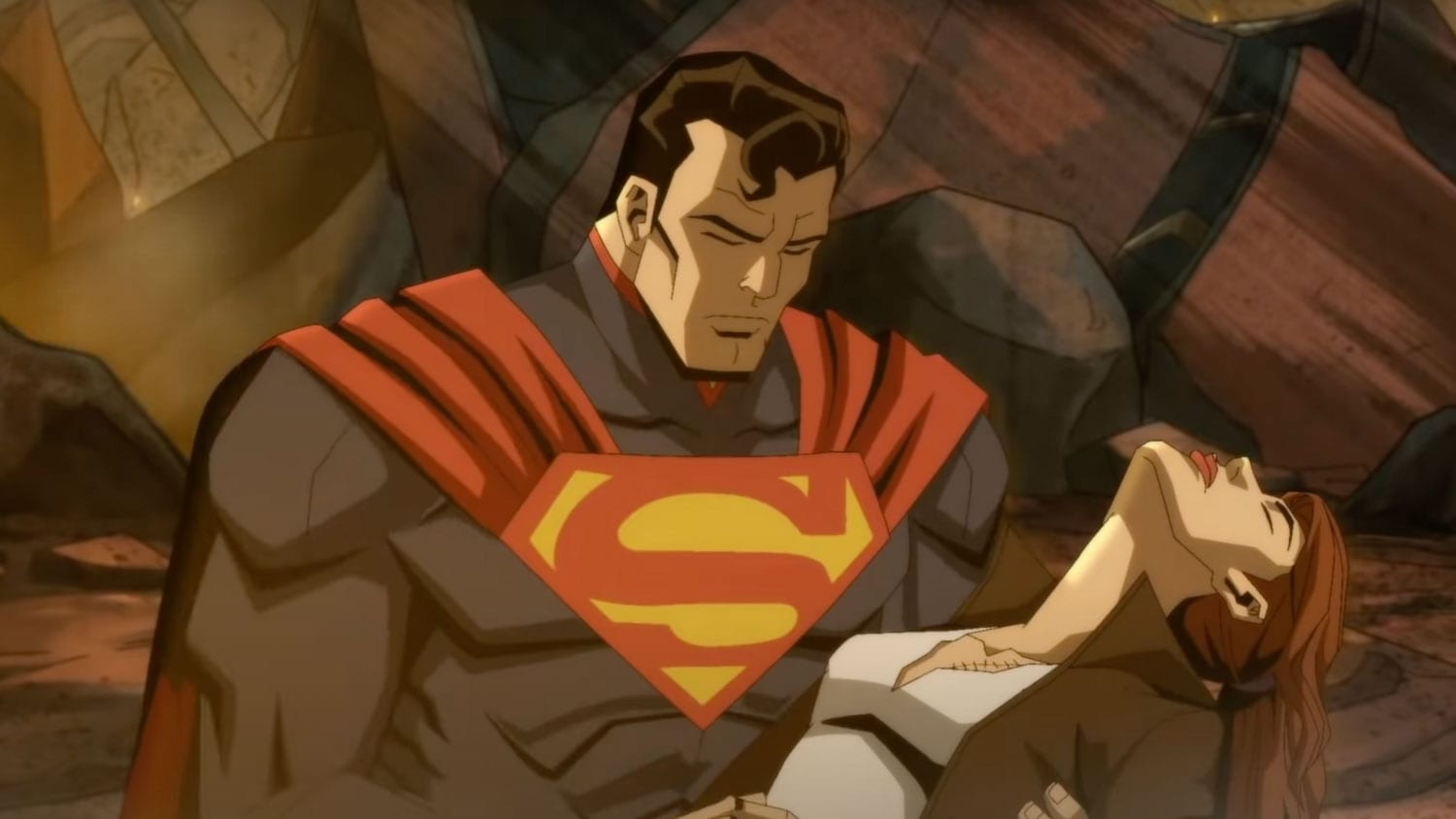
Hence we get “Injustice,” an animated movie loosely based on the hit video game and the long-running comic-book series that served as its prequel. Sadly, it’s a bare-bones, rather shapeless kind of film, and it’s kind of shallow both in plot and theme – the moral issues raised by the source material are boiled down to “taking away people’s freedoms and rights is bad.” The voice acting is lackluster and the need to fulfill a three-act structure leads to a very rushed and somewhat anticlimactic ending.
The Joker decides to give Superman the “one bad day” treatment – he kidnaps the pregnant Lois, attaches the trigger of a nuclear bomb to her heart, and tricks Clark into killing her. The bomb goes off, destroying all of Metropolis. Enraged and grief-stricken, Superman murders the Joker in front of Batman. Then, with the support of Wonder Woman, decides that he is going to bring peace and order to the world…. whether the world likes it or not.
Only a few heroes, antiheroes and Harley Quinn dare to oppose Superman’s new regime, with Batman as their leader. But as their resources and numbers dwindle – including a loss that forever fractures Batman’s family – Superman makes a Faustian alliance with a villain who promises to help him achieve his dream of peace, and descends further into murder and tyranny as he kills those who offend him. The only hope that this Earth has is for Batman to free Mr. Terrific, and find someone who can stop Superman.
It was always going to be a challenge to reduce a long-running, years-spanning comic series and a full-length video game into a movie that isn’t even ninety minutes long. That’s a lot of character development, subplots, battles and important events that need to be trimmed away. So needless to say, the story is very bare-bones and loses a lot of its narrative oomph – as well as the expansive cast of characters one would expect of the Justice League. I’m still not entirely sure why Harley Quinn is involved except as comic relief.
The story also seems to not have much depth – the main message of “police states and fascism are bad” is a good one, but it isn’t presented with much complexity or nuance. The movie also suffers from having to neatly wrap up everything in a bow after a third-act battle… which it utterly fails at. Lots of plot threads are left hanging when it slams into the credits, only seconds after the whole superpowered-tyrant-controlling-the-world issue is resolved in a very, very anticlimactic way. And whenever a hero is killed – which happens frequently – there’s barely time to register it. Most of the many deaths just don’t matter, and some characters just walk right out to never be seen again (such as Aquaman and Shazam).
It also inherits some original sins from the source materials, and despite many changes, it makes no attempt to explain them. For instance, Wonder Woman is strangely hostile to Batman and all-too-eager to turn Superman into a super-tyrant, apparently being too stupid to see how all this could escalate. Why is she so different from the usual Wonder Woman we know and love? No idea. She just is.
The animation is…. okay. Not the best I’ve seen, but not offensively bad. The voice acting is resolutely mediocre, through – most of the actors range from okay-but-not-very-good (Anson Mount, Justice Hartley, Gillian Jacobs, a strangely stiff Janet Varney) to this-is-just-really-bad (Faran Tahir, Kevin Pollak’s Joker). Derek Phillips is admittedly quite good as Nightwing, and Oliver Hudson is pretty fun as Plastic Man.
The one good aspect of “Injustice” is that it reminded me that I’ve been meaning to watch “Superman Vs. The Elite,” an animated movie that delves into the morals of superheroes and what happens when they throw aside laws. Consider that a recommendation, and give it a watch instead of this halfhearted, fatally-flawed adaptation.
We’re currently in an unpleasant phase in corporate/fan relationships. The attitude of the media, some consumers and a number of people in the entertainment industry is essentially that fans should not be pandered to. Which is to say, “shut up and eat the foul sludge we’re peddling without questioning it, plebeian.”
Dare to question your corporate overlords, and you’re labelled a troll or “toxic fan,” which is a convenient way of not actually engaging with the fans who care about things like character consistency and good writing.
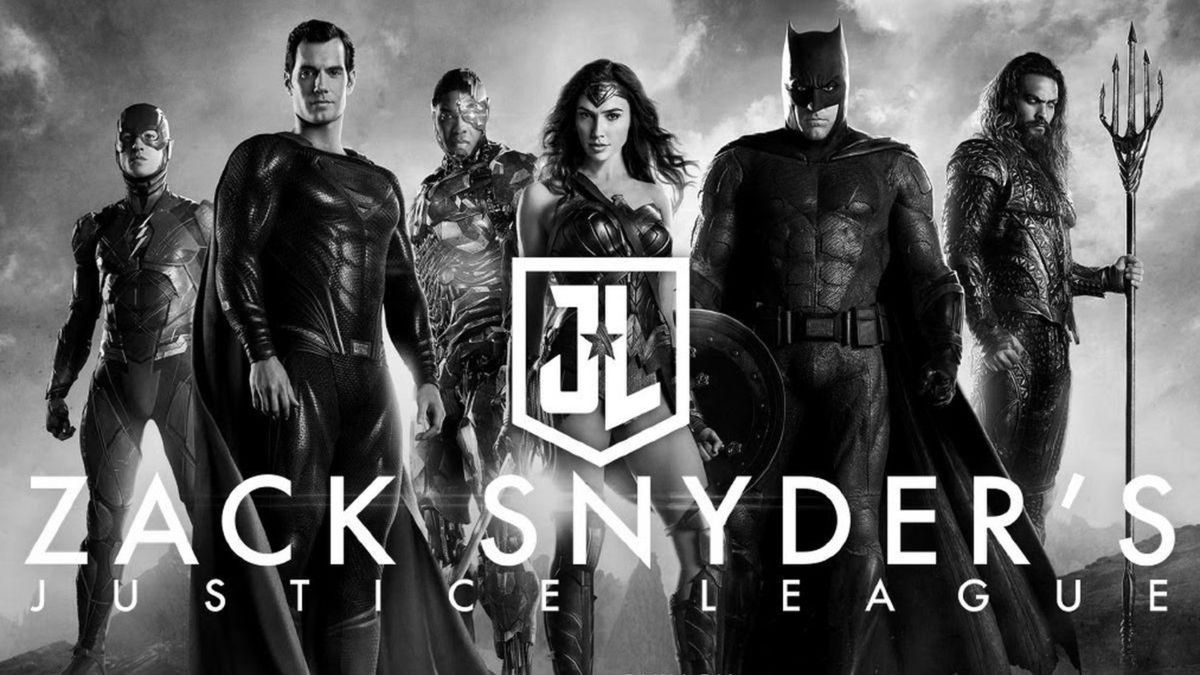
That’s why it’s so heartening to see Zack Snyder’s four-hour cut of Justice League has finally been released after four years of kicking and screaming from online fans. Now, I have not yet seen the Snyder Cut, though I hope to enjoy it more than the Frankenstein Monster that was the “Josstice League” cut. I don’t like Joss Whedon, in case I haven’t mentioned it. I’ve seen some side-by-side comparisons of various scenes, and the Snyder Cut… honestly feels like the superior cut. It’s more epic, less stupid, and more tonally cohesive.
I know that a lot of critics have trashed it as being a horrible movie, but also found that a number of those critics don’t like superhero movies anyway. And honestly, I’m kind of inclined to view them as biased anyway, because… as much as I hate this phrase… this movie was not made for them. It was not made to court critical acclaim. It was not made for people who actively did not want fans to get the Snyder Cut because it would be “rewarding” them, who viewed the fans as “toxic” for demanding something from their betters. It was made for the audience to enjoy.
That’s why, even if the Snyder Cut is bad, I’m glad it was finished and released, and I hope it’s wildly successful. The entertainment business needs to be reminded – forcibly, with money – that the fans and the wider audience do not owe corporations their money or their loyalty. It is not “pandering” or “rewarding” people to give them entertainment that they have expressed a desire for, or want to actually see done well.
There’s another recent example – the movie Sonic the Hedgehog. It’s a completely inoffensive and mildly funny movie, a good movie to watch with children. But the impression left by its first trailer was… catastrophic. The CGI model immediately put people’s teeth on edge.
So what did the studio do? They reeled the movie back in, fixed the CGI, and everyone cheered. The only sourpuss was Jim Carrey, who complained about – what else? – entitled fans being given what they wanted, instead of what the studio shoveled out of a cesspit.
But what was the result? Not only was Sonic a success financially, it was a hit with audiences. Not just because it’s a thoroughly okay children’s movie, but because they didn’t just tell the fans they were toxic and flounce away. They actually fixed what people didn’t like.
So we can hope that studios are starting to pay attention – it does not pay to diss the fans and denounce all criticism. When you work with the fans rather than against them, they are more inclined to give you their money and praise.
I am what you could call moderately informed about mainstream comics. I know about all the A-list characters, quite a few of the B-list, and a fair number of C-listers. I’m an avid viewer of Linkara’s comic-book review videos, as well as a few other channels that cover comic content, as well as research, TV adaptations… and the comics themselves, of course.
But when it comes to comics, very few things irritate me like taking a magnificent character… and doing them dirty.
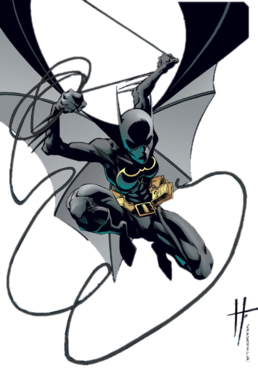
For instance, I was livid when Birds of Prey came out, and I saw what they had done to Cassandra Cain. The character in the comics is a complex, well-developed character with a unique backstory, a lot of moral and personal confusion, a likable, good-hearted personality, and some representation for people with learning disabilities. She’s an elite super-assassin who couldn’t bear to kill, and who didn’t speak or read because she was able to read body language so well.
Cassandra Cain in the movie? She’s a mouthy little brat played by a kid who can’t act. It was revolting.
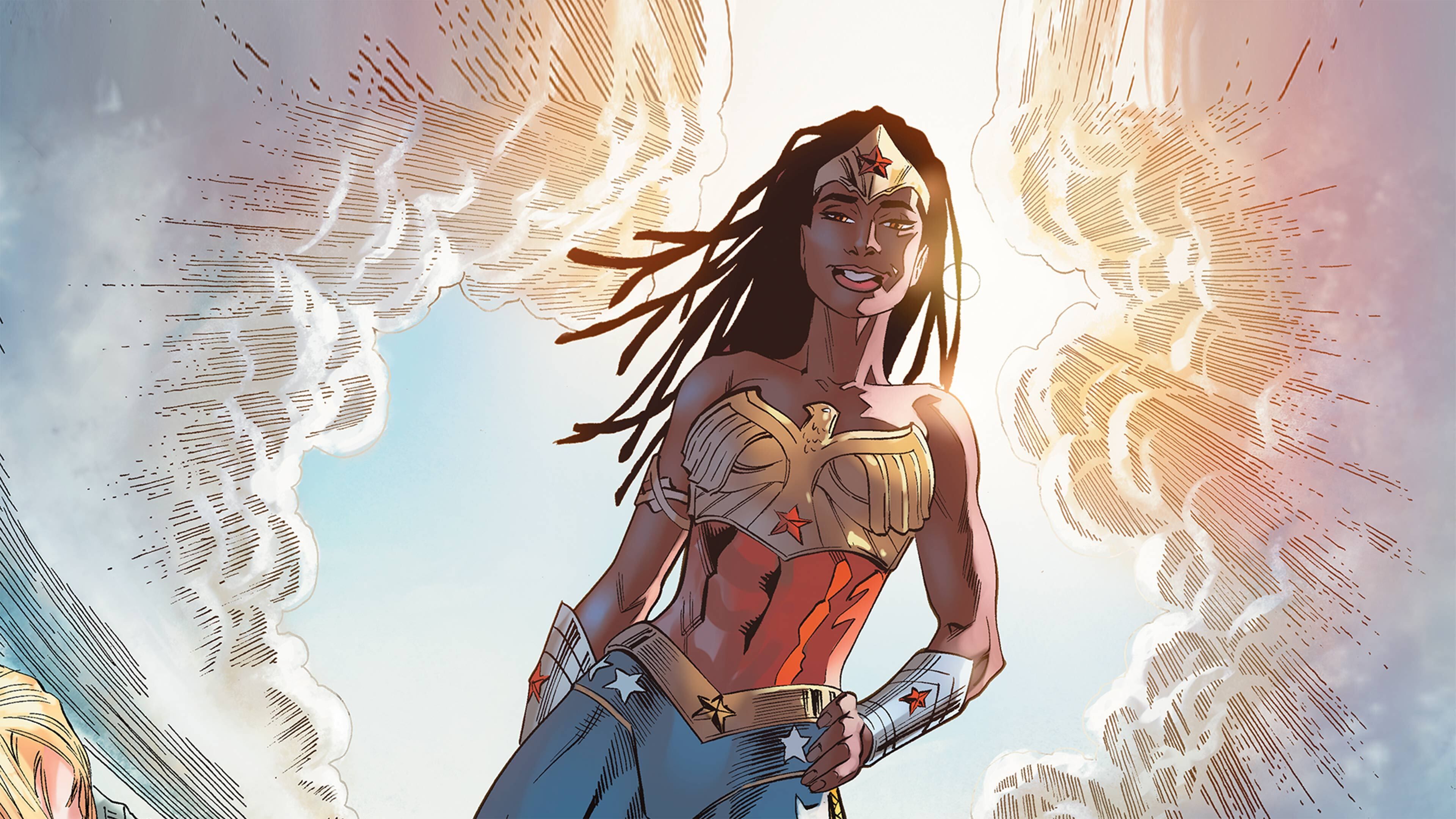
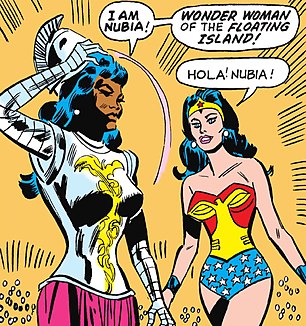
And I sort of feel the same way about Nubia. Now for context, until a few days ago, I had no idea that the character of Nubia even existed, because despite her superhero pedigree – she’s the kidnapped twin sister of Wonder Woman – she’s surprisingly absent from most comic books and not talked about very much. In fact, she’s so obscure that I realized that I had actually read Injustice 2, a comic with her in a small role… and I hadn’t realized that she wasn’t just made up for that comic.
And it’s really a shame, because Nubia is a character that could have a lot of power and resonance.
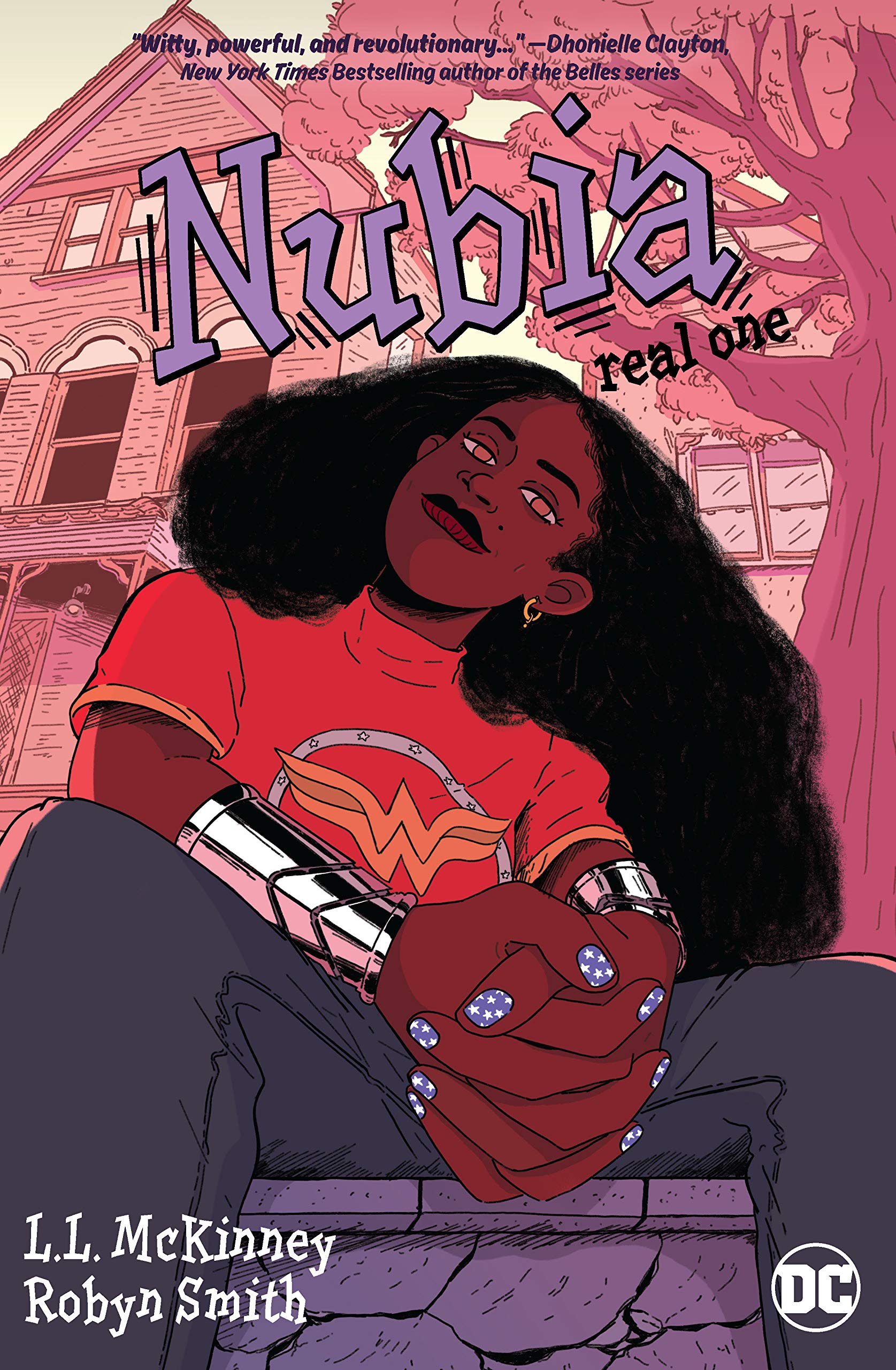
Unfortunately, her most visible reappearance in recent years… is Nubia: Real One.
This comic book is a perfect microcosm of everything wrong with DC Comics’ young adult stuff at present. They are desperately trying to reach out to younger readers at present, but instead of respectfully making stories about characters like the Teen Titans, Red Robin, Miss Martian, Superboy and other popular young DC characters… they make stories about the woes of being a mostly-ordinary, not-very-dynamic girl living in a crime-ridden rathole of a city, with a little bit of Wonder Woman crammed in there almost as an afterthought.
And yes, they deal with sensitive, painful, complex social issues… with all the subtlety of a wooden club to the nose.
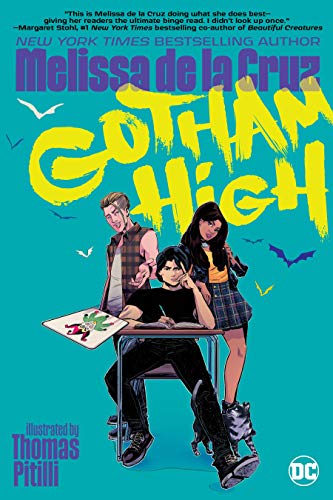
These recent graphic novels are also made by people who are clearly not interested in writing superhero stories. Gotham High is perhaps the most obvious example of this, where it reimagines Bruce Wayne, Selina Kyle and… the Joker… as teenagers going to Gotham’s public schools. Melissa de la Cruz’s take on this concept was absolutely ghastly, and I hated every page of it. Reimagining the Joker as a slightly edgy but good-hearted poor boy in love with Selina absolutely made my blood boil. What they did to Alfred – having him abandon the traumatized Bruce for ten years – was unforgivable.
Just the cover makes me angry
The future releases don’t look promising either. I Am Not Starfire focuses on a dumpy, self-pitying pouty goth teen who seems to detest the popular and beloved Starfire character, her mother, and whose lack of superpowers means she won’t be doing anything heroic. We get to focus on coming-of-age woes, mother-daughter drama, and probably how awful Starfire. How enticing. And the Jessica Cruz graphic novel seems to be abandoning the galaxy-spanning space-cop stuff for Mesoamerican mythology and immigration issues. It’s not impossible to deal with such issues in a Green Lantern title, but you should keep the core of the character intact – you can have space problems and social issues!
I’m not going to go into the politics represented in Nubia: Real One, because they are so polarizing. And I hate politics. What I can tell you is this:
There’s a lot of hate woven into the book. It’s the exact opposite of the Black Panther movie, which drew most people in by both acknowledging the struggles that African-Americans face and the need to help, and the fact that trying to get revenge or use violent means is ultimately self-defeating and wrong. It had a good heart that embraced everyone, and this comic… doesn’t. Whatever your political position, it should not come from a place of hatred, which is unfortunately the position of most people today.
A lot of aspects of it do not make sense when you think about them for more than two seconds (why is a well-connected rich boy going to a crappy inner-city public school?).
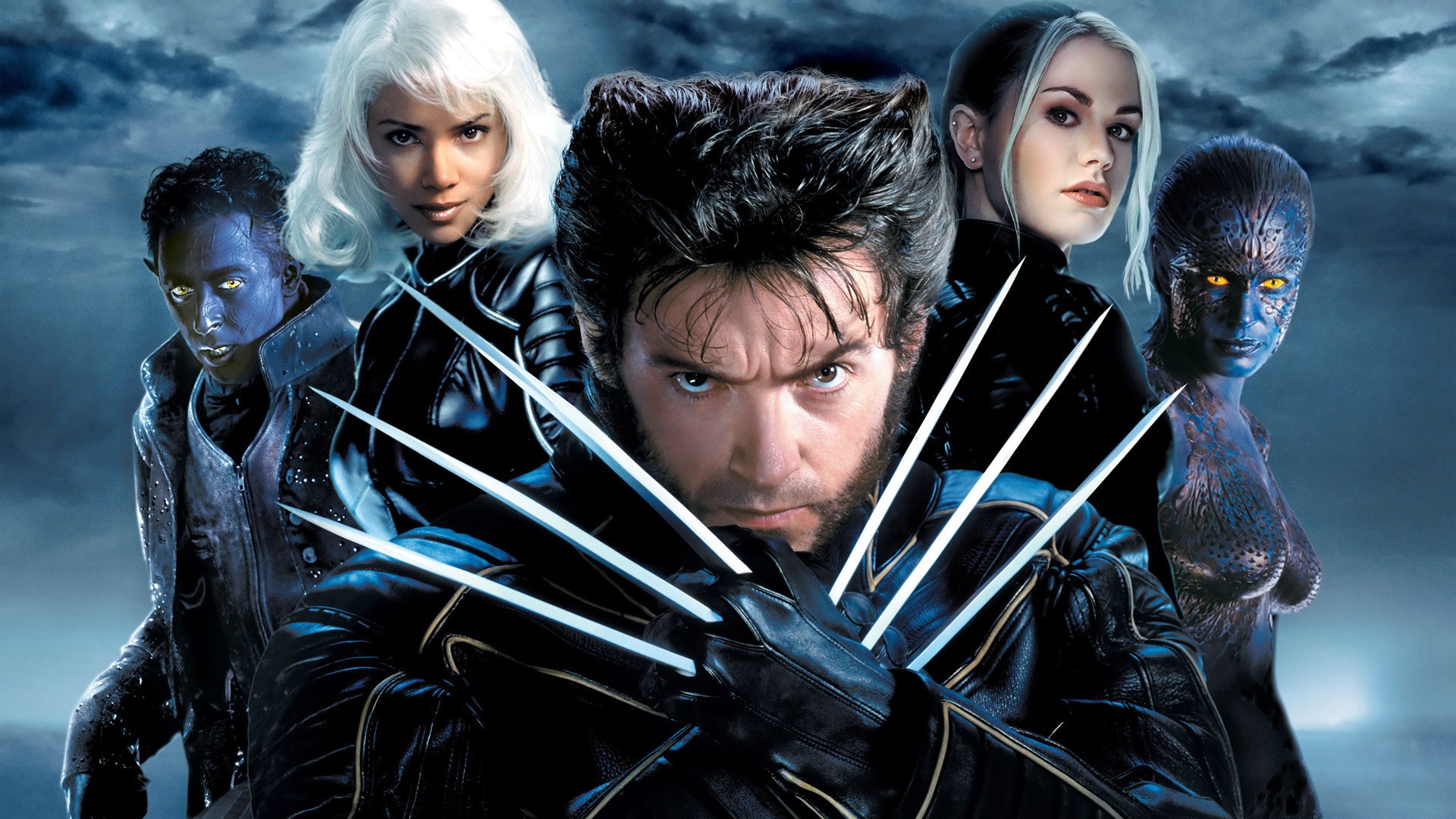
There is no zero subtlety. None. You know how the X-Men are often used as analogies for various minorities – black people, Jewish people, LGBTQ people? This allows the reader to examine the core nature and effects of prejudice without getting too tangled up in specific immediate politics, and allows them to be taught lessons in a timeless way. This comic is the exact opposite: it bludgeons you with current-day, extremely polarizing politics in almost every single page.
And really, Nubia deserves better. The Nubia of this book is almost painfully unremarkable in every way but her super-strength. I think we’re supposed to see her as becoming powerful and strong at the end, but it feels so artificial after watching her cower, cringe and cry for the entire book. Basically, someone gives her a pep talk about how great she is, and somehow this causes a complete change in personality. Not that she had much of a personality – she has the dynamic qualities of a wet sock.
Furthermore, Nubia is not a superhero in this. She does one vaguely superheroic thing early on, which only occurs in order to establish that all white people hate her because she’s black. But if you hear “Nubia is Wonder Woman’s black twin sister, and she has similar powers!” you expect her to do something… superheroic. Something epic. Something powerful. And it never happens.
Don’t you want to see this woman kick some butt?
In fact, you could probably cut Wonder Woman (who looks awful, by the way) out of the story altogether, and you would just have a rather melodramatic, poorly-written story about a not-very-interesting teenage girl dealing with over-the-top racism.
And that is not what the character of Nubia should be. I don’t know much about the character, but I would expect her to have a lot in common with Diana. And you would expect her story to involve massive threats, gods, monsters, magic, and some kind of epic journey for Nubia that spans both the world of the Amazons and the world of humankind. That is the kind of story that Nubia – the Nubia of the original comics – deserves.
She deserves to be bold, fiery, strong yet compassionate, and confident in her physical and mental power. Not saying she can’t have vulnerabilities – I love doubts and vulnerabilities in powerful characters – but the Nubia of this book is too drippy. I don’t want to see her punch a cop. I want to see her superhero-land on the ground so hard that it leaves a crater, only to rise flawless and indomitable from the dust, and punch some mythic monster in the face.
But it doesn’t happen. Because this book is made for people who don’t read superhero comics, by people who don’t read or write superhero comics.
Don’t ask me why Diana is suddenly speaking Spanish.
I can only speculate on why, because DC seems to be specifically deemphasizing everything superheroic about their superheroes… at a time when superheroes are more popular than they have ever been. I can only wonder why they are making stories that people who don’t like superhero comics won’t pick up because they ostensibly involve superheroes, and people who do like them won’t pick them up because they’re actually all about social issues and bad teen romance, not superheroing.
With a little research, I bet that I could have created a phenomenal story for Nubia. Perhaps one that marries the Grecian origins of the Amazons with some African mythology, for instance, and one that has oodles of action, fantasy and adventure. But for some reason, DC doesn’t want that kind of story to be offered to new readers.
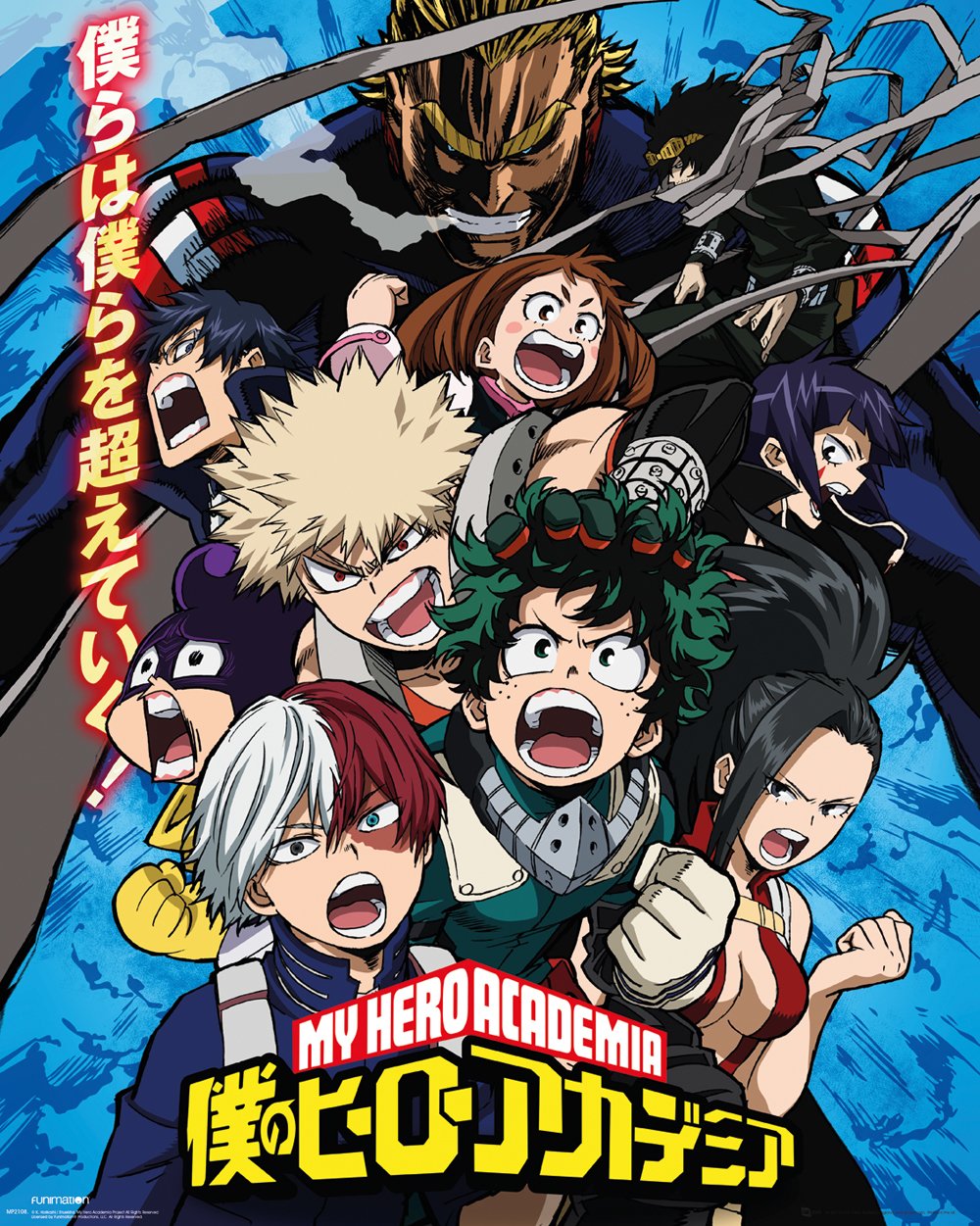
And yet they wonder why My Hero Academia, an unabashed and unashamed superhero story full of action, drama, horror, heart and character development, resonates so strongly.
Oh, and the art in all of these books is horrific. Just the worst. I am shocked that the people who drew these are actually employed at a major comic company rather than posting on Deviantart. DC Comics has access to some of the best comic-book illustrators in the world – see the image at the top of the page – and they keep choosing people whose art is just… ugly and amateurish.
I could perhaps give this art a pass if it were being posted on social media by an enthusiastic self-published person, or someone with a small publisher. But this is DC. It’s one of the Big Two. The art in these books should be polished and sublime, and… are they under the impression that kids only like ugly blobby sloppy artwork in their cartoons and comics? Because when the art of Gotham High is as good as it gets, you have a problem!
Anyway, those are my thoughts on Nubia, Nubia: Real One, and the current slate of DC’s young-adult releases. Ciao!




 The Forest