Review: Five Nights At Freddy’s (2023)

Even if you’re not a gamer, you’ve probably heard of “Five Nights At Freddy’s.” Scott Cawthon’s hit video game franchise is about employees (and occasionally children) being pursued by anthropomorphic ghost-robot animals. Also, serial killers.

And it’s not surprising that the “Five Nights At Freddy’s” movie shines the brightest when it dives into mascot horror and the lore of the franchise. It’s substantially weaker when it focuses on the human characters’s familial conflicts and internal turmoil, which means that it rebounds solidly in the final act when the various loosely-wound plot threads are finally tied together. Still, did we need custody drama?

Michael (Josh Hutcherson) is a young mall security guard obsessed with the abduction of his little brother when he was a child. But then he loses his job, and faces the possibility of losing custody of his little sister Abby (Piper Rubio) to his vicious aunt. So he takes the only new career path available: a night security guard at the arcade/pizza restaurant known as Freddy Fazbear’s, where he’s mostly there to guard the animatronics. He also encounters Vanessa (Elizabeth Lail), a friendly cop who seems to be very well-informed about the place.

But he soon realizes that the animatronics are actually “alive,” possessed by the spirits of children murdered many years ago – and they seem to have a special bond with Abby. Unbeknownst to him, they also kill people who break in. As he tries to enlist their help to find out who abducted and murdered his little brother, Michael soon discovers that the animatronics are far more dangerous than he ever expected – and they aren’t alone.

“Five Nights At Freddy’s” is easily at its best when it sticks to being “Five Nights At Freddy’s.” The most gripping and engaging parts of the story are when the animatronics are prowling around chewing people’s faces off or biting them in half. It’s not too bloody or graphic, considering this is a Blumhouse movie (it’s actually rather tame for a horror movie) but it does capture some sense of dread and creepiness, especially in the unnaturalness of the animatronics’ movements.

Unfortunately, you also have to wade through a lot of Michael’s personal problems to reach the “Five Nights”-ness, and… they’re not terribly interesting. Obviously some kind of personal stuff is required for the security guard, but the movie needed fewer custody fights and more spooky nighttime conflicts with the killer animatronics. We also didn’t need a scene where the animatronics build a giant blanket fort with Abby, which was just… awkward.

Fortunately, things improve drastically when the third act rolls around, when the animatronics go back to being homicidal, and the backstory behind their deaths is finally explored. There’s a real sense of dread at the thought of dead children brainwashed into amnesiac killers who don’t even remember what they are, so that you both pity them and want to run away from them at top speed. As for the mastermind of the whole scenario, his arrival gives the story an extra jolt of fizzing energy, and I honestly couldn’t get enough of his villainy.

While Hutcherson’s character spends too much time on non-“Freddy” stuff, he gives a very good performance as a young man who has been fundamentally damaged by loss and guilt. Mary Stuart Masterson and Elizabeth Lail also give solid if uncomplicated performances, and Piper Rubio’s performance is pretty good, even though her character seems like she was written to be several years younger than the actress. Matthew Lillard has little screen time, but he absolutely dominates the screen and has just the right amount of scenery chewing. Chef’s kiss.

“Five Nights At Freddy’s” is weaker when it tries to incorporate more original elements, but is at its best when it sticks to what “Five Nights At Freddy’s” is all about. For those who enjoy tales of killer animatronics and serial killers, it’s a mixed bag but one still worth seeing.
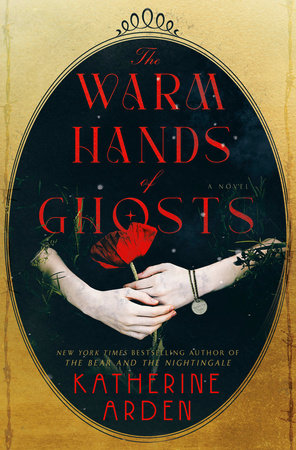
Review: The Warm Hands of Ghosts

Disclaimer: I received a copy of this book from NetGalley in exchange for an honest review.

Nowhere seems more appropriate for a story about the lost and forsaken than a story set in one of the World Wars, whether it’s a fantasy or straight historical fiction. And the search for one of those lost, forsaken souls sparks off the events of “The Warm Hands Of Ghosts,” Katherine Arden’s historical fantasy about a woman’s search for her brother, and that brother’s fall from grace. It’s not a comfortable or complicated book, but it does have a certain dark, dismal charm.

It’s 1918, World War I is raging, and nurse Laura Iven has little other than her work to occupy her – her parents died in freak accidents, she suffered some nasty injuries in her field work at the front, and her brother Freddy has just been declared missing, presumed dead. Then a seance tells her that Freddie is still alive – and though she doesn’t entirely believe it, she decides to go back to the front with her new friends Pim Shaw and Mary Burton to find out what happened to him.

Soon after arriving, the women take shelter in a strange, dreamlike hotel, where a man named Faland plays the fiddle and tantalizes people with a magic mirror. While Laura searches for some sign of her brother, she is told stories about the Fiddler and the sinister spell he weaves over the people who find him – and she begins to wonder if Freddie’s fate might somehow be connected to this man.

Alternating chapters also show what happened to Freddie the year before – how he was left for dead in an overturned pillbox, with a German soldier named Hans Winter. The two men bond as they try to find a way back to one of their armies, and Freddie goes to extreme lengths to make sure his new friend will survive. But these lengths also put him in the hands of Faland, and a Faustian pact that will steal away what is most precious to him.

“The Warm Hands of Ghosts” is a book that is easier to appreciate than to actually enjoy – it’s a beautifully-written, beautifully-sculpted tale about the horrors of war, the price people will pay to escape them, and the bonds between people facing those horrors. But at the same time, Katherine Arden’s tale has stretches that aren’t exactly gripping, especially in Laura’s part of the story, and while the grey bleakness of the war is well-explored, she doesn’t really fully address the implications or theological aspects of the story that she brings up.

Furthermore, the alternating chapters from Laura and Freddie’s perspectives do start to sap some of the tension, especially when Faland’s true nature reveals itself – you kind of want the story to just stick to Freddie and explore the horror of his situation. Instead, every time something important happens in one of the parallel narratives, it’s cut off and we switch to the other one.

The characters also are a mixed bag – Laura is a character that it’s easier to admire than to like, being a rather cold and prickly woman. It’s entirely understandable, and well-displayed, how she became that way, but it’s hard to warm up to her. Supporting characters like the enchantingly feminine Pim or the bluntly practical American doctor Jones end up feeling more like characters you want to follow. And Freddie is a more raw and dynamic character, since his journey is more horrifying and gripping, as is his relationship with enemy soldier Winter.

“The Warm Hands of Ghosts” is a striking, well-written and well-researched tale of war, loss and the sinister forces that underlie human horrors. However, it needed more fleshing-out of some aspects of the plot, and a heroine who feels less cold and armored.

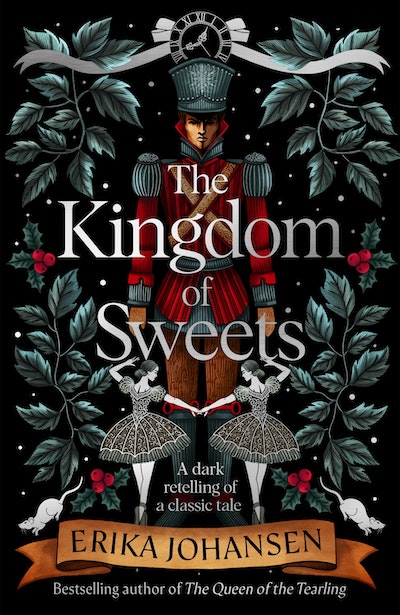
Review: The Kingdom of Sweets by Erika Johansen

“The Kingdom of Sweets” is a lot like its protagonist: difficult to love.

In fact, the standalone novel based very loosely on E. T. A. Hoffmann’s short story/Pyotr Ilyich Tchaikovsky’s ballet is genuinely hard to read for the first two-thirds of its length. This dark fantasy tinged with horror is expertly put together and cleverly weaves together fantasy with Russian history, but is also graced with characters who are uniformly unlikable.

As newborns, Clara and Natasha were blessed/cursed by the sorcerer Drosselmeyer – Clara was declared “light” and Natasha “dark.” And they grew up accordingly: Clara was beautiful and beloved by everyone, while Natasha was unattractive and ignored, taking her solace in a world of books. Then, at the Christmas party that marks their seventeenth birthday, it’s announced that newly-pregnant Clara is marrying the wealthy boy that Natasha is infatuated with – and both girls are given strange living toys by Drosselmeyer.

Soon Clara is whisked away into a magical Kingdom of Sweets, and Natasha follows her doggedly. But she soon senses that there is something profoundly wrong about this strange sugar-coated dimension, which is ruled over by the Sugarplum Fairy.

And as a bitter, jealous Natasha discovers the depths of her sister’s betrayal, she is offered a Faustian bargain by the Fairy – if she helps the Fairy destroy Drosselmeyer, the Fairy will let her kill Clara and take her appearance and her life. But the life that Clara seizes for herself isn’t as sweet as she hoped it would be – and as the years go by, she discovers that she can’t escape the sins of her own actions. Her only hope is to uncover the ancient magic that Drosselmeyer coveted, which may be her only escape.

Let’s be upfront about this: for the first two-thirds of “Tbe Kingdom of Sweets,” there are absolutely no likable characters. At all. Everybody without exception is a terrible person of one stripe or another, whether they’re a cold unfeeling parent, a murderous sorcerer, sadistic socialites or a shallow selfish sister. This includes Natasha herself, who is a bitter, hate-consumed person who has a heavy dose of Not Like Other Girls Syndrome, and deludes herself into thinking she is smarter and more insightful than everybody else. She would fit in well on social media.

As a result, I had to struggle to get through the first two-thirds of the book, despite Erika Johansen’s skillful writing and some well-written interlacing of Hoffman’s tale with actual Russian history from the turn of the 20th century. It just wasn’t enjoyable to be in Natasha’s head because I was so repulsed by the character, especially since the narrative doesn’t really hint at future growth, and I couldn’t really bring myself to care much about whatever ironic punishment she suffered as a result of her own actions.

However, things started to turn around when Clara reenters the story; the story becomes more streamlined and organic, and Natasha is forced to face the evil that has been brewing inside her for so long. It makes that last third of the book more poignant, more gripping, and more suspenseful as Natasha has to find a way to, if not undo what she’s done, then at least try to make amends while defeating the Fairy. It becomes more a story about redemption and forgiveness, which softens Natasha’s harsh, prickly worldview and how she looks at others, such as the priest.

But to get to that solid final third, you have to slog through the first two-thirds, which are simply not enjoyable to read. If you don’t mind that, then “The Kingdom of Sweets” is a solid dark’n’twisted version of the Nutcracker story.

Review: Heaven Official’s Blessing Volume 7

The malevolent White No Face has returned, forced Xie Lian to relive the most horrifying experiences of his long life, and locked him inside the Kiln. Amazingly, that is nowhere near as bad as things are going to get for the good guys.

But one thing that can’t be denied is that the seventh volume of “Heaven Official’s Blessing” is the most insane and wild volume to date, with Mo Xiang Tong Xiu unleashing her fertile imagination in all sorts of grandiose, sometimes bizarre ways. At the same time, she reveals the series’ most shocking plot twist, and explores the horrifying backstory of just what White No Face is, what shaped him into the monster he has become, and why he’s so obsessed with Xie Lian.

Trapped in the Kiln, Xie Lian faces off against White No-Face – and ends up breaking free in an awesome, spectacular manner that I won’t spoil here. He’s reunited with Hua Cheng and his friends and tries to escape the erupting Mount Tonglu – but the tormented souls of the people of Wuyong escape the volcano, threatening a new plague of Human Face Disease on the world. Xie Lian, Hua Cheng and their allies – along with a few familiar faces from along the way – are all that stand between the human world and horrifying mayhem.

But that’s nothing compared to what happens when Xie Lian learns the terrifying truth of who White No-Face really is, and how and why the ghost has been stalking him for hundreds of years. Furthermore, his enemy has even more power than he ever suspected – enough to topple Heaven and overwhelm even the most powerful of gods. Xie Lian will need some help to even hope to defeat him and save humanity from a plague – not just from Hua Cheng, but from friends, enemies and total strangers.

It’s very difficult to praise “Heaven Official’s Blessing Volume 7” in specific terms, simply because it requires me to praise its colossal plot twist and the immense payoff of… well, the entire story so far. It’s hard to do that without giving away White No-Face’s secrets and identities, as well as the question of why he dedicated so much time and energy to tormenting Xie Lian, because MXTX did a masterful job of surprising audiences with the many answers to the questions raised over the course of her story. It’s exceptional, and it should be read blindly so you can be surprised.

That also applies to some of the massive, imaginative developments in this extended climax, worthy of a blockbuster movie scripted by a crazed genius. While a lot of it involves sneaking around, mass curbstomps and a very long exposition scene involving Xianle’s state preceptor, MXTX throws in some gloriously over-the-top, wildly imaginative scenes. Like the fiery city-mechan. Or a Statue-of-Liberty-sized divine statue flying into space, fueled by kisses and drawn by butterflies and lanterns. I am not making that up. It actually happens. It’s glorious.

At the same time, she spins up a web of lies, answers, complicated backstories, bloody action, a very sad seeming-death, and some bursts of slightly frenetic comedy (Quan Yizhen beating up Qi Rong with his own statue). Everything comes to a climactic boiling point as just about everything up until now – corpse-eating rats, ghost garments, fetus ghosts, volcanoes and magic evil-revealing swords – comes back into the story with a distinct purpose. Same with the characters, reintroducing everyone from Pei Ming’s crazed stalker to Xie Lian’s eccentric mentor.

With all this stuff going on, the romance could have easily been lost in the shuffle, but MXTX mixes in countless little tender moments between Hua Cheng and Xie Lian, made all the more endearing by Hua Cheng’s mischievous flirtations and Xie Lian’s giggling nervousness. It’s very cute, and MXTX stuffs a little fluff into every crevice in the story where it can fit, even if it’s just Hua Cheng sitting next to Xie Lian while he listens to exposition.

“Heaven Official’s Blessing Volume 7” hurtles towards the grand finale like a freight train – full of wildly apocalyptic action, charming romance and explanations for just about everything. And the ride ain’t over yet.

Review: The Forest Grimm by Kathryn Purdie

Disclaimer: I received an advance copy of this book from Netgalley in exchange for an honest review.

Outside the town of Grimm’s Hollow is the Forest Grimm – a magical place twisted by a malevolent curse that draws bespelled people into its depths and is slowly killing the surrounding farmland.

And as you could probably guess by the name of the forest, “The Forest Grimm” by Kathryn Purdie wraps itself in a cloak of glittering fairy tales. But these aren’t the sanitized, Disneyfied stories you might know, where all you need to fix things is true love’s kiss. Instead, her elegant, winding fantasy tale delves into the dark, distorted versions of these familiar tales, with a seemingly doomed heroine as perhaps the only chance of breaking the curse.

For her entire life, the cards telling Clara’s fortune have said only one thing – she will die young, as a result of a “fanged creature.” Despite this dismal future, she is determined to enter the hostile Forest Grimm and find her beloved mother, who was the very first person to be lost there – and if she can’t find her mother directly, then she wants to find a missing magical book, the Sortes Fortunae, to end the curse once and for all.

Then she discovers something shocking: the forest will allow a person to enter it if they have red rampion. And before she vanished, Clara’s mother made her a hooded cloak dyed with rampion flowers – which she takes as a sign that she’s destined to enter the Forest Grimm and change the fate of everyone in the forest and the town. She’s accompanied in her quest by Axel, a strikingly handsome young man whose fiancee Ella vanished into the forest, and her best friend Henni, who also happens to be Ella’s sister.

Unfortunately, the Forest Grimm has bigger dangers than vicious trees and a constantly-shifting landscape. It doesn’t just take the people of Grimm’s Hollow – it changes and twists them, and its dark, malevolent magic is channeled through them. Also, a giant wolf is following Clara, and she’s pretty sure it’s the fanged creature destined to kill her. But fate may have something else in mind, if Clara can stay alive long enough.

“The Forest Grimm” is one of those fantasy stories that trips lightly on the edge of horror, especially the gruesome whimsy found in old-timey fairy tales. The fairy tale figures here are not sweet-natured princesses in pretty dresses – they are cruel, maddened and extremely dangerous, whether they are using a vast web of prehensile hair, tree roots or some well-timed magic mushrooms. And yes, it’s THAT kind of magic mushrooms.

And Kathryn Purdie weaves the entire tale together with elegance and skill. Her writing has a timeless quality reminiscent of the fairy tales she twines into her original tale, except for a few more modern-sounding descriptions of how attractive Axel is. And alongside her dark fairy-tale trappings, she also dips into some fairly heavy thematic material about whether a person can change their fate, and whether your fate is necessarily what you think it is.

It helps that Clara is one of the most likable and engaging heroines I’ve read about in years – she’s earnest and unselfish, resourceful and determined. Believing that she has no future, she tries to ensure a future for other people, even if it hurts her in the process. Axel is a thoroughly wholesome male lead alongside her, and their budding relationship is a tentative, sweet one… if they can get past issues with obligation, guilt and loneliness.

Perhaps the most frustrating thing about “The Forest Grimm” is finishing it, and realizing that the story is not actually over – meaning that I now have to wait for Kathryn Purdie to publish the sequel before I can find out what’s next for Clara, Axel and Henni. In the meantime, it’s a richly-imagined, shadows-and-tatters homage to Grimm’s fairy tales.

Review: The horrors of “The Lord of the Rings: Gollum”

It hasn’t been a good few years to be a Lord of the Rings fan.

First, Amazon crapped on Tolkien’s intellectual property with The Rings of Power, even as they followed the time-honored tradition of attacking the fans preemptively to try to bully people into watching. I’ve been blocked by TheOneRingNet on Twitter after I called them out for bigotry against Tolkien’s religion and their abuse of fans, and I am very proud of that fact. Being blocked by bigots is practically a compliment.

And then… we got The Lord of the Rings: Gollum.

If anything will make you miss the glory days of Lord of the Rings games, it will be this… thing. The Lord of the Rings: Gollum proves that there is a distinct lack of quality control in J.R.R. Tolkien’s franchise, displayed here through a game that is deeply and intensely broken on every level. Nothing about this game is good, except for possibly the entertainment factor of goggling at whatever aspect of Tolkien’s world that is being molested.

The core concept is not necessarily a bad one. Sure, a video game about a cannibalistic crackhead who obsesses about jewelry sounds like a terrible idea, but Gollum is a complex and nuanced enough character to lend himself to an expanded story. He’s also strong and nimble, which lends itself well to the idea of a parkour game. The story supposedly covers Gollum’s adventures prior to the events of The Lord of the Rings, namely how he was captured by Sauron and imprisoned in Mordor, and then captured by the wood-elves and imprisoned in Mirkwood.

Unfortunately, it soon becomes obvious what is wrong with the game. For one thing, it looks like a PS2 game that somehow fell through a time vortex and landed in the year 2023… and was given a PS5 release. The graphics are primitive at best, eye-gougingly ugly at worst. Gollum looks like he’s melting 95% of the time, and almost all of the other characters look primitive and sometimes actually unfinished. The color palette is depressingly muted, except for when the world suddenly becomes radioactive and burns your retinas.

There are also a thousand artistic choices that are absolutely baffling. Why does Thranduil look like an overtrimmed shrub is growing out of his head? Why is Gandalf referred to as “wizard”? Why do some of the orcs have phallic armor? Why is there a random Russian in Mordor? Why is one of the orcs French? Why does Gollum have a bird sidekick? Why does the Mouth of Sauron dress like an extra from “Dune”?And why, in the name of Eru, did someone decide that Sauron, the Nazgul and the orcs weren’t sufficient villains for the story, and thus we needed a new and chilling enemy titled “The Candle Man”?

Even this might have been slightly tolerable if they had plumbed the depths of Gollum’s tortured, addiction-wracked, divided mind. Unfortunately, most of what the devs seem to know about him is the existence of his Smeagol alter ego… and not much else. He’s never convincingly depicted as the sly, corrupt, malign, disgusting little creature of Tolkien’s works – this Gollum has an internal moral debate about killing a beetle and adopts a little baby bird. For context, the Gollum of Tolkien’s books ate babies. Human babies.

As if the story wasn’t bad enough, the game is extremely broken – glitchy and buggy, frequent crashes, and a confusingly random frame rate that often makes the animation janky and stuttering. The stealth mechanics are poor, with some tasks that are very difficult to complete due to a lack of user-friendliness, and it’s often difficult to see what’s going on around Gollum. It sometimes feels like a game made by enthusiastic but not-very-well-trained amateurs who did their best… except that you’re expected to pay for it.

Playing The Lord of the Rings: Gollum is a thankless, joyless experience, and it is all the more egregious when you realize it was based on the life’s work of a man who so expertly and passionately crafted his imaginary world. There are many good or at least tolerable Lord of the Rings games, and any of those would be better than this one.

Recommendation: The Untamed

I will probably write a full-blown review of this TV series sometime in the future, once I figure out how to summarize fifty plot-packed episodes that bounce around the timeline of almost twenty years.

So, quick sum-up: The Untamed is a Chinese xianxia TV show that became a hit on Netflix because… well, people are starved for good TV, and it’s a good TV show. It’s based on the Mo Dao Zu Shi/Grandmaster of Demonic Cultivation books by Mo Xiang Tong Xiu (pseudonym), which recently got published in the United States. The original novels are part of a genre called danmei, which refers to books aimed at the female reading public that focus on a romantic relationship between two men. But because of Chinese censorship laws, the TV show just has the most intense bromance you will ever find.

The bare-bones summary is that it takes place in an ancient-medieval-styled fantasy world where Daoist magic allows people to have superpowers, fly on their swords, manipulate spiritual energy, and so on. A mentally ill man summons the spirit of Wei Wuxian, who was sort of the bogeyman of the cultivation world. Before he died sixteen years ago, he used demonic magic and rebelled against all the various sects, so they regard him as being a sort of low-level Sauron. Wei Wuxian ends up in the body of the mentally-ill man so he can enact revenge against the guy’s family, and ends up tangled in a weird supernatural mystery. He also reconnects with Lan Zhan, who was his best friend in his old life, despite them having opposite personalities.

It’s a little hard to understand what’s going on in the first two episodes, but it quickly flashes back for about thirty episodes to reveal everything that got the main characters to the present day. Basically, refined uptight boy Lan Zhan despised Wei Wuxian at first because Wei Wuxian was a free spirit who regularly flouted the rules, but eventually grew to admire and care about him. At the same time, the various sects have to deal with the Wen clan, who are effectively taking over everything, and Wei Wuxian ends up sacrificing everything to help other people, but is branded a monster for doing so. He’s also being framed by somebody who is only revealed much later on.

After that flashback, it’s a good idea to go watch the first two episodes a second time, now that you know who everybody is and what their history consists of. After that, it follows Wei Wuxian and Lan Zhan as they try to figure out who the mastermind behind all this is.

The biggest problem of the story is obviously the censorship. Not just because they had to remove the romantic elements, but because it won’t allow such things as ghosts and zombies… in a story about a necromancer. As a result, there are some scars and stitch marks in the narrative where things had to be excised or drastically changed.

But if you can get past that, it’s a great show. The casting is one of the most perfect ones I’ve seen since Lord of the Rings – every actor is giving a pitch-perfect performance, and some of the roles are pretty difficult. The roles of the two leads are particularly hard. Lan Zhan is a sort of defrosting ice prince who conveys a lot of emotion with very few words and extremely understated facial expressions.

And the actor playing Wei Wuxian is called on to play a mercurial quirky genius. He could have been a very irritating character in a less talented man’s hands, but he’s absolutely charming instead – and it’s worth noting that Wei Wuxian goes through a LOT of development. He suffers a complete mental breakdown, is tormented for months until he’s suffering from PTSD, has a fixation on family relationships, has a crippling fear of dogs, and so on and so forth. He overall grows from a brilliant but cocky youth into a clever and more insightful man, all without losing his mischievous streak or his ADHD.

And there are billions of characters in this drama, and many of them have their own stories and development as well. Hell, a few of them get whole side-stories, such as the psychotic Xue Yang and the pure-hearted Xiao Xingchen.

A few cultural details require explanations to understand, but the backbone of The Untamed is just really good storytelling, excellent acting and a gripping, complex story that will keep you mesmerized right to the end.

Review: Tress of the Emerald Sea

While the rest of us were gaining weight and getting depressed during the Covid-19 lockdown, Brandon Sanderson was doing what he does best: churning out books.

And the first of these four surprise books is “Tress of the Emerald Sea,” a Cosmere novel that mingles quirky fairy-tale quests for a true love with the rough’n’tumble life of a pirate. Sanderson gives us a extraordinarily ordinary heroine who stumbles and triumphs on her quest, along with a talking rat, seas of colorful spores, and the occasional zombie doctor.

Tress is a seemingly ordinary girl on a small rocky island in the green spore sea – she collects teacups, washes windows, loves her family, and regularly meets with the local duke’s son, Charlie. When the duke realizes that his son is in love with a window-washing girl, he whisks the boy off the island to marry a princess. When the duke returns, he’s got a brand new heir with a new wife – and Charlie is nowhere to be seen. He’s been sent off to the realm of the Sorceress in the Midnight Sea, which means he’s effectively doomed.

But Tress is determined to get him back, so she smuggles herself off the island… and finds herself the prisoner first of smugglers, and then a crew of pirates ruled by the bloodthirsty Captain Crow. She also acquires a talking rat friend, Huck, who becomes her best friend and ally, especially since he knows some things about the Sorceress. Though the situation isn’t ideal, Tress believes the ship can get her to the Sorceress, and manages to work her way into the crew.

But her plans are complicated when she becomes friends with several of the pirates, and learns some disturbing facts about Crow. How can a simple window-washer girl defeat a pirate captain, sail the deadly Crimson and Midnight Seas, escape a dragon and defeat the terrible Sorceress – all while learning the true nature of spores and aethers?

“Tress of the Emerald Sea” is one parts fairy tale, one part pirate adventure, and one part Cosmere story (especially since the narrator is none other than Hoid, who plays a pivotal role). And the world Sanderson conjures is a fascinating one, where twelve moons produce a steady downfall of spores that form whole seas that wooden ships can sail on. But, much like a mogwai, never expose them to water, or very bad things happen.

Since Hoid is the one telling the tale, the entire story unfolds in a quirky, laid-back narrative style, reminiscent of William Goldman or a more modern fairy tale. It’s arch, snarky and very omniscient third-person (Tress’s hair is once described as an “eldritch horror” bent on “disintegrating reality, seeking the lives of virgins, and demanding a sacrifice of a hundred bottles of expensive conditioner”). The only major flaw, ironically, is that self-same snarky tone – it sometimes becomes kind of overbearing, especially during the more serious parts of the story, and sometimes it feels like Hoid is hijacking the story.

It also has Sanderson’s exceptional world-building, especially in the idea of the spores, which will immediately erupt into SOMETHING – air, vines, crystals – upon contact with water. And while Sanderson weaves in elements of the Cosmere, creating a more science-fiction-y world, there are elements of magic included in it, such as Huck. No, I will not explain what is up with the rat, only that not all is as it seems… as you’d expect with a talking rat.

Tress herself is an exceptional heroine – smart, resourceful, determined, good-hearted and practical, with a nimble brain and a love for collectible cups. Her relationship with Huck is very wholesome and sometimes heartwrenching, as are her friendships with other members of the crew – a seemingly-zombie doctor, an assistant cannonmaster who never successfully hits anything, a cheery deaf man with a writing board, and the deadly, nihilistic Captain Crow. There are also Dougs, but we don’t care about them.

“Tress of the Emerald Sea” is a charming, well-paced story that is a little too suffused in Hoid for its own good. For those seeking a rollicking pirate adventure with some wild fantastical twists, this is a must-read.

Review: Heaven Official’s Blessing Volume 2

Xie Lian has ferreted out another god’s dirty laundry… but he had no idea that someone would reveal his own past misdeeds.

In fact, a great deal of “Heaven Official’s Blessing” Volume 2 is dedicated to Xie Lian’s past, both recent and ancient – Mo Xiang Tong Xiu (hereafter referred to as MXTX) delves into a situation that threatens to stain Xie Lian’s reputation, before diving back eight hundred years to his days as a mortal prince. There are a heavy load of unexpected twists, a loathsome new villain, and some gripping insights into how Hua Cheng came to be so enraptured by the prince of Xianle.

The heavenly emperor Jun Wu gives Xie Lian a new mission: enter Ghost City and find out what happened to a Heavenly Official who sent out a distress call. Accompanied by the exuberant, gender-flipping Wind Master Shi Qingxuan and the earnest Lang Qianqiu, he heads into what qualifies as enemy territory… except that Ghost City is also Hua Cheng’s demesne. And Hua Cheng is very, very pleased to see him there, which unfortunately doesn’t make Ghost City any less perilous.

To make matters worse, Lang Qianqiu discovers that Xie Lian is a figure from his own past – the state preceptor who murdered his family. Even more shocking, Xie Lian freely admits his guilt. But Hua Cheng knows there’s something more than meets the eye, and invades Heaven itself to take Xie Lian away from captivity. Alongside this mysterious ghost, Xie Lian will find out exactly what happened centuries ago… and rediscover a terrible figure from his own past.

Speaking of his past, we then get bounced back in time eight hundred years. Back then, Xie Lian was a kind but naive teen prince who believed he could do anything – like abandon a ritual fight during a parade to rescue a child from a fatal fall. To the dismay of the state preceptor, he steadfastly refused to accept any kind of blame. When his cousin tries to murder the child for the second time, Xie Lian takes the boy under his wing – with no idea how the boy will affect his future.

If the first volume of “Heaven Official’s Blessing” was devoted mostly to unraveling supernatural mysteries, then the second one is devoted mostly to exploring some of Xie Lian’s backstory. Obviously a character who’s eight hundred years old can’t be summed up that quickly, but we see a little of how he used to be – especially the glimpse of him as a mortal teenager, still recognizably kind and good-hearted, but also kind of spoiled and arrogant.

It stands in stark contrast to the Xie Lian of the present, who is much humbler, more self-deprecating, and happy to live in a shack-turned-shrine. At the same time, we see the scars that his past actions have left on him, and hear about some particularly nasty run-ins he’s had. Conversely, we get glimpses of Hua Cheng from the past – seriously, it’s abundantly clear who the little boy in the flashback is – that contrast sharply against the confident, powerful, seductive figure he is now.

We also encounter an array of new characters – we see more of Mu Qing and Feng Xin, Xie Lian’s former servants, both in the present and the past; the powerful and promiscuous Pei Ming; the friendly and unembarrassable Shi Qingxuan; and the vaguely paternal Jun Wu.

MXTX also shows off her ability to combine twisty, cleverly-plotted story arcs with amusing, warmer moments for the characters (Xie Lian and Hua Cheng nerding out over a room full of rare swords) and the occasional laugh-out-loud moment (Xie Lian publicly faking impotence to escape a prostitute). She also demonstrates a talent for weaving romance into the story, such as when Hua Cheng “teaches” Xie Lian to roll dice. Nothing obvious, nothing explicit – just the characters gazing at each other and touching one another’s hands. Very sensual.

ZeldaCW also deserves credit for the interior illustrations, black-and-white pictures of both detail and delicacy. Particular highlights includes Xie Lian stroking Hua Cheng’s sword (no, not a euphemism), Shi Qingxuan doing battle in a sexy dress (while male), Xie Lian being swarmed by butterflies, and his teenage self in his God-Pleasing Warrior garb.

The second volume of “Heaven Official’s Blessing” delves a lot deeper than the first one did, revealing more about the self-deprecatingly pleasant prince and the mysterious ghost who loves him. And it leaves you poised to dive right into the third volume, just to find out what happens next. Beware – it’s going to get dark.

Review: Heaven Official’s Blessing Volume 1

Once upon a time, Xie Lian was the beloved crown prince of a beautiful kingdom, who ascended to godhood in his teens. But then he interfered in mortal affairs, made things worse, and was cast out. He ascended to godhood a second time… and was kicked out again.

And in “Heaven Official’s Blessing Volume 1,” we find out what happens when this unfortunate godling ascends to deityhood for the third time. Mo Xiang Tong Xiu (pen name, to be hereafter referred to as MXTX) digs into Xie Lian’s story with a heady mix of timeless romance with a uniquely Chinese brand of high fantasy, where the powerful or virtuous can become deities, but the tormented and tragic may become something else.

Upon his third ascension to godhood, Xie Lian discovers that nothing has really changed – he’s deeply in debt, and none of the other gods like or respect him. The usual way to pay off his debt is by receiving merits from the worship of mortals… except people stopped worshiping him eight hundred years ago. But there is another way – he can investigate a certain mysterious problem on a rural mountain, where seventeen brides have been abducted by a mysterious “ghost groom.”

With the assistance of the sulky, combative Fu Yao and Nan Feng, he goes undercover (as a bride) to find out what is abducting the girls – and ends up being escorted up the mountain by a handsome, mysterious stranger dressed all in red, who turns into a swarm of silver butterflies. But that man was NOT the ghost groom – which leaves Xie Lian to uncover the horror that lives atop the mountain. To make matters worse, the locals are also searching for the ghost groom, which only makes things more complicated when things inevitably go pear-shaped.

After that, Xie Lian decides to set up a shrine to himself in an abandoned shack, with the help of a young man named San Lang, who is very obviously not what he pretends to be. But trouble finds Xie Lian again when someone tries to trick him into going to a haunted pass in the Gobi desert, near the dead city-state of Banyue. Even weirder, the other gods seem to avoid talking about this.

Along with San Lang, Fu Yao and Nan Feng, he sets out to the pass to find out what’s going on there, and ends up encountering a sandstorm, a few dozen merchants… and a cave full of scorpion-snakes. But that’s only the beginning of the undying terrors that still dwell in Banyue, killing anyone unlucky enough to pass through. And soon Xie Lian realizes that someone in Banyue has a very strong connection to him.

I personally like my romance stories with a heavy dose of plot, which makes “Heaven Official’s Blessing” perfectly balanced – even if the slow-blooming romance weren’t part of the story, it would still be a solid fantasy-horror series with gods, ghosts, goblins, zombies, and a really freaky undead face in the ground. The exalted and elegant world of the gods is a stark contrast to the nightmarish creatures that lurk in the mortal world below.

It’s also a fantasy that feels distinct from its western cousins – its world and cosmology are uniquely Chinese, drawing heavily from Taoism and other Chinese beliefs. The two supernatural mysteries are pretty well-developed, both horrifying and yet tragic, and the stories occasionally slow down a little for either some mild comic relief (the entire “Tremendous Masculinity” story, which is thankfully explained in full) or an ethereal romantic moment between Xie Lian and his mysterious red-clad man of the silver butterflies.

MXTX’s writing is bright and evocative, with a casual omniscent narrator (“One might ask, if there was an Upper Court and a Middle Court, was there a Lower Court? … No.”) that makes it feel like you’re sitting in the room with her and explaining her story as she tells it. There are also a number of very nice interior illustrations by ZeldaCW, delicate and evocative, of such things as Xie Lian and San Lang surrounded by snakes and riding in a cart, Xie Lian in a wedding dress, and an adorable chibi drawing of the four with the broken sword.

Xie Lian is an easy character to like – perpetually unlucky and unpopular, yet unfailingly earnest and kind to everyone around him (as long as they don’t beat up girls). But MXTX gives us broad hints that he hasn’t always been so upbeat about his unfortunate life, and of past struggles yet to be explored. On the flip side, we have the mysterious Hua Cheng, a supposedly terrifying figure that treats Xie Lian with flirtatious kindness that hints at deeper emotions; and the cast is rounded out by Fu Yao and Nan Feng, a couple of clashing, abrasive young men who actually do care about the disgraced prince.

“Heaven Official’s Blessing Volume 1” is a solid beginning to a webnovel series that perfectly balances out a slow-blooming romance, a solid blend of fantasy and horror, and some supernatural mystery. A great place to start.