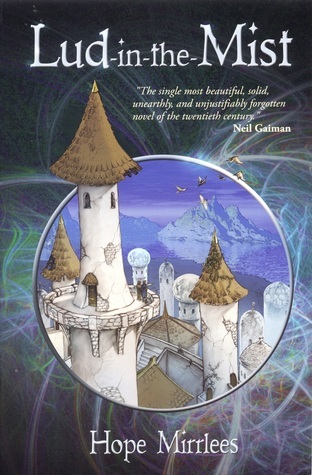
Even though many have tried, only a few fantasy books have the qualities that come naturally to “Lud-In-The-Mist” – a quirky sense of humor, a complicated and timeless plot, and a sense of the ethereally magical that makes you feel like you’re walking on the thin edge between the real and the mystical.
And while not as influential as works by the titans of the fantasy genre, Hope Mirrlees’ classic novel is nevertheless a haunting and engaging read – it’s as if “The Hobbit” had been written by Lord Dunsany, edited by Neil Gaiman and given a few extra flourishes by Peter S. Beagle. It’s a sweet pastoral story that slowly blossoms out into a very unique story — there’s a little murder mystery, an amusing village of hobbity people, and a quicksilver dream of beautiful fairyland and otherworldly danger.
Fairy is forbidden in the town of Lud — not just fairy creatures and their exquisite fruit, but mentions of them, the dead who walk with them, and the Duke Aubrey who left with them. But all his life, the steadfastly dull Mayor Nathaniel Chanticleer has a lingering longing/fear for a strangely magical musical note. Despite all this, life remains boring and rather pleasant — until Chanticleer’s son Ranulph begins acting strangely, claiming that he’s eaten fairy fruit.
After Chanticleer sends his son off to a farm for a vacation, the teenage girls at Miss Primrose’s Crabapple Academy suddenly seem to go pleasantly insane, and then race off into the hills. Life seems to seep out of the old town, and Nathaniel must connect the present crises to a past conspiracy, all of which hinges on Fairyland, fairy fruit, and the sinister doctor Endymion Leer. The journey to discover the truth will take him out of the everyday world — and change him forever.
“Lud-in-the-Mist” is not one of those stories where the fairies and elves feel like humans with pointy ears, and their magic can be easily understood. Mirrlees conjures a dreamlike atmosphere and faraway lands that are only glimpsed in passing – there’s the underlying feeling that there’s a frightening, exquisite world that is barely separated from ours.
Some parts of “Lud-in-the-Mist” are pleasantly familiar, even if you don’t live in pastoral British regions of the early twentieth century. Little charming towns full of staid, prosperous people who try to avoid the dark, wild things that dwell outside their borders, and definitely The strange and exquisite is always just out of sight, and Mirrlees’ writing is capable of bringing that to life.
She also is capable of spinning up a very solid plot to match the fantastical atmosphere – she intertwines a fantasy and a murder mystery seamlessly into one another, and then winds Chanticleer’s personal journey into it. Her writing style also evolves over the course of the story; during the first parts of the book, her style is pleasantly cozy, mellow and reminiscent of the era in which she wrote it. But as the story blossoms into a tangle of crises and mysteries, Mirrlees’ writing becomes more lush, exquisite and haunting.
It also has a hero who doesn’t fit the usual mold of a high fantasy lead character. Chanticleer is very reminiscent of Bilbo Baggins – who was first written several years later – being a pleasant, boring, stodgy middle-aged man. But we learn that he has a brave, eccentric interior that gradually transforms him from respectability to something more attuned to the fairy world. And the other inhabitants of Lud are similarly engaging and just a little bit quirky — fairy-struck teenagers, snippy old ladies, the haughty farmer’s wife, the quietly malevolent Endymion Leer, and the happily mad people.
While it doesn’t have the fame that many subsequent fantasy novels still enjoy, Hope Mirrlees’ “Lud-in-the-Mist” is a thing of beauty – funny, exquisite and boundlessly clever. Most of all, it will leave you feeling like you just ate fairy fruit.
Once upon a time, Xie Lian was the beloved crown prince of a beautiful kingdom, who ascended to godhood in his teens. But then he interfered in mortal affairs, made things worse, and was cast out. He ascended to godhood a second time… and was kicked out again.
And in “Heaven Official’s Blessing: Season 1,” we find out what happens when this unfortunate godling ascends to deityhood for the third time. This donghua series (think anime, but Chinese) based on Mo Xiang Tong Xiu’s novels of the same name, is a slow-burn that mingles romance with a uniquely Chinese brand of high fantasy, where the powerful or virtuous can become deities, but the tormented and tragic may become something else.
Upon his third ascension to godhood, Xie Lian discovers that nothing has really changed – he’s deeply in debt, and none of the other gods like or respect him. The usual way to pay off his debt is by receiving merits from the worship of mortals… except people stopped worshiping him eight hundred years ago. But there is another way – he can investigate a certain mysterious problem on a rural mountain, where seventeen brides have been abducted by a mysterious “ghost groom.”
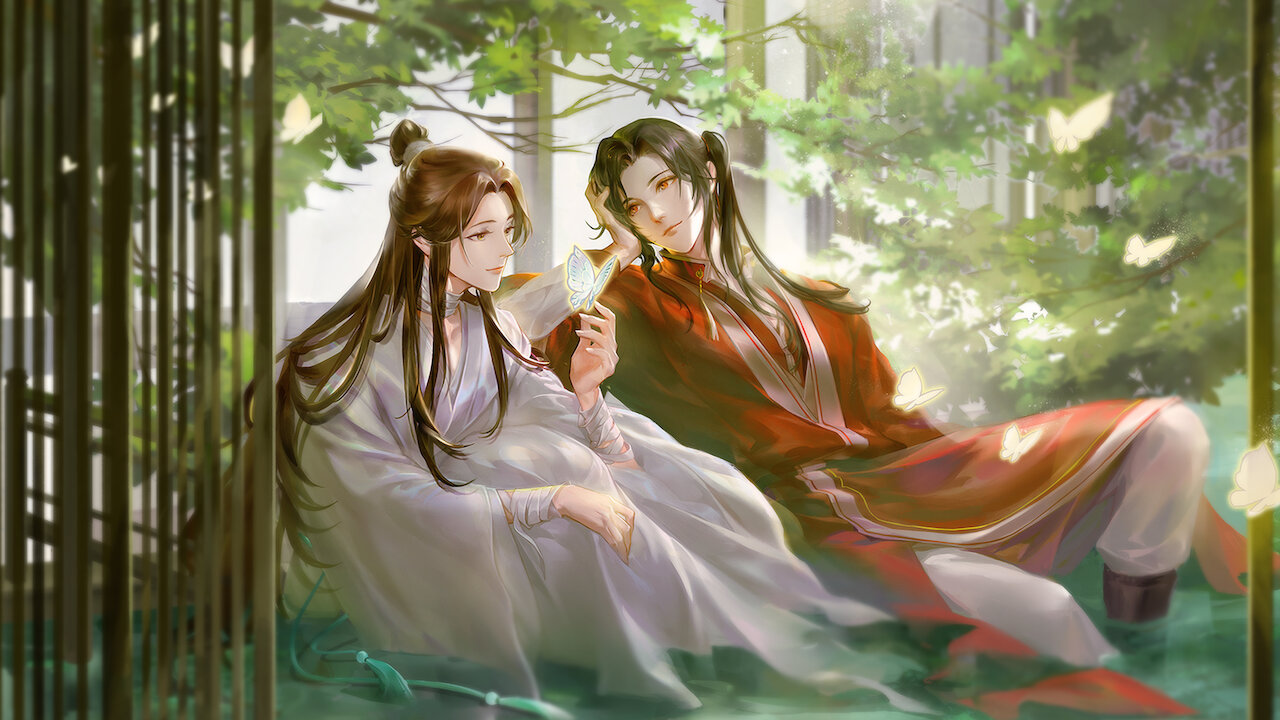
With the assistance of the sulky, combative Fu Yao and Nan Feng, he goes undercover to find out what is abducting the girls – and ends up being escorted up the mountain by a handsome, mysterious stranger dressed all in red, who turns into a swarm of silver butterflies. But that man was NOT the ghost groom – which leaves Xie Lian to uncover the horror that lives atop the mountain. To make matters worse, the locals are also searching for the ghost groom, which only makes things more complicated when things inevitably go pear-shaped.
After that, Xie Lian decides to set up a shrine to himself in an abandoned shack, with the help of a young man named San Lang, who is very obviously not what he pretends to be. But trouble finds Xie Lian again when someone tries to trick him into going to the Half Moon Pass in the Gobi desert, near the dead city-state of Banyue. Even weirder, the other gods seem to avoid talking about this.
Along with San Lang, Fu Yao and Nan Feng, he sets out to the pass to find out what’s going on there, and ends up encountering a sandstorm, a few dozen merchants… and a cave full of scorpion-snakes. But that’s only the beginning of the undying terrors that still dwell in Banyue, killing anyone unlucky enough to pass through. And soon Xie Lian realizes that someone in Banyue has a very strong connection to him.
I personally like my romance stories with a heavy dose of plot, which makes “Heaven Official’s Blessing” perfectly balanced – even if the slow-blooming romance weren’t part of the story, it would still be a solid fantasy-horror series with gods, ghosts, goblins, zombies, and a really freaky undead face in the ground. The ethereal beauty of the lead characters and their sparkling heavens is a stark contrast to the nightmarish creatures that lurk in the mortal world below.
It’s also a fantasy that feels distinct from its anime cousins – its world and cosmology are uniquely Chinese, drawing heavily from Taoism and other Chinese beliefs. The two supernatural mysteries are pretty well-developed, both horrifying and yet tragic, and the stories occasionally slow down a little for either some mild comic relief (Fu Yao and Nan Feng’s constant fighting) or an ethereal romantic moment between Xie Lian and his mysterious red-clad man of the silver butterflies.
The animation is quite lovely for the most part, with some really beautiful moments standing out in the Puqi Temple or when the red-clad man escorts Xie Lian up the mountain. The only area where it falls down is when CGI is inserted, usually where it’s not needed. It’s very clunky.
Xie Lian is an easy character to like – perpetually unlucky and unpopular, yet unfailingly earnest and kind to everyone around him (as long as they don’t beat up girls). Howard Wang gives him a low-key, soothing kind of voice even when he’s upset. The mysterious Hua Cheng (whose identity is blatantly obvious) makes for a solid love interest, and the cast is rounded out by Fu Yao and Nan Feng, a couple of clashing, abrasive young men who actually do care about the disgraced prince.
“Heaven Official’s Blessing: Season 1” is an animated show that perfectly balances out a slow-growing romance, beautiful animation, and solid fantasy/horror. For those seeking an alternative to anime, this might do the trick.
A mummy movie is possibly the easiest kind of horror movie to make — it comes to life and terrorizes the living. Simple, but effective.
And yet “The Eternal: Kiss of the Mummy” (aka “Trance”) has managed to screw that simple formula up. Despite the ever-interesting presence of Christopher Walken and some pretty cinematography, the story itself is a flaccid, flabby mess of plot holes and basic writing errors — including some of the least sympathetic characters I’ve ever seen in a movie.
Nora (Alison Elliott) and Jim (Jared Harris) are a pair of wealthy alcoholics in New York, who have decided to dry out on a visit to her grandmother in Ireland. Yes, they plan to dry out in the land of Guinness, because apparently it doesn’t count as booze. But when they arrive, Nora immediately blacks out and crashes the car.
And it keeps getting better — her grandmother has that highly selected senility you only see in movies, and her weird uncle Bill (Walken) only seems interested in the bog-preserved mummy of a druid witch who murder-suicided in the Iron Age. Of course, the mummy comes back to life… for no reason that’s ever explained… and she looks exactly like Nora. Now she apparently wants to steal Nora’s body… even though her own body seems to be working fine.
Director/writer Michael Almereyda seems to have only a vague idea of how proper storytelling works. Important characters appear without introduction two-thirds of the way through, logic is constantly violated (so Niamh doesn’t realize that a cigarette is ON FIRE, but she knows what whiskey is?), and the awkward climax ends up pretty much making no sense at all.
Worst of all: huge oozing lumps of exposition are constantly thrown at us like lumps of excrement… from people who couldn’t POSSIBLY know what they are talking about. How does Bill know the history of Niamh? Magic, apparently. How does Alice know all about her powers and intentions? Never explained. It becomes infuriating after awhile, especially when you realize that Alice is JUST there to exposit.
Almereyda tries to compensate by draping the movie in a dreamy atmosphere and Ireland’s peaty, raw beauty… but it’s not enough. The movie sludges by at a painfully slow pace, with lots of people wandering around and having the world’s slowest conversations, most of which are pretentious muckity-mystical drivel (“Every day; all the time. You wake up, open your eyes, take a breath, start over: that’s how it is”). And of course, Alice monologues over everything. EVERYTHING.
And rarely do you see a movie that is so padded, yet STILL manages to drag by at a snail’s pace. For instance, several characters fall down the stairs. There’s apparently no symbolic meaning to it — they just fall down the stairs because it eats up a few minutes of screen time and looks dramatic.
It also has a cast where you root for nobody, because nobody is likable. Christopher Walken comes the closest merely by being himself — weird, off-kilter, and utterly unconvincing as a lifelong resident of Ireland. But he sadly exits the movie after only a few scenes, and we’re left with… everyone else.
I kept waiting for a moment to come when we start to like and empathize with the lead characters — a pair of rich, irresponsible alcoholics — only to eventually realize that Almereyda intended for us to like them already. Elliott and Harris are mediocre and charmless here, especially since Elliott has to play the dual role of Nora and Niamh, which she does with slack-jawed dullness worthy of Kristen Stewart.
And the character of Alice is the most naked, blatant “exposition fairy” that I have ever seen in a film. I kept thinking that she was the love child that Nora claimed to have aborted, but it turns out that she is nobody special. Just a source of pseudo-mystical narration… and nothing else.
Watching “The Eternal: Kiss of the Mummy” is like being slowly dragged facedown through Ireland’s mud — it will leave you cold and miserable. And eventually, you’ll want a Guinness to dull the pain.
I have a confession to make: I kinda like the Mortal Kombat movie from 2021.
I mean, it’s not as controversial as saying you’re an unironic fan of Battlefield Earth or something like that. But as I understand it, fans of the video games didn’t like it a great deal, even just compared to the 1990s movie.
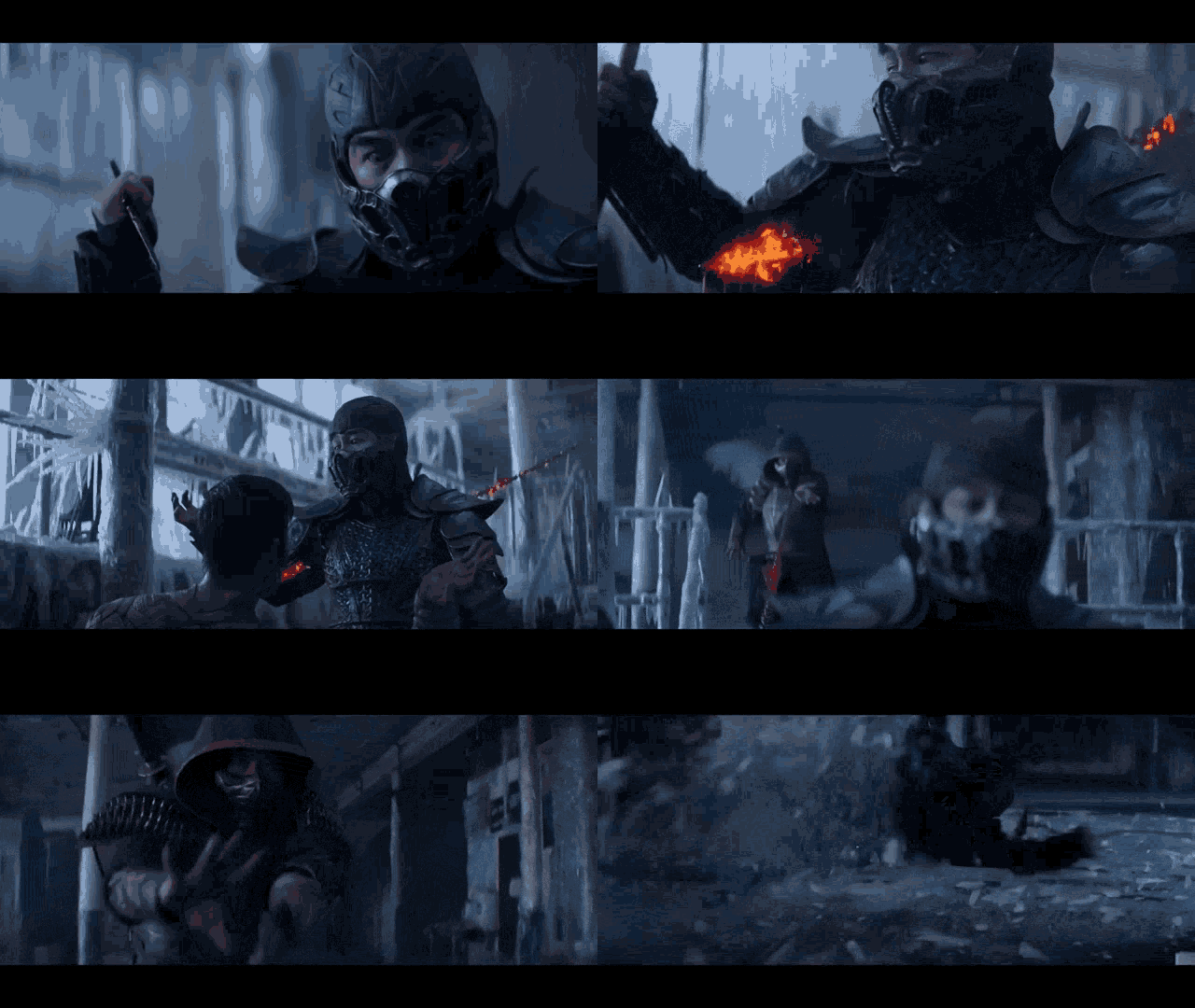
And I won’t lie – it’s flawed. Cole is a pretty bland lead character who isn’t from the games, though he’s inoffensive and he avoids the whole Gary Stu character aspect. Kano is lots of fun to watch, and I suspect the actor had a ball playing him. Shang Tsung is not really very intimidating, There’s some eye candy for women and a small number of men (Liu Kang is basically this ALL THE TIME). The special effects are pretty decent. Hiroyuki Sanada and Joe Taslim are basically perfect as Scorpion and Subzero, and there’s a reason the entire climax is about these two whaling on each other.
But I think of all the characters, I enjoy watching Sonya Blade the most, because she is an example of a warrior woman written correctly. And we don’t have a lot of those anymore – a lot of female characters in current-day action movies are essentially written as power fantasies…. which are okay, as long as it’s acknowledged that they’re nothing better than that. These characters are coldly constructed to maximize feelings of shallow empowerment without risking upsetting anyone by making the character look “weak” by having them be vulnerable, struggle to do anything, or need anything from a man.
Disney, I’m looking at you. You gave us Rey, Live!Mulan and Captain Marvel.
Sonya Blade is literally not like the other girls… and for once, that’s a good thing. The first thing to note is that she is always depicted as a butt-kicking badass – she’s a military veteran who’s good enough to fight in Mortal Kombat, and she’s strong and skilled enough to capture Kano and keep him chained up in her house. When Subzero is chasing down Cole, she’s the one that Jax sends him to to keep him safe.
But it’s worth noting that in raw physical power, she’s not the strongest. On average, men are much stronger than women physically, which many movies and TV shows don’t want to acknowledge because… I guess acknowledging it would be considered misogynistic. But Mortal Kombat does implicitly acknowledge it, because Sonya is shown going toe to toe with physically powerful men not based on raw muscle power, but using her brains, her training, and her agility. Her part of the climax is a wonderfully intense game of cat-and-mouse, where she not only has to battle Kano’s physical power but his laser eye, which she manages through manipulating her surroundings as well as physical attacks.
Which brings me to another aspect of Sonya that many other action heroines don’t have anymore – she struggles. Watch the Disney action heroines mentioned above, and you’ll be lucky if they EVER struggle to take down their enemies.
In the shallow minds of the people writing these stories, I think they imagine that a woman struggling would make her look weak… and that idea is bad storytelling. Seeing your hero struggle is part of the experience of wanting them to triumph – you watch them sweat, get punched, collapse to the ground and struggle to get up again, and lose their initial fights. That makes it all the more cathartic and satisfying when they finally triumph – because you know they worked for their triumph over the bad guys, and all the sweat, blood and tears were worth it in the end.
If the hero’s only flaw is “he/she needs to realize how AWESOME he/she is!”, and they breeze through, effortlessly winning the day without breaking a sweat… the only people who find that satisfying are people who just want a power fantasy.
And yes, Sonya struggles. She follows the arc of HERO FIGHTS –> HERO FAILS –> HERO REGROUPS/TRAINS –> HERO FIGHTS AGAIN –> HERO WINS AFTER STRUGGLE, like Luke Skywalker and other classic heroes. Her ultimate triumph over Kano – and gaining an arcana – is narratively satisfying because we watched her grapple with him right to the end, and it was a near thing. So when she looks at her dragon mark and laughs, it feels earned.
I do not get that feeling from a Captain Marvel, a Rey, a Live!Mulan. They don’t struggle to win, so there’s no cathartic satisfaction when they do win. It’s like watching Usain Bolt outrunning a toddler. Who’d find that satisfying?
I also really like Sonya’s relationships with the men around her. She doesn’t really interact much with the female characters – I think she only encounters Mileena, who skips out on murdering her because she wouldn’t get Mortal Kombat street cred from it. I guess she probably meets Cole’s wife and daughter at the end of the film.
Anyway, throughout the movie Sonya interacts mainly with the male characters, and for the most part… they treat her no differently than if she were a man. The only exception of Kano, who is a walking mass of personality defects, who is sexist to her because he’s casually offensive to everyone (and also he’s salty that she chained him up). But the men on her side treat her with respect and admiration, not considering her any less worthy because she’s a woman, and it’s hard to imagine that, say, Cole would treat her any differently if she were a guy.
That also goes for her relationship with Jax. I’m not sure what the age difference is between them, but it seems like they have a big brother/little sister connection, with a hint of mentor/student.
One thing I’ve noticed about movies in recent years is that women are often not allowed to be the mentees/students of men anymore – a woman must either know everything she needs automatically, or she must learn from another woman. See Rey, Captain Marvel, etc. That makes it kind of wholesome when Sonya admits that when she first entered the military, she wanted to make Jax proud, and that was clearly an important motivation in her training and her service.
It’s also worth noting that in the second act, she also spends a lot of time just supporting Jax. She’s told that she can’t train for Mortal Kombat because she doesn’t have a dragon mark that gives you superpowers, and instead of pouting or kicking up a fuss, she decides to go support her best friend, who just lost both of his arms and has been given little dinky robot ones instead. She doesn’t make it all about her, but about her friend who needs help.
On the subject of Sonya not having an arcana, I also liked that she’s demonstrated to have actual morals rather than a vague sense of goodness that is never challenged or confronted with temptation. You see, Sonya wants an arcana because she wants to engage in Mortal Kombat (DA DA DA, DADADA DA DA DA!), but there are only two ways to gain one. Either you are an elite fighter and vague supernatural powers bestow it on you, or you gain it by killing someone else who has the marking.
Kano has the marking. Now, Kano is a person who has done all sorts of hideous criminal things, and killing him would probably make the world a better place. In fact, he keeps taunting Sonya about killing him, even to the point where she fights him but does not kill him, just to demonstrate that she can in fact beat him. But she doesn’t kill him, because at that point he was technically an ally and wasn’t a direct threat.
Does she kill him? Yes. But only after he turns against the group and tries to murder her twice, in self-defense.
The same way a hero has to struggle for his success to mean anything, a hero’s morals have to be challenged for their morality to have any depth. If the hero is never tempted to do the wrong thing, then their morality doesn’t really mean anything. This is especially true in a situation where doing the wrong thing feels like it might be the right thing, such as killing a loathsome murderer who will get superpowers and probably misuse them to kill even more people.
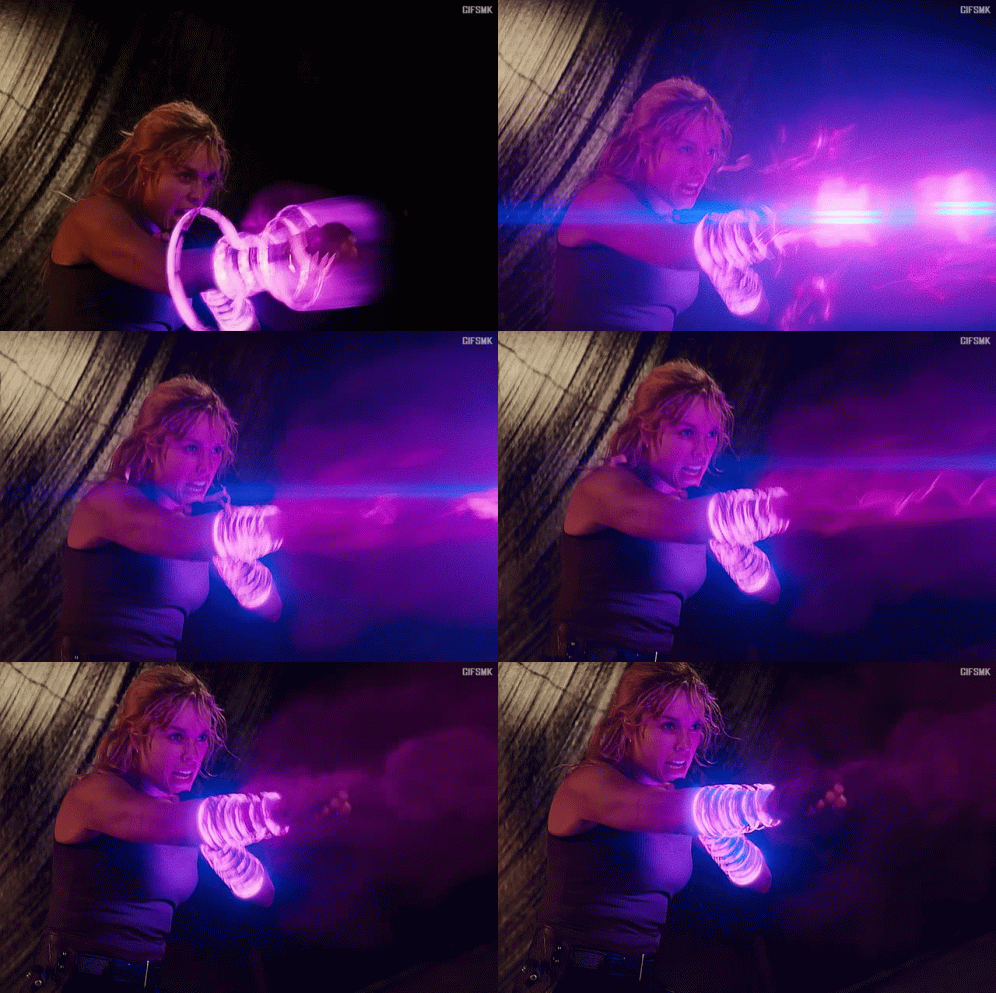
Anyway, those are my scrambled thoughts on the character of Sonya Blade in the Mortal Kombat movie, and why I liked her far better than most action heroines in current-day films. She’s tough, she’s smart, she’s compassionate, she’s skilled, and she fires pink laser beams. Not bad.
Over the past few decades, many urban fantasies with a similar theme came up – some girl discovers that she’s part/all faerie and becomes enmeshed in that world. Success varied.
But of particular note is the trilogy that helped popularize that trope – Holly Black’s “Modern Faerie Tales: Tithe; Valiant; Ironside,” a darkly glittering collection of clever, entrancing urban fantasies that spin up spellbinding stories of the fair folk… and then add a little grime and blood to the mix, without sacrificing any of its beauty.
“Tithe” introduces us to Kaye, a young girl who has spent years traveling with her mother’s rock band… until one night when her mother’s boyfriend/guitarist tries to stab her. With nowhere else to go, Kaye and her mother return to her grandmother’s New Jersey house for the time being, which brings back memories for Kaye of the imaginary faerie friends she had as a child.
… except it turns out that faeries are very, very real, as she finds a wounded faerie knight named Roiben, whose life she saves. Soon Kaye finds herself enmeshed in the secret world of the faeries, and discovers a shocking fact about her own life – she is a changeling, a faerie girl swapped out with a human baby, under a glamour so strong that no one knew what she really is. Unfortunately, finding out who she is comes with a lot more danger.
You might be expecting the second of the Modern Faerie Tales to deal with more of Kaye’s adventures, but instead “Valiant” switches the narrative over to Valerie Russell, who runs away from home when she discovers that her mother is having an affair with Valerie’s boyfriend. She makes her way to New York city, and falls in with a gang of teenage subway-dwellers.
She also finds out about the magical underbelly of the city, since it turns out the kids are friends with a troll named Ravus, who makes a mysterious drug that makes faeries temporarily immune to iron… and allows humans to use magic. Unfortunately, a lot of faerie exiles are being poisoned, and Ravus is suspected of the crime. Only Val can save him by uncovering the true murderer.
“Ironside” returns the action to Kaye and Roiben, as the faerie knight is about to be crowned. But when a drunken Kaye declares her feelings for him, he gives her an impossible task – find a faerie who can tell a lie. Devastated, Kaye tells her mother the truth about what she really is – and then begins a personal quest to find the “real” Kaye Fierch, who was kidnapped as a baby.
Meanwhile, Roiben has become tangled up in Silariel’s schemes, and so Kaye also becomes involved in a forthcoming battle for the throne of the Unseelie Court. In order to be together with the man she loves – even if he seems cruel to her at first – Kaye will need all her wits and strength – but even that might not be enough to stop the Bright Court’s queen.
The Modern Faerie Tales are stories that very much deserve the label “urban fantasy,” primarily because Holly Black’s writing feels like a genuine blend of the fantastical and the gritty. Faerie ethereality and glamour is mingled together with grime, wire and subway tunnels of New York; there’s both a delicate timeless beauty to the stories, and a sort of raw rough punk aesthetic.
The same goes for Black’s writing – it’s dark, it’s wild, and it’s studded with moments of poetry (“red and gold flames licked upward. A sea of burning oil and diesel fuel spread to scorch everything it touched”). And she never turns away from the uglier facets of her world — the faerie courts contain casual brutality against the weak and helpless, and Val ends up addicted to a magical drug.
Her heroines are no less compelling, even if they have little to do with each other. Kaye starts the story feeling a little too edgy, fey and immature, but Black smoothly causes her to grow up as she learns who she truly is, and demonstrates her selflessness and love for her family and Roiben. Val is more of an awkward tomboy than a rock’n’roll girl – a wounded girl losing her way and herself, as she struggles to find a place to belong. And there’s a variety of likable supporting characters, like a hunky troll, the icy knight Roiben, and the nerdy gay friend Corny.
Amongst the stories about “I’m a faerie and never knew it,” Holly Black’s “Modern Faerie Tales: Tithe; Valiant; Ironside” stands out as one of the best – darkly glittering, dramatic and perfectly blending the urban and the ethereal.
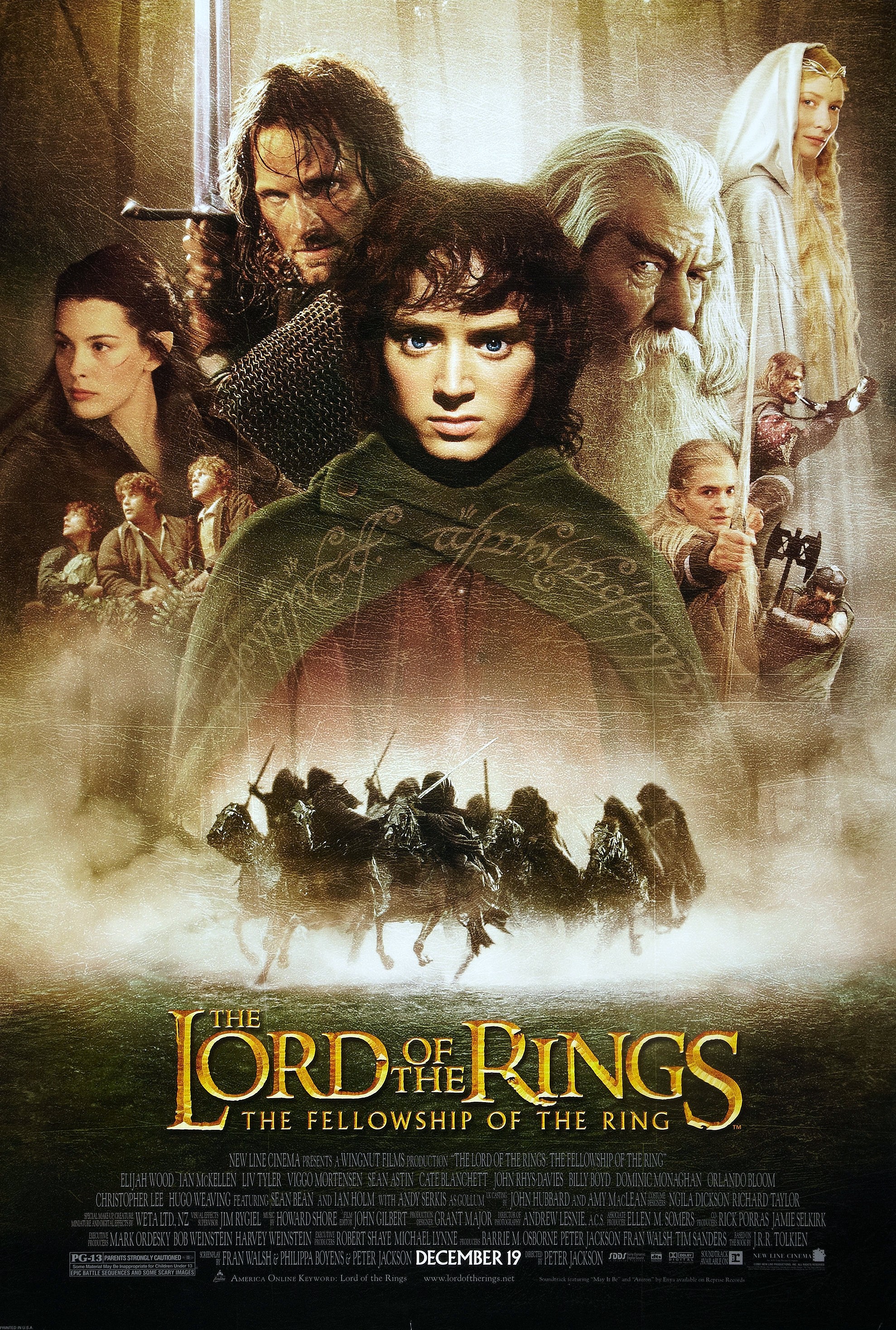
J.R.R. Tolkien’s “Lord of the Rings” trilogy was considered unfilmable for a very long time – the story was too big, too fantastical.
But in the late 1990s, New Zealand director Peter Jackson got the green light to shoot the “Lord of the Rings” movie trilogy: a sprawling fantasy epic that chronicles the tipping point of the mythical Middle-Earth, and the humble hobbits who change the world. The richness of J.R.R. Tolkien’s world is translated exquisitely into a movie trilogy full of beauty, horror, hope, humor and vibrant characters.
“The Fellowship of the Ring” introduces us to the hobbits. Eccentric old Bilbo Baggins (Ian Holm) leaves the peaceful Shire at his 111st birthday, leaving all he has to his young nephew Frodo (Elijah Wood) — including a golden Ring that makes the wearer invisible. But the grey wizard Gandalf (Ian McKellen) reveals that it’s actually the One Ring, which is the source of power for the demonic Dark Lord Sauron. So Frodo and his best pals leave the Shire and join a band of elves, men, and dwarves to take the Ring to the only place where it can be destroyed.
“The Two Towers” picks up immediately after “Fellowship” ends, with Frodo and Sam (Sean Astin) lost on the path to Mordor, and being stalked by the murderous Ring-junkie Gollum (Andy Serkis). Elsewhere, Aragorn (Viggo Mortensen), Legolas (Orlando Bloom), and Gimli (John Rhys-Davies) make a desperate stand with the kingdom of Rohan, but must face off against the evil wizard Saruman (Christopher Lee) and his orc armies.
“Return of the King” brings the trilogy to a dizzying head: Frodo and Sam’s friendship is threatened by Gollum’s trickery, leading Frodo into a potential fatal trap. Gandalf and Pippin head for the city of Gondor, while Aragorn summons an ancient army that might be able to turn the tide against Mordor. But no matter how many battles they win, the war will never be won if Frodo is not able to destroy the Ring once and for all.
J.R.R. Tolkien’s “Lord of the Rings” is one of those stories that is too big to fit into one movie – it’s almost too big to fit into three. While Jackson had to streamline the story considerably, the heart of the original novels is still there, with its message about how misfortunes can become blessings, and even the smallest and least imposing person can change the world. Despite the richness of the world-building and the complexity of the characters, it all boils down to that.
Changes are certainly made, such as altering and adding to the characters of Arwen and Faramir, as well as obviously having to leave a lot of events and characters out. Certainly the trilogy doesn’t need Tom Bombadil. But the overall story is remarkably faithful to Tolkien’s tale, and Jackson’s script with partner Philippa Boyens is a masterpiece of storytelling – full of humor and dramatic moments, adapting Tolkien’s richly-archaic prose into powerful speeches (such as Sam’s powerful final speech in “The Two Towers”).
Furthermore, it’s a beautifully-constructed movie – the exquisite sets and expansive New Zealand landscapes are breathtaking; the battle scenes are bloody and exciting; the different cultures of Middle-Earth feel deep and well-lived-in. All the trappings — clothes, jewelry, even beer mugs — are realistic. And the special effects are almost entirely convincing-looking, especially the gruesome Gollum. He’s the first fully convincing CGI character, and after awhile you’ll forget he is made digitally.
It also has a cast who give the performance of their lives – Elijah Wood as the wide-eyed, wounded Frodo Baggins; Sean Astin as his steadfast best friend Sam, who supports him no matter what happens; and Dominic Monaghan and Billy Boyd as the mischievous but brave Merry and Pippin. Ian McKellen’s Gandalf is the prototypical wizard – kindly and grandfatherly, but capable of anger and fear when confronted by the Ring – and Viggo Mortensen is outstanding as the noble king-in-waiting Aragorn. Orlando Bloom and John Rhys-Davies round out the cast as the elegant elf Legolas and doughty, down-to-earth dwarf Gimli – and there are a bunch of other great performances by actors such as Christopher Lee, Sean Bean, Liv Tyler, Hugo Weaving, Cate Blanchett, Miranda Otto, and many many more.
The extended versions of the movies are even better than the theatrical versions — plenty of cut scenes that fill out the characters and plotline are put back in. As a result, the extended versions cleave more closely to the original books. Not to mention TV specials, featurettes, cast commentary on everything in the movies, Sean Astin’s sweet little short film “The Long and Short of It,” and extensive behind-the-scenes footage that will inform viewers about special effects, sets, direction, and everyday life filming “Lord of the Riings.”
The movie adaptations of “The Lord of the Rings” trilogy are classics for a reason – while they have some flaws, Peter Jackson managed to adapt a brilliant story into brilliant, beloved movies. Powerful, gripping and full of beauty.
Necromancers are usually the bad guys in fantasy. When you can control dead bodies, it’s a given that people might not like you.
But Garth Nix turned that little trope on its head with “The Old Kingdom” trilogy, three interconnected fantasies about a family of necromancers who lay the dead — and forces of evil — to rest. His richly-realized world, elaborate magicks and brilliantly detailed writing give this wry, horrific high-fantasy a special quality that few other fantasy books have. Each of the three books about the Abhorsens is definitely a deserving classic.
“Sabriel” is the story of a teenage girl living happily at a girl’s school, while her necromancer father (the Abhorsen) roams around putting the dead to rest. All that changes when a sending brings her father’s sword and bells, meaning that he is dead or incapacitated. So Sabriel takes on her father’s duties, accompanied by a Free Magic cat and a mysterious young prince, and battles the specter of a horrible evil creature that is reaching out from death to snare her.
“Lirael” takes us to the cold citadel of the Clayr, a race of seers to whom the Sight is everything. Young Lirael is depressed because she doesn’t have the gift of Sight yet, even though everybody else her age does. But things take a sinister turn when she sets a horrifying, bloodthirsty creature loose, and must work — with the help of the mysterious Disreputable Dog — to get rid of it. But what Lirael doesn’t know is that the outside world is in danger too, from a sinister new enemy — and her destiny may take her out of the Clayr glacier, to where Sabriel’s family is struggling to keep their kingdom safe.
“Abhorsen” brings the series to an explosive conclusion. Lirael and her nephew Sameth — along with “cat” Mogget and the Disreputable Dog — are in danger from the invading Dead, and the Destroyer Orannis has escaped from his prison and is being assisted by an evil necromancer and the Dead called Chlorr — and an unfortunate pal of Sameth’s, who was mistaken for the young prince and his now be bespelled. Now Lirael must face her true destiny — not as a Clayr, but as the future Abhorsen.
Garth Nix had only written a couple of books, one of which was an “X-Files” novelization, when the first Old Kingdom book burst onto the fantasy scene. Now he’s one of the most respected, prolific and well-liked fantasy writers in years — and his tales of the Old Kingdom are undoubtedly his best work. They are a perfect example of dark fantasy, with its grotesque dead zombies that occasionally lurch out to attack the heroes, magical bells, and shadowy beasties that can (sometimes) be restrained.
Nix’s invented world is a seamless blend of the modern and the medieval, each ruling one side of the Wall — and he handles this complex world and its magical Charter with the deftness of a master storyteller. He draws everything in exquisite detail, whether it’s the labyrinthine Clayr glacier or the slightly eerie house of the Abhorsen, a bombed-out bunker or a sunny boarding school. And his command of atmosphere is great enough that his depiction of Death’s grey river is enough to chill.
And he comes up with the brilliant concept of the Abhorsen necromancers — who have power over dead and/or magical creatures, manipulate magic with little effort, and bind malignant creatures with Charter marks and a series of magical bells. Got it — binding, not raising.
Virtually all of Nix’s characters are likable, especially the gutsy Sabriel, the strong-willed Touchstone and their nervous teenage son Sameth. Even the annoying Ellimere elicits some smiles. It takes a bit longer to warm up to Lirael, since she spends several chapters in the same-named book moping about her differentness, but once she gets moving she’s unstoppable — and quite likable, once she figures out who she is. And the animal characters are the most brilliant — Mogget and the Disreputable Dog steal the show with their sharp wit and humorous quirks, although we’re constantly reminded that these are magical beings.
Dark fantasy was redefined and reimagined in “The Old Kingdom” trilogy, and these first three books of Garth Nix’s series are a clever, action-packed, magical journey through the Old Kingdom. Definitely a must-read.
I feel like fantasy author Diana Wynne-Jonesdoesn’t get as much love and attention as she deserves.
Oh, other authors often laud her, like Neil Gaiman, and Studio Ghibli has adapted two of her books into animated movies (one amazing though a loose adaptation, one mediocre). But she’s not a household name despite the charm and imaginativeness of her books, and the movies based on her books are more associated with Studio Ghibli than the original author.
She did experience something of a renaissance several years ago during the Harry Potter craze of the late nineties to late aughts – it was a time when people were hopping on the bandwagon of children’s/young-adult’s fantasy stories, hoping to strike Potter gold. Some of these would-be franchises were good (Artemis Fowl), and some were bleeding-from-the-eyes-bad (G.P. Taylor’s Christian fantasies presented as Potter alternatives).
Diana Wynne-Jones seemed like a natural choice to reprint and promote – she had already written a huge number of fantasy stories, often involving witches and wizards. She was also British, and she had a great deal of the same charm of style and setting that had been presented in Rowling’s books. And she was imaginative – arguably much more so than Rowling – with multiverses, dimensional hopping, twists and even science-fiction woven into the fantasy.
Maybe that’s why she didn’t become as famous as Rowling – her books take more effort to comprehend, and a structure and framework that take more time to comprehend. A school for magic is a little easier to understand than the Chrestomanci universe, which has many different parallel worlds. Or a story based on the ballad of Tam Lin. Or the time-bending antics of A Tale of Time City. Or the plot twists that blow your mind in Archer’s Goon, The Power of Three and Deep Secret.
But obviously, less popular doesn’t mean less good. Jones came up with some wildly clever ideas and plumbed them to their depths, sometimes with clever yet affectionate parodies of the fantasy genre (and many affectionate nods to J.R.R. Tolkien). She was also even better than Rowling at writing twisty mysteries within her fantasy stories.
The Chrestomanci stories are a wonderful series of stories about Christopher Chant, a supremely powerful magician born with nine lives who travels between worlds. He’s not always the center of the stories, because they tend to be focused on the people who become involved with him in these worlds – kids forbidden from using magic, a seemingly ordinary boy whose narcissistic sister is a gifted sorceress, a Romeo and Juliet story, a boy cursed with bad karma, and so on.
Then there are the Magid stories. Sadly, Jones only wrote two of these – Deep Secret and The Merlin Conspiracy, but they are among my favorites. The first one is a bizarre sci-fantasy story set at a scifi/fantasy convention, in which a colorful cast of characters are trying to figure out who the heir of an interstellar empire is. The second is a world-hopping love story between the best character of Deep Secret and a girl from another world, where royalty is magic and a conspiracy may take over magic throughout the multiverse.
I won’t summarize every book she’s written, only say that they involve time travel, Norse gods, a malevolent old woman with supernatural powers, a Goon, a star in a dog’s form, a ghost attempting to solve her own murder, a game diving into everyone’s favorite books, a Celtic-flavored fantasy that I can’t describe without spoiling the twist, and various other things.
So if you like stories with imagination, a dark edge and that clever, slightly quirky Britishness, than her books are a must-read.
From its very first opening moments, the 2019 reboot “Hellboy” shows us exactly the kind of movie that it is – with a bird eating the liquefied eyeball of a rotten corpse, and Ian McShane throwing a gratuitous F-bomb.
Specifically, it’s the kind of movie that a 13-year-old who thinks he’s edgy would make – lots of swearing, lots of characters being obnoxious, lots of extremely graphic violence shown in lovingly-framed detail, and so on. “Hellboy” seems to aspire to be kind of like “Deadpool” in its mixture of comedy and bloody violence, but the meandering, overstuffed storyline and unlikable lead characters make it a chore to sit through.
After killing a B.P.R.D. agent who had been vampirized, Hellboy (David Harbour) angsts about his status as a monster, and what that means to an organization dedicated to stamping them out. He’s then sent to help the Osiris Club in England with exterminating a trio of giants… only for the Club to try to kill him because he’s destined to bring about the apocalypse. If you’re wondering what all this has to do with the main plot, the answer is: very little.
The actual villain of the piece is Nimue (Milla Jovovich), the legendary sorceress, who was chopped into six pieces by King Arthur and sent to six different parts of England. Not the world. Not Europe. Just England. Now the pig-fae Gruagach (Stephen Graham) is reuniting her various body parts – and if she is fully restored, she will bring down an apocalyptic plague across the entire world, wiping out humanity.
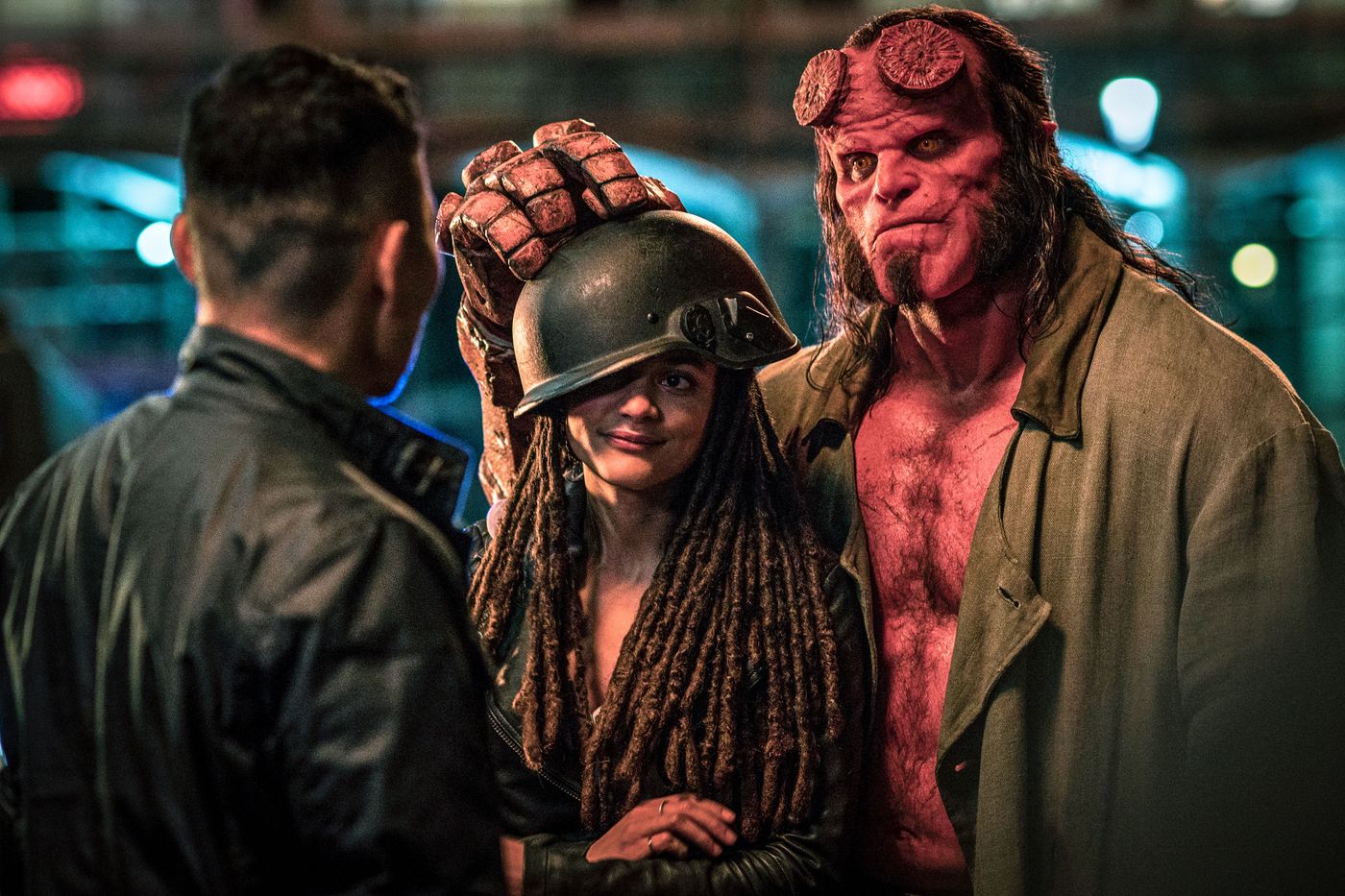
Hellboy is soon called on to stop Nimue, along with ghost-punching medium Alice Monaghan (Sasha Lane) and surly B.P.R.D. agent Ben Daimio (Daniel Dae Kim). But Nimue quickly decides that she wants Hellboy as her king, since she knows of his apocalyptic destiny and wants him her to rule over a new world at her side. Unfortunately for the current world, Hellboy seems quite tempted by the offer.
“Hellboy” was already facing an uphill battle, given that the character’s previous appearances were directed by the beloved Guillermo del Toro. But even if one appreciates it entirely on its own merits, the movie is still pretty terrible – and only part of that is due to the relentless swearing and hyper-graphic gore, which feel like a teen boy’s idea of what an R-rated movie should be like.
One of the big problems is that the story is an overstuffed mess, with subplots unrelated to the main plot. Whole chunks of the narrative could have been easily streamlined out, such as Hellboy’s fight with the giants, which feels like a side-quest in a video game. The cinematography is pretty ugly and grimy, the special effects range from acceptable to “how did this get released in theaters?”, and the dialogue is bad more often than not (“But it’s not going to work, you know, cause I’m a Capricorn and you’re f***ing nuts!”).
It also has a wealth of characters who exist entirely to vomit exposition. Baba Yaga, for instance, is a character who exists entirely to tell people to go places, rather than having any real impact on the plot. Or consider the blind woman with precognitive powers, who is just there to recount baby’s Hellboy’s entry into our world, a bizarre scene that is somehow sidetracked by the appearance of Lobster Johnson. “Who?” you may be asking. The answer: nobody who matters to the plot, so it doesn’t matter.
Of course, the main characters aren’t much better. It’s worth noting that no criticism should fall upon David Harbour, who gives as good a performance as anyone could possibly give. The movie fails him, not the other way around.
Specifically, it fails him by making Hellboy a whiny, passive-aggressive brat who is easily swayed by Nimue and gripes about his father constantly. His angst over monsters not getting to live in the open seems rather hollow as well, considering that we see virtually no monsters who aren’t actively harmful to humans… and since Hellboy himself is hardly a secret, since he goes on a days-long bender in a Mexican bar.
The other characters aren’t particularly likable either – Alice tends towards being smugly annoying, and Daimio seems to be stuck in a combatively bad mood with no particular reason or resolution. No, being revealed as a werejaguar does not count as an arc. The closest to a character who actually feels three-dimensional is Ian McShane’s Professor Broom, although even he isn’t a terribly likable person.
The 2019 reboot of “Hellboy” stumbles badly in its attempt to give us a darker, grittier portrait of our demonic hero – mainly because of the sloppy plot and painfully clumsy script. Stick with the comics or the earlier films.
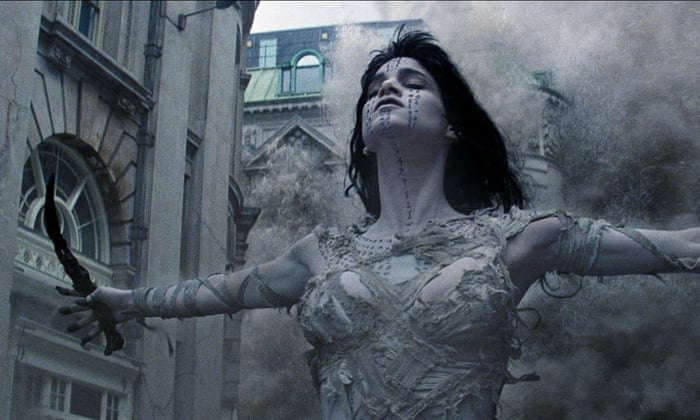
One of the many changes made to Mummy lore in the Tom Cruise movie The Mummy is that it focused on a female mummy rather than the traditional male ones. Despite Twitter’s beliefs that all gender/race flips are greeted with sexist racist fanboy hatred, the viewing public did not have a problem with gender-flipping the mummy, especially since she was played by the wonderful Sofia Boutella, who gives the character a real sense of wiry, acrobatic physicality.
Unfortunately, the movie sucked for myriad reasons. Among the reasons: the crushing lack of research, the lack of Egypt, Tom Cruise’s midlife crisis, the need to shoehorn a S.H.I.E.L.D.-like organization into the story, the script full of holes, the blatant ripping off of An American Werewolf In London, and so forth. It’s not a good movie, and I didn’t enjoy it.
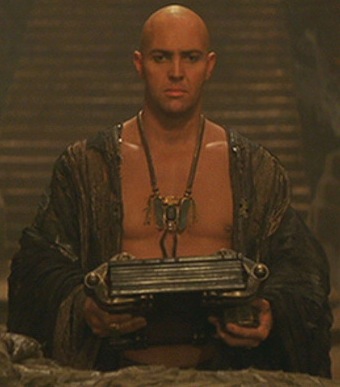
But the thing that really stuck out to me is that despite deciding to make the mummy female… the movie is actually rather sexist towards her. This is best highlighted when you compare the 2017 mummy, Ahmanet, to her male counterpart in the 1999 movie, Imhotep. And two things really stuck out at me.
One, Ahmanet is weak. I don’t mean she’s weakly characterized – although she is – but that she’s not very powerful for an undead mummy powered by divine sponsorship. About midway through the movie, she’s captured by the troops of Prodigium (the monster-hunting equivalent of S.H.I.E.L.D.). Do they use magical tools and amulets? Do they somehow neutralize the power of Set, rendering her helpless? Do they use centuries of research and knowledge and technology and the supernatural to overwhelm this godlike figure’s godlike powers?
Nope. They use ropes and hooks to catch her, then chain her up with a mercury drip. It isn’t even hard for them.
If that doesn’t sound weak, stop for a moment and remember Imhotep from the 1999 movie. Imhotep was powerful. Ridiculously so. He had his weaknesses (like kitties), but it’s hard to imagine him being completely incapacitated by some guys with ropes. Yet the female mummy is weak and gets taken down almost effortlessly.
And you may be thinking, “Well, it’s to show how amazing Prodigium is! They’re so capable and strong that they can stop a god-powered mummy!”
But no, that isn’t the case. Because that is the second time that Ahmanet is taken down by mere mortal schlubs – the first time was in ancient Egypt right after she murdered her family, and she was newly juiced-up with Set’s power. Not only were the people who caught her ordinary people, but they didn’t have technology, centuries of organized study and gathered magical power. They were just people. Not only did they catch her, but they successfully mummified her alive (which is not possible, incidentally) and transported her to another country before properly imprisoning her in a neutralizing element. That is, for a mummy, quite weak.
For the record, Imhotep also was caught and buried alive by ordinary humans… but that was before he had most of his powers. So it made sense that the Medjai could catch him!
The other part of Ahmanet that struck me as sexist is her ultimate goal. Her initial goal seems to be to rule Egypt, because she apparently was raised with the belief that she would be the queen regnant when her father died, but then his wife had a baby boy so she was knocked out of the succession. For the record, pharoahs had many wives, so the chances of a pharoah having only two children in twenty years is… very unlikely. That’s a more medieval-European trope.
Anyway, she was so upset about not becoming queen that she summoned the god Set, and he gave her… skin text and four pupils, and a knife. So she wandered off and killed her entire family, baby included, and then decides to bring Set into a mortal man’s body because she’s in love with him. When she revives in the present, her motive does not change – she wants Set to incarnate in Tom Cruise’s body.
Now, let’s again compare her to Imhotep.
Imhotep also had romantic love as the centerpiece of his quest. He was the secret lover of the pharoah’s mistress (why not a lesser wife or concubine? Again, very medieval-European!), until she committed suicide so that the Medjai wouldn’t capture Imhotep. So his goal was to bring her back to life. He was captured and sealed away under a magic spell, and when he is revived as a mummy, his ultimate goal is also unchanged – once he has his body restored, he wants to bring his lover’s soul back in Rachel Weisz’s body.
Similar motives, similar goals, similar story progression, yes?
Well, no. Like I mentioned before, Ahmanet’s goal is to revive an evil god, so he can rule the world. She wants to be his queen, not a queen regnant. She even explicitly says this, and she acts like a lovesick fangirl for most of the story.
Imhotep, on the other hand, never gives the impression that he’s going to be subservient to any person, and at no point do you imagine that his lover is going to be the one sitting up on the throne while he’s just the arm candy.
I don’t know much about the production of this movie, but I will say that this motivation feels a little like it was shoved in there. It may be bad writing giving the character inconsistent or poorly-explained motives… or it may be the obviously-insecure-about-his-age Tom Cruise insisting that all women in the movie must be dazzled by his toothy charm. I don’t know.
But either way, the handling of the female mummy was not good, and they should have simply followed this rule: if it isn’t something you can see Imhotep doing, leave it out.






 The Forest