Elio Vs. KPop Demon Hunters – What’s In A Name?

So right now, two animated original stories have recently been released. One is Elio, a Pixar movie about a kid who gets abducted by aliens and… well, the plot doesn’t seem to have much more than that. The other is K-Pop Demon Hunters, which… is about K-pop stars who are also secretly demon hunters.

Now, I cannot speak to the quality of these two movies, since I haven’t seen either in full, except to say that the reception I’ve seen to Elio has been very mixed. Some people think it’s great, some people think it sucks. K-Pop Demon Hunters seems to have gotten overall a much more positive reaction despite a very silly premise, and as far as I can tell, that’s due to two things. One, it’s a well-written movie, from the clips I’ve seen. Two, it’s a genuine movie made out of someone’s culture and passions, not a soulless corporate product.

But I think one big contributor to the downfall of Elio and the rise of K-Pop Demon Hunters is the titles.

KPDH has a title that tells you, upfront and openly, what it’s about. It’s a movie about K-pop and demon-hunting. The premise is silly, like I said, but it doesn’t care how silly it sounds. You will probably know right out of the gate if this is a movie you are interested in. Furthermore, the title is eye-catching. It’s bold, it’s brash, it’s unapologetically different from every other title out there – and that makes it both memorable and attractive. It makes you want to know more.

On the other hand… what does “Elio” tell you?

Honestly, to me it sounds like the name of an indie dramedy about an older man (I keep imagining Tom Hanks) whose wife died and he’s been depressed ever since, but then he adopts a stray dog and it teaches him how to live again or something sappy like that. That dramedy would ultimately be trying to get an Oscar, but everybody would have forgotten about it by the time Oscar season rolls around.

That is what the title Elio says to me. It doesn’t say “wacky children’s space adventures with slug aliens.” It doesn’t say ANYTHING about the movie it’s attached to, or what to expect, or WHY you should see the movie. It’s just… a name. The movie could just as easily be called “Wally” or “Sean” or “Jake” or “Mike.” It tells you nothing except that it has a character named “Elio” in it, and that’s… not enough to really attract attention and interest.

And yes, I know that there are some very successful movies that are just the characters’ names – John Wick comes to mind. But there are also ones that definitely weren’t done any favors by their titles, like Salt.

I’m not saying that Pixar has to go full out K-pop Demon Hunters in their titles. But they really need to stop with the really bland, nondescript titles that are either names (like this and Luca), or they show a minimum of effort (like Soul). Their movies have been struggling for the past few years, for varying reasons, but the titles certainly don’t help.

Oh, and ditch the current art style too. The bean-mouth thing is tired.

Review: Exhuma

Imagine if your ancestors had the power to curse you for… well, general discomfort after death.

That premise forms the bedrock for the South Korean horror movie “Exhuma,” in which a quartet of shamans, geomancers and morticians join forces to deal with vengeful ghosts. This is a movie that could never be remade in another country – not just because it relies on tension and dread rather than jump scares, but because the historical and cultural backdrop are so uniquely Korean.

Shaman Hwa-rim (Kim Go-eun) and her tatted apprentice Bong-gil (Lee Do-hyun) are summoned to Los Angeles to investigate a newborn baby who has been cursed by one of his ancestors. Hwa-rim makes arrangements with the family patriarch to exhume and cremate the child’s great-grandfather back in South Korea, with the help of her friends: feng-shui geomancer Kim Sang-deok (Choi Min-sik) and experienced mortician Yeong-geun (Yoo Hae-jin).

But the job turns out to be more complicated than expected. The grave is on a mountaintop near the North Korean border, surrounded by malign omens: foxes, an unmarked stone, rumors of graverobbing, and a snake with a human head. The only way the corpse can be exhumed is with a complex ritual that draws out and dissipates the malignant energies (involving knives, a drum and several dead pigs), so they can dig up and then cremate the unopened coffin. Sounds simple, right?

Not so simple, because some brain donor opens it, unleashing a vengeful spirit that decides he wants to kill his entire family – and our heroes have limited time to save the remaining kin from meeting gruesome ends. But it turns out that ironing out this family debacle is only the beginning of the horrors to come, as another coffin is found buried beneath the first – and dealing with this angry ghost will not be so easy.

“Exhuma” is the kind of movie that horror needs. No jump scares, even when something shocking and unexpected happens. This is a movie that slowly builds up a sense of pervasive, eerie dread, filling every shadowy corner until it suddenly flows with splattered blood and soaring fire. It’s also a uniquely Korean movie – without revealing some of the plot twists, the story relies heavily on both Korean history and Korean folklore, so it couldn’t really be told anywhere else.

Director/writer Jang Jae-hyun slowly layers mysteries and atmosphere (so many foxes!) on top of each other, then slowly peels away those layers like an onion. Some of the scenes in the second and third acts of the movie are deeply disturbing, especially when Bong-gil speaks for the angry ghosts. If the movie has a flaw, it’s that it feels a little weird that we go through the entire cycle of dealing with the cursed family… and then, suddenly, that plot Trojan-horses an entirely unrelated evil ghost for the third act. It’s kind of odd. Not bad, exactly, but disorienting.

The actors are all uniformly quite good: Kim Go-eun is cool and collected as an intelligent, businesslike shaman, which makes it all the more unnerving when the character is stricken with bone-chilling fear in the third act. Lee Do-hyun plays a secondary role to her throughout most of the movie, but gets to show his acting chops when Bong-gil gets possessed a few times. And Choi Min-sik and Yoo Hae-jin have delightful chemistry as a couple of old buddies who specialize in exhuming and reburying troublesome dead people, swinging between easy camaraderie to harrowing battles against the supernatural.

“Exhuma” has a slightly odd plot structure, but that doesn’t keep it from being a harrowing, suspenseful movie that slowly builds its way up to the blood’n’fire. Definitely worth watching for those who appreciate atmosphere in their horror.

Review: Five Nights At Freddy’s (2023)

Even if you’re not a gamer, you’ve probably heard of “Five Nights At Freddy’s.” Scott Cawthon’s hit video game franchise is about employees (and occasionally children) being pursued by anthropomorphic ghost-robot animals. Also, serial killers.

And it’s not surprising that the “Five Nights At Freddy’s” movie shines the brightest when it dives into mascot horror and the lore of the franchise. It’s substantially weaker when it focuses on the human characters’s familial conflicts and internal turmoil, which means that it rebounds solidly in the final act when the various loosely-wound plot threads are finally tied together. Still, did we need custody drama?

Michael (Josh Hutcherson) is a young mall security guard obsessed with the abduction of his little brother when he was a child. But then he loses his job, and faces the possibility of losing custody of his little sister Abby (Piper Rubio) to his vicious aunt. So he takes the only new career path available: a night security guard at the arcade/pizza restaurant known as Freddy Fazbear’s, where he’s mostly there to guard the animatronics. He also encounters Vanessa (Elizabeth Lail), a friendly cop who seems to be very well-informed about the place.

But he soon realizes that the animatronics are actually “alive,” possessed by the spirits of children murdered many years ago – and they seem to have a special bond with Abby. Unbeknownst to him, they also kill people who break in. As he tries to enlist their help to find out who abducted and murdered his little brother, Michael soon discovers that the animatronics are far more dangerous than he ever expected – and they aren’t alone.

“Five Nights At Freddy’s” is easily at its best when it sticks to being “Five Nights At Freddy’s.” The most gripping and engaging parts of the story are when the animatronics are prowling around chewing people’s faces off or biting them in half. It’s not too bloody or graphic, considering this is a Blumhouse movie (it’s actually rather tame for a horror movie) but it does capture some sense of dread and creepiness, especially in the unnaturalness of the animatronics’ movements.

Unfortunately, you also have to wade through a lot of Michael’s personal problems to reach the “Five Nights”-ness, and… they’re not terribly interesting. Obviously some kind of personal stuff is required for the security guard, but the movie needed fewer custody fights and more spooky nighttime conflicts with the killer animatronics. We also didn’t need a scene where the animatronics build a giant blanket fort with Abby, which was just… awkward.

Fortunately, things improve drastically when the third act rolls around, when the animatronics go back to being homicidal, and the backstory behind their deaths is finally explored. There’s a real sense of dread at the thought of dead children brainwashed into amnesiac killers who don’t even remember what they are, so that you both pity them and want to run away from them at top speed. As for the mastermind of the whole scenario, his arrival gives the story an extra jolt of fizzing energy, and I honestly couldn’t get enough of his villainy.

While Hutcherson’s character spends too much time on non-“Freddy” stuff, he gives a very good performance as a young man who has been fundamentally damaged by loss and guilt. Mary Stuart Masterson and Elizabeth Lail also give solid if uncomplicated performances, and Piper Rubio’s performance is pretty good, even though her character seems like she was written to be several years younger than the actress. Matthew Lillard has little screen time, but he absolutely dominates the screen and has just the right amount of scenery chewing. Chef’s kiss.

“Five Nights At Freddy’s” is weaker when it tries to incorporate more original elements, but is at its best when it sticks to what “Five Nights At Freddy’s” is all about. For those who enjoy tales of killer animatronics and serial killers, it’s a mixed bag but one still worth seeing.

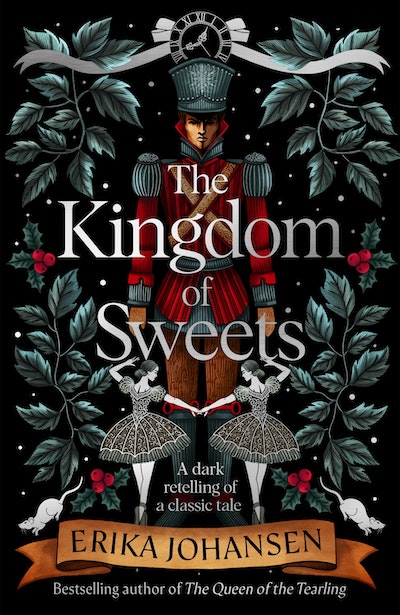
Review: The Kingdom of Sweets by Erika Johansen

“The Kingdom of Sweets” is a lot like its protagonist: difficult to love.

In fact, the standalone novel based very loosely on E. T. A. Hoffmann’s short story/Pyotr Ilyich Tchaikovsky’s ballet is genuinely hard to read for the first two-thirds of its length. This dark fantasy tinged with horror is expertly put together and cleverly weaves together fantasy with Russian history, but is also graced with characters who are uniformly unlikable.

As newborns, Clara and Natasha were blessed/cursed by the sorcerer Drosselmeyer – Clara was declared “light” and Natasha “dark.” And they grew up accordingly: Clara was beautiful and beloved by everyone, while Natasha was unattractive and ignored, taking her solace in a world of books. Then, at the Christmas party that marks their seventeenth birthday, it’s announced that newly-pregnant Clara is marrying the wealthy boy that Natasha is infatuated with – and both girls are given strange living toys by Drosselmeyer.

Soon Clara is whisked away into a magical Kingdom of Sweets, and Natasha follows her doggedly. But she soon senses that there is something profoundly wrong about this strange sugar-coated dimension, which is ruled over by the Sugarplum Fairy.

And as a bitter, jealous Natasha discovers the depths of her sister’s betrayal, she is offered a Faustian bargain by the Fairy – if she helps the Fairy destroy Drosselmeyer, the Fairy will let her kill Clara and take her appearance and her life. But the life that Clara seizes for herself isn’t as sweet as she hoped it would be – and as the years go by, she discovers that she can’t escape the sins of her own actions. Her only hope is to uncover the ancient magic that Drosselmeyer coveted, which may be her only escape.

Let’s be upfront about this: for the first two-thirds of “Tbe Kingdom of Sweets,” there are absolutely no likable characters. At all. Everybody without exception is a terrible person of one stripe or another, whether they’re a cold unfeeling parent, a murderous sorcerer, sadistic socialites or a shallow selfish sister. This includes Natasha herself, who is a bitter, hate-consumed person who has a heavy dose of Not Like Other Girls Syndrome, and deludes herself into thinking she is smarter and more insightful than everybody else. She would fit in well on social media.

As a result, I had to struggle to get through the first two-thirds of the book, despite Erika Johansen’s skillful writing and some well-written interlacing of Hoffman’s tale with actual Russian history from the turn of the 20th century. It just wasn’t enjoyable to be in Natasha’s head because I was so repulsed by the character, especially since the narrative doesn’t really hint at future growth, and I couldn’t really bring myself to care much about whatever ironic punishment she suffered as a result of her own actions.

However, things started to turn around when Clara reenters the story; the story becomes more streamlined and organic, and Natasha is forced to face the evil that has been brewing inside her for so long. It makes that last third of the book more poignant, more gripping, and more suspenseful as Natasha has to find a way to, if not undo what she’s done, then at least try to make amends while defeating the Fairy. It becomes more a story about redemption and forgiveness, which softens Natasha’s harsh, prickly worldview and how she looks at others, such as the priest.

But to get to that solid final third, you have to slog through the first two-thirds, which are simply not enjoyable to read. If you don’t mind that, then “The Kingdom of Sweets” is a solid dark’n’twisted version of the Nutcracker story.

Review: The Forest Grimm by Kathryn Purdie

Disclaimer: I received an advance copy of this book from Netgalley in exchange for an honest review.

Outside the town of Grimm’s Hollow is the Forest Grimm – a magical place twisted by a malevolent curse that draws bespelled people into its depths and is slowly killing the surrounding farmland.

And as you could probably guess by the name of the forest, “The Forest Grimm” by Kathryn Purdie wraps itself in a cloak of glittering fairy tales. But these aren’t the sanitized, Disneyfied stories you might know, where all you need to fix things is true love’s kiss. Instead, her elegant, winding fantasy tale delves into the dark, distorted versions of these familiar tales, with a seemingly doomed heroine as perhaps the only chance of breaking the curse.

For her entire life, the cards telling Clara’s fortune have said only one thing – she will die young, as a result of a “fanged creature.” Despite this dismal future, she is determined to enter the hostile Forest Grimm and find her beloved mother, who was the very first person to be lost there – and if she can’t find her mother directly, then she wants to find a missing magical book, the Sortes Fortunae, to end the curse once and for all.

Then she discovers something shocking: the forest will allow a person to enter it if they have red rampion. And before she vanished, Clara’s mother made her a hooded cloak dyed with rampion flowers – which she takes as a sign that she’s destined to enter the Forest Grimm and change the fate of everyone in the forest and the town. She’s accompanied in her quest by Axel, a strikingly handsome young man whose fiancee Ella vanished into the forest, and her best friend Henni, who also happens to be Ella’s sister.

Unfortunately, the Forest Grimm has bigger dangers than vicious trees and a constantly-shifting landscape. It doesn’t just take the people of Grimm’s Hollow – it changes and twists them, and its dark, malevolent magic is channeled through them. Also, a giant wolf is following Clara, and she’s pretty sure it’s the fanged creature destined to kill her. But fate may have something else in mind, if Clara can stay alive long enough.

“The Forest Grimm” is one of those fantasy stories that trips lightly on the edge of horror, especially the gruesome whimsy found in old-timey fairy tales. The fairy tale figures here are not sweet-natured princesses in pretty dresses – they are cruel, maddened and extremely dangerous, whether they are using a vast web of prehensile hair, tree roots or some well-timed magic mushrooms. And yes, it’s THAT kind of magic mushrooms.

And Kathryn Purdie weaves the entire tale together with elegance and skill. Her writing has a timeless quality reminiscent of the fairy tales she twines into her original tale, except for a few more modern-sounding descriptions of how attractive Axel is. And alongside her dark fairy-tale trappings, she also dips into some fairly heavy thematic material about whether a person can change their fate, and whether your fate is necessarily what you think it is.

It helps that Clara is one of the most likable and engaging heroines I’ve read about in years – she’s earnest and unselfish, resourceful and determined. Believing that she has no future, she tries to ensure a future for other people, even if it hurts her in the process. Axel is a thoroughly wholesome male lead alongside her, and their budding relationship is a tentative, sweet one… if they can get past issues with obligation, guilt and loneliness.

Perhaps the most frustrating thing about “The Forest Grimm” is finishing it, and realizing that the story is not actually over – meaning that I now have to wait for Kathryn Purdie to publish the sequel before I can find out what’s next for Clara, Axel and Henni. In the meantime, it’s a richly-imagined, shadows-and-tatters homage to Grimm’s fairy tales.

Fifty Authors I Will Not Read

I think most people have authors they won’t read, even if other people love their books. I have quite a few. Some are authors I tried in the past and have no desire to revisit, and some are authors I refuse to read on principle.

So for instance…

  1. Philip Pullman
  2. Mercedes Lackey
  3. John Norman
  4. James Joyce
  5. E.L. James
  6. Dan Brown
  7. Victor Hugo
  8. William Faulkner
  9. Ayn Rand
  10. Bernard Cornwell
  11. Richard Dawkins
  12. Tim LaHaye/Jerry Jenkins
  13. Jean M. Auel
  14. Margaret Mitchell
  15. Nicholas Sparks
  16. Marion Zimmer Bradley
  17. Candace Bushnell
  18. Friedrich Nietzsche
  19. Blanka Lipinska
  20. Peter David
  21. Clive Barker
  22. Diana Gabaldon
  23. Anne McCaffrey
  24. Junji Ito
  25. Alice Oseman
  26. Warren Ellis
  27. Barbara Kingsolver
  28. R.F. Kuang
  29. Ernest Cline
  30. Chuck Palahniuk
  31. John Steinbeck
  32. Ernest Hemingway
  33. Anne Bishop
  34. Dan Simmons
  35. Isabel Allende
  36. Scarlett St. Clair
  37. Herman Melville
  38. Michael Moorcock
  39. J. D. Robb
  40. Chuck Wendig
  41. Joe Haldeman
  42. Glen Cook
  43. Franz Kafka
  44. Brian Herbert
  45. Jodi Picoult
  46. R. A. Salvatore
  47. Kevin J. Anderson
  48. James Patterson
  49. John Updike
  50. John Ringo

I think I’ve got a pretty diverse listing of books I refuse to read – science fiction, fantasy, classic fiction, modern fiction, mystery, romance, comics, etc. The one thing they have in common is that I have zero desire to read them, even ironically or to explore/review how bad they are (which is why L. Ron Hubbard is conspicuously absent from the list, even though he wrote the worst book I have ever seen in my life – and I have seen some crappy books).

There are also pretty diverse reasons why I refuse to read these books. A lot of these authors bore or annoy me, for instance. Kevin J. Anderson, for instance, is like eating a diet of only white bread to me – it’s boring, it’s unmemorable, and I immediately start craving something with flavor and meatiness. Another is Herman Melville, whose magnum opus is about six thousand pages of whaling minutiae. Or James Joyce, because… James Joyce. Or R. A. Salvatore, who has been writing basically the same pap for decades.

Another large category is authors who are bigots. Typically, bigots against me and people like me. I don’t try to force anyone to boycott artists who disagree with them, like many do. But I reserve the right to criticize, to call out and to make it clear that these people are bigots. For instance, Philip Pullman, who wrote an entire fantasy trilogy about how much he hates Christianity. He’s not getting my money, because he’s a bigot filled with hate, and anyone who claims to be against hate better also be against him.

There’s a lot of bigots on that list. Some very big names. Nobody is too famous to call out.

A much smaller category would be ones that I have political or religious disagreement with. I am willing to listen to people of various political or religious persuasions, although I am obviously not going to entertain and agree with all viewpoints. Only idiots do that. But someone like Ayn Rand simply doesn’t make any sense in the real world, and promotes a hideous way of thinking mixed with childish self-worship, which we already have too much of in the world. And guys like John Ringo and John Norman are just… blech. Their attitudes towards women are hideous.

I also don’t think that authors should necessarily be expected to be any better than any other person; having skeletons in their closet, addictions or bad stuff in their past is not a reason to avoid someone’s work. However, I am not going to read books by Marion Zimmer Bradley – not just because she was a pedophile, but because her work is so suffused in her spiritual corruption that it is literally painful for me to read, and it was painful long before I learned what she was.

This is kind of tied into the bigot and political/religious thing, but some of these authors are simply awful people, and it’s unpleasant to put your mind in their playground.

The smallest listing of all – only two people, actually – is people I don’t want to read because they do their job too well. That is the only reason Junji Ito is on it, so… if you’re a fan of his, you can unclench. Being listed on here is actually a compliment.

I’ll probably come up with more authors I refuse to read in the future, but for now, fifty is plenty.

Review: Jujutsu Kaisen Volume 1: Ryomen Sukuna

There are a lot of ways that shonen manga heroes get their powers or abilities… but I don’t think anyone before Yuji Itadori gained them by swallowing a decayed finger.

But it definitely allows “Jujutsu Kaisen Volume 1: Ryomen Sukuna” to stand apart from the pack. Gege Akutami’s breakout fantasy/horror manga series doesn’t stray too far from shonen tropes here, but it does distinguish itself with some nimble humor, a likable protagonist, an intriguing villain, and a promising supernatural world of curses to explore.

Supernatural occurrences in our world are caused by curses (which look like weird, very imaginative monsters) manifested by cursed energy. The most powerful of these was the malevolent Ryomen Sukuna, whose twenty fingers are capable of causing all kinds of chaos. The only ones who can destroy these curses are jujutsu sorcerers, who use their own cursed energy to exorcise harmful curses.

Which brings us to Yuji Itadori. When his friends accidentally unwrap one of Sukuna’s fingers, they’re attacked by powerful curses that first-year jujutsu sorcerer Megumi is unable to deal with. To save his friends, Yuji swallows the finger. Not his brightest moment. But surprisingly, he turns out to be one of the rare people who can control Sukuna, rather than being killed or possessed.

So the eccentric Gojo manages to get a deal for Yuji: the jujutsu sorcerers will allow him to live until he consumes all twenty fingers, which will allow them to kill Sukuna once and for all. Yuji transfers to the Tokyo Prefectural Jujutsu High School, where he’s in the same class as Megumi and the pushy Nobara. But none of them are prepared for just how nasty things are about to get.

“Jujutsu Kaisen Volume 1” has various familiar tropes of an urban-fantasy shonen series – you have the secret magical organization that fights evil stuff, various monsters needing to be slain, an eccentric but powerful teacher, a tough but big-hearted teenage hero and his complementary friends, and so on. None of this is bad, mind – it’s more important for a story to be good than to be wholly original, and Gege Akutami’s opening chapters are pretty solid work.

Of course, the introductory chapters are a little rough, but still very effective, and Akutami has a knack for tugging the heartstrings, comedy (the punching stuffed animals) and bloody fight scenes. He has a real talent for generating creatures that are grotesque and unnerving, such as the grinning fish-man or the stretched-face creature asking about receipts. Whenever a curse appears, even a weak one, there’s a sense of grinding dread that can only be dispelled by its exorcism.

The art is similar to the writing – it’s a little rough, but effective. Akutami’s style is lanky and angular, with lots of detail and greater realism given to his fight scenes and monsters. The guy has talent, and it should be rewarding to see how his art evolves over the course of the series.

Yuji Itadori is a pretty classic shonen hero – he’s a teenage boy who isn’t the brightest, but is ridiculously strong and has a will of iron. He’s also given a personal goal (to make sure people have good deaths), but isn’t unchallenged in his goals: one of his fights has him freaking out and lamenting that he doesn’t want to die, which is painfully relatable. The rest of the main cast is also pretty solid – Megumi is reserved and uptight, but has a more compassionate side; Nobara is brash and capable; Gojo is the weird and cheerful mentor figure.

For those who have enjoyed series like “Bleach” or “Kekkaishi,” “Jujutsu Kaisen Volume 1: Ryomen Sukuna” is a solid beginning to the hit series, leaving you hungry for the next volume.

Review: Twixt

Once upon a time, Francis Ford Coppola made movies like “The Godfather” and “Apocalypse Now.” He also made “Bram Stoker’s Dracula,” but that doesn’t eclipse his accomplishments.

But Francis Ford Coppola clearly has entered the “I’m going to do whatever I want, even if it makes no sense” phase in his career. Exhibit A: “Twixt,” a baffling little movie that twines together ghosts, vampire bikers, child murder, Edgar Allen Poe and a big messy knot of subplots that may or may not be real.

I once tried to summarize “Twixt” to an acquaintance, and ended up babbling incoherently about Poe, vampires, ghosts and dead children. But I’ll try to tackle it anyway: Second-string horror author Hall Baltimore (Val Kilmer) is touring for his latest novel, and ends up in a small town that doesn’t even have a bookstore. That evening, he encounters a strange, ghostly young girl who calls herself “V” (Elle Fanning).

He soon finds that strange things are afoot in this town — time seems to be frozen (none of the clock faces move), there is a gang of bikers who may be vampires camped out on the lakeshore, and the ghost of Edgar Allen Poe visits him in his dreams to reveal half-forgotten secrets. And what does all this have to do with the recently-murdered girl lying in the police station?

It’s really hard to even pass judgement on “Twixt” — it would involve understanding what the director was trying to do… or thinking… or understanding ANYTHING. It feels like Coppola had four or five different ideas for stories (“Vampire bikers! A vampire/ghost orphan! Dream messages from Poe! A failing author with personal issues!”), and so he squashes all of them into one movie.

The result feels like a mad hybrid of Stephen King and David Lynch. The small-town setting, the supernatural threats and the eccentric characters feel somewhat like something King would put in a story… but the way it’s presented is wildly Lynchian, with giant lumps of misty symbolism and blurred borders between fantasy and reality. You could watch this movie a dozen times, and still not be sure what is happening.

For instance, one scene features Baltimore wandering into a blue-lit bar, where he listens to two people who speak in an affected, dreamlike way and occasionally sings “The Big Rock Candy Mountain.” After one of them attacks V, they babble some more about how the clocks do not work and time cannot be measured… and Baltimore just leaves. Utterly baffling… and no, it is never referred to again.

I suspect that Val Kilmer was just as baffled, because that’s effectively the performance he gives — total confusion. He does a decent job with Baltimore’s frustration and grief over the problems in his life, but most of the time he’s left staring around in confusion. Elle Fanning isn’t in much of the movie, but she does do a good job as a girl who may be a ghost, a vampire, a dream, or whatever.

But one thing that Coppola does not fail at is making the movie beautiful — it’s a misty, night-hued story that drifts over lakes, through ruined stone walls, through moonlight-dappled forests. Some of the greenscreen is a bit obvious, but it doesn’t distract from the hauntingly lovely, surreal visuals that fill most of the movie.

Francis Ford Coppola has become the elderly winemaking version of people who make amateur horror shorts and put them up on youtube. “Twixt” is utterly baffling and bizarre, but at least it’s a pretty kind of baffling/bizarre.

Review: The Eternal (1998)

A mummy movie is possibly the easiest kind of horror movie to make — it comes to life and terrorizes the living. Simple, but effective.

And yet “The Eternal: Kiss of the Mummy” (aka “Trance”) has managed to screw that simple formula up. Despite the ever-interesting presence of Christopher Walken and some pretty cinematography, the story itself is a flaccid, flabby mess of plot holes and basic writing errors — including some of the least sympathetic characters I’ve ever seen in a movie.

Nora (Alison Elliott) and Jim (Jared Harris) are a pair of wealthy alcoholics in New York, who have decided to dry out on a visit to her grandmother in Ireland. Yes, they plan to dry out in the land of Guinness, because apparently it doesn’t count as booze. But when they arrive, Nora immediately blacks out and crashes the car.

And it keeps getting better — her grandmother has that highly selected senility you only see in movies, and her weird uncle Bill (Walken) only seems interested in the bog-preserved mummy of a druid witch who murder-suicided in the Iron Age. Of course, the mummy comes back to life… for no reason that’s ever explained… and she looks exactly like Nora. Now she apparently wants to steal Nora’s body… even though her own body seems to be working fine.

Director/writer Michael Almereyda seems to have only a vague idea of how proper storytelling works. Important characters appear without introduction two-thirds of the way through, logic is constantly violated (so Niamh doesn’t realize that a cigarette is ON FIRE, but she knows what whiskey is?), and the awkward climax ends up pretty much making no sense at all.

Worst of all: huge oozing lumps of exposition are constantly thrown at us like lumps of excrement… from people who couldn’t POSSIBLY know what they are talking about. How does Bill know the history of Niamh? Magic, apparently. How does Alice know all about her powers and intentions? Never explained. It becomes infuriating after awhile, especially when you realize that Alice is JUST there to exposit.

Almereyda tries to compensate by draping the movie in a dreamy atmosphere and Ireland’s peaty, raw beauty… but it’s not enough. The movie sludges by at a painfully slow pace, with lots of people wandering around and having the world’s slowest conversations, most of which are pretentious muckity-mystical drivel (“Every day; all the time. You wake up, open your eyes, take a breath, start over: that’s how it is”). And of course, Alice monologues over everything. EVERYTHING.

And rarely do you see a movie that is so padded, yet STILL manages to drag by at a snail’s pace. For instance, several characters fall down the stairs. There’s apparently no symbolic meaning to it — they just fall down the stairs because it eats up a few minutes of screen time and looks dramatic.

It also has a cast where you root for nobody, because nobody is likable. Christopher Walken comes the closest merely by being himself — weird, off-kilter, and utterly unconvincing as a lifelong resident of Ireland. But he sadly exits the movie after only a few scenes, and we’re left with… everyone else.

I kept waiting for a moment to come when we start to like and empathize with the lead characters — a pair of rich, irresponsible alcoholics — only to eventually realize that Almereyda intended for us to like them already. Elliott and Harris are mediocre and charmless here, especially since Elliott has to play the dual role of Nora and Niamh, which she does with slack-jawed dullness worthy of Kristen Stewart.

And the character of Alice is the most naked, blatant “exposition fairy” that I have ever seen in a film. I kept thinking that she was the love child that Nora claimed to have aborted, but it turns out that she is nobody special. Just a source of pseudo-mystical narration… and nothing else.

Watching “The Eternal: Kiss of the Mummy” is like being slowly dragged facedown through Ireland’s mud — it will leave you cold and miserable. And eventually, you’ll want a Guinness to dull the pain.

Recommendation: Decker Shado

Right now this particular reviewer is getting his butt kicked by the Youtube algorithm, probably because he puts out videos devoted to science fiction, Asian cinema, cult movies and horror rather than… well, I don’t know what does well in the Youtube algorithm, because I don’t watch it.

And of course, Godzilla movies. He’s fun, dramatic and has luscious hair, and seems like a very nice person. So please support him in whatever way you can!

https://www.youtube.com/channel/UCsxn3qKFpbnD-8f1d9F5ipA