Review: The Blackout: Invasion Earth

More than anything else, “The Blackout: Invasion Earth” reminds me of the TV show “Lost.” If Damon Lindelof were Russian, this might be the sort of movie he would produce.

And that’s because “The Blackout: Invasion Earth” has a truly fascinating sci-fi premise as a beginning, and for a while it seems like it’s chugging along pretty effectively – there’s military action, strange occurrences, and eventually some aliens. But the more answers that are revealed, the less satisfying they become, and the more hamfisted, clumsy and needlessly nihilistic the writing becomes.

The first half of the movie is a fascinating setup, with almost limitless potential. A complete blackout suddenly strikes most of the Earth’s surface, except for a circular region in Eastern Europe (including Moscow). The rest of the planet, thereafter dubbed the Quarantine Zone? Dark, incommunicado, and effectively uninhabited. Where did everyone go? Why is all technology down outside the “circle of life”? Why did all the bears attack the Russian army? And what blasted a giant tunnel through several urban skyscrapers, seemingly from space?

So far, so good. Egor Baranov crafts a genuinely suspenseful, semi-apocalyptic atmosphere, while introducing a variety of characters who find themselves on the front lines of the Quarantine Zone – an embittered man who has found purpose in the crisis, a compassionate journalist, a soldier and the medical doctor he hooked up with, and a general who is just trying to figure out what to do.

But… then we start getting answers, and they aren’t very good.

It seems that a small number of people have developed psychic powers. We don’t see most of them – just one guy, who is seeing visions of strange people who tell him that he’s needed to save the world. Soon the humans learn that all this insanity and change is part of a chilling alien invasion that has already begun, and which threatens our species with extinction if they don’t find a way to stop it.

“The Blackout: Invasion Earth” is a perfect demonstration that, when you build up a mass of mysteries and fascinating possibilities, you have to really stick the landing. But the more answers this film produces, the less satisfying they become – and a lot of the cool moments, such as the blasted skyscrapers and the bear attack, really don’t make a lot of sense when you find out what’s really going on. It’s like the story was written around these cool little moments, rather than the cool moments being the product of a well-thought-out story. See above comparison to “Lost.”

And without revealing too much about the ending, it’s ultimately a bleak, rather nihilistic depiction of humanity in general. Only in the last two minutes does anything even remotely positive happen, and it feels slapped on. Not to mention abrupt – the movie simply thuds to a stop, all problems unresolved.

Admittedly some of the problems – the uneven pacing, the thin characterization, the thin romance that leads nowhere – might be because this was originally conceived as a television series. But being a series wouldn’t have helped the flimsiness of the alien invasion plan, which shows the need for a few more script revisions. Honestly, the entire movie would have been better off without the aliens claiming they built the pyramids and started all religion.

As for the actors, they’re… meh. Just meh. Most of them do serviceable but not very good jobs, although Ksenia Kutepova is almost painfully out of her league whenever she tries to act serious. The only really memorable performance is Artyom Tkachenko as “Id,” an alien who claims he’s here to help humanity – given the structure of the aliens’ faces, Tkachenko is reduced to mainly acting with his eyebrows and eyes, and he gives a pretty decent performance.

“The Blackout: Invasion Earth” began with such promise and such memorable concepts… and then fell flat on its face with poor answers and a cast of rather uninteresting characters. Give this one a miss.

Review: The Thing

Imagine that you’re in a remote Antarctic outpost, locked in eternal icy winter, with little to do and only a few people to spend time with. Now imagine that a screaming, fleshy alien horror infiltrates your base, turning everyone it touches into extensions of itself – and if you don’t stop it, the entire planet will be destroyed.

That’s the premise behind “The Thing,” a haunting 1982 horror movie by masterful director John Carpenter. And this classic cult film is a prime example of science fiction at its most terrifying – it’s a slow-burning, claustrophobic film filled with psychological dread that periodically erupts into tentacular, flame-filled warfare. This is no jump-scare-filled schlock movie, but a finely-crafted nightmare.

A seemingly ordinary sled dog runs into an American station in the Antarctic, pursued by a crazed screaming Norwegian with a gun, who is quickly shot dead in self-defense. Helicopter pilot MacReady (Kurt Russell) and Dr. Copper (Richard Dysart) venture to the Norwegian base, and find that someone has burned it down. Everyone is dead and burned, frozen or both… and they find the remains of a horribly malformed, inhuman creature.

Well, they find out what happened when the Norwegian dog is kenneled with the other sled dogs: it starts absorbing them into one grotesque tentacled mass. Only fire kills it. The Americans soon realize that it’s an alien organism from a nearby crash site, which can perfectly mimic other organisms – so perfectly that no one can be sure who is really human, and who is part of The Thing. Even worse, it could assimilate all life on Earth in a relative short time, if it ever got out of the frozen wasteland of Antarctica.

So, unsurprisingly, there’s a lot of paranoia and suspicion among the Americans, especially after Dr. Blair (Wilford Brimley) sabotages their vehicles and destroys their communications equipment. Deprived of sleep and not knowing who to trust, MacReady and the others must discover who is a Thing before it’s too late.

John Carpenter produced a number of outstanding classic films like “Halloween,” “The Fog,” “They Live,” “Big Trouble in Little China,” “Escape From New York,” and so on. But “The Thing” may be Carpenter’s finest hour – it’s one of those carefully-cultivated, intricately intelligent movies that has pretty much no flaws. The acting, the writing, the atmosphere, and the feeling of all-consuming, gnawing paranoia right to the very final seconds of the film.

Carpenter’s direction here is mostly a slow-burn, building up a tripwire tension that permeates every scene… until, without warning, flesh starts stretching, tentacles whip out, and strange fluids pour out. The nightmarishness of the whole claustrophobic experience is only heightened by the way the movie makes you feel for the characters. You feel the horror of being surrounded by people who might not even be human, of being too afraid to sleep, of being surrounded by a wasteland of snow and burned remains.

And a lot of the movie’s effectiveness comes from its special effects. These are some of the most convincing practical effects ever captured on film – they’re fleshy, dripping with fluid, twisting and gnarling into something bloated and grotesque. And yet, for all the giant grainy teeth, oozing fluids and spider-legs, the most horrifying moments of The Thing’s presence are when it looks just a little too much like something ordinary and living, such as the giant screaming snarling dog-Thing. There’s almost a sense of cathartic relief when the humans fry one of the Things, just because something so profoundly wrong and horrifying is now dead.

The acting is also absolutely top-notch here, with Russell taking center stage as MacReady. The character isn’t really a hero – he’s just a guy who flies helicopters, who finds himself in the unenviable position of saving the world by whatever means necessary. He may be less educated than many of the other people in the outpost, but he’s undeniably intelligent, cunning and resourceful. But Russell is bolstered by some excellent supporting actors, including Brimley, Dysart, Keith David, and… well, pretty much everyone. The dog isn’t a bad actor either – its unnatural silence and calm is an early clue to what it truly is.

It may not have gotten the love it deserved when it was first released, but “The Thing” has proven over time that it is a true horror/sci-fi classic. Absolutely masterful.

Review: Strange Planet

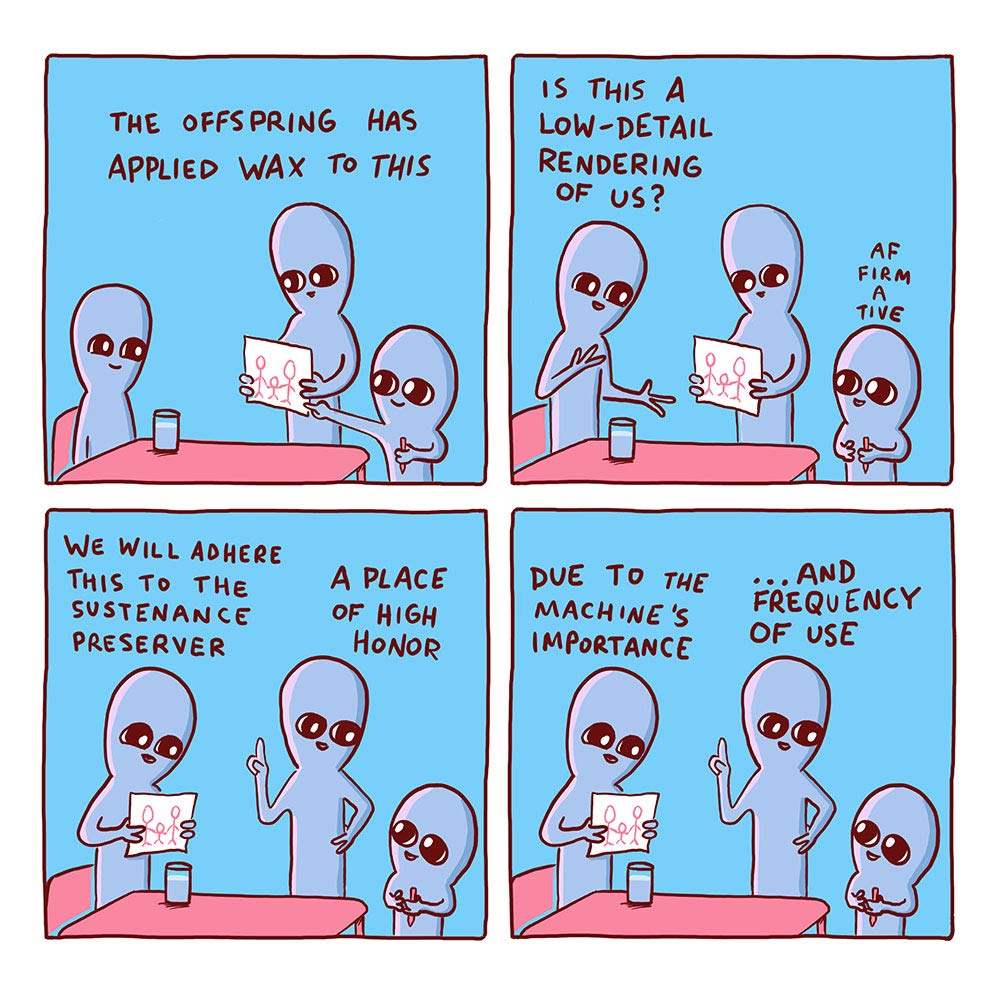
In Nathan W. Pyle’s little alien world, large-headed gray aliens with enormous eyes live their everyday lives, while explaining their actions in oddly formal, factual ways.

That’s it. That’s pretty much it.

It’s a simple formula, but one that is thoroughly endearing. “Strange Planet” is a collection of Pyle’s little four-panel comics about a “strange planet” occupied by these little gray aliens, whose lives are more or less identical to human lives, but who often explain themselves in ways that gently highlight the absurdity of things we take for granted.

These include surprise parties (“I believed the falsehoods you told me.” “Because trust!”), mosquitoes, babies, cats (“It’s vibrating”), coffee, birthday wishes (“Who wants to ingest this now that I have exhaled on it?”) smoke alarms, salt, TV news, giving flowers, makeup, wine, working out, assembling furniture, dogs, piercings (“I am considering a new hole in me”), pizza delivery, dental visits (“I’m here to scrape your mouth stones”), swimming pools, sports, and many other things.

Of course, it helps that the aliens have odd ways of phrasing things (“The group of orb-catchers that represent our region did not catch the orb tonight”). Also included: dougslice, rollmachine, personal star dimmers, seriousness cloth, sweet disks, plant liquid partially digested by insects and then stolen, the rollsuck, the hotdanger screamer, and many other charming little names.

They also have a knack for declaring their feelings in an oddly formal manner that reflects the most rational perspective on their actions, such as a sports fan declaring happily “I feel undeserved pride!” or a college graduate loudly declaring “My knowledge suffices” while other aliens announce “We smack our hands.” It’s this manner of phrasing things that calls attention to the oddness of some of our actions (wishing on falling stars) and makes them charmingly sardonic in nature.

The series’ charm also lies in Pyle’s simple art – the aliens are adorable with their little sexless gray bodies, bulbous heads and enormous eyes. Their surroundings are minimal, and their backgrounds often blank. They also all look alike, so you’re often not sure if most of the strips feature the same aliens or all-new ones every time.

Part of the charm of “Strange Planet” is that it isn’t that strange at all – it just calls attention to our own strangeness. And the chronicles of these cute little aliens are well-worth an hour or so of gentle smiles.

Review: Powers Volume 1: Who Killed Retro Girl?

Imagine a world where superheroes and supervillains actually exist – there are “powers” who use technology and superhuman abilities to save and/or endanger the world…

… and there are also cops who have to deal with all the mess.

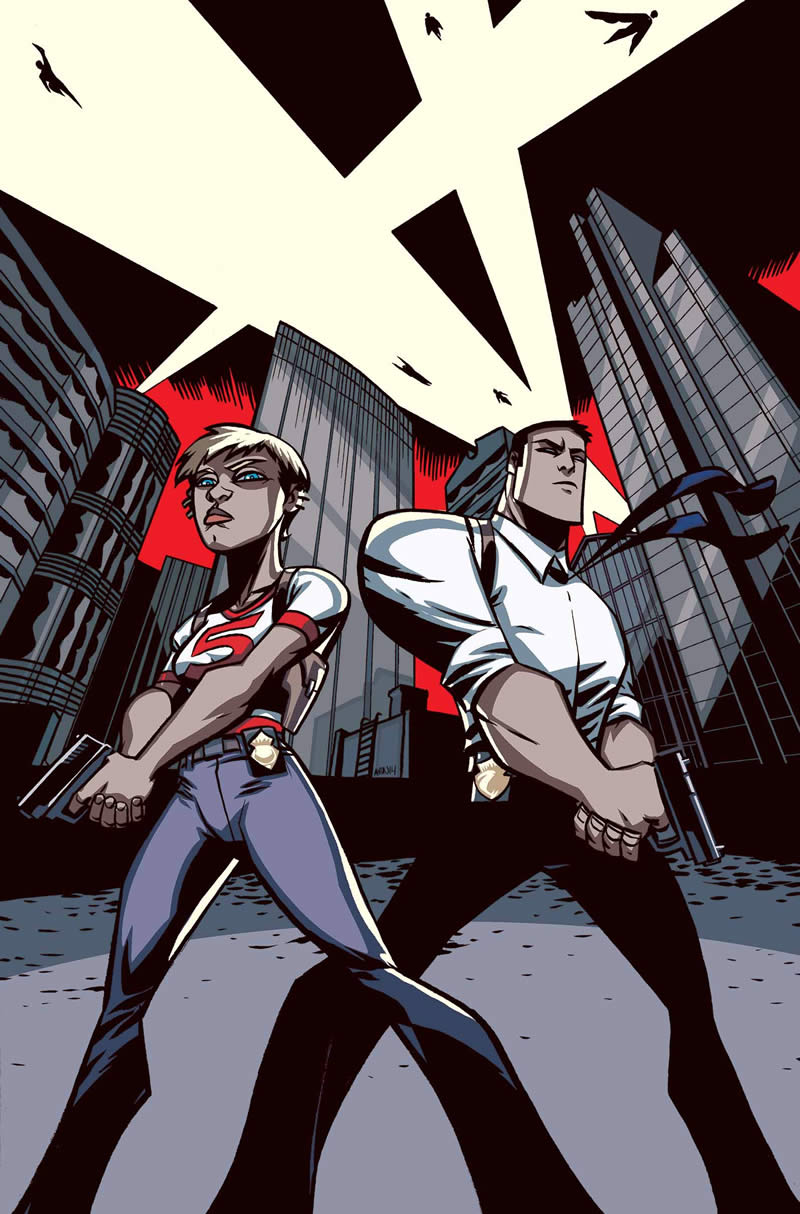
That should give you an idea of the world that “Powers Volume 1: Who Killed Retro Girl?” takes place in – this darkly clever comic book series is a police procedural about ordinary non-powered cops trying to solve violent crimes in a world where superhumans are everyday occurrences. Brian Michael Bendis spins up a genuinely suspenseful, gritty murder mystery with some twists and turns, which pairs up nicely with Michael Avon Oeming’s spare, angular artwork.

Christian Walker is called into a hostage situation, in which he saves a little girl named Calista from her mother’s deranged boyfriend. As if being saddled with a little girl wasn’t enough of a detriment to his day, he’s called into a homicide that rattles the city to its foundations. The famed and beloved superheroine known as Retro Girl has been stabbed in the throat… which is impressive, since she was nigh-invulnerable.

Oh, and Walker now has a new partner: Deena Pilgrim, a small but scrappy detective who has a penchant for crop-tops, and a deep-seated curiosity about Walker’s past.

As the city grieves and the news drags up every possible detail of her life, the two detectives begin investigating anyone who could have possibly wanted to kill Retro Girl. Supervillains, superheroes and local mafia bosses are all possible perps, but nothing that you could really hang your hat on. And as they try to unravel the seemingly impossible mystery, Deena begins to suspect that her new partner might be a power himself.

Police officers in superhero comics are usually pretty ineffectual characters, because they generally don’t have superpowers/superior tech and… well, many of the people committing crimes in superhero comics do. Superman could be an amazing police officer just by virtue of his Kryptonian abilities, but what can ordinary non-powered cops do when someone like Superman is murdered?

And Bendis crafts a pretty solid whodunnit: some clever clues strewn through the investigation, a lot of red herrings, and backstory for Retro Girl is conveyed through news reports that run at the bottom of the pages rather than interrupting the narrative. It’s a clever tactic, and it does keep the energy going. The entire story has a gritty, noir-ish atmosphere, peppered through with some dry comedy (the hypoglycemic coroner going off on a rant about space lizards and apes with laser guns).

But we’re also presented with a second mystery: what is actually up with Christian Walker? We see that he’s an exceptionally strong and rather skilled cop, quiet and rather reserved, but Deena quickly figures out that there’s more to him than meets the eye. And no, he’s not an Autobot. Deena herself is an excellent counterpoint to Christian’s introverted self – she’s sharp, fiery, outspoken and more than willing to beat up a whole room of bald mooks. Even her appearance is the opposite of his: light where he’s dark, small and slim where he is bulky and masculine.

Which brings me to the artwork. There’s something of a “Batman: The Animated Series” look to the character designs, especially the broad-shouldered, top-heavy, strong-jawed Christian. The style is fairly simple with thick lines, heavy shadows and geometric shapes, and Oeming often soaks whole scenes in specific colors – the red of Johnny Royalle’s club, the blue of the morgue, the purple of Triphammer’s home, and so on. It’s very striking, and keeps it from looking too murky.

Bendis and Oeming craft a powerful, striking opening story for their superhero-comic subversion, and “Powers Volume 1: Who Killed Retro Girl?” leaves you hungry for more adventures by Walker and Pilgrim. Gripping and intriguing.

Brandon Sanderson’s Cosmere

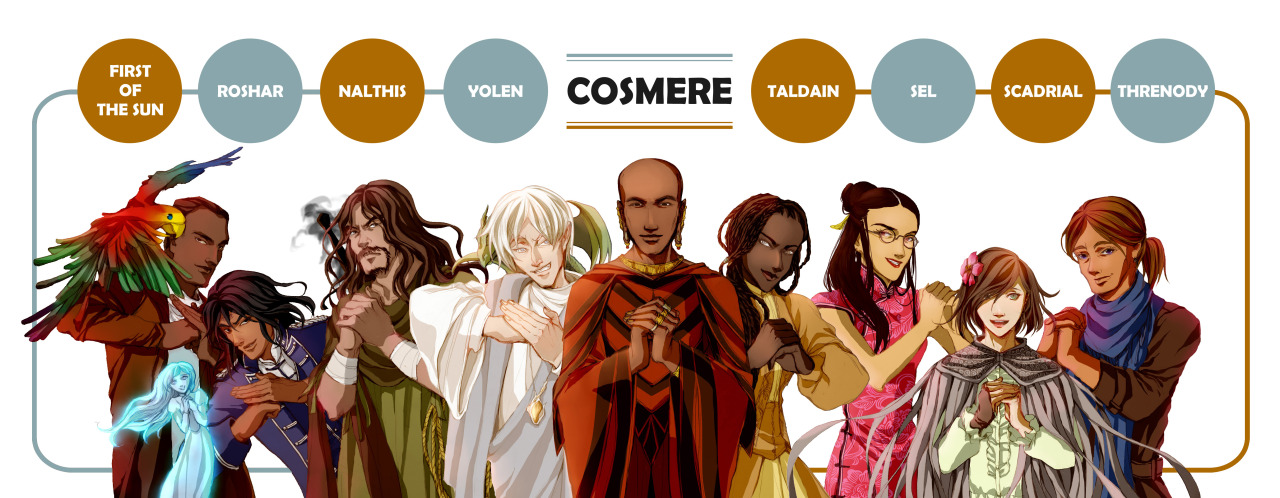
https://botanicaxu.tumblr.com/post/138862187844/finished-nine-characters-from-eight-shardworlds

Brandon Sanderson is one of my favorite authors, partly because he can take a genre where most of the corners have been explored, and expands them with either amazing skill or brilliant new ideas. He also just executes these books with incredibly complex plotting, such as the Stormlight Archive series, which will apparently have ten enormous volumes (the fourth is currently available for preorder). Even this man’s unpublished books are better than most authors can manage (the original White Sand and Aether of Night, which you can obtain from his message board by request).

And he’s created his own interconnected universe known as the Cosmere, which links together most of his published work. Mostly this is through the concept of Shards, which are fragments of this universe’s murdered power of creation, Adonalsium. This fuels the magic of these different worlds, which comes out in different unpredictable ways – in some of them, you might turn into a living zombie, and in others you can “burn” metals that give you superpowers. This blanket mythology allows him to tell various stories with various types of magic, but allows him to interlink them so that they can have greater significance in the future.

To date there have been eleven books in the Cosmere, along with several novellas and short stories that you can find in the Arcanum Unbounded collection, and a graphic novel series. Which, by the way, I do not recommend reading in its entirety until you’ve read the novels.

If this sounds intimidating, it really isn’t. Some of these works can be read pretty much independently of their greater mythology, and then later works can give you an appreciation of the greater, more universe-spanning story being told here.

If you’re interested in checking it out, I’d recommend that newcomers to the Cosmere start out with Elantris, Warbreaker or the first Mistborn trilogy. White Sand, the graphic novel, is also a good starting point if you want to get into it via comics (although I do recommend the unpublished text, which has some notable differences and a cliffhanger ending). These books were my introduction to the Cosmere, and they are stories that can be appreciated on their own before you connect them to a larger story. Or you can just read them independently, and enjoy them independently. It’s your choice.

(Also, Elantris has some flaws – I’d rate it three stars out of five – because it was one of Sanderson’s early works, but the overall story is an engaging one. So if that one isn’t to your taste, I’d recommend checking out Warbreaker before coming to any conclusions)

Then, I’d recommend checking out the short stories and novellas such as Mistborn: Secret History, Allomancer Jak and the Pits of Eltania, Shadows for Silence in the Forests of Hell, The Emperor’s Soul and Sixth of the Dusk. You can find all these in the Arcanum Unbounded collection that I mentioned before, along with a Stormlight Archive novella that takes place after the second book. But obviously, don’t read that until you read the first two Stormlight Archive books. Then there is the second era of Mistborn, which takes up the next three books in a much later time period than the original – and unlike most epic fantasy, it actually has technological advancements!

If you have read the books/stories and like them, and want to see more, then check out… well, the Stormlight Archive. These books are absolutely massive – each one is like a brick made out of paper – but they don’t feel that way. Reading the first one actually flew by pretty quickly for me – it took longer for me to read The Great Gatsby. These are ones that are best appreciated when you’ve read Sanderson’s other works and understand the universe they exist in; they delve into the cosmology of the Cosmere and how things got to be the way they are.

And the Cosmere is still expanding: Sanderson will be releasing a new Stormlight Archive book this November, and a new Mistborn novel after that. Furthermore he has plans for a bunch of other books, including a sequel to Warbreaker, two more trilogies for Mistborn, two more Elantris books, more Stormlight Archive, and a prequel series that he’s planning after the Stormlight Archive has concluded. And who knows? He may get other ideas for novels, novellas or short stories along the way.

So if you want epic fantasy that doesn’t just copy Tolkien, Martin or one of the other big names, Sanderson is a good option (especially since the Mistborn trilogies advance technology over time, and one future one will be a space opera!). And I haven’t even gotten into his non-Cosmere stuff…

Where Susanna Clarke led me…

I am old enough to remember before Google effectively ran the universe and Wikipedia was the main source of information, meaning that by Internet standards, I am pretty much Methusaleh. I also remember when phones plugged into the wall. But that means that I remember the days before you could go into a rabbit hole of information that could lead you to strange new obsessions in a matter of minutes.

Which brings me to Susanna Clarke. If you haven’t heard of Susanna Clarke, she is the brilliant author of the fantasy known as Jonathan Strange and Mr. Norrell, a story about feuding magicians in Regency England, with fairies and the Napoleonic War. If you haven’t read it, give it a try. It’s like if Jane Austen decided to collaborate with Diana Wynne-Jones – if that sounds good to you, you might enjoy it. Also, the miniseries the BBC adapted from it is quite good as well.

But that book is not what I’m talking about. I’m talking about Piranesi, her not-yet-released third book/second novel. The book is apparently about an infinitely large and complex house with an ocean within its walls, and it sounds like there may be something about parallel worlds or something like that. The summary is a little blurry, but that’s probably because it isn’t a “regular” fantasy novel, and there’s an element of mystery.

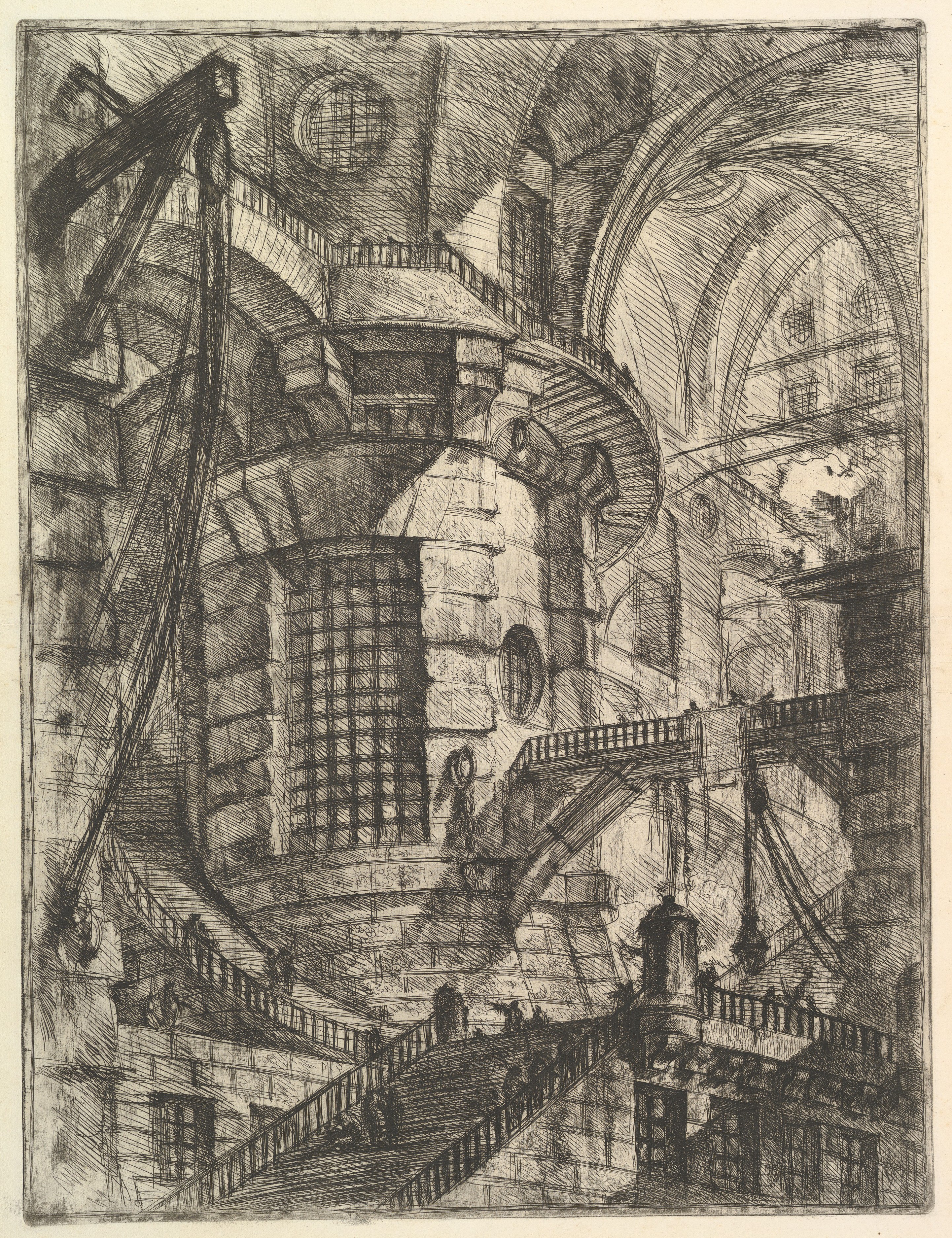
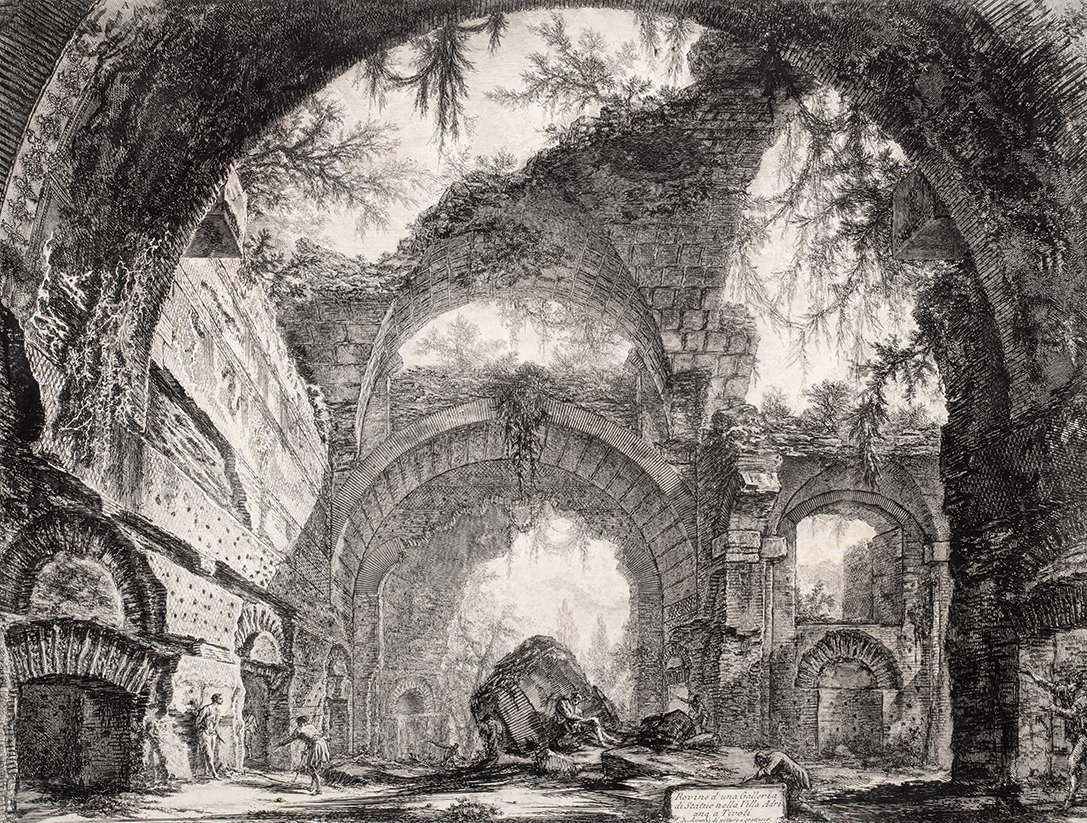
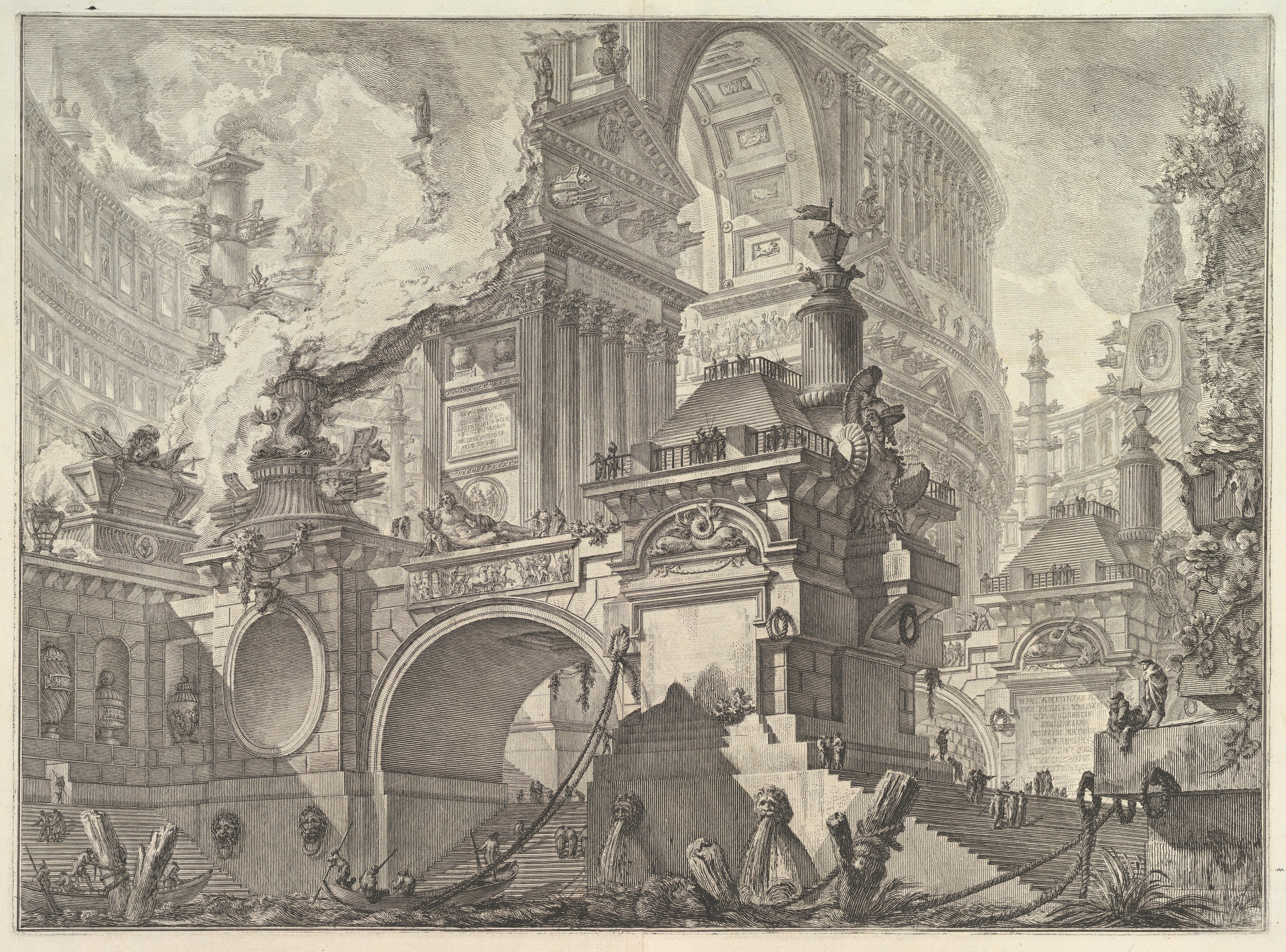
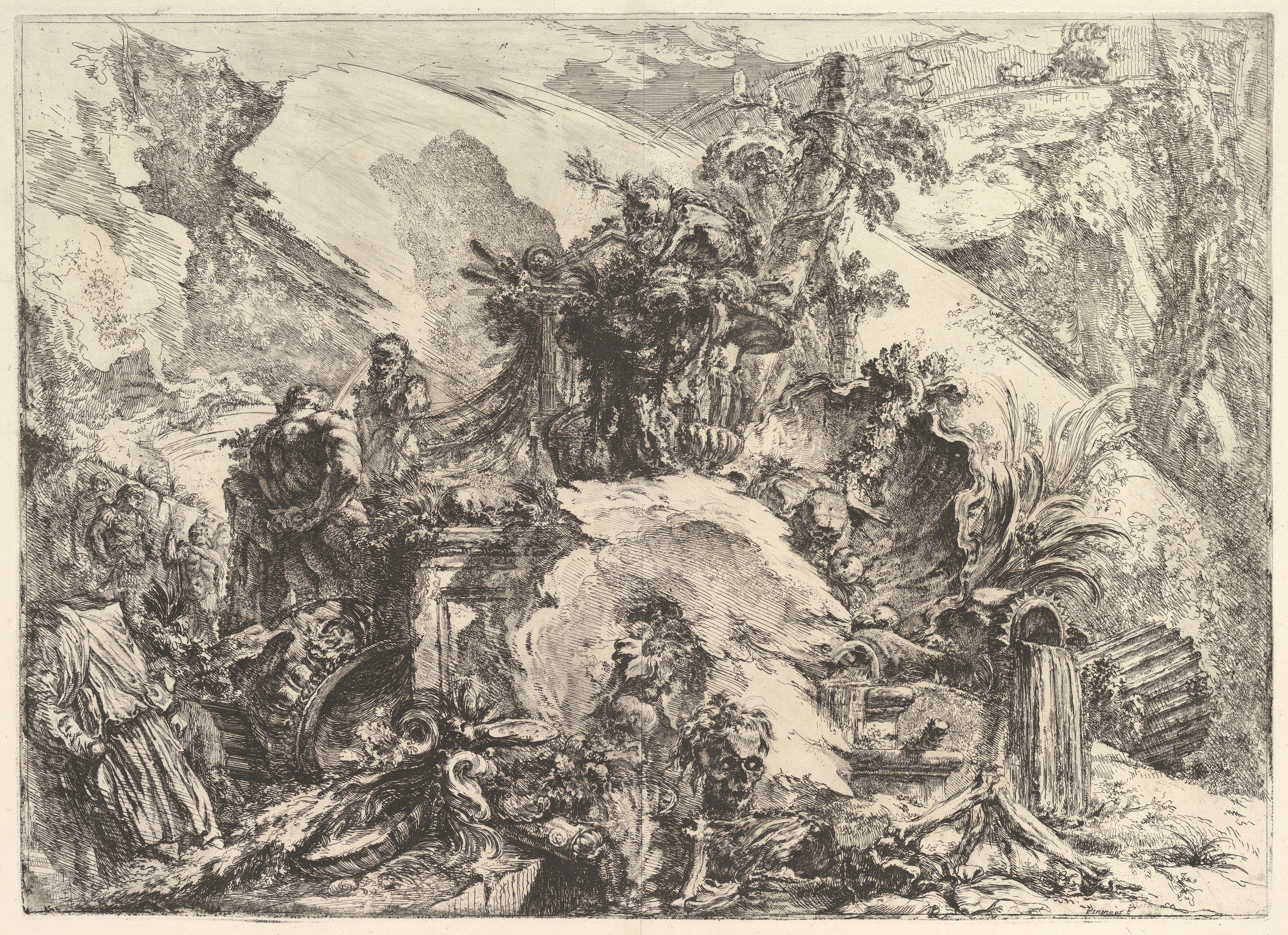
But I decided to google “Piranesi” to learn more. And lo and behold, I found very little information about the novel, and quite a bit about one Giambattista Piranesi, who lived in the 18th century.

Unlike some, I am not going to pretend that I knew all about Piranesi in order to sound more sophisticated. I freely admit that there are artistic spheres, genres and disciplines that I know virtually nothing about, because I either have very little interest in them or have not had the chance to study them extensively. Etchings are one of these areas.

But I really was swept away by Piranesi’s artwork.

I don’t know about Clarke’s creative process, because to my knowledge she does not have a website or social media. But I wonder if these etchings in some way inspired the novel Piranesi. Not necessarily in the sense of the plot, because as far as I can tell, Piranesi’s etchings don’t really have a “narrative” that you can discern…

… but more in the sense that some of these etchings give a sense of structures with immense space, age and complexity. Sometimes they feel downright fantastical or otherworldly. And that sounds like the aesthetic for the House in Piranesi.

So nothing too deep, just me sharing that I like Piranesi’s etchings, and I wonder if Clarke was inspired in some way by the aesthetic of his architectural studies.

Also, check out Piranesi when it comes out. And read Jonathan Strange and Mr. Norrell. That’s all.

Review: Superman/Batman: Apocalypse

Two things to keep in mind about “Superman/Batman: Apocalypse”:

  1. Yes, it is a sequel to “Superman/Batman: Public Enemies,” but aside from a single line by an unnamed extra, there is no real connective tissue between these two films. If you ignored that one line, this movie could be watched on its own.
  2. It’s not really a movie about Superman and Batman directly teaming up. They work together as part of a team, but the movie is not really about them doing stuff together – or about Wonder Woman, who does her fair share of fighting and bickering alongside the men.

No, the movie is really about Supergirl and her relationship with the DC trinity – especially Superman – even as she tries to find a place for herself in a new alien world. And as the title might have tipped you off, DC’s most legendary heroes are going up against their enemies from the hellish planet Apokalips, led by the cruel Darkseid. Don’t worry – all three of them, plus Big Barda, get their chance to shine in combat.

A massive chunk of Kryptonite lands in the water near Gotham City, and turns out to have a pod with a naked girl inside. She soon exhibits powers similar to Superman’s, which she isn’t very good at controlling, causing quite a bit of mayhem until Batman subdues her. Superman quickly discerns that she is his cousin Kara, but Batman is suspicious of her – especially since Kara’s control of her strength and heat vision is still not particularly good even after weeks of learning.

So he enlists Wonder Woman to take Kara to Themyscira, where she can be trained away from ordinary humans. But there’s another reason for this change: a minor superhero known as Harbinger has been having visions that seem to bode ill for Kara.

Well, to put it simply, the visions come true – Themyscira is invaded by cloned enemies from Apokalips, and Kara is kidnapped by Granny Goodness and Darkseid. Obviously Superman, Batman and Wonder Woman are going to Apokalips to get her back, and they have to enlist the reluctant Big Barda to help them get there. But getting to Apokalips is the easy part – the hard part is getting Kara, and getting back alive.

I must admit, I was slightly disappointed that a movie titled “Superman/Batman: Apocalypse” didn’t feature much of Superman and Batman teaming up – they work together, but it’s mostly in independent ways. In fact, there’s some friction between Superman and both Wonder Woman and Batman, since he’s annoyed by Batman’s suspicious nature and Wonder Woman dragging his cousin into combat training on Themyscira rather than letting her have a normal life.

What the movie is really about is Kara seeking a place for herself in this new world of hers. It threads through the entire movie, right to its end, including her stint in Apokalips. Flaws? Well, it feels like the movie avoids the longer-term psychological effects of Kara being brainwashed and forced to do terrible things. She just kind of snaps out of it, like a binary good/bad switch has been flipped.

But don’t worry, the main trio get plenty of screentime – all three kick considerable amounts of butt, from an army of Doomsday clones to Granny Goodness’s female Furies. Batman seems a little too tough for a mere ordinary human (he survives being eaten by a giant dog), but otherwise the fight scenes are gritty, expansive and full of nightmarish scenery to get smashed through.

It also highlights their different personalities and ways of approaching problems: Batman is suspicious and protective of those close to him, Superman is idealistic and overprotective of his cousin, and Wonder Woman is practical and caring in a no-nonsense way. And Big Barda rounds out this little cast, a strong but scarred woman who cherishes the “boring” life she has, because she has lived in the hellscape of Apokalips.

“Superman/Batman: Apocalypse” has a slightly deceptive title, but is a solid, fast-driving movie that shows this superhero trinity at their best. If you want a DC animated movie, this is an enjoyable way to spend an afternoon.

Recommendation: The Brokenwood Mysteries

My most beloved genres are science fiction and fantasy… fantasy a little more than sci-fi, since I have limited tolerance for the intolerance of many sci-fi writers. But when I was but a wee cynic, I was a devoted watcher of murder mysteries – Agatha Christie stuff, some Ngaio Marsh adaptations, and the wonderful Murder She Wrote. Some of my earliest television memories are of these shows.

And I still do watch mysteries now, although a lot of the more recent Christie stuff has turned me off. I tried watching Scandinavian murder mysteries, but they… how do I put this?… made me want to blow my brains out because everything is so overcast, depressing and bleak. Wales is a close second with Y Gwyll. So I get a great deal of my murder mystery viewing from merrie olde Englande.

But there’s a big exception: The Brokenwood Mysteries, a charming little series from the beautiful land of New Zealand, the country of Lord of the Rings and Flight of the Conchords. If this is what this country has to offer, I would love to see more mystery series from them.

Part of that is the energy that New Zealand seems to have. Now, I admit I have never been to New Zealand, and I don’t know a lot of people from New Zealand. But the people I have met and the media I’ve consumed from that country give off a very mellow feel – not pushovers, but people who don’t get too overexcited, too bleak or too angry, and are generally pretty welcoming and pleasant. That’s the energy this has, even in its darker episodes or when it tackles serious topics like molestation.

So this series takes place in the town of Brokenwood, which starts out as a quaint little small town but acquires new attractions and institutions every time it needs them (like a women’s prison, several wineries, a major country music show, a whole steampunk community and a historical village). It’s kind of like Cabot Cove in that regard. The main detective is Mike Shepherd, a much-married-and-oft-divorced detective who moves to Brokenwood (and buys a house with a failing vineyard) after solving a complex case that stems from a botched murder investigation years earlier. I’m not going to tell you what that case was, because I really want you to watch the show yourself.

But the thing is, Mike is very quirky. He’s a country music enthusiast with a love of vintage stuff (sort of like a middle-aged hipster), and he has conversations with murder victims. He’s backed by the less quirky younger cops, Detective Kristin Sims and Detective Constable Sam Breen, who are relatively normal. Breen does have some comic relief, though, because every single interview he does with a suspect – and sometimes with people who aren’t suspects – ends up a disaster. For instance, he ends up in the wilderness with possum fat on his face. Or a mental patient takes apart the interview table. Or he has to deal with a UFO conspiracy theorist.

There’s also Dr. Gina Kadinsky, a hilarious Russian medical examiner who has all sorts of weird proverbs and sayings and viewpoints that always have Mike off-kilter. Also when someone gets stabbed, she will bring out slabs of meat and stab them with different implements to see what probably did it.

There’s also an array of supporting characters who cycle in and out of the various episodes over the length of the series, including:

  • Jared Morehu, a Maori man who lives next door to Mike, and who is a sort of local jack-of-all-trades who sometimes helps out.
  • Frodo, a rather unfortunate little man who goes through various jobs and tends to accidentally be close to suspects and crime scenes.
  • Mrs. Marlowe, a very socially active old lady with a very lurid imagination.
  • Dennis Buchanan, an annoying lawyer with an…. interesting sex life.
  • Ray Neilson, a local grumpy pub owner who runs a Lord of the Rings-themed tour on the side and occasionally gets drunk with country roadies.

And there are a bunch of other characters who float in and out in various episodes, and there’s no way of knowing what part they’ll play. A suspect from an early episode is a murder victim later on. Another recurring character turns out to be a murderer. But it really gives a feeling of an actual community to have characters floating through in different places, knowing each other and being fleshed out with their subsequent appearances.

I may be making The Brokenwood Mysteries sound like it’s almost comedic, but it’s not. It does have a lot of moments and characters who are lighter-hearted compared to many American or British shows – or, heaven forbid, Scandinavian shows – but it does give due gravity to serious, sad topics that are central to the plots, like gaslighting, molestation, infidelity, and so on. Sometimes it ends on a relatively downer note, even if the bad guy is caught.

But I also don’t want to make it sound too depressing. The murders are pretty colorful and varied, not just your garden-variety poisonings and stabbings – some are lurid, some are bizarre (caffeine poisoning), some will make you wince (the skydiving incident), and so on. But they are very rarely boring murders; there’s always something like a tanto or a dead bride to keep things interesting. Then Breen will have a nightmarish time talking to suspects, Gina will say or do something weird, Mike will go on about country music or his old car, Kristen will make coffee and it will be bad… and you’ll smile despite all the blood and death.

And furthermore… Brokenwood just has a very oddly homey, welcoming feeling to it. Despite the high murder rate, it feels like a place you would want to live – it’s small-towny and close-knit, but at the same time it’s full of interesting people and things. And that mellow, laid-back feeling of New Zealand media just adds to the feeling.

So if you like murder mysteries, or New Zealand, or both… check out The Brokenwood Mysteries. There have been twenty-four hour-and-a-half-long episodes thus far, and it’s a good series to binge.

Review: The Ballad of Songbirds and Snakes

In the time of Katniss Everdeen, Coriolanus Snow is the tyrannical president of Panem, a cruel man who uses the Hunger Games as a weapon against any who would rebel. But once, long ago, he was just a aristocratic teenage boy in the Capitol, raised in the shadow of a terrifying rebellion that gave birth to the Hunger Games.

The Ballad of Songbirds and Snakes is a look back at the early days of Panem’s dystopian tyranny, and a glimpse of how Snow turned into the president he would later become. This tale is a very different one from Suzanne Collins’ other Hunger Games tales, whether it’s the third-person narrative, the cold and ambitious protagonist, or the general feeling of hopelessness and ruin that you know is not really going to get any better.

Born to the purple but raised in poverty, Coriolanus Snow is the only hope his grandmother and cousin Tigris have for any kind of comfort and dignity. He has to acquire a university prize and brilliant career in the upper echelons of the Capitol’s society, without ever betraying that he and his family are surviving on boiled cabbage and old outgrown clothes. If not, the Snow family will descend into… well, being ordinary poor people in the Districts, and Snow can’t bear the thought.

But then he’s dealt a blow. When various young mentors are assigned to the Hunger Games tributes, he’s given the girl tribute from District 12: Lucy Gray Baird, a strange girl with a luscious singing voice and plenty of stage presence. Though he thinks she’s crazy at first, Snow is determined to make the best of his assignment, and he even begins to believe that Lucy Gray’s charm and charisma can somehow help him.

The days before the Tenth Hunger Games are cruel to both the mentors and the tributes – there are bombings, venomous snakes, torture, and the psychopathic Dr. Gaul. But Snow’s efforts to save Lucy Gray from death in the arena, based on both his growing feelings and his desperation for success, will push them both to terrible extremes – revealing to Snow who he truly is, and what he’ll do to save himself.

In The Hunger Games, Suzanne Collins depicted District 12 as a painfully impoverished place where starvation was only a missed meal away. And in The Ballad of Songbirds and Snakes, she depicts a different kind of poverty in the Capitol – it’s a relatively luxurious place full of wealth and parties, but there’s a rotten layer to this crumbling society, a sense of dark decay that underlies Snow’s world. And she reminds us constantly that the Capitol is still scarred by the war between Panem and the rebels, which got so bad that wealthy people cannibalized their servants in the streets.

Collins also switches up her writing here – rather than the first-person perspective of the Hunger Games trilogy, she relates Snow’s teenage adventures in the third person. Her prose is tense and taut, with moments of horror (the deaths of some of the tributes) or chilling sadness (“Tell her… that we are all so sorry she has to die”) spattered across it. The plot does grow less intense after the Hunger Games, when it seems like Snow has had to embrace a new life, but then takes a sharp twist into tragedy.

And though he’s the protagonist, Coriolanus Snow is never quite a likable person. We know where he’s coming from and what drives him, but he’s still a very chilly, proud, selfish person motivated by a belief that he is genuinely and inherently better than everyone else. When he’s around Lucy Gray, Collins slips in some actual human emotion, which builds up gradually throughout the book… but Collins never lets us forget for long that he’s not a good person, as seen when he talks about killing the mockingjays.

And he’s backed by characters who aren’t necessarily what they seem. While there’s the compassionate and slightly melodramatic Sejanus as a counterpoint to Snow’s more amoral approach, Lucy Gray is an elusive, mercurial presence that is hard to nail down. And Dr. Gaul is genuinely scary, a mad scientist who apparently does mad science entirely because she can.

There’s a deep sadness at the heart of The Ballad of Songbirds and Snakes – a knowledge that this is a story that can’t have a happy ending, and can’t have a hero. But it is a fine dystopian tale, giving greater depth to the history of Panem.