Review: Teenage Mutant Ninja Turtles #89

For many issues now, the IDW “Teenage Mutant Ninja Turtles” series has featured Splinter as the head of the Foot Clan – and has followed his slow moral downfall as a result.

So what better subject is there for a “Christmas Carol”-style examination of the past, present and possible future of someone who isn’t really doing the right things with his life? The eighty-ninth issue of this ongoing series shows what happens to the mutant rat when he’s alone at Christmas, and supernatural beings come a-knockin’. The final parts of the issue are somewhat abrupt, but it’s a nice little yuletide story augmented by Michael Dialynis’s expressive artwork.

Splinter is alone for Christmas Eve, since he is still estranged from his Turtle sons. Suddenly the ghost of Oroku Saki appears in front of him, warning Splinter that he is in danger of the same fate that has befallen his old enemy, and that three apparitions will take him on a time-tripping journey, etc etc. Sure enough, that night Splinter is visited by three members of the Pantheon – the first will take him to his distant past as a human, the second will show him his sons’ somber Christmas Eve, and the third will show him the dark consequences of his current path…

The IDW “Teenage Mutant Ninja Turtles” series has always been eager to celebrate Christmas, so it isn’t surprising that they managed to squeeze in another holiday story between major plotlines. However, this one is more bittersweet than the others – partly this is due to recent developments in the comics, but also to the ongoing evil-creep of everyone’s favorite rat sensei. The “Christmas Carol” story developments perfectly fit someone who started out well, but is slowly being subsumed in his own sins, and needs to be warned of what mistakes he’s made and what might await him.

Flaws? Well, compared to the more leisurely explorations of the past and present, the future portion and aftermath of Splinter’s journey are kind of abrupt. The future is shown only in a page and a half, though what Splinter sees there packs a massive punch, and the denouement feels pretty rushed as well. Just bam! Everyone is there.

It also has some very good art by Michael Dialynas – his illustrations are very expressive and very dynamic, with a lot of slightly exaggerated facial cues for the humans. He especially excels at showing the emotions of the mutants in this issue, such as in Michelangelo’s unhappy conversation with Leonardo about the losses they’ve experienced, and particularly of the darker, battle-hardened Turtles shown in Splinter’s final vision. You can see the different mixed emotions in their faces, and the tragedy of what has happened.

The eighty-ninth issue of the IDW “Teenage Mutant Ninja Turtles” series is a nice little bittersweet Christmas interlude – a mix of light and dark, with some very nice art and a great use of the Dickensian holiday staples. But it leaves you wondering: what will Splinter do now?

Review: The Graveyard Book

Imagine Rudyard Kipling’s “Jungle Book”… but replace the animals with ghosts, ghouls, werewolves and other such supernatural creatures.

Such is the concept of “The Graveyard Book,” which cleverly turns Kipling’s classic story into an exquisitely-written, darkly witty fantasy. While it starts as the assorted supernatural adventures of a young boy raised by ghosts, the story slowly evolves into a beautifully ghastly confrontation between Nobody Owens and the people who want to do him harm.

“There was a hand in the darkness, and it held a knife.” A man named Jack kills an innocent family at night — except for a baby boy, who toddles out to the graveyard.

With the approval of the Lady on the Grey, the Owens ghosts adopt the boy, whom they name Nobody (or “Bod” for short), and the mysterious not-dead-or-alive Silas is appointed his guardian. Bod slowly grows up, but his upbringing is hardly ordinary — he is taught by a Hound of God, wanders into the horrific realm of Ghulheim, watches a danse macabre, and befriends a witch’s spirit from the Potter’s Field.

But the man named Jack is still out there, and for some reason he (and the organization he works for) still wants to kill Bod. And though Silas and the ghosts are trying to keep him safe, Bod is becoming curious about the world of living humans — and about the man who murdered his family. And when they come for him, he’ll be ready.

The world of Neil Gaiman is never a safe place — it’s always painted in shadows and shades of grey, and something horrible may be lurking around the corner. And the world of “The Graveyard Book” is no exception to this — it’s filled with strange supernatural creatures, hellish red cities with decayed moons overhead, and midnight parades where ghosts dance with the living.

The world of the graveyard is an intriguing one — moonlight, crumbly headstones, a little stone church, and a creepy barrow where the Sleer lurk. From a lesser author this would be kind of boring, but Gaiman’s beautiful prose brings it to life (“There was a silent implosion, a flutter of velvet darkness, and Silas was gone”).

And Gaiman explores Bod’s childhood with dark humour (“Can you imagine how fine a drink the black ichor that collects in leaden coffins can be?”) and adventure. But the tone changes as Bod grows older, especially with the creepily professional Jack and his cohorts slowly closing in on him. It’s a coming-of-age tale, and a bittersweet, sometimes terrifying one.

Bod himself is a lovable kid, who slowly explores first the world of the graveyard and then the world of the living. He’s both ruthless and kind, sweet and strong. The mysterious Silas — whose true nature is only revealed late in the book — serves as a kindly but stern mentor, who pretty clearly loves young Bod like a father.

And there’s a pretty wide supporting cast — Bod’s childhood friend Scarlett is rather bratty, but the ghosts make up for that. The snappy, witty witch Eliza, the kindly Owenses, Mother Slaughter, the fussy Mr. Pennyworth, and the schoolteacherish substitute guardian Miss Lupescu all round out the cast. And with only a few lines, Gaiman makes them seem practically real.

“The Graveyard Book” is a beautifully written, bittersweet coming-of-age tale with some moments of pure creepiness. A magnificent fantasy story, which is not to be missed.

Review: The Fork, the Witch, and the Worm

The Inheritance Cycle ended with a number of loose threads left flapping in the breeze, and the door wide open for more adventures in Alagaesia.

And Christopher Paolini has started telling those adventures in “The Fork, the Witch, and the Worm,” a trio of short stories nested in early stories about Eragon’s new home. While it likely won’t grip fans of the series the way the original books did — these are basically stories within a fairly sedate framework — Paolini’s writing has matured somewhat, and he tells the tales here with more steadiness and assuredness than in his past works.

A year has passed, and Eragon is living in a new mountain fortress being created for a new generation of Dragon-Riders. The problems and new responsibilities are weighing on him, so at Saphira’s insistence, he spends some time with the Eldunari. The dragons’ hearts show him events unfolding elsewhere in Alagaesia — a small girl encounters a mysterious (yet familiar) traveler who advises her on how to deal with bullies… right before they both find themselves in a deadly confrontation. It involves a fork.

Then that winter, Angela the herbalist arrives at Eragon’s new home, bringing with her Elva the accursed witch-child — and her autobiography (written by the author’s sister, Angela Paolini), which reveals her experiences with Elva. Finally, a tragic accident at Mount Arngor leaves Eragon unhappy and tired, which leads to him being told a story by the Urgals — the tale of an Urgal girl’s quest for revenge against the vicious dragon that killed her father.

“The Fork, the Witch, and the Worm” seems to be Paolini preparing to expand his fictional universe, perhaps only through short stories or perhaps through more full-length novels. Through these stories, he not only catches up with the characters left from the previous four books — Eragon, Murtagh, Angela and Elva — but he also hints at new and terrible villains to be explored later.

But fans are unlikely to be satisfied by this, because Eragon’s role is mostly just to sit around and listen to other people tell him things. He doesn’t even interact much with Saphira. Also, about half the book is taken up by the Urgal story, which has limited appeal.

Paolini’s writing is decent here — while not entirely mature, his writing has some nice turns of phrase (“Black as charred bone, with a polished gleam to his fitted scales and a throat packed with fire”) as well as some that could have used an editor’s pen (“A slight twinge of heartsickness formed in his chest”). His sister’s writing, alas, is not as good; I found myself skimming through most of it.

Eragon is fairly steady and a little more mature in this volume, although he’s still ridiculously overpowered (he manages to not only lift a collapsed tunnel’s broken rocks, but instantly reassembles them). Saphira is a fairly small presence here, compared to characters like Ilgra the sorcerous Urgal, and a small girl named Essie who has been bullied and blackmailed by a popular girl, only to find out how nasty and frightening other people can truly be.

The trio of stories in “The Fork, the Witch, and the Worm” are reasonably readable little tales that return readers to Alagaesia — seemingly just as the warm-up for some new adventures for Eragon and his allies. Fluffy, but not too bad.

Review: Spider-Man: Into the Spider-Verse

Imagine not only becoming a superhero, but finding that there are other superheroes just like you — same powers, same gimmick — from other dimensions.

Such is the situation of Miles Morales, a boy who unexpectedly finds himself not only with the same powers as Spiderman, but the responsibility to be a world-saving hero. “Spiderman: Into the Spider-Verse” is an energetic, colorful tale that effortlessly juggles an ever-expanding cast of Spider-individuals and suitably sinister villains, without getting tangled up in its own plot or mythology.

Miles Morales was an ordinary kid from Brooklyn — albeit one going to a ritzy private school — until a subterranean excursion with his uncle caused him to be bitten by a glowing spider. The next morning, he finds that not only has he become more muscular and agile, but his hands are sticking to anything he touches. Since, in story, there are comic-books about real-life superheroes, he recognizes his powers as being those of Spiderman.

And when he retraces his steps, Miles encounters none other than Spiderman himself, battling the Green Goblin and the Kingpin to stop a collider from accessing parallel universes. Spiderman, recognizing Miles’ abilities as being similar to his own, entrusts him with the key to stopping the collider… before he is unexpectedly killed.

And as the world mourns the loss of Spiderman (now known to be Peter Parker), Miles encounters another Peter Parker from another universe — an older Parker, more jaded and emotionally stunted, with a small gut. The fate of the entire world may lie on Miles’ shoulders as he tries to convince Parker to help him destroy the collider — but their dangerous quest will reveal that Parker wasn’t the only Spider-individual to be pulled into Miles’ world.

“Spiderman: Into the Spider-Verse” is a love letter to all things Spiderman — and especially to the different incarnations of the character, not all of whom are Peter Parker. Or male. Or human. In fact, the film unfolds by introducing more and more Spider-individuals to help Miles on his quest, reminding us that in every universe, Spiderman (or Spiderwoman) is an everyman hero who never gives up.

The movie certainly isn’t hurt by the presence of Phil Lord and Christopher Miller, the former of whom also cowrote the script. It swings swiftly from plot point to plot point, switching to flashbacks and explanatory interludes that keep the story from being bogged down with too much dialogue (such as the backstory of the Kingpin, or the fast-moving backstory of Other-Universe-Peter-Parker). It whips by swiftly and smoothly like a rhythmic gymnast’s ribbon, curling and twisting in all the right places with additional villains and unexpected revelations.

The animation takes a little getting used to, though. It’s good with expressions and big, expansive action scenes (including a wild webslinging chase through a forest), but some of the movements are a little herky-jerky, like some of the less fluid stop-motion animation. Still, the exaggeration and quirky visual cues harken back to the comic book roots of the characters, and everything is colorful, dynamic and fast-moving.

It doesn’t hurt that Miles Morales is a pretty likable kid — a boy who stumbled into a familiar set of powers, and has no idea how to go about being Spiderman, even as he struggles with the woes of school and “real life.” His relationship with the extradimensional Peter Parker is also quite nice — Peter is reluctant to mentor a brand-new Spiderman, but the two gradually warm up and learn from each other as they struggle to save the world.

In the shadow of the more blockbustery tales of Spiderman, “Spiderman: Into the Spider-Verse” stands apart as a dynamically-animated celebration of everything Spidery. A delight.

Review: Teenage Mutant Ninja Turtles/Usagi Yojimbo

Usagi Yojimbo has a long history with the Teenage Mutant Ninja Turtles – the original comics had a few crossovers, and the character made guest appearances in three different Turtles TV shows.

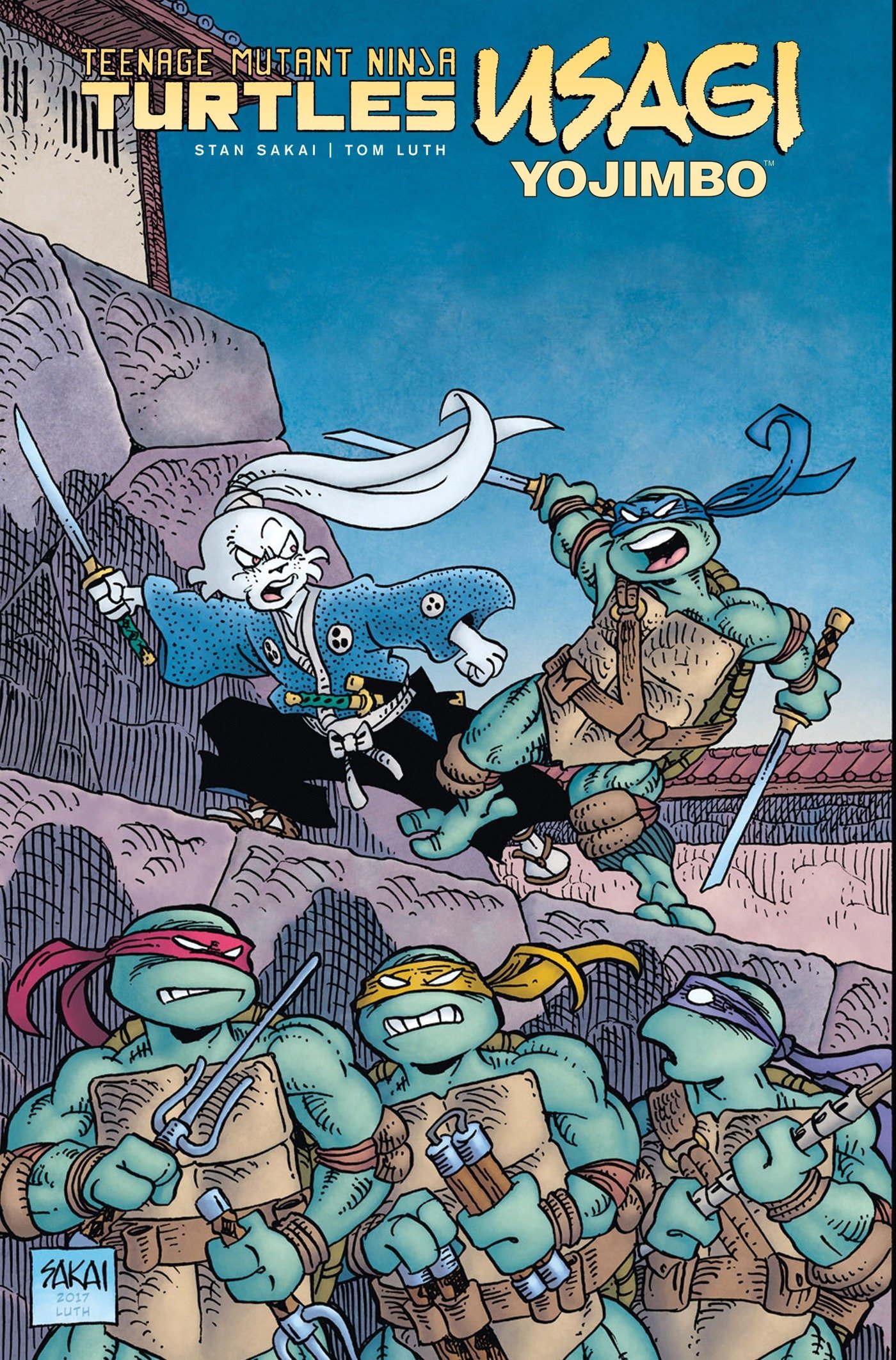
And in “Teenage Mutant Ninja Turtles/Usagi Yojimbo,” Stan Sakai’s rabbity ronin encounters a new quartet of Ninja Turtles – the four boys from the IDW ongoing comic book series. The tale could have been a little longer than it is, and had more time with Usage and the Turtles just hanging out and fighting evil together, but Sakai’s lovably bendy-looking artwork and nimble writing is a joy to read.

Miyamoto Usagi defeats a group of bandits, and is greeted by a small group of travelers who tell him that “The Old One” is waiting for him in a nearby grotto. “The Old One” turns out to be Kakera, who says that he must undertake a journey to Tashima Shrine – but he needs protection, and the rabbit yojimbo isn’t enough alone. So Usagi gathers four small turtles from the grotto, and Kakera summons the Ninja Turtles.

Only, these aren’t the Ninja Turtles that Usagi knows, and they’re kind of upset at being kidnapped by Japanese-speaking strangers. But once that little misunderstanding is ironed out, Kakera explains that he is on a quest to reunite a fragment of rock with a larger stone, which will end the earthquakes caused by a giant catfish and save their entire land. Yes, that’s the explanation. Unfortunately, he is being pursued by the malevolent Jei, who will let nothing stand in his way as he tries to destroy the land.

Honestly, I wish “Teenage Mutant Ninja Turtles/Usagi Yojimbo” had been twice the length it was, at least – it just leaves you hungry for more interaction between Usagi and the IDW Ninja Turtles, especially after the combative first impressions they made on one another. Perhaps Sakai will write another crossover in the future, but for the time being he has crafted a nimble little story with lots of swords, bandits and a bit of bromance.

The story is best read by someone with at least a passing familiarity with the two different comic-book series, but it doesn’t take much knowledge to jump right in and figure out who people are and what they’re doing. Sakai’s artwork here is enchanting – deceptively simple and colorful, with over-expressive faces and curved limbs, and the Turtles being bulkier and more visibly muscular than Sakai’s own more willowy creations.

And his story is pretty straightforward, with a good chunk of the plot being devoted to Usagi’s first encounter with the Turtles (and a subsequent sword-swinging freakout from both Usagi and Leo). After that, it’s more or less a straightforward walk to the shrine, and a subsequent battle with Jei and his forces. It could have used a few more detours or problems along the way, especially to develop the burgeoning friendship and admiration between Leo and Usagi.

It could have used a little more narrative meat, but “Teenage Mutant Ninja Turtles/Usagi Yojimbo” is a pretty entertaining crossover between two very familiar franchises. A fun read for fans of either or both.

Review: The Sandman, Vol. 6: Fables and Reflections

“The Sandman, Vol. 6: Fables and Reflections” is not quite as essential to the main storyline as the other Sandman short story collections.

But that doesn’t mean it isn’t a spellbinding, haunting series of stories, ranging from whimsical glimpses into the Dreaming to dark stories about the consequences of power. Neil Gaiman imbues every story with a sense of richness, mining mythology and history for the backdrops of his tales — and every single one casts a powerful spell over the readers.

The stories include:
-A theatrical director whose fear is reflected in a nightmare of falling.
-The story of Joshua Abraham Norton, the first and only Emperor of the United States – and the center of a struggle between Morpheus and Desire.
-Lady Johanna Constantine sets out to post-Revolutionary France to retrieve a very unusual severed head for Morpheus, and must fight against the repressive, destructive regime.
-An old legend of a werewolf obsessed with the portrait of a lovely young lady, and the lengths he goes to to find her.
-A Roman Emperor who becomes a beggar for a day, reflecting on his horrendous past and Rome’s bleak future.
-Marco Polo becomes lost in the desert, and stumbles into one of the places where the Dreaming overlaps with the waking world.
-The caliph of Baghdad realizes that for all the beauty and majesty of his city, it will eventually crumble like all other great things. So he seeks out the king of dreams to make a very unusual pact with him.

The two most intriguing stories are “The Song of Orpheus” and “The Parliament of Rooks.” The former is a story of Dream’s legendary son, who loses his true love right after their wedding. Grief-stricken, Orpheus feuds with his powerful father, and calls on his aunt Death to help him get his love back. And the latter is a charming little story about Daniel Hall, a toddler who slips into the Dreaming during his naptime. While there, he is told the story of Adam’s three wives, the tale of Cain and Abel, and the parliament of rooks….

While few of the stories in “Fables and Reflections” are directly tied to the central Sandman storyline, this collection of shorts adds a lot of richness and texture to Morpheus’ world. Witches, gods, emperors, werewolves, severed heads and artists all wend their way through these stories, in a world where magic — often dark, twisted and strange — lurks everywhere.

It also seems to have many meditations on the impermanence of things, and the need to remember the past — “Thermidor” shows us a France where all of the past is repressed and obliterated, including the myths that shaped its culture. Baghdad’s beauty and culture are threatened by time, and Rome begins to crumble out of one man’s terrible secrets.

Morpheus wends through these tales like a dark silk ribbon, subtlely shaping the destinies of those he touches — an emperor, a caliph, an explorer and a little baby boy. We see him sorrowful, majestic, cold-hearted and kind, particularly in the tales involving Orpheus, whom he loves but has still not forgiven. And we have more background on Eve, Cain and Abe, all dwelling in the world of the Dreaming.

“The Sandman, Vol. 6: Fables and Reflections” is a jigsaw puzzle of silken dreams and shadowy memories — a beautiful experience, even in its darker moments.

Review: The Sandman Volume 7: Brief Lives

Approximately 300 years ago, one of the Endless vanished. None of the others have seen him since, nor do they know where he went.

But it was pretty inevitable that one day, somebody would go looking for him. “The Sandman Vol. 7: Brief Lives” finally reveals what happened to the long-lost lord of Destruction, but it’s as the capstone to a bittersweet saga of everyday people, immortals, fallen gods and the most dysfunctional family in the universe.

After having a small meltdown in a gay bar, Delirium decides that she wants to find her older brother Destruction. She tries to enlist Dream to help her, and he decides to accompany his acid-tripping little sister on her quest. He’s already decided that her quest is hopeless, but he has nothing better to do after his latest romance failed.

But as Dream and Delirium make their way through the world, they come into contact with several people — both mortal and supernatural, from bellgirls to goddesses. Soon Dream realizes that they are spreading mayhem to anyone who tries to help them, and that finding his brother will exact a terrible cost from him.

At first, “Sandman Vol. 7: Brief Lives” felt kind of like a lighter, quirky chapter in the Sandman saga — it’s basically Morpheus and Delirium going on a little road trip to find Destruction. It’s kind of cute at first, especially since any story with Delirium is sure to be fun. Three words: tiny chocolate people.

But Gaiman’s story grows darker and more bittersweet as the the story winds on, especially since he unearths the stories of immortals adrift in a mortal world (think the goddess Ishtar dancing at a strip club). It’s a gritty, grimy world full of little flickers of haunting beauty, and ringed with magical realms.

Morpheus has changed drastically over the course of the Sandman series, growing from a cold arrogant creature to a more compassionate one. He’s still arrogant, but he recognizes it himself here — and in a twist worthy of Greek tragedy, he is forced into actions that will resonate through the rest of the series.

We also see more of Delirium, who has always seemed like a quirkily pathetic figure in a psychedelic sherbet-flavored wonderland. But here we see not only her deep love for her family, but a hint that she’s more powerful and perceptive than we’ve seen. And the people who are struck with misfortune aren’t just random redshirts — Gaiman lovely paints out their hopes, pasts and current lives.

While it seems rather lightweight at first, “The Sandman Vol. 7: Brief Lives” winds itself into a darkly bittersweet masterpiece — and the springboard for the Sandman series’ ending.

Review: Sandman Volume 5: A Game of You

Do you remember Barbie? Not the doll, but the creepily perky blonde from “The Doll’s House” who had a matching husband named Ken. Well, she’s the protagonist of the fifth “Sandman” collection, which is accurately titled “A Game of You” — a haunting, fairy-tale exploration into a young woman’s dreaming imagination, and the friends who are trying to save her.

Having split from Ken, Barbie has since moved to New York and is living in a small apartment building with a lesbian couple named Hazel and Foxglove, a kindly transwoman named Wanda, a creepy guy, and a prim mystery woman named Thessaly. She also hasn’t dreamed in two years.

But then she has a run-in with an imaginary creature from her childhood, who gives her the magical jewel called the Porpentine with his dying breath. And that night, she goes back into a fantasy world from her childhood — a place of talking animals, haunted forests, and a mysterious enemy called the Cuckoo.

But as Barbie (aka Princess Barbara) sets out to defeat the Cuckoo, Thessaly wakes Foxglove, Hazel and Wanda, and reveals that Barbie is in desperate need of their help — and uses her magic to open a gateway to the realm of dreams. But they may not be in time to save Barbie from the machinations of the Cuckoo — or New York from the destructive magic being stirred.

In most authors’ works, supporting characters are just window dressing for the main characters. In Neil Gaiman’s works, every character has their own unique backstory and purpose in the plot — Barbie was just one of the minor background characters in a previous story, but in “A Game of You” we discover her dreams, her past, her fears, and her own connection to the Dream King.

And in turn, the other characters are given well-developed backstories, problems and personalities — the no-nonsense Thessaly, hinted to be an ancient witch or something; Hazel, who is afraid of what her pregnancy might mean for her relationship, and the sensitive, loyal Wanda who will never let Barbie down. Even the crazy dog-hating lady has a REASON to be here, and a history of her own.

Gaiman’s storytelling here mingles an enchanted high fantasy world (reminiscent of Narnia) with a darker, more gruesome story. I mean, there’s a skinned face with eyes and tongue NAILED TO THE WALL, having a casual conversation with Wanda. Ew. And even if things are worked out by the end, not everything turns out all right — there are tragic losses, changes, and Barbie has left behind a part of her life.

And where is Morpheus in all this? He only appears in a few scenes, but his involvement is truly vital to the story. And no, I won’t say how.

“Sandman Volume 5: A Game of You” will probably leave you with a little smile, but a tear in your eye. A magnificently powerful, haunting story.

Review: The Sandman Volume 4: Season of Mists

Morpheus of the Endless has had many trials throughout the ages… but none quite as strange as the one he must face in “The Sandman, Volume Four: Season of Mists.” The fourth collection of Neil Gaiman’s classic Sandman series centers on sudden changes in the world of Hell, and the terrifying choice that the Lord of Dreams must make — who does it go to?

After a disastrous meeting with the other Endless, Morpheus goes to Hell to set free his onetime lover, Nada. But when he gets there, he finds that Lucifer is tired of being the lord of Hell, and is shutting the whole place down — and he gives ownership of it to Morpheus. In the meantime, the souls of the damned are roaming Earth, and the anguished demons have nowhere to go.

Morpheus isn’t interested in ruling Hell, so soon various powers appear to claim Hell — Norse, Japanese and Egyptian gods, a trio of powerful demons, Order, Chaos, a Faerie diplomat, and a pair of angels are sent to watch the proceedings. Threats, bribes and tricks ensue, leaving Morpheus with a seemingly-impossible choice to make.

Just a warning: This comic book, despite its brilliant storytelling, left me with a sort of squirmy feeling, because it bases itself on Christian theology that many people actually believe in (heaven, hell, Satan, angels, God, etc). But it isn’t in line with those beliefs, so some parts of it come across as… uncomfortable.

However, you should always keep in mind that it is merely fiction. “Season of Mists” is epic in scope — it encompasses different worlds, dimensions and lands in a seeemingly endless, wondrously terrifying universe. Gaiman is absolutely brilliant at conjuring the exquisite and the grotesque, the eerie and the strange — and he manages all of those here.

And the art really helps here — the bleak, raw wastes of Hell, the snowflake beauty of the angels, the visceral grotesqueness of the demons (one is a lumpen creature with a melting eyeless head and toothy mouths for nipples), and the twilit, mildly unnerving realm of Dreaming.

As for Morpheus himself, this story is a surprisingly personal one. He’s given a realm he doesn’t want, but doesn’t seem to have any good way of ridding himself of it (at least, not at first). And the Lord of Dream has to face up to his own misdeeds — namely, he FINALLY figures out that he was horrible to Nada, and that his punishment of her was cruel. The way their story is wrapped up is painful, but still very touching.

“The Sandman Volume Four: Season of Mists” made me uncomfortable with some of its handling of Christian theology, but there is no denying that it is a richly-imagined, powerful story by a master storyteller.

Review: Teenage Mutant Ninja Turtles: 20/20

For its 20th anniversary, IDW Comics is doing something a little unusual – they are creating one-off issues of some of their series, set twenty years after or before the main series.

And since the Teenage Mutant Ninja Turtles are chronologically only a few years old, their comic issue therefore has to be twenty years later. This brings us to “Teenage Mutant Ninja Turtles: IDW 20/20,” a future tale that takes place in a war-torn 2039, and shows how the Turtles have changed – or not changed – in the next two decades, though fans of other characters may be left disappointed.

So what are the Turtles of the future like? Well, Raph seems more level-headed and less angry, and is still accompanied by his faithful pet dinosaur Pepperoni. Leonardo is more distant and mystical than in times past, and has acquired both a brown cloak and the ability to astrally teleport. Michelangelo has become more mature and tactical in his thinking, which is a good thing since he is now the team’s leader. And Donatello… he hasn’t really changed much, except that he now has armored shoulder pads.

The second Utrom civil war is raging across Europe, and the imprisoned Donnie sends his brothers news of a backup Technodrome. So the three set out (in their flying van) to Florence, deep in the heart of enemy territory, to stop the enemy Utroms before they can terraform first Europe, and then the world. They’re surrounded by foes on every side, and even Donnie’s unexpected return may not be enough to turn the tide – but the Turtles will triumph no matter what.

Fans of other characters in “Teenage Mutant Ninja Turtles” – Splinter, April, Casey, Alopex, Old Hob, Angel, Harold Lillja and the rest – may be a bit disappointed in “Teenage Mutant Ninja Turtles: IDW 20/20,” since the only supporting character whose future is revealed is Sally Pride. No, the focus in this comic is on the Turtles themselves – how they’ve changed, how they haven’t changed, and the brotherly bond that holds them together despite everything.

The story itself is a brief, pivotal slice of a much more epic tale, stretching across countries and encompassing entire wars and armies, and involving a large amount of action. Most of it involves the Turtles facing up against an onslaught of pink blobs in armored walkers, and the occasional explosion or blast of a dinosaur-mounted laser cannon. And while the situation remains grim and combative right through to the end, the story reminds us that no matter what, the Turtle brothers will always triumph where it counts.

Leo is the one that has changed the most in this future scenario – he’s more withdrawn, more quiet and distant from his brothers, which has clearly saddened all of them. But his connection to his brothers proves to be stronger than the pressure he has felt, and we see him break out of his shell (so to speak). Mikey is the other big change, having taken up the mantle of leader, which tempers his happy, optimistic personality with the stresses and fears of the job. Donnie and Raph haven’t changed nearly as much – the former is still an enthusiastic, nerdy peacemaker, and the latter is still passionate and driven in a fight.

It doesn’t give too much away about the future of the Turtles’ allies, but “Teenage Mutant Ninja Turtles: IDW 20/20” is an ultimately uplifting ode to what four reptilian brothers can do when they put their minds to it. Namely, saving the world.