Review: Malignant

“Malignant” is one of those movies that is… hard to judge. It’s hard to judge because the intent of it is not entirely clear, and so you’re left unsure whether the filmmaker responsible for it was successful in their ambitions.

Specifically, it’s hard to tell if it was meant to be funny or not.

In the broadest sense, “Malignant” is a horror movie, by the current king of horror, James Wan. And for the first two acts, it serves as a perfectly serviceable buildup to some kind of horrifying revelation, with distinct overtones of the gothic and giallo. Then… the third act happens, and somehow the drama, the absurd action and the bizarreness of it all splatters across the screen like so much CGI blood. It’s absolutely gutsplitting.

When her abusive husband cracks her head against a wall, pregnant Madison Lake (Annabelle Wallis) locks herself in her bedroom. But she’s woken in the night by the murder of her husband – and an attack by a mysterious figure with long hair over his face, which leads to her losing her baby. Detectives Kekoa Shaw (George Young) and Regina Moss (Michole Briana White) investigate, but the only evidence to be found is bizarre and inexplicable, so they suspect Madison.

Upon returning to her home, Madison begins having visions of the killer hunting down and murdering other people – and it turns out that yes, her visions are coming true. The problem is, it’s all tied up in Madison’s mysterious childhood, before she was adopted by her parents… and she can’t remember that. To find out who “Gabriel” is, and how to stop him before he murders again, Madison will have to uncover a horrifying truth about herself.

I’m going to be blunt about this – “Malignant” is not a good movie. It has plot holes up the wazoo, a massive plot twist that can be easily figured out in the first ten minutes, and countless unanswered questions. For instance, why doesn’t Madison have a scar? How is Gabriel able to control electricity? Why does he wear a leather coat? Why does he have superhuman agility? All of these questions will not be answered, because the plot comes unraveled like a cheap sweater when you think about it for more than a few minutes!

But at the same time, there’s something strangely lovable about the movie. It has the innate drama and striking, haunting visual artistry seen in old giallo movies, right down to the copious gore, mingled with a kind of bad 1990s horror-movie aesthetic that just isn’t seen anymore. The opening sequence alone is a block of pure cheese, and it’s beautiful.

This gives the movie a rather inconsistent tone – during most of the police work and Madison’s daily life, we’re given a fairly realistic, subdued directorial style from Wan. Then Gabriel appears, and suddenly everything is crashing lightning, gothic castle-hospitals, and medical awards being used to brutally stab people to death. And of course, there’s the third act, where everything is dialed up to eleven – the sentimentality, the cheese, the bizarre plot twists.

This includes a scene that seems like it was made to be hilarious, but I honestly can’t tell if it was – a scene in which “Gabriel” carves his way through the police station, with superhuman acrobatics, snapped spines and rivers of gore… all performed backwards. James Wan, what exactly was your intent here?

Annabelle Wallis is merely passable as Madison – she’s okay when the role demands she be scared, and her crazy-eyes stare is pretty solid, but most other emotions just make her look like she has a stomachache. Maddie Hasson gives a pretty good performance as Madison’s younger sister, and Young has a striking presence as the police detective who looks beneath the veneer of the obvious to find out what is happening.

If nothing else, be glad that James Wan got the chance to make “Malignant” – an original horror movie that isn’t part of a glossy franchise, and which wears its niche influences like a badge of honor. It’s not a good movie, but it is an entertaining and memorable one.

Review: J.T. Leroy

I have a special fondness for the story of J.T. Leroy, a colorful and bizarre hoax that managed to fool not only readers, but editors, authors and Hollywood stars. Specifically, the fact that J.T. Leroy – a fragile junkie-child-prostitute-turned-bestselling-writer – did not exist, but was the concoction of a woman who liked to pretend to be a young boy on suicide hotlines.

With a story that weird and fascinating, it isn’t a surprise that eventually Hollywood decided to take a stab at chronicling it. “J.T. Leroy” – based on the memoir of Savannah Knoop, who “played” the titular personage – is a serviceable retelling of the highlights of Knoop’s tenure as J.T. Leroy, but doesn’t really stray outside its comfort zone by really embracing the weirdness of the tale.

Savannah Knoop (Kristen Stewart) moves to San Francisco to be near her brother Geoff, a struggling musician, and his longtime girlfriend Laura (Laura Dern). Laura introduces Savannah to the books of J.T. Leroy, who also happens to be her alter ego, and eventually convinces Savannah to pretend to be Leroy – first in an interview photo, then a whole shoot, and finally on trips to France and movie sets.

Savannah soon finds herself wrapped up in Leroy’s glamorous life, including a romance with a beautiful French actress (Diane Kruger) who wants to adapt one of Leroy’s books into a film. But her lifestyle of lies begins to bleed into her real one, leaving her trying to find out what is real in her double-life – until everything unexpectedly falls apart when a journalist reveals the cold, hard truth about J.T. Leroy.

As you’d expect from a Hollywood chronicle of real-life events over several years, “J.T. Leroy” is a fairly surface-level skim of what happened during Savannah Knoop’s double life. Various things are streamlined out (Laura and Geoff’s son, the band Thistle) or changed (Asia Argento is made into a fictional French actress), and some stuff is added for dramatic effect, but the overall tale is a fairly good representation of the events of J.T. Leroy’s reign and downfall. Effectively, it’s a cliffs-notes version of the story.

And it’s presented in a… serviceable way. Justin Kelly’s directorial style is perfectly adequate, but doesn’t really embrace the weirdness of the tale. But his scriptwriting feels hesitant and unwilling to fully tackle any of the stuff that is brought up – for instance, it’s suggested by Savannah’s boyfriend that being J.T. Leroy is like a drug to her… but the parallel is effectively dropped after that scene.

And that problem extends to analyzing Laura’s motivations for writing as J.T. Leroy, which he seems to be trying really, really hard to justify. For instance, one scene slaps you in the face with the suggestion that Laura only pretended to be a sexually-abused teen prostitute because she was oppressed by evil sexist men… which not only is wholly made up, as far as I can tell, but which is directly contradicted by a whole monologue at the film’s conclusion. It feels intellectually dishonest, and rather desperate to justify what is, essentially, lying.

Kristen Stewart is a pretty good choice for an awkward, sexually-ambiguous young woman, although it’s a little difficult to tell how much of that was intended. Laura Dern is the real star here as Laura Albert – a cracking bonfire of energy and embroidered realities, who is thrilled to be rubbing elbows with the famous and artistic because of her books, but who is also relegated to the role of “annoying hanger-on” because of her secret.

“J.T. Leroy” is a good introduction to the tale of J.T. Leroy for newcomers, but be warned that it’s a deeply Hollywoodized version of the tale, with much of the uniqueness of the story sanded off. Better to stick with the documentaries.

Review: Injustice

Imagine what would happen if Superman went bad. Not a mustache-twirling villain, but a frighteningly powerful fascist who demands loyalty and obedience from…. well, everyone. Sort of like a Twitter warrior with godlike powers.

Hence we get “Injustice,” an animated movie loosely based on the hit video game and the long-running comic-book series that served as its prequel. Sadly, it’s a bare-bones, rather shapeless kind of film, and it’s kind of shallow both in plot and theme – the moral issues raised by the source material are boiled down to “taking away people’s freedoms and rights is bad.” The voice acting is lackluster and the need to fulfill a three-act structure leads to a very rushed and somewhat anticlimactic ending.

The Joker decides to give Superman the “one bad day” treatment – he kidnaps the pregnant Lois, attaches the trigger of a nuclear bomb to her heart, and tricks Clark into killing her. The bomb goes off, destroying all of Metropolis. Enraged and grief-stricken, Superman murders the Joker in front of Batman. Then, with the support of Wonder Woman, decides that he is going to bring peace and order to the world…. whether the world likes it or not.

Only a few heroes, antiheroes and Harley Quinn dare to oppose Superman’s new regime, with Batman as their leader. But as their resources and numbers dwindle – including a loss that forever fractures Batman’s family – Superman makes a Faustian alliance with a villain who promises to help him achieve his dream of peace, and descends further into murder and tyranny as he kills those who offend him. The only hope that this Earth has is for Batman to free Mr. Terrific, and find someone who can stop Superman.

It was always going to be a challenge to reduce a long-running, years-spanning comic series and a full-length video game into a movie that isn’t even ninety minutes long. That’s a lot of character development, subplots, battles and important events that need to be trimmed away. So needless to say, the story is very bare-bones and loses a lot of its narrative oomph – as well as the expansive cast of characters one would expect of the Justice League. I’m still not entirely sure why Harley Quinn is involved except as comic relief.

The story also seems to not have much depth – the main message of “police states and fascism are bad” is a good one, but it isn’t presented with much complexity or nuance. The movie also suffers from having to neatly wrap up everything in a bow after a third-act battle… which it utterly fails at. Lots of plot threads are left hanging when it slams into the credits, only seconds after the whole superpowered-tyrant-controlling-the-world issue is resolved in a very, very anticlimactic way. And whenever a hero is killed – which happens frequently – there’s barely time to register it. Most of the many deaths just don’t matter, and some characters just walk right out to never be seen again (such as Aquaman and Shazam).

It also inherits some original sins from the source materials, and despite many changes, it makes no attempt to explain them. For instance, Wonder Woman is strangely hostile to Batman and all-too-eager to turn Superman into a super-tyrant, apparently being too stupid to see how all this could escalate. Why is she so different from the usual Wonder Woman we know and love? No idea. She just is.

The animation is…. okay. Not the best I’ve seen, but not offensively bad. The voice acting is resolutely mediocre, through – most of the actors range from okay-but-not-very-good (Anson Mount, Justice Hartley, Gillian Jacobs, a strangely stiff Janet Varney) to this-is-just-really-bad (Faran Tahir, Kevin Pollak’s Joker). Derek Phillips is admittedly quite good as Nightwing, and Oliver Hudson is pretty fun as Plastic Man.

The one good aspect of “Injustice” is that it reminded me that I’ve been meaning to watch “Superman Vs. The Elite,” an animated movie that delves into the morals of superheroes and what happens when they throw aside laws. Consider that a recommendation, and give it a watch instead of this halfhearted, fatally-flawed adaptation.

The Two Documentaries about JT Leroy

I’m kind of fascinated by scandals, and hoaxes, and the like. And one that has drawn me in in recent years is a scandal from perhaps fifteen years ago, when author JT Leroy was outed as being an incredibly elaborate literary hoax.

As a general explanation, JT Leroy was a famous writer of edgy semi-autobiographical fiction, who became extremely famous and beloved by a lot of people. His unique quality was that he was a former child prostitute who had been a drug addict, who had been homeless, who was gay and genderfluid and HIV-positive. He was this sort of fragile, ethereal artist who produced romanticized tales of his past, being sexually abused by men and emotionally and physically abused by his beautiful mother Sarah. Celebrities loved him, he was a bestseller, he was rich and famous, a movie was made from one of his books.

And then it came out – he didn’t actually exist.

He was a fictionalized persona created by his supposed foster mother (who also faked her own identity by pretending to be a British woman named Emily), Laura Albert, who had a weird habit of calling help lines and pretending to be a boy. The physical presence of JT Leroy was Albert’s boyfriend’s sister Savannah Knoop, who dressed up in androgynous clothes and a bad wig and pretended to be the person in question (Savannah also wrote a memoir about it some years ago, which I recommend).

This is explored a lot more in the documentaries Author: The JT LeRoy Story and The Cult of JT Leroy, both of which I watched recently. These documentaries actually complement each other perfectly, because they tell both sides of the whole hoax. Author is almost exclusively told from the perspective of the hoaxer, Laura Albert, as she tells the whole thing from her perspective and her life story and so on. Cult focuses more on the people who were taken in by it, how they feel and see it. And I don’t mean the customers buying the books – I mean people who thought they knew and had deep, close relationships with JT Leroy.

Author has a big bias. Normally I don’t disbelieve people with stories of abuse, both sexual and physical, and so on. But it becomes very obvious in this documentary that Laura Albert fetishizes child molestation and abuse. She romanticizes it. She wrote literally nothing else in her JT Leroy phase, and it was revealed to be all made up. I don’t feel comfortable believing anything she says about her past that cannot be confirmed by a reliable third-party source.

Remember, this is a woman who literally lied for a living, for a decade. She tries to claim that no, it wasn’t a lie or a hoax, it was “real” and JT Leroy was real to her – but we all know it wasn’t. You literally cannot believe a person like this; you should be skeptical of the things they claim, especially if they try to get your sympathy or argue that their sins and crimes are not that bad.

Always remember: if someone has a motive to lie to you about something, you should question every word that comes from their mouth.

In a way, Cult almost feels like a response to Author. This movie eventually centers on Laura Albert from the perspective of people who met her, including her ex-boyfriend Geoff, who confirmed the hoax after they separated. It’s a lot less flattering – a lot of people in it, including Albert’s psychiatrist, offer their viewpoints on her behavior, and it ranges from “mentally ill” to “she’s just a trained con artist.”

It also deals with the repercussions of the hoax and the lies. Author downplays the actual effects of Albert’s lies, presenting it as not being that bad, or even not being “real” lies at all.

But Cult bluntly presents the effects that those lies had on the many people who admired and followed him. Not the celebrities who latched onto the trendy it-kid of the literary world, but the authors, agents, doctors and fans who spent years conversing with him over the phone and emails, crafting seemingly-deep and emotionally-intimate relationships with him, and sometimes even coaching him through mental crises and suicidal periods. They formed online groups and communities, had readings of his work, and bonded over their love of him.

And it was all a lie – all those people were earnestly devoting their love and energy and time to someone who… wasn’t real. It was just some lady with a fetish for pretending to be a damaged, sexually-abused boy.

It wasn’t just the people who actually “knew” JT Leroy who were hurt. One scene in Cult features LGBTQ teenagers living in a shelter in San Francisco, and many of them are homeless, many have drug addictions, many prostitute themselves, and many have sexually transmitted diseases. I can utterly understand why these people were angry when JT Leroy was revealed as a fake – because their lives are hard and painful and sometimes very short.

And yet this woman used their suffering and their experiences as an “edgy” backstory for her fictional alter ego. It trivializes the reality of what they experience, and that is a terrible thing to do to anyone who is suffering.

For the record, I’m not saying an author can’t represent things they haven’t experienced in their fiction, because I don’t believe anyone should be forced to “stay in their lane” when it comes to writing. Write whatever characters with whatever backstory – do it sensitively and with respect if the experiences are something that others have had, but don’t let people tell you “it’s not your story to tell.”

But that isn’t what Laura Albert did. She basically played pretend with these serious issues, and presented this as reality – and that was a lot of what JT Leroy was. It made him stand out, it made people empathize with him, and it made up his fiction.

I know I’ve spent most of this blog post ranting about Albert and her lies, and how she hurt other people, but I really do recommend watching both Author and Cult. Watch them in that order – get Laura Albert’s side of the story, then flip around the narrative and listen to the thoughts, feelings and experiences of the people she hurt.

It’s a fascinating story, and I really wish someone would write an in-depth, all-the-nuts-and-bolts, every-possible-perspective chronicle of the entire ten-year saga. If you enjoy reading about stranger-than-fiction escapades, it might be fun.

Subverting Expectations and “Mob Psycho 100”

People don’t talk as much about it now, but for a few years it felt like aspiring critics (and some actual bad critics) were wibbling on constantly about stuff “subverting expectations,” which they treated as if it were the Holy Grail of storytelling. The actual quality of the storytelling in question was rarely actually examined – all they cared about was that the showrunners and directors didn’t give audiences what they wanted or expected.

Thankfully, the end of Game of Thrones seems to have killed the popularity of this trend, as I haven’t heard much about it for awhile. I will admit that I still hear it pop up occasionally when a failed intellectual sings the praises of The Last Jedi.

And yes, I’m going to go there – I’m going to say that The Last Jedi sucks. It is not subverting the audience’s expectations to create whole subplots and characters in a movie that ultimately achieve nothing and lead to nothing. That is just wasting the audience’s time, and the fact that people expected competent storytelling – and were disappointed – doesn’t make it genius when that expectation is subverted.

Simply put, people like the Game of Thrones showrunners and Rian Johnson are the sort of people who like to break things for the sake of breaking them, because that is what subversion for its own sake is. That doesn’t lead to good storytelling.

But… subverting expectations is not always horrendously bad. It can be done well – it just usually isn’t.

That brings me to Mob Psycho 100.

In case you haven’t seen it, Mob Psycho 100 is an anime series centering on Mob, a young boy with apocalyptically strong psychic powers that are unleashed when his repressed emotions reach 100%. Despite his powers, Mob’s personal life is filled with very relatable concerns – he wants to be popular, he wants to win the affection of his first love, he wants to improve himself physically, and he works a part-time job with a con-artist pretending to be psychic.

So how does this show subvert your expectations? Well, that happens in the second episode, which is about a Telepathy Club at Mob’s school attempting to enlist him so that they won’t be abolished and lose their meeting room. If they don’t enlist another member – and Mob is their only potential candidate – the room will be given over to the Body Improvement Club, a gathering of musclebound jocks.

Anyone familiar with anime – or high-school settings in general – would probably expect the episode to end with Mob joining the good-hearted oddballs in the Telepathy Club, saving the day and protecting the club from the intrusive, probably bullying jocks. But… it doesn’t.

Throughout the episode, we see that the Telepathy Club is less a bunch of open-minded oddballs being picked on by the establishment, and more a bunch of slackers who hang out and eat junk food. At the end of the episode, he joins the Body Improvement Club instead, and it’s revealed that rather than arrogant bullies intruding on the club, the Body Improvement Club is actually made up of very nice, good-hearted guys who happily welcome a new member to their club.

Part of the reason that this works is that the episode doesn’t waste your time, as The Last Jedi does. It’s lean and well-written, with every scene ultimately serving a purpose in the narrative. Furthermore, when you get to the end, you can look back on everything that happened before, and realize, “Oh yeah, that makes sense now.”

But another way in which it succeeds in subverting your expectations is because those expectations are based on tropes and cliches, not in subverting the story progression up to that point. At no point does Mob Psycho 100‘s second episode try to overturn what has been previously established, as The Last Jedi and Game of Thrones did. So it doesn’t need to twist characters or waste build-up – all it needs to do is tell a familiar story from a different angle.

Here’s an example – take the Chekov’s Gun. In the first act, we focus on an antique rifle on a mantlepiece, and mention that it is the only weapon that can kill vampires. In a Rian Johnson movie, the third act would have someone irreparably break it, and toss it out like so much garbage. A waste of your time, and bad storytelling.

So the lesson is… avoid most media that “subverts your expectations,” and focus instead on stuff like Mob Psycho 100. Embrace media that wants to tell a good story first and foremost, and has expectation subversion as a natural and organic part of the process rather than an attempt to flip a table into the audience’s faces.

So… watch Mob Psycho 100. It’s really good.

Review: Kinky Boots

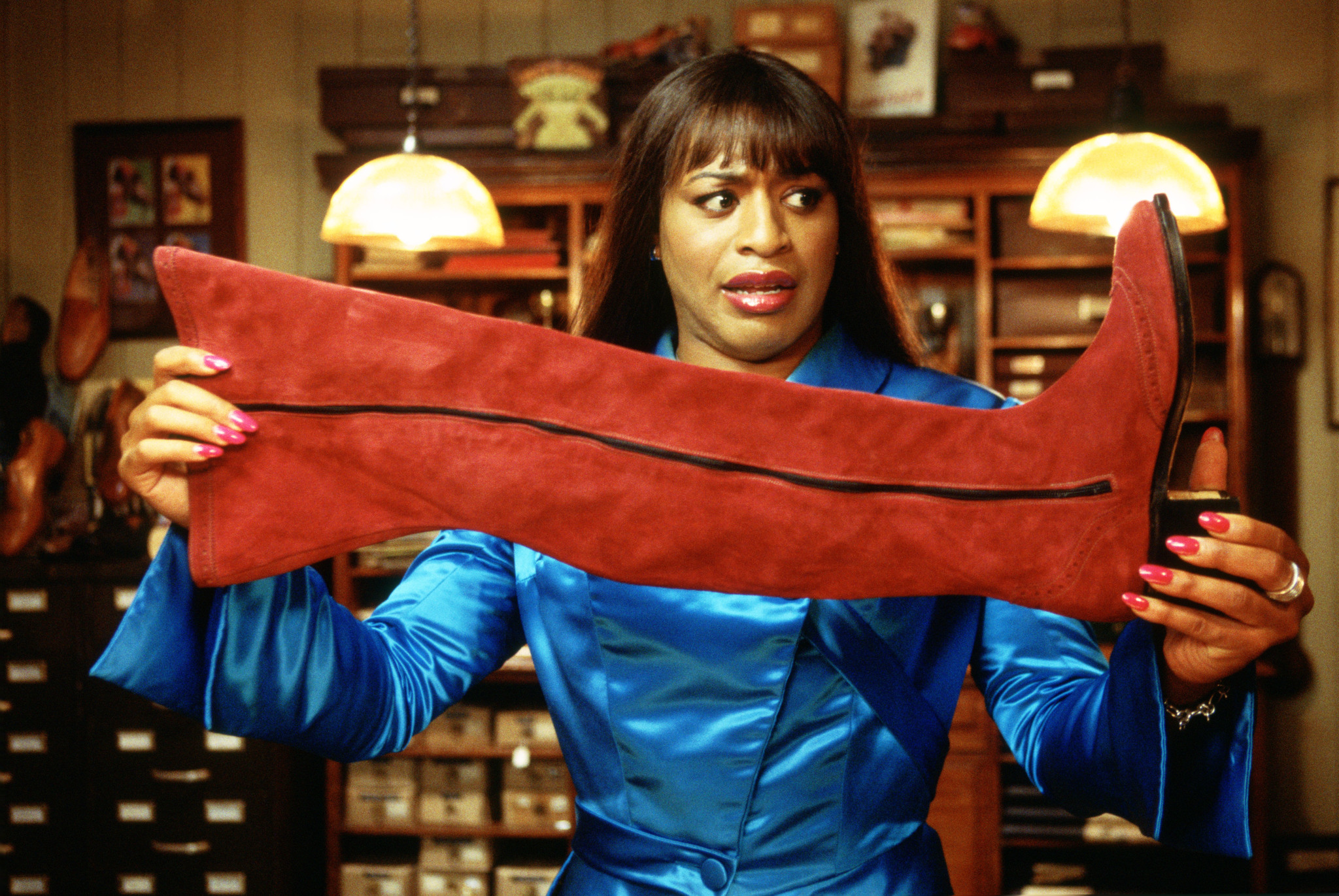
Women’s heeled shoes aren’t made for men’s feet. Not only are men often heavier, but their feet are actually a different shape — they have wider heels and narrower forefeet.

And that dilemma spawns a brilliant new idea in “Kinky Boots,” a clever little comedy about the transvestite boots that may save a struggling shoe company from extinction. It’s a little predictable in the lessons that are learned (I wonder if the straitlaced factory folk will come to respect Lola!), but it’s also charming, flashy, clever and unexpectedly vulnerable in all the right places — while also having a rather sweet friendship at its core.

Charlie Price (Joel Edgerton) and his materialistic fiancee Nicola (Jemima Rooper) have just moved to London when they have to go back to Northampton — his dad has died, leaving him the family’s Northampton shoe factory, which produces high quality men’s shoes. But because the shoes aren’t selling, he’s forced to fire two dozen employees.

While drunkenly wandering the streets of London, he comes across some guys harassing a woman… and after getting knocked out defending her, discovers “she” is actually a drag queen, Lola (Chiwetel Ejiofor). Lola’s difficulties with the sexy boots she wears inspires Charlie to embrace a wild new idea — embracing a niche market by creating a new line of women’s shoes aimed at men (and presumably women born with men’s bodies). He rehires an outspoken worker named Lauren (Sarah-Jane Potts) to help him out with this new approach.

Lola is scornful of the first efforts (“Please, God, tell me I have not inspired something burgundy!”) but soon joins the factory as their new designer. But the new line is threatened by personal problems — Charlie’s fiancee is enraged that he refuses to sell the factory to a developer, one of the employees (Nick Frost) starts harassing Lola, and Lola (or “Simon” out of drag) feels nervous about being a drag queen in a smaller conservative city. With only days to go before their big show in Milan, they will have to churn out some really gorgeous kinky boots, or the company is finished.

Despite the title, “Kinky Boots” is not really a kinky movie. It’s a feel-good movie with all the sorts of twists and turns you would expect from it — the whole situation with the fiancee, the single employee who is nasty to anyone who challenges the whole heteronormativity thing, the fight with Lola, the “will they or won’t they show up?” dilemma at the climax when it seems all is lost. So yeah, it’s kind of predictable in that regard, and many of the plot developments are ones you’ve seen elsewhere.

However, it’s a nice feel-good movie. While most of the story is in the grey grit and grime of a Northampton working-class factory, director Julian Jarrold splashes it with glitz and bright colors (“Red is the color of sex and fear and danger and signs that say, Do. Not. Enter. All my favorite things in life!”) and a sense of wry humor that plays off well with the brash, brassy approach of Lola (“Sorry to be presumptive. ARE you a mister?” “I’m a Charlie. From Northampton”). The dialogue is clever and often snappy, interspersed with rather awkwardly charming conversations.

Jarrold doesn’t shy away from issues like homophobia (though Lola/Simon’s sexuality is left ambiguous), or the cruelty that may be lavished on people who don’t fit gender norms. A lot of Simon’s issues with places like Northampton comes from a lifetime of rejection for being who and what he is, and we see his fragility under the Lola armor when he confides in Charlie about his awful childhood. But he also weaves in the idea that these differences don’t matter if you’re a good person underneath — one charming scene has Lola’s landlady cheerily asking “Are you a man?” just so she’ll know how to leave the toilet seat.

And as such, the central friendship is a rather sweet one — Charlie is a kind-hearted, rather introverted man who doesn’t care about shoes so much as he cares about helping people, and Lola/Simon is an brassy, limelight-loving drag queen who comes to like and befriend the people he previously feared. They have a lot in common, having had childhoods overpowered by fathers who quashed their true selves in favor of what they wanted them to do (make shoes or be a boxer).

And the actors all do good jobs, especially Chiwetel Ejiofor — he blasts through musical numbers, arm-wrestling competitions and the occasional fight with robust charm, and seems to be having fun in his wigs and sexy dresses. He never holds back on the brash and brassy, but he also can play Simon’s fragile, painful awareness that other people don’t think of him as normal. And Edgerton plays the exact opposite — a timid, pleasant young man who doesn’t seem to have any particular drive, but who discovers his own backbone when he finds something to fight for.

“Kinky Boots” is not particularly kinky, but it does have a lot of boots — sexy, glitzy boots that change the lives and hearts of the people making them. A fun, funky little movie… especially if you like seeing Chiwetel Ejiofor sing “I Want To Be Evil.”

Women and “The Thing From Another World”

The Thing From Another World is usually dismissed as the “original” version of John Carpenter’s The Thing, and considered to be an inferior adaptation of the original short story. After all, 1950s special effects were simply not up to the task of making a shapeshifting monster, and the direction of most 1950s movies cannot measure up to one of the greatest horror/sci-fi movies of all time.

But despite the carrot monster, I do think this is a good movie seen on its own merits. Not because the story is particularly interesting or unique as 1950s sci-fi goes, but because of the way its characters are presented.

Specifically, the female characters.

The 1950s weren’t the best time for female characters in movies. Not saying they were all bad, because the existence of this movie clearly shows that they weren’t. But there were some extremely misogynistic attitudes in many movies that went unchallenged. These weren’t even hateful in many cases – some of them were just people who couldn’t break out of their mindsets, like in Forbidden Planet or It: The Terror From Beyond Space.

So it’s worth noting that The Thing From Another World has a pretty egalitarian approach to its characters, and treats the women with an impressive level of respect. The most basic level is just the fact that they’re there at this scientific/military outpost, holding important positions. And at no point do they fetch coffee for the menfolk, on the assumption that men will turn to sea foam if they make their own food.

But that isn’t enough to really earn my respect. It’s more that the women and men interact casually as equals – the men don’t treat the women with the casual condescension often found in old movies. In fact, they banter and pal around with the female lead in the same way they would with a male character, including when she teases her male romantic partner.

Speaking of which, the romantic subplot is also refreshing. Rather than a macho hero sweeping a woman off her feet, the two have a cute backstory that involved him falling asleep during a date, and being kind of embarrassed by it, especially since she thinks it’s so funny. It feels much more organic and realistic, and less like a personal fantasy.

Furthermore, the women don’t end up as damsels. Despite the DVD cover, there are no screaming women in peril here… or at least, no more peril than the men are in. There is a woman threatened by the monster at one point, where she is forced to hide behind a flaming mattress, but she isn’t screaming and she actually chose to take this perilous position rather than being transparently corralled into it by the screenwriter so the men can save her.

So while The Thing From Another World isn’t a standout as old sci-fi goes, it does have some qualities that bring it above the herd. It can’t measure up to The Thing, but it’s still worth seeing.

Review: Mortal Kombat (2021)

While the 1990s Mortal Kombat movie was cheesy fun, it wasn’t quite the film that fans of the game franchise wanted… primarily because it was PG-13, and thus bloodless and tame. It didn’t help that its sequel, Mortal Kombat: Annihilation, was one of the most legendarily bad movies of all time.

And so, nearly twenty-five years later, we have been graced by a new Mortal Kombat reboot which promises the fatalities, the gore, and the endless swearing from Kano. Its biggest problem is that it’s a build-up to a tournament that will apparently happen in the sequel, meaning that it’s mostly a lot of people running around fighting with little purpose… but hey, it’s mindlessly entertaining, bloody and acrobatic running around.

The main character is Cole Young (Lewis Tan), a past-his-prime MMA fighter who regularly gets beaten up for $200 a pop. The glaring problem with this character is simple: he’s very boring and generic. There’s really not much to him except his family lineage – he is Completely Normal Guy who serves as an audience proxy.

But then he and his family are attacked by a cryomantic Chinese ninja known as Sub-Zero, who really wants them dead. They’re rescued by Jax (Mehcad Brooks), an ex-soldier with the same dragon marking that Cole has, although he loses both arms in a fight with Sub-Zero. Fellow ex-soldier Sonya Blade (Jessica McNamee) explains that the dragon marking is a sign of being chosen for a great interdimensional tournament known as Mortal Kombat.

After an attack by a reptilian monster, Cole and Sonya convince a scummy criminal named Kano (Josh Lawson) – who has also acquired a dragon marking – to lead them to the god Raiden’s temple. Once there, Cole and Kano begin training under fellow champions Kung Lao (Max Huang) and Liu Kang (Ludi Lin). However, the evil soul-eating sorcerer Shang Tsung (Chin Han) is determined to kill Earth’s champions before the tournament even begins, and invades Raiden’s temple.

If there’s one word to describe the Mortal Kombat reboot, it’s “setup.” The entire movie is essentially a setup for the actual Mortal Kombat tournament, and everything that happens within that movie is a setup for some kind of epic fight scene. And in that regard, it works pretty well – the third act is almost wall-to-wall mortal kombat, with plenty of exploding heads, bodies sawed in half, and the occasional evisceration.

And as far as the plot is concerned, the “setup” status is perhaps its weakness – there’s not really much plot here, just the heroes getting together, trying to develop superpowers, getting their butts kicked, regrouping, and then fighting with the myriad colorful bad guys. The closest to a true plot is the feud between Sub-Zero and Scorpion that spans centuries and dimensional boundaries. That subplot is the powerhouse of the movie, and the epicness of their eventual clash is almost cathartic.

It has a fairly good cast as well – Tan does as good a job as anyone could with his nondescript character, and it has solid performances by Brooks, Lin and Huang. McNamee is a strong female character of the type we need more of – intelligent, fierce, smart, compassionate and moral – and Hiroyuki Sanada is absolutely brilliant in his brief screen-time. Lawson’s Kano is also a complete delight to watch – he is so unabashedly, over-the-top vile that it makes him almost lovable.

It’s light on story and heavy on gory, making the “Mortal Kombat” reboot a film that is best appreciated with your brain turned off. It’s an entertaining spectacle for people who want some gore and guts, but you’ll have to wait for the sequel for any actual tournament action.

Truly Great Acting – Christopher Lee

Here’s how to tell when you’re watching truly great acting.

Way back in ancient times, when The Lord of the Rings movies were in theaters, I went to see Fellowship of the Ring thirteen times. Thirteen. I saw it in the company of many different people, from screaming four-year-olds afraid of the Nazgul to my elderly grandmother, whose immersion was ruined by the presence of tomatoes.

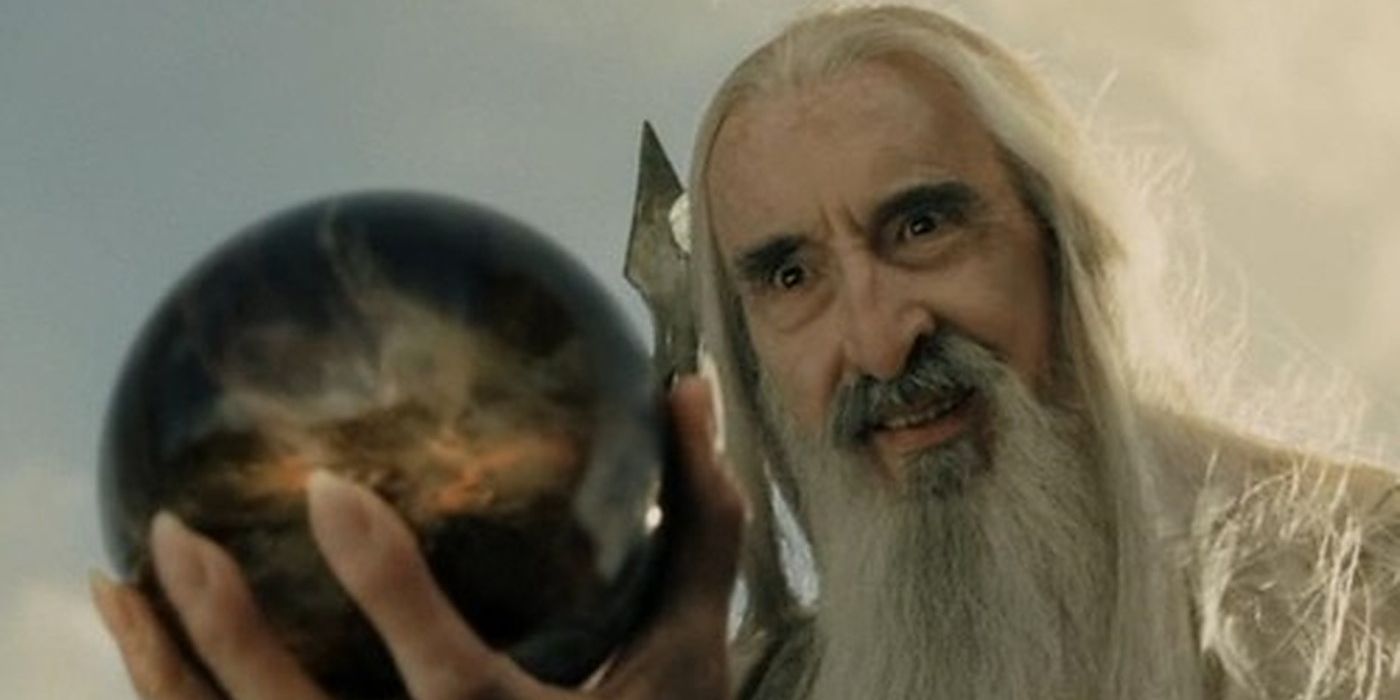
Honestly, I think that that movie trilogy is probably the finest display of its actors’ talents; I’ve never seen a better performance from any of them. And one of the best displays of this came from the late, great Christopher Lee. I feel a bit sorry for him because apparently in his earlier days, he dreamed of playing Aragorn or Gandalf… and I’ll admit, in his youth he would have made an excellent Aragorn. Tall, kingly, imposing, et cetera.

But make no mistake – nobody else could have played Saruman as well as he did.

And I know this because not only did he look like Saruman, but he had the compelling, persuasive voice that the character is supposed to have.

This was evident from the audience at one of these screenings of the first movie, when he’s revealing his master plan to Gandalf. Some of the people in the audience started getting glassy-eyed and looking like they were thinking, “Yeah, that makes sense…” until the film snapped them out of it by reminding us that yes, he is evil and he’s in league with Sauron. He consistently had that effect on people, and it was amazing.

RIP, Mr. Lee.

The aliens of “Battleship”

The movie Battleship is bad. Very bad.

I could write a book on all the ways this movie is terrible, starting with the fact that it is essentially a Michael Bay movie without Michael Bay. Everything you hate about a Michael Bay movie is here – the destruction porn, the fetishization of the American military, the hot women that exist to be hot, the obnoxious lead character, the ludicrously dumb plot… it can go on forever.

I will be fair, however, and note that it is better than a Bay film in several ways. There is no racism on display, not much terrible comic relief, the obnoxious lead character is actually acknowledged as being an idiot and a perennial screwup, Rihanna is realistically de-glammed, and real military personnel are shown genuine respect rather than being treated as square-jawed macho dolls for Bay to make pew-pew noises with.

But in the many ways that this movie is bad, one thing really stuck out at me: the aliens.

Yes, instead of making some kind of period wartime story about depth charges or missiles, they decided to make it a science fiction story about a bizarre alien invasion. Again, I could write a sequence of essays about the many ways this is mishandled, but today I’m going to address the fact that the aliens are really bad.

A lot of this comes down to the design. If you’re going to have your aliens show up in scary-looking all-concealing armor and masks that hide them from sight, one of two things has to happen.

One, they have to remain armored and masked so that they seem more menacing.

Two, they have to be really well-designed. If you pull off that mask, people have to gasp in horror at what they are seeing, and marvel at just how alien and freaky the creature underneath looks.

Battleship… does neither.

The sad thing is that the alien armor is sufficiently menacing-looking that the aliens could have worked if they had just kept it on, maybe with some subtle glimpses of something weird peeking through the visor. The problem is, partway through the story, the Navy captures one of the aliens and pulls off its helmet.

And it looks… pretty bad. By “pretty bad,” I mean it’s wildly unimaginative – they basically took the overall look of a human, stuck some keratin spines on the chin, gave them catlike eyes, and tweaked the details just enough that they don’t look technically human. It’s a design that you’d expect to see in a subpar episode of Star Trek.

I don’t know about anyone else, but the sheer lack of imagination in their design really killed any sense of menace they had for me. All I could think was a sarcastic, “Oh no, the Earth is being invaded by goat people.” Even when we saw them striding around in their intimidating armor, I couldn’t stop seeing those terribly-designed goat people. There’s nothing about them that activates instincts of fear and revulsion.

And remember, this was a tentpole blockbuster. It had a budget of well over $200 million (which seems like way too much for a movie that doesn’t have a well-proven franchise or director behind it). I do not for a second believe that it didn’t have the money to spare to make something really bizarre and creative! I’m not talking about John Carpenter’s “Thing,” but throw on some nonhuman skin textures or a bunch of extra eyes or tentacles or something.